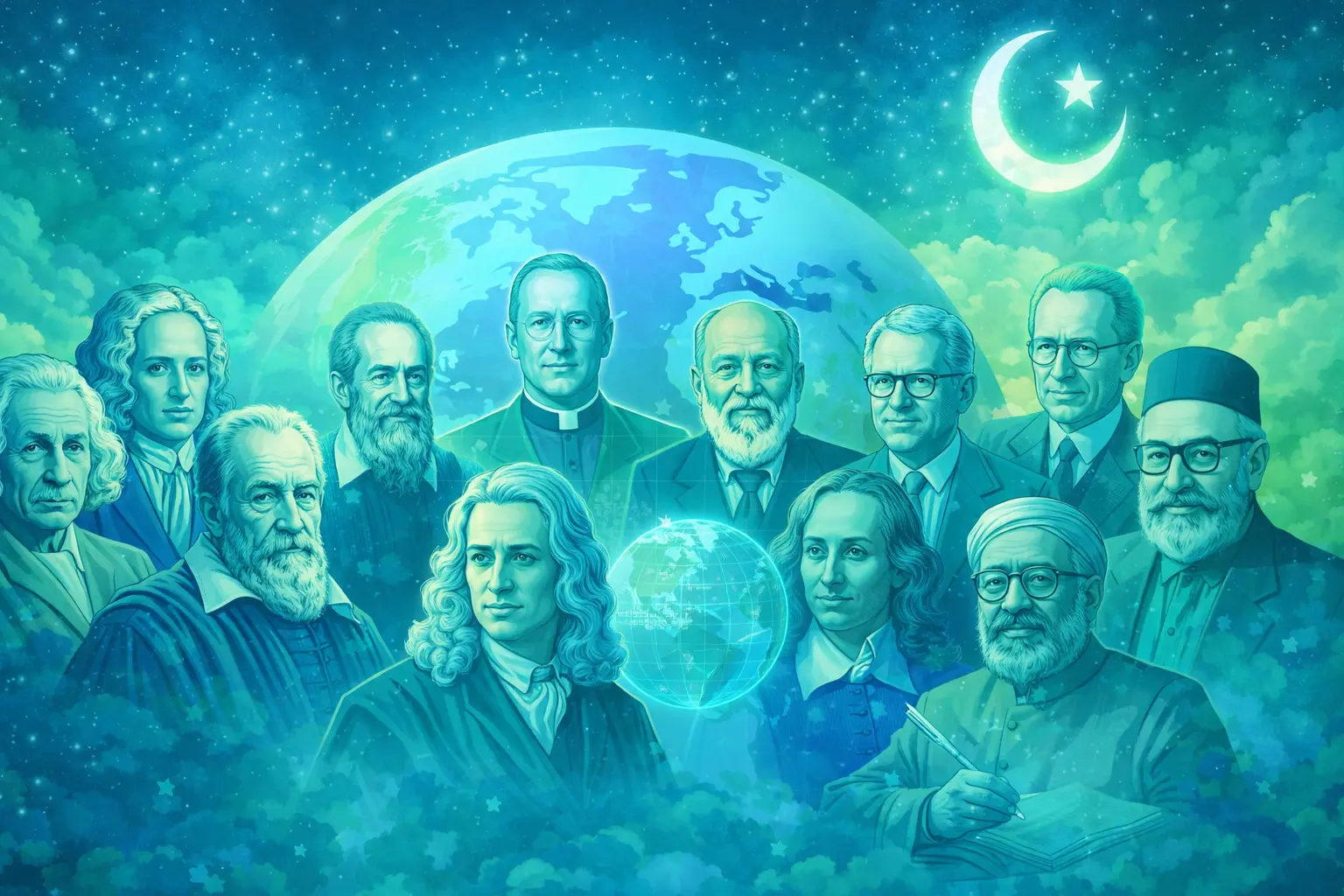
Top 13 Scientists Who Believe in God
It is a common misconception today that you must choose between facts and faith. We are often told that logic belongs to the laboratory and belief belongs to the mosque or church. However, history tells a very different story regarding scientists who believe in God.
The truth is, many of the most brilliant minds in history were deeply devout. They did not see science as a tool to disprove the Creator, but rather as a telescope to better appreciate His work.
For those scientists who believed in God, every discovery was a testament to a higher power.
The idea that science necessitates atheism is a modern invention. When we look at the evidence, we find that the pursuit of knowledge has always been a spiritual journey for scientists who believe in God.
1. Isaac Newton
When people ask about scientists who believe in God, Isaac Newton is often the first name that arises. He is the father of classical physics and one of the most influential intellects in human history.
Newton did not just write about gravity and motion; he wrote extensively about theology. For him, the perfect order of the universe could not have come from chaos.
Newton believed the cosmos was a “cryptogram” set by the Almighty. He famously stated, “This most beautiful system of the sun, planets, and comets, could only proceed from the counsel and dominion of an intelligent and powerful Being.”
For Newton, gravity explained how the planets moved, but it did not explain who set them in motion. He saw scientists believe in God not as a contradiction, but as a logical necessity to explain the first cause.
Isaac Newton Rejected Trinity
Newton privately rejected the Trinity. After analyzing early church history, he concluded that the doctrine of the Trinity was a corruption introduced later into Christianity.
Isaac Newton believed that God (the Father in the Christianity dogma) was the only Supreme Creator.
Newton had to keep these views secret to avoid persecution, but his private manuscripts reveal a man whose scientific mind led him to a strictly monotheistic view. For Newton, the “God” of the Bible was the One True Creator unassociated with partners.
2. Ibn al-Haytham is a Pioneer Among Scientists Who Believe in God
Often called the “first true scientist,” Ibn al-Haytham revolutionized the study of optics and the scientific method itself.
Ibn al-Haytham famously stated that he constantly sought knowledge of the truth to become closer to Allah.
For Ibn al-Haytham, the physical world was a manuscript written by Allah. By testing hypotheses and observing light, he was engaging in an act of worship.
Ibn al-Haytham stands as a primary example for those searching for scientists who believe in God, proving that empirical rigor strengthens, rather than weakens, one’s faith.
Have Questions About Islam?
Our team is ready to answer your questions clearly and respectfully. Ask freely and receive honest guidance.
Ask Us Now3. Al-Khwarizmi – Mathematic Scientist
Muhammad ibn Musa al-Khwarizmi is the father of Algebra (from the Arabic Al-Jabr). His massive contributions to mathematics were not secular pursuits; they were deeply practical and religious.
He developed complex mathematical systems to solve issues related to Islamic inheritance laws (Fara’id) and to calculate the movement of celestial bodies for the Islamic calendar.
Al-Khwarizmi demonstrates that scientists that believe in God use their intellect to serve their community and obey Allah’s commandments regarding fairness and justice.
4. Werner Heisenberg – Modern Scientists
Werner Heisenberg, a pioneer of quantum mechanics and the uncertainty principle, offers a profound insight for scientists that believe in god.
He famously noted the journey of a scientist’s mind: “The first gulp from the glass of natural sciences will turn you into an atheist, but at the bottom of the glass God is waiting for you.”
This quote beautifully illustrates that superficial knowledge might lead one away from faith, but deep, profound understanding leads one back to it.
Heisenberg understood that as you go deeper into the building blocks of matter, the complexity and design point inevitably to a Creator.
Read also: Geniuses Who Believe in God
5. Al-Biruni – Astronomy Scientist
Abu Rayhan al-Biruni was a polymath who made groundbreaking discoveries in measuring the earth’s radius and understanding geography. When asked which scientists believe in God, Al-Biruni is a definitive answer.
He viewed his scientific work as a direct response to the Quranic verses urging mankind to reflect on the heavens and earth.
He wrote that the study of nature was a way to witness the wisdom of Allah. For him, every measurement and calculation was a step toward Tadabbur (reflection).
6. Lord Kelvin
William Thomson, known as Lord Kelvin, was a giant in thermodynamics. He was very vocal about his faith and is a prime example of how scientists believe in god through the study of life.
He stated, “If you think strongly enough you will be forced by science to the belief in God.” Kelvin saw science as a tool to affirm faith, not destroy it.
He argued that the origins of life could not be explained by random forces. To him, the creative power of the Almighty was the only scientific explanation for the existence of life.
7. Ibn al-Nafis
Ibn al-Nafis is one of the most important figures in the history of medicine, renowned for discovering the pulmonary circulation of blood centuries before William Harvey. But he was not just a physician; he was also a prominent scholar of Islamic law (Fiqh) and theology.
Ibn al-Nafis viewed the study of anatomy as a direct path to understanding the perfection of Allah’s design.
In his writings, he argued that the complexity of the human body acts as a definitive proof for scientists who believe in God that there is a Wise and All-Powerful Creator sustaining every heartbeat.
Read also: Monotheism – The Belief in a Single God
8. Francis Collins – Modern Scientists
Francis Collins, the director of the Human Genome Project, is a powerful contemporary example of scientists who believe in god. He led the team that mapped the human DNA code.
For Collins, uncovering the human genome was not a purely mechanical task; it was a spiritual experience. He describes DNA as “The Language of God,” an instruction manual written by the Creator.
He famously stated, “The God of the Bible is also the God of the genome. He can be worshipped in the cathedral or in the laboratory.”
His work proves that even in the most advanced fields of modern genetics, scientists believe in God as the ultimate author of life’s complexity.
9. Al-Zahrawi – Surgery Scientist
Known in the West as Albucasis, Al-Zahrawi is considered the “Father of Modern Surgery.” His encyclopedia, Kitab al-Tasrif, introduced surgical instruments and techniques that are still used today. Al-Zahrawi serves as a prime example of devotion through action.
Albucasis treated his patients with deep compassion, viewing his medical practice as a form of worship and service to Allah’s creation.
Al-Zahraw famously advised his students to treat their patients like their own children, grounded in the Islamic principle that saving a life is akin to saving all of humanity.
Read also: Do Jews and Muslims Believe in the Same God?
10. Robert Boyle – Chemistry Scientist
Robert Boyle, considered the first modern chemist, gave us “Boyle’s Law” concerning gases. He was also a devout believer who spent his own money to translate religious texts into other languages.
Boyle argued that the study of nature was a “religious duty.” He believed that the intricate mechanisms of the physical world—like the structure of an eye or the properties of air—were irrefutable evidence of an Intelligent Designer.
For Boyle, scientists believe in God because the laboratory provides daily proof of His wisdom.
11. Mariam al-Astrulabi – Engineering Scientists
Mariam al-Astrulabi was a brilliant female innovator during the Islamic Golden Age, known for designing and constructing advanced astrolabes.
These devices were crucial for navigation and, importantly, for determining the Qibla (direction of prayer) and prayer times.
Her career highlights that scientists believe in God not just in theory, but in practice. Her technical skills were applied directly to facilitate the worship of Allah, merging technology with spiritual devotion seamlessly.
12. Jabir ibn Hayyan – Chemistry Scientist
Often called the “Father of Chemistry,” Jabir ibn Hayyan (Geber) introduced the experimental method to science, moving it away from superstition. He emphasized that scientific excellence requires practical work and rigorous testing.
For Jabir, chemistry was not about random reactions; it was about discovering the hidden Mizan (balance) that Allah placed within all matter.
Jabir ibn Hayyan is a key figure among scientists that believe in God, teaching that the laws of nature are consistent because they come from a single, consistent Lawgiver.
13. Al-Jazari – Engineering Scientist
Al-Jazari was a mechanical genius whose inventions in robotics and water clocks laid the groundwork for modern engineering. His famous “Elephant Clock” was a masterpiece of multicultural symbolism and mechanical precision.
Al-Jazari’s work demonstrates that scientists believe in God by using their skills to improve the lives of their community.
Whether building water-raising machines to help farmers or designing automata, Al-Jazari’s engineering was an act of Ihsan (excellence)—seeking to perfect his craft as a way of honoring the gifts Allah bestowed upon him.
The Islamic Perspective on Science and Faith
In the Islamic worldview, there is no conflict between “religious truth” and “scientific truth.” Both originate from the same source: Allah.
Islam teaches that Allah revealed two “books” for humanity to read. The first is the Quran (the Revelation), and the second is the Universe (Creation).
Investigating the physical world is not just a secular activity; it is an act of Tadabbur (deep reflection) and worship.
When a scientist studies the complexity of a cell or the vastness of a galaxy, they are uncovering the Sunnah (laws) of Allah in His creation.
The Quran explicitly challenges human beings to observe the natural world to find their Creator.
“Indeed, in the creation of the heavens and the earth and the alternation of the night and the day are signs for those of understanding.” (Aal-i-Imran 3:190)
For a Muslim, science is not a replacement for faith. It is a path to Yaqeen (certainty).
The more we understand the intricate balance of the universe, the more we stand in awe of Allah’s wisdom.
Have Questions About Islam?
Our team is ready to answer your questions clearly and respectfully. Ask freely and receive honest guidance.
Ask Us NowExplore the Connection Between Reason and Revelation with Salam
Do you want to understand how reason and revelation work together? Read more about the harmony of Islam and science on our blog.
Explore with Salam the Quran’s verses on the creation of the universe.
Contact us at Salam if you have questions about faith, logic, or the purpose of life. We are here to listen and discuss.
Conclusion
The historical record reveals a consistent pattern: many pioneering scientists understood discovery as an act of reflection. Figures from Newton to Ibn al-Haytham viewed physical laws not as rivals to faith, but as structured expressions of an intelligent, sustaining Creator.
In both classical and modern contexts, scientific rigor frequently deepened belief rather than dissolving it. Advances in mathematics, medicine, chemistry, and physics repeatedly reinforced the idea that complexity, balance, and order point toward a purposeful origin.
Within the Islamic worldview especially, studying nature functions as a form of worship. Revelation and reason emerge from the same source, guiding humanity toward certainty, humility, and awe as each layer of creation unfolds its signs.
Curious about Islam?
Journey towards clarity and purpose. Our team is here to support you in your search for truth and spiritual guidance.
Embrace the Truth