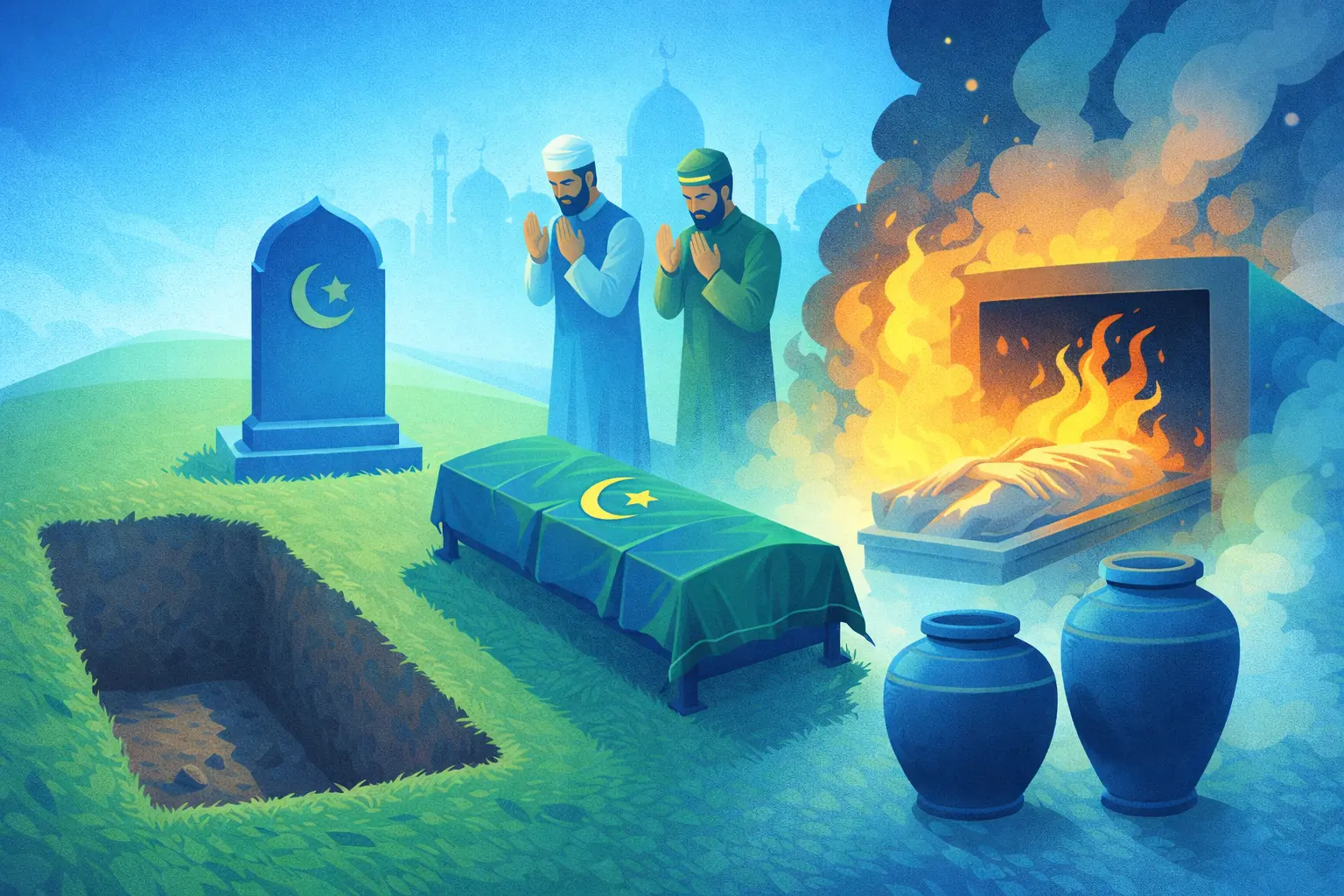
Do Muslims Believe in Cremation?
When someone asks whether Muslims believe in cremation, the answer is clear and unambiguous: no, cremation is forbidden in Islam. This ruling carries the weight of both Quranic guidance and authentic prophetic teaching, and it connects to a much deeper Islamic understanding of the human body, death, and what comes after.
Death in Islamic thought is a transition, not an end. The body that carried a person through this life deserves the same dignity in departure as it received in living. That principle — dignity for the human form — is what sits at the heart of the Islamic position on cremation.
Do Muslims Believe in Cremation?
No, Muslims do not believe in cremation. The scholarly consensus is that cremation is haram — prohibited. This position is not a cultural preference or regional tradition. It rests on explicit prophetic guidance and the broader Quranic framework of honoring human beings.
The Quran establishes that Allah honored the children of Adam in a way unlike any other creation:
وَلَقَدْ كَرَّمْنَا بَنِي آدَمَ
“And We have certainly honored the children of Adam.” (Quran 17:70)
This honor extends beyond life. The human body remains the amanah — the trust — of its Creator, and burning it is considered a violation of that trust. Islamic scholars have consistently held that the body must be returned to the earth, as it was created from it.
Have Questions About Islam?
Our team is ready to answer your questions clearly and respectfully. Ask freely and receive honest guidance.
Ask Us NowWhat Did the Prophet Muhammad Say About Burning the Dead?
The prohibition of cremation among Muslims is grounded directly in prophetic authority. The Prophet Muhammad forbade the burning of bodies — whether human or animal — as punishment or as burial practice.
“Breaking the bone of a dead person is like breaking it when he is alive.” (Abu Dawood)
This hadith illustrates a principle that Islamic scholars apply directly to the cremation question: the body retains a form of sanctity even after the soul has departed.
Causing pain, destruction, or indignity to a corpse is treated with the same moral weight as doing so to a living person.
The Prophet Muhammad also instructed:
“Do not burn anyone with fire, for only the Lord of fire punishes with fire.” (Sunan Abu Dawood)
What is the Islamic Way of Burial?
Islamic burial practice is a complete, structured ritual — one of the most carefully defined acts of communal worship in the religion. When a Muslim dies, the community carries out a series of obligations:
The body is washed (ghusl) with care and deliberateness.
It is wrapped in a simple white shroud (kafan).
The funeral prayer (Salat al-Janazah) is performed by the community.
And then the body is lowered into the earth, laid on its right side, facing the qiblah — toward Mecca.
Every step reflects a theological conviction. The simplicity of the white shroud levels all distinctions of wealth and status. The direction of the grave points toward Allah. The earth burial fulfills the divine statement:
مِنْهَا خَلَقْنَاكُمْ وَفِيهَا نُعِيدُكُمْ وَمِنْهَا نُخْرِجُكُمْ تَارَةً أُخْرَىٰ
“From it We created you, and into it We will return you, and from it We will extract you another time.” (Quran 20:55)
Cremation cuts this cycle entirely. It bypasses the return to earth that Allah ordained, and for Muslims, that alone makes it impermissible regardless of any external reasoning.
How Islamic Scholars Address the Argument That Cremation Does Not Affect Resurrection
The resurrection is entirely within Allah’s power regardless of what state remains. The Quran makes this plain when describing the resurrection of those lost at sea, consumed by animals, or scattered by calamity. Decomposition, burning, or any form of physical dissolution poses no limit to divine power.
The ruling on burial, however, is about our conduct — what we are commanded to do, not about what limits Allah.
A Muslim is commanded to pray five times a day, but missing a prayer does not prevent Allah from knowing one’s sincerity. The obligation exists because Allah ordained it.
The same logic applies here: cremation is prohibited because the command of the Prophet Muhammad and the honor of the human body require it, not because resurrection depends on the state of the corpse.
This distinction matters enormously. Islamic rulings are acts of obedience, not calculations of outcome.
When a Muslim follows the commanded burial practice, they are expressing tawakkul — trust in Allah — and submission to divine wisdom even when the full rationale may not be immediately apparent.
What Muslims Living in the West Can Do to Ensure an Islamic Burial?
For Muslims in Western countries, the practical steps toward securing an Islamic burial are more accessible than many assume. Most major Western cities now have:
Designated Islamic sections in public cemeteries, or entirely Muslim-owned burial grounds.
Funeral service organizations run by Muslim communities familiar with Islamic requirements.
Legal frameworks in most Western countries that respect religious burial rights.
Pre-arranged burial planning options that allow Muslims to document their wishes and appoint someone to carry them out.
For those without nearby Islamic burial facilities, scholars have given dispensation for burial in the closest available location that still meets the basic requirements — a grave in the earth, proper orientation, and a proper ghusl and kafan where possible.
Any Muslim concerned about this should connect with their local mosque or Islamic center early, before the need arises. It is an act of care for one’s own soul.
Have Questions About Islam?
Our team is ready to answer your questions clearly and respectfully. Ask freely and receive honest guidance.
Ask Us NowLearn More and Connect with Salam
If this article raised further questions — about Islamic beliefs around death, the afterlife, or other aspects of Islam you’ve been curious about — the Salam blog covers these topics with the same care and depth.
At Salam Platform, we welcome every question — from the curious, the skeptical, and those genuinely considering Islam. Whether you want to understand a ruling, explore Islamic theology, or simply learn more, we’re here for that conversation.
For personal guidance, questions about how to enter Islam, or topics not covered in our articles, reach out to us directly through the Salam Platform — a team of knowledgeable, welcoming people ready to assist you.

Conclusion
The Islamic prohibition of cremation flows from a coherent theology: the human body carries divine honor, and that honor persists after death. Returning the body to the earth is an act of submission to the Creator who fashioned it from the earth to begin with.
Muslim burial practices — the washing, the shroud, the prayer, the grave — form a unified expression of tawheed, the oneness of Allah. Every element points back to Him, and every step reflects the belief that death is a passage, not a conclusion.
For Muslims navigating this question in Western contexts, the path forward is clear: seek out the Islamic burial resources available in your community, document your wishes, and trust that the ummah — the global Muslim community — has preserved this practice with care across every era and geography.
Curious about Islam?
Journey towards clarity and purpose. Our team is here to support you in your search for truth and spiritual guidance.
Embrace the Truth