What Does the Quran Say About Jesus’s Death?
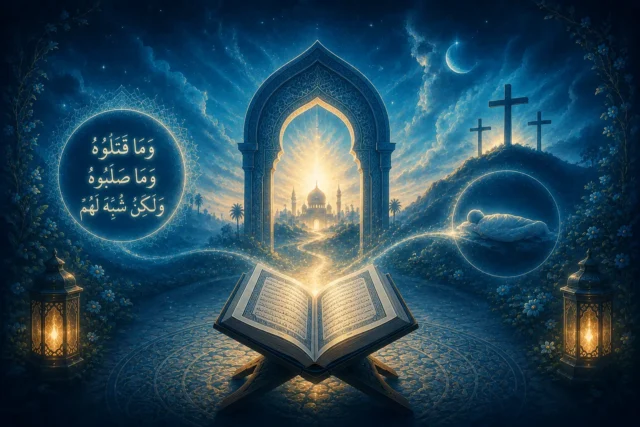
Key Takeaways The Quran states in Surah An-Nisa 4:157 that Jesus was neither killed nor crucified, but that it was made to appear so to…
The central scripture of Islam, believed to be the final revelation from God. Its verses provide guidance on faith, worship, morality, and the purpose of human life.
Key Takeaways The Quran states in Surah An-Nisa 4:157 that Jesus was neither killed nor crucified, but that it was made to appear so to…
The Quran speaks about parents with a weight and tenderness that surprises many people encountering Islam for the first time. Honoring one’s mother and father…
Key Takeaways The Quran does not name music explicitly haram in a single direct verse, but Surah Luqman 31:6 has been understood by many companions…
The Quran addresses divorce with a rare combination of realism and restraint. The Quran permits divorce, but it frames the act as spiritually costly and…
The Quran commands hijab directly, but it does not prescribe a specific worldly punishment for abandoning it. This distinction matters enormously, because confusing “no stated…
Marriage in Islam is not a contract of convenience. It is described in the Quran as one of Allah’s signs — a bond woven from…
Hardship is not a sign of abandonment in Islamic belief. It is woven into the very structure of the test of this worldly life, and…
Patience and success are bound together in the Quran with a directness that surprises many new readers. Sabr, the Arabic term usually translated as patience,…
Life, in the Quranic view, is neither an accident nor an end in itself. Every soul that draws breath has been placed here for a…
The Quran contains some of the most direct, repeated reassurances found in any scripture — that hardship is temporary, that no burden exceeds a person’s…
Quran quotes in Arabic carry a weight that translation alone cannot fully capture. Muslims describe an experience that goes beyond reading — a physical and…
Key Takeaways Mary, called Maryam in Arabic, is the only woman named directly in the Quran and the only one to have an entire surah,…
Key Takeaways Ya’juj wa Ma’juj (Gog and Magog) appear in the Quran in Surah Al-Kahf (18:83-98) and Surah Al-Anbiya (21:96-97), describing them as a real…
Key Takeaways The Quran permits a man to marry up to four wives in Surah An-Nisa 4:3, but only on the strict condition of equal…
Key Takeaways Quran 5:5 permits Muslim men to marry chaste women from the People of the Book, meaning Jews and Christians. Quran 2:221 prohibits marriage…
The Quran commands Muslims to invite the People of the Book to a shared word of pure monotheism, found in Surah Al-Imran 3:64. “People of…
The Quran confirms that Allah originally revealed the Torah and the Gospel as authentic guidance before the Quran was sent down. The Quran instructs the…

Key Takeaways The Quran states in Surah At-Tawbah (9:30) that a group among the Jews said Ezra is the son of Allah, and the Quran…
Key Takeaways No — the Quran does not teach that Christians, as a group, enter Paradise while holding Christian belief. Quran 2:111-112 directly addresses this…
Key Takeaways The Quran describes disbelief in Allah (kufr) as a rejection of clear truth after evidence has been presented, not an intellectual accident. Surah…
Key Takeaways Yes, the Quran explicitly states that some Jews and Christians distorted their scriptures, using the Arabic term tahrif in four core verses: 2:75,…
Key Takeaways The Quran addresses Bani Israel (the Children of Israel) across dozens of passages, covering their history, covenants, and relationship with the prophets sent…

Key Takeaways The Quran commands believing women to cover their adornments and draw their outer garments around themselves in two distinct verses in Surah An-Nur…
Key Takeaways The Quran commands all Muslims — male and female — to seek knowledge, with the Arabic word Muslim in key Hadith narrations covering…
Key Takeaways The Quran does not say the earth is flat — Islamic scholars have affirmed the earth’s spherical shape for over a thousand years.…
Key Takeaways Every alleged contradiction in the Quran dissolves under careful analysis of Arabic linguistic context and classical Islamic scholarly interpretation. The six-day creation narrative…
Key Takeaways The Quran describes the embryonic stages of human development — nutfa, alaqa, mudgha — with a precision that modern embryology has confirmed centuries…
Key Takeaways The Quran contains verses describing natural phenomena that some scholars and scientists view as consistent with discoveries made centuries after its revelation. Surah…
Key Takeaways Non-Muslims are permitted to read, hear, and study the Quran — Islam’s sacred scripture actively invites seekers to engage with it. Islamic scholars…
Key Takeaways Reading the Quran is not a condition for becoming a Muslim — entering Islam requires only the sincere utterance of the Shahada with…
Resources and insights designed to help Muslims strengthen their connection with the Qur'an through understanding, reflection, and daily practice.
Key Takeaways The five pillars of Islam — Shahada, Salah, Zakah, Sawm, and Hajj — are each established by explicit Quranic verses and confirmed by…
Key Takeaways The word “Muslim” derives from the Arabic root s-l-m, meaning submission, and a Muslim is one who fully submits to the will of…
Key Takeaways Muslims read the Quran because it is the literal, unaltered word of Allah revealed to Prophet Muhammad (PBUH) through the angel Gabriel. Reciting…
Key Takeaways The Quran is the verbatim word of Allah, revealed to Prophet Muhammad (PBUH) as the primary and supreme source of guidance for all…
Key Takeaways The Quran is the direct, preserved word of Allah revealed to Prophet Muhammad (PBUH) and serves as the primary guide for every dimension…
An introduction to the Qur'an for readers who are new to Islam, covering its message, themes, history, and significance.
Key Takeaways Non-Muslims are permitted to read, hear, and study the Quran — Islam’s sacred scripture actively invites seekers to engage with it. Islamic scholars…
Key Takeaways Reading the Quran is not a condition for becoming a Muslim — entering Islam requires only the sincere utterance of the Shahada with…
In his description of the non-Muslim experience of reading the Quran, Dr. Jeffrey Lang, the former atheist, said: “When I read it for the first…
Key Takeaways The Arabic word kāfir (كافر), often translated as “infidel,” derives from the root k-f-r, meaning “to cover” — one who covers or conceals…
Key Takeaways The Quran establishes a clear framework for treating non-Muslims based on justice, fairness, and the recognition of their humanity. Muslims are commanded to…
Discover powerful verses and passages from the Qur'an that inspire reflection, provide guidance, and deepen understanding of Islam.
Key Takeaways The Quran states in Surah An-Nisa 4:157 that Jesus was neither killed nor crucified, but that it was made to appear so to…
The Quran speaks about parents with a weight and tenderness that surprises many people encountering Islam for the first time. Honoring one’s mother and father…
Key Takeaways The Quran does not name music explicitly haram in a single direct verse, but Surah Luqman 31:6 has been understood by many companions…
The Quran addresses divorce with a rare combination of realism and restraint. The Quran permits divorce, but it frames the act as spiritually costly and…
The Quran commands hijab directly, but it does not prescribe a specific worldly punishment for abandoning it. This distinction matters enormously, because confusing “no stated…
Marriage in Islam is not a contract of convenience. It is described in the Quran as one of Allah’s signs — a bond woven from…
Hardship is not a sign of abandonment in Islamic belief. It is woven into the very structure of the test of this worldly life, and…
Patience and success are bound together in the Quran with a directness that surprises many new readers. Sabr, the Arabic term usually translated as patience,…
Examine verses that discuss the natural world and explore how Muslims have understood the relationship between the Qur'an and scientific discovery.
Key Takeaways The Quran does not say the earth is flat — Islamic scholars have affirmed the earth’s spherical shape for over a thousand years.…
Key Takeaways Every alleged contradiction in the Quran dissolves under careful analysis of Arabic linguistic context and classical Islamic scholarly interpretation. The six-day creation narrative…
Key Takeaways The Quran describes the embryonic stages of human development — nutfa, alaqa, mudgha — with a precision that modern embryology has confirmed centuries…
Key Takeaways The Quran contains verses describing natural phenomena that some scholars and scientists view as consistent with discoveries made centuries after its revelation. Surah…
Key Takeaways Every alleged scientific error in the Quran dissolves under careful linguistic and contextual analysis rooted in classical Islamic scholarship. The Quran’s descriptions of…
Explore the narratives of prophets, nations, and individuals mentioned in the Qur'an, and the timeless lessons they continue to offer.
Key Takeaways Mary, called Maryam in Arabic, is the only woman named directly in the Quran and the only one to have an entire surah,…
Key Takeaways Ya’juj wa Ma’juj (Gog and Magog) appear in the Quran in Surah Al-Kahf (18:83-98) and Surah Al-Anbiya (21:96-97), describing them as a real…
Key Takeaways Ibrahim (Abraham) is mentioned by name 69 times in the Quran, making him one of the most frequently referenced prophets in the entire…
Key Takeaways Moses (Musa, peace be upon him) is the most frequently mentioned prophet in the Quran, appearing in over 30 surahs across more than…
Key Takeaways Adam and Eve are indeed mentioned in the Quran, where their story is presented as a foundational truth about human origin and the…
Key Takeaways The Quran is the literal word of Allah, revealed to Prophet Muhammad (PBUH) over 23 years and preserved without alteration to this day.…
Learn how the Qur'an is organized, from its chapters and verses to its themes, literary style, and unique composition.
Key Takeaways The Quran contains 114 chapters (Surahs), each composed of individual verses called Ayat, revealed to Prophet Muhammad (PBUH) over approximately 23 years. Surahs…
You can ask any question without judgment. Start a private and respectful conversation whenever you are ready.