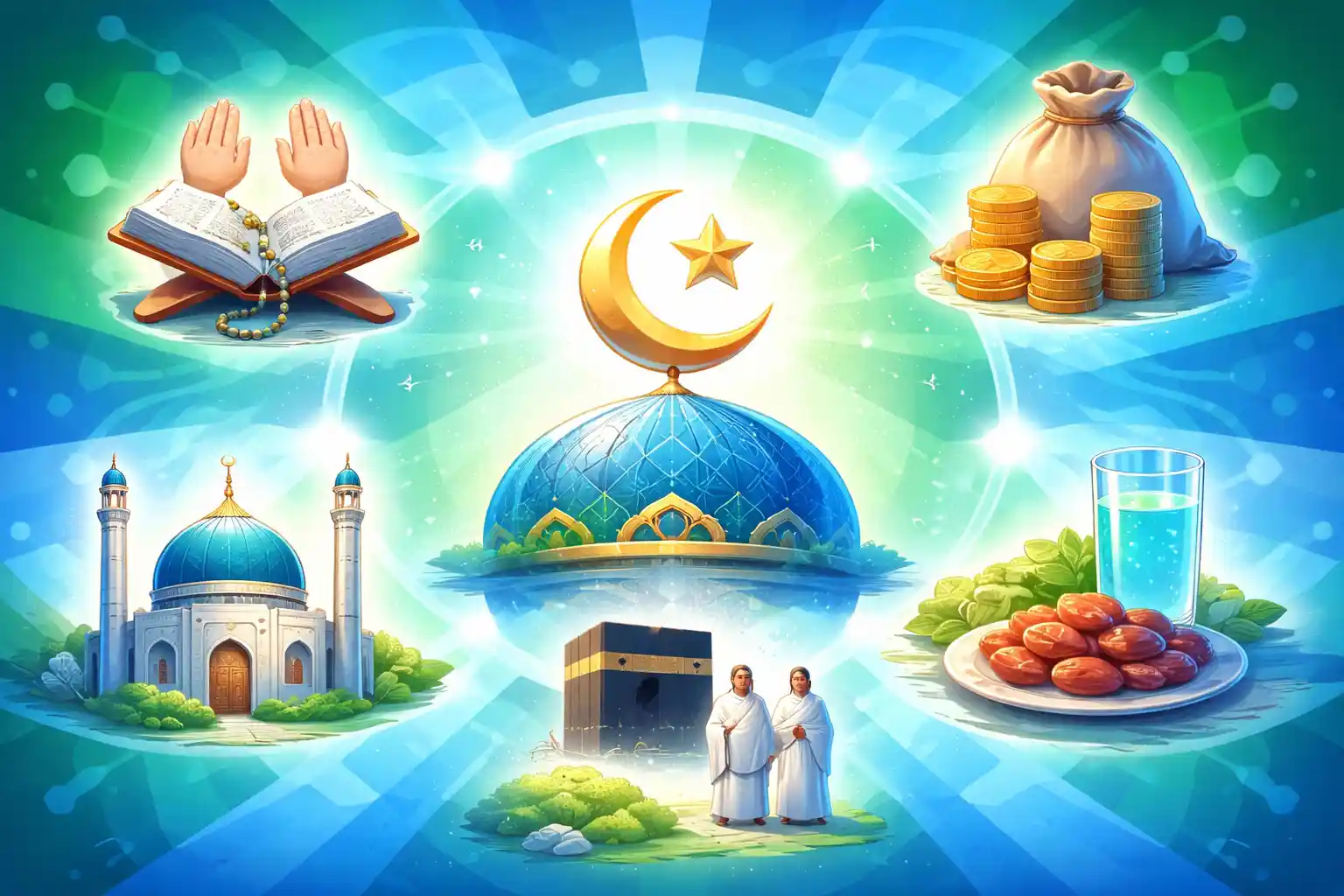
The Five Pillars of Faith
Every major tradition has something at its center — a beating heart that gives the rest of it life. For Islam, that center is the five pillars of faith: five practices so fundamental that without them, Islamic life as a whole loses its shape. They are the architecture of a Muslim’s daily existence, and understanding them is the most direct way to understand what Islam actually demands of its followers.
These are not rituals layered onto belief as an afterthought. The Prophet Muhammad ﷺ made their centrality explicit:
“Islam is built upon five things: the testimony that there is no god worthy of worship except Allah and that Muhammad is the Messenger of Allah, establishing the prayer, giving Zakat, fasting Ramadan, and the pilgrimage to the House.” (Sahih Bukhari; Sahih Muslim)
Five pillars. One structure. A life oriented entirely toward Allah.
1. The Shahada – Lā ilāha illā Allāh, Muḥammadun rasūlullāh
The Shahada — Lā ilāha illā Allāh, Muḥammadun rasūlullāh — translates as: there is no deity worthy of worship except Allah, and Muhammad is His Messenger.
Pronounce it with genuine conviction, and you enter Islam. Live by it, and it reshapes how you see every corner of existence.
The first half of the Shahada strips away every false absolute. False gods, wealth, status, desire, ideology — none of these hold ultimate claim over a Muslim’s life.
The second half anchors the believer to a specific, historical revelation: Allah did not leave humanity to guess. He sent a messenger whose life and teachings are preserved and followable.
Allah describes the weight of this testimony in the Quran:
شَهِدَ اللَّهُ أَنَّهُ لَا إِلَٰهَ إِلَّا هُوَ وَالْمَلَائِكَةُ وَأُولُو الْعِلْمِ قَائِمًا بِالْقِسْطِ
“Allah witnesses that there is no deity except Him, and [so do] the angels and those of knowledge – [that He is] maintaining [creation] in justice.” (Quran 3:18)
The Shahada, then, carries the weight of divine testimony itself. A Muslim who truly internalizes it lives with a clarity that most human philosophies spend centuries trying and failing to manufacture.
2. The 5 Daily Prayer
Salah — the five daily prayers — is the Shahada made physical and made constant. A Muslim prays at dawn, midday, afternoon, sunset, and night.
No matter where life takes you, those five moments pull you back to the same orientation: facing the Kaaba, addressing Allah directly, without priest or intermediary.
The Quran commands it with unmistakable clarity:
إِنَّ الصَّلَاةَ كَانَتْ عَلَى الْمُؤْمِنِينَ كِتَابًا مَّوْقُوتًا
“Indeed, prayer has been decreed upon the believers a decree of specified times.” (Quran 4:103)
What Salah does to a person over years is difficult to overstate. Five times a day, the Muslim stands before Allah and recites Al-Fatiha — a plea for guidance, a reorientation of purpose.
The accumulation of those moments across a lifetime builds a relationship that secular frameworks have no equivalent for. The Prophet ﷺ described the prayer as the coolness of his eyes, the thing he found genuine rest in:
“The prayer has been made the delight of my eyes.” (Sunan An-Nasa’i)
A Muslim who guards their Salah is someone who, at minimum five times every day, remembers who they are and why they are here. That is not a small thing.
Learn More About Islam
Discover the beauty, teachings, and wisdom of Islam in a clear and welcoming way. Start exploring and deepen your understanding today.
Learn More4. The Obligatory Zakat
Zakat is the mandatory annual contribution — 2.5% of qualifying wealth — given to those the Quran specifies as eligible recipients. It is the third pillar, and its placement is telling.
It follows prayer consistently throughout the Quran, the two frequently mentioned together, because Islam treats worship of Allah and care for human beings as inseparable.
وَأَقِيمُوا الصَّلَاةَ وَآتُوا الزَّكَاةَ وَمَا تُقَدِّمُوا لِأَنفُسِكُم مِّنْ خَيْرٍ تَجِدُوهُ عِندَ اللَّهِ
“And establish prayer and give Zakat, and whatever good you put forward for yourselves — you will find it with Allah.” (Quran 2:110)
The word Zakat itself carries the meaning of purification. The understanding behind it is that wealth belongs ultimately to Allah, and a portion of it was never really yours to begin with.
Paying Zakat is an acknowledgment of that, as much as it is an act of solidarity with the poor.
This makes Islamic economic ethics coherent in a way that neither pure capitalism nor socialism achieves.
Wealth generation is permitted and even encouraged in Islam — but hoarding it while others lack is a spiritual failure, not merely a social one. Zakat institutionalizes generosity at the level of religious obligation.
4. Sawm (Fasting) In Ramadan
Sawm — fasting during the month of Ramadan — means complete abstention from food, drink, and marital relations from dawn until sunset, every day for an entire month.
It is the fourth pillar, and it does something to a person that few disciplines can replicate: it demonstrates, repeatedly, that the human being is capable of commanding the body’s most insistent demands.
يَا أَيُّهَا الَّذِينَ آمَنُوا كُتِبَ عَلَيْكُمُ الصِّيَامُ كَمَا كُتِبَ عَلَى الَّذِينَ مِن قَبْلِكُمْ لَعَلَّكُمْ تَتَّقُونَ
“O you who have believed, decreed upon you is fasting as it was decreed upon those before you that you may become righteous.” (Quran 2:183)
The goal is taqwa — God-consciousness, moral vigilance. Hunger becomes a teacher. Thirst sharpens awareness. The person who can forgo eating and drinking for Allah’s sake finds it considerably easier to forgo lesser temptations throughout the year.
In a famous Hadith Qudsi, Allah says regarding the fast:
“Every deed of the son of Adam is for himself, except for fasting — it is for Me, and I shall reward it.” (Sahih)
Ramadan also transforms communities. Iftar tables open to strangers. Mosques fill. The awareness that an entire global Ummah is fasting simultaneously produces something that transcends individual spiritual benefit. It is an annual reminder that Muslims, wherever they are, belong to one another.
5. The Hajj Pilgrimage
Hajj — the pilgrimage to Mecca — is obligatory once in a lifetime for every Muslim who is physically and financially capable of making the journey.
It takes place in the month of Dhul Hijjah, and it draws millions of Muslims from every nation, every background, every language, into one valley, wearing the same simple white garments, performing the same rites.
وَلِلَّهِ عَلَى النَّاسِ حِجُّ الْبَيْتِ مَنِ اسْتَطَاعَ إِلَيْهِ سَبِيلًا
“And [due] to Allah from the people is a pilgrimage to the House — for whoever is able to find thereto a way.” (Quran 3:97)
The Hajj pilgrim walks in the footsteps of Ibrahim ﷺ and his family — the same sa’i between Safa and Marwa that Hajar ran in desperation, now walked by millions in her memory.
The same Kaaba that Ibrahim ﷺ built, circled by people who crossed oceans to be there. History collapses at Hajj. The individual Muslim stands directly within the long, unbroken line of those who submitted to Allah before them.
And when the pilgrimage is completed sincerely, the Prophet ﷺ promised:
“Whoever performs Hajj and does not commit any obscenity or wrongdoing, he returns as the day his mother bore him.” (Sahih)
A complete renewal. That is what the fifth pillar offers at its summit.
How Do the Five Pillars of Faith Form a Single, Unified Architecture of Muslim Life?
Considered together, the five pillars reveal an internal logic. The Shahada establishes the premise: Allah alone deserves ultimate loyalty.
Salah sustains that loyalty across every day.
Zakat expresses it outward toward other human beings.
Sawm deepens it through discipline and self-governance.
And Hajj seals it with a physical journey that places the Muslim, once in their life, at the literal center of Islamic history.
Each pillar reinforces the others. A Muslim who prays five times daily but hoards their wealth has missed something Salah was meant to teach.
One who fasts Ramadan but has never internalized the Shahada is performing empty ritual.
The pillars are designed to work as a system — and when a person engages with all five seriously, the result is a life shaped at its core by conscious, active submission to Allah.
That is what Islam means. Submission. The five pillars are simply what that submission looks like in practice.
Learn More About Islam
Discover the beauty, teachings, and wisdom of Islam in a clear and welcoming way. Start exploring and deepen your understanding today.
Learn MoreExplore More About the Five Pillars of Faith and Islamic Life on the Salam Platform
If this article opened questions rather than closed them — that is a good sign. The five pillars are an entry point into a tradition of extraordinary depth, and the Salam platform exists precisely to accompany that exploration.
Browse our blog for articles covering every dimension of Islamic belief and practice, from the foundations of Aqeedah to the biography of the Prophet ﷺ to the most common questions that seekers bring.
If you have a specific question not addressed here, want to learn more about what it means to enter Islam, or simply want to understand Islamic teachings more clearly, reach out to us directly. We are here, and the conversation is always welcome.

Conclusion
Declared in a single breath and lived across an entire lifetime, the Shahada sets the axis around which all Muslim practice revolves — a commitment to divine unity that colors every decision a believer makes.
From the discipline of five daily prayers to the communal renewal of Ramadan, the pillars train different facets of the human being simultaneously: the tongue, the body, the wealth, the willpower, and ultimately the soul itself.
Hajj stands as the culminating act — a physical embodiment of a life spent in submission, drawing the Muslim into the oldest community of faith on earth and offering the extraordinary possibility of beginning again, completely clean.
Curious about Islam?
Journey towards clarity and purpose. Our team is here to support you in your search for truth and spiritual guidance.
Embrace the Truth