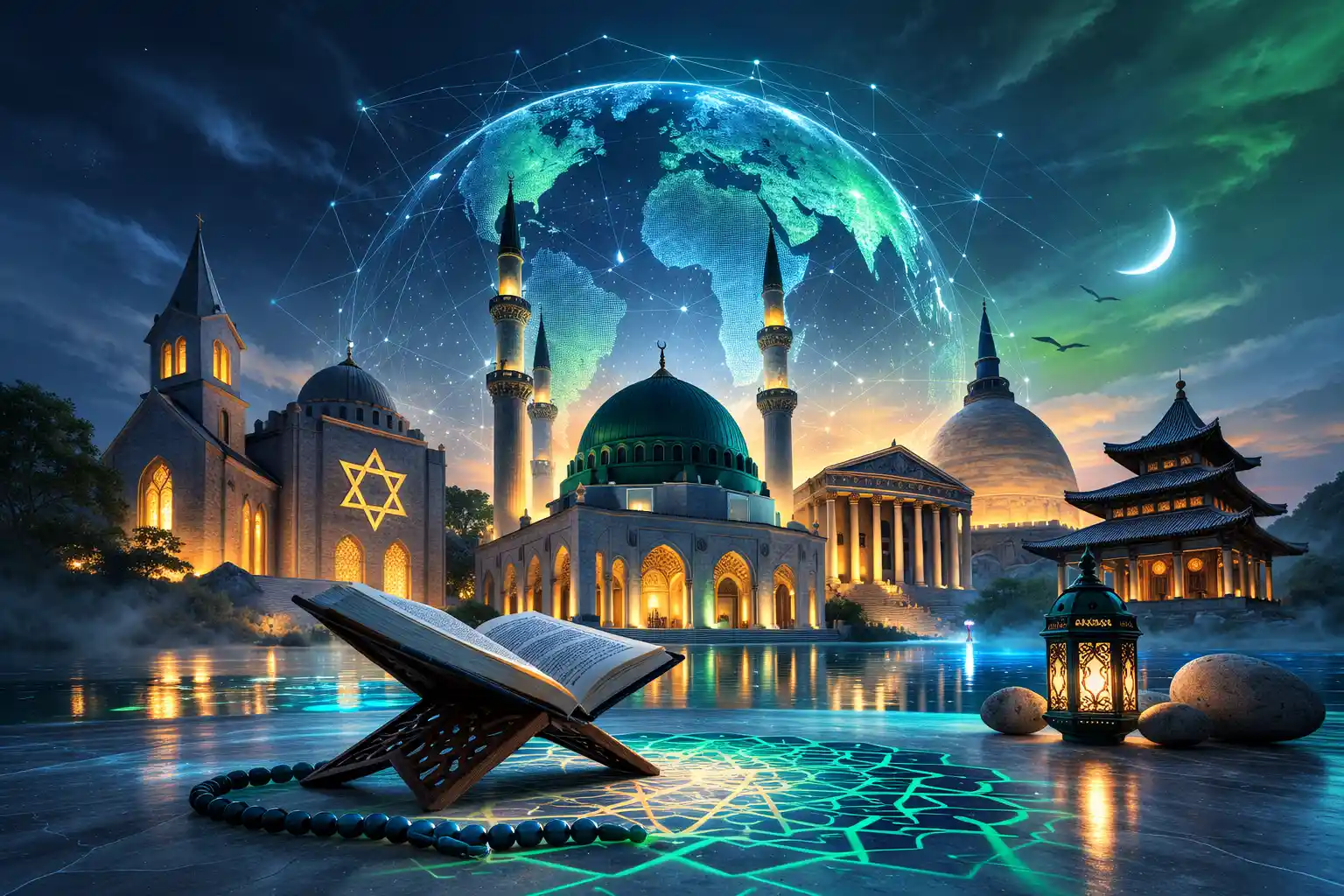
How Islam Views Other Religions?
Every major tradition on earth claims some relationship with truth. So when someone asks how Islam views other religions, they’re really asking something deeper: does Islam see itself as one path among many, or does it make a singular claim on truth?
Islam’s position on other religions is neither dismissive nor relativistic. It comes from a coherent theological framework rooted in the Quran and the Sunnah, and understanding it properly dismantles a great deal of the confusion that surrounds this topic in Western discourse.
1. All Humanity Began with One Religion
The Islamic understanding of religious history begins not with Prophet Muhammad but with Adam — the first human and the first prophet. From the very beginning, Allah sent guidance to mankind.
There was no original period of polytheism that monotheism later corrected. The Quran teaches the reverse: pure monotheism was the starting point, and deviation came afterward.
كَانَ النَّاسُ أُمَّةً وَاحِدَةً فَبَعَثَ اللَّهُ النَّبِيِّينَ مُبَشِّرِينَ وَمُنذِرِينَ
“Mankind was [of] one religion [before their deviation]; then Allah sent the prophets as bringers of good tidings and warners.” (Quran 2:213)
This verse reframes all of religious history. Every prophet — from Noah to Abraham to Moses to Jesus to Muhammad — carried the same essential message: worship Allah alone, and live according to His guidance.
The diversity of religions in the world today is not the original design. It reflects centuries of human alteration, selective preservation, and theological drift from what the prophets actually taught.
2. Islam Recognizes the Divine Origin of Earlier Scriptures and Prophets Before Human Alteration
One of the most misunderstood aspects of how Islam views other religions is that Islam does not reject the Abrahamic traditions, Islam is their continuation and, in the case of the Quran, their uncorrupted preservation.
Muslims are required by their faith to believe in the Torah (Tawrah) revealed to Moses, the Psalms (Zabur) given to David, and the Gospel (Injeel) given to Jesus.
Belief in all the prophets, including those revered in Judaism and Christianity, is a pillar of Islamic faith. Rejecting any of them is a rejection of Islam itself.
قُولُوا آمَنَّا بِاللَّهِ وَمَا أُنزِلَ إِلَيْنَا وَمَا أُنزِلَ إِلَىٰ إِبْرَاهِيمَ وَإِسْمَاعِيلَ وَإِسْحَاقَ وَيَعْقُوبَ وَالْأَسْبَاطِ وَمَا أُوتِيَ مُوسَىٰ وَعِيسَىٰ وَمَا أُوتِيَ النَّبِيُّونَ مِن رَّبِّهِمْ
“Say, ‘We have believed in Allah and what has been revealed to us and what has been revealed to Abraham and Ishmael and Isaac and Jacob and the Descendants and what was given to Moses and Jesus and what was given to the prophets from their Lord.'” (Quran 2:136)
The Quran honors Jesus as one of the mightiest messengers of Allah, born of a miraculous virgin birth, performing extraordinary miracles, and destined to return before the Day of Judgment.
Islam honors Moses as the one who spoke directly with Allah and led his people from bondage. This recognition is genuine, not tactical.
Learn More About Islam
Discover the beauty, teachings, and wisdom of Islam in a clear and welcoming way. Start exploring and deepen your understanding today.
Learn More3. Earlier Scriptures of Other Religions Were Changed Over Time
Respect for the origin of earlier revelations does not mean Islam considers their current forms intact. The Quran explicitly states that the scriptures of previous nations were altered — not entirely fabricated, but subjected to omission, addition, and misinterpretation over generations.
فَوَيْلٌ لِّلَّذِينَ يَكْتُبُونَ الْكِتَابَ بِأَيْدِيهِمْ ثُمَّ يَقُولُونَ هَٰذَا مِنْ عِندِ اللَّهِ
“So woe to those who write the ‘scripture’ with their own hands, then say, ‘This is from Allah.'” (Quran 2:79)
This is why Islam views the Quran as the final, preserved word of Allah — the benchmark against which all other claims are measured.
The Prophet Muhammad was sent to humanity at large, at a time when no uncorrupted divine guidance remained universally accessible.
The Quran itself has remained textually identical since its revelation, a fact that even secular historians of manuscript traditions acknowledge as historically remarkable.
Read also: Belief in Angels in Islam
4. Islam’s View of Judaism Reveals Critique of Its Alterations
Of all the world’s religious communities, the Children of Israel hold a particularly significant place in the Quran. Allah chose them, favored them above the nations of their time, and sent them prophet after prophet — Moses, Aaron, David, Solomon, and dozens more. The Quran speaks of this with unmistakable dignity.
يَا بَنِي إِسْرَائِيلَ اذْكُرُوا نِعْمَتِيَ الَّتِي أَنْعَمْتُ عَلَيْكُمْ وَأَنِّي فَضَّلْتُكُمْ عَلَى الْعَالَمِينَ
“O Children of Israel, remember My favor which I have bestowed upon you and that I preferred you over the worlds.” (Quran 2:47)
Prophet Moses holds a place of extraordinary prominence in Islamic theology — mentioned more than any other prophet in the Quran.
The Torah he received was divine revelation. The monotheism he preached was Islam in its essence. The Quran affirms all of this without reservation.
The Quran’s Documented Critique of What Happened to the Torah
Where Islam diverges is in its assessment of what happened to that tradition over time. The alterations the Quran identifies are not vague accusations — they are specific, and they are supported by explicit verses.
The first is the deliberate rewriting of scripture by religious authorities who passed off their own compositions as divine revelation:
“So woe to those who write the ‘scripture’ with their own hands, then say, ‘This is from Allah,’ in order to exchange it for a small price.” (Quran 2:79)
The second is the concealment of truths that were known — particularly prophecies about the coming of Prophet Muhammad that certain religious leaders recognized but chose to suppress:
يَا أَهْلَ الْكِتَابِ لِمَ تَكْفُرُونَ بِآيَاتِ اللَّهِ وَأَنتُمْ تَشْهَدُونَ
“O People of the Scripture, why do you disbelieve in the verses of Allah while you witness [to their truth]?” (Quran 3:70)
الَّذِينَ آتَيْنَاهُمُ الْكِتَابَ يَعْرِفُونَهُ كَمَا يَعْرِفُونَ أَبْنَاءَهُمْ ۖ وَإِنَّ فَرِيقًا مِّنْهُمْ لَيَكْتُمُونَ الْحَقَّ وَهُمْ يَعْلَمُونَ
“Those to whom We gave the Scripture know him as they know their own sons. But indeed, a party of them conceal the truth while they know [it].” (Quran 2:146)
The third is the distortion of words from their original meanings — changing the text itself, or shifting its interpretation so drastically that the original meaning is lost:
مِّنَ الَّذِينَ هَادُوا يُحَرِّفُونَ الْكَلِمَ عَن مَّوَاضِعِهِ
“Among the Jews are those who distort words from their [proper] usages.” (Quran 4:46)
The Quran is careful to distinguish between the community as a whole and those within it who committed these acts.
The Prophecy of Muhammad in What Remained of the Torah
Even through the alterations, the Quran asserts that traces of the prophecy concerning Prophet Muhammad remained — written clearly enough that those who encountered him recognized him immediately:
الَّذِينَ يَتَّبِعُونَ الرَّسُولَ النَّبِيَّ الْأُمِّيَّ الَّذِي يَجِدُونَهُ مَكْتُوبًا عِندَهُمْ فِي التَّوْرَاةِ وَالْإِنجِيلِ
“Those who follow the Messenger, the unlettered prophet, whom they find written in what they have of the Torah and the Gospel.” (Quran 7:157)
Islam’s relationship with Judaism is therefore one of deep affirmation at the root and clear-eyed critique of what grew over that root across the centuries.
The prophetic lineage is honored in full — the final chapter of that lineage was Prophet Muhammad, whose coming was foretold and whose message completed what Moses began.
Read also: Islam’s View on Contraception
5. A Clear Rejection of the Trinity of Christianity
No prophet receives more affectionate and detailed treatment in the Quran after Muhammad than Jesus — known in Islam as Isa ibn Maryam.
The Quran confirms his miraculous virgin birth, his ability to speak as an infant in the cradle, his healing of the blind and the leper, his raising of the dead, and his ascension.
Mary, his mother, has an entire chapter of the Quran named after her, and the Quran describes her as the greatest woman ever created.
إِذْ قَالَتِ الْمَلَائِكَةُ يَا مَرْيَمُ إِنَّ اللَّهَ اصْطَفَاكِ وَطَهَّرَكِ وَاصْطَفَاكِ عَلَىٰ نِسَاءِ الْعَالَمِينَ
“And [mention] when the angels said, ‘O Mary, indeed Allah has chosen you and purified you and chosen you above the women of the worlds.'” (Quran 3:42)
The Islamic position on Jesus is that he was one of the greatest prophets and messengers of Allah — a human being of extraordinary spiritual stature, supported by the Holy Spirit, and destined to return to earth before the Day of Judgment.
He will descend, break the cross, and affirm that he never claimed divinity.
The Quran’s critique of Christianity targets two theological developments it identifies as human additions: the Trinity and the doctrine of the crucifixion as atonement. Both are addressed directly.
لَّقَدْ كَفَرَ الَّذِينَ قَالُوا إِنَّ اللَّهَ ثَالِثُ ثَلَاثَةٍ ۘ وَمَا مِنْ إِلَٰهٍ إِلَّا إِلَٰهٌ وَاحِدٌ
“They have certainly disbelieved who say, ‘Allah is the third of three.’ And there is no god except one God.” (Quran 5:73)
As for the crucifixion, the Quran states that Jesus was neither killed nor crucified — that it was made to appear so, and that Allah raised him to Himself.
This is not a peripheral detail in Islamic theology. It is central to the Islamic understanding of divine protection for prophets and the corruption of the Gospel narrative over time.
Islam sees Christianity not as a false religion from its roots but as a tradition whose original message — the pure monotheism Jesus preached — was gradually overwritten by councils, theologians, and institutional church authority in the centuries after his ascension.
Read also: The Islamic View on Euthanasia
6. Islam Affirms That the Final Message Was Sent to All of Humanity
The prophets before Muhammad were sent to specific peoples and specific times. Moses was sent primarily to the Children of Israel. Jesus, by his own reported words in the Gospels, described his mission in particular terms. Muhammad صلى الله عليه وسلم was the first prophet explicitly sent to all of humanity, for all time, until the Day of Judgment.
وَمَا أَرْسَلْنَاكَ إِلَّا كَافَّةً لِّلنَّاسِ بَشِيرًا وَنَذِيرًا
“And We have not sent you except comprehensively to mankind as a bringer of good tidings and a warner.” (Quran 34:28)
Sahih Bukhari records the Prophet saying:
“Every prophet used to be sent to his nation only, but I have been sent to all mankind.”
This universality is foundational to how Islam views its relationship with all other religions. The Quran was not meant to be the scripture of one ethnic group or one region.
Its claim is total — a final message that supersedes, completes, and corrects all that came before.
Read also: Muslim Beliefs About Heaven
7. Islam Calls All People to Accept the Final Message
The duty of Muslims is to convey the message with wisdom and good counsel. The Quran makes this responsibility explicit:
ادْعُ إِلَىٰ سَبِيلِ رَبِّكَ بِالْحِكْمَةِ وَالْمَوْعِظَةِ الْحَسَنَةِ
“Invite to the way of your Lord with wisdom and good instruction.” (Quran 16:125)
Once the message has been conveyed clearly, accountability rests with each individual before Allah. Muslims engage other religious communities through speech, example, and reasoning.
8. Islam Rejects Religious Relativism While Upholding Upholding Justice for All
One point that needs to be stated clearly is that Islam does not accept the modern Western framework of religious relativism — the idea that all religions are equally valid paths to the same destination.
The Quran is explicit that Islam, in its final revealed form, is the religion accepted by Allah.
إِنَّ الدِّينَ عِندَ اللَّهِ الْإِسْلَامُ
“Indeed, the religion in the sight of Allah is Islam.” (Quran 3:19)
وَمَن يَبْتَغِ غَيْرَ الْإِسْلَامِ دِينًا فَلَن يُقْبَلَ مِنْهُ
“And whoever desires other than Islam as religion — never will it be accepted from him.” (Quran 3:85)
This theological position is maintained with clarity and without apology. At the same time, the Quran commands fairness and kindness toward non-Muslims who live peacefully alongside Muslims.
لَّا يَنْهَاكُمُ اللَّهُ عَنِ الَّذِينَ لَمْ يُقَاتِلُوكُمْ فِي الدِّينِ وَلَمْ يُخْرِجُوكُم مِّن دِيَارِكُمْ أَن تَبَرُّوهُمْ وَتُقْسِطُوا إِلَيْهِمْ
“Allah does not forbid you from those who do not fight you because of religion and do not expel you from your homes — from being righteous toward them and acting justly toward them.” (Quran 60:8)
Theological confidence and human decency are not in tension in Islam. A Muslim can hold that Islam is the complete and final truth while treating every neighbor with full justice and kindness.
Learn More About Islam
Discover the beauty, teachings, and wisdom of Islam in a clear and welcoming way. Start exploring and deepen your understanding today.
Learn MoreDiscover More on the Salam Platform
If this article raised more questions than it answered — that’s a good sign. The relationship between Islam and other religious traditions is deep, historically rich, and theologically precise. There’s much more to explore.
Visit the Salam Blog for articles covering Islamic theology, the Prophet’s life, common misconceptions, and the Quran’s message to contemporary readers.
If you have a specific question not addressed here — whether about entering Islam, understanding a particular teaching, or simply learning more — the Salam Platform team is available to help. Reach out directly; every question is welcomed without judgment.

Conclusion
Islam’s view of religious history flows from a single conviction: that Allah never left humanity without guidance. Every prophet carried the same torch, and the Quran represents its final, preserved form — a message addressed to every person who has ever asked whether truth is knowable.
The theological distinctions Islam draws between religious communities are not rooted in cultural superiority but in a carefully articulated understanding of revelation, prophecy, and divine will. Recognizing earlier scriptures while affirming their alteration, honoring earlier prophets while completing their mission — this is a coherent position, not a contradiction.
For anyone genuinely seeking to understand how Islam positions itself in the world’s religious landscape, the answer lies not in polemics but in the Quran’s own voice: confident in its message, clear in its boundaries, and open in its invitation to every human being regardless of their starting point.
Curious about Islam?
Journey towards clarity and purpose. Our team is here to support you in your search for truth and spiritual guidance.
Embrace the Truth