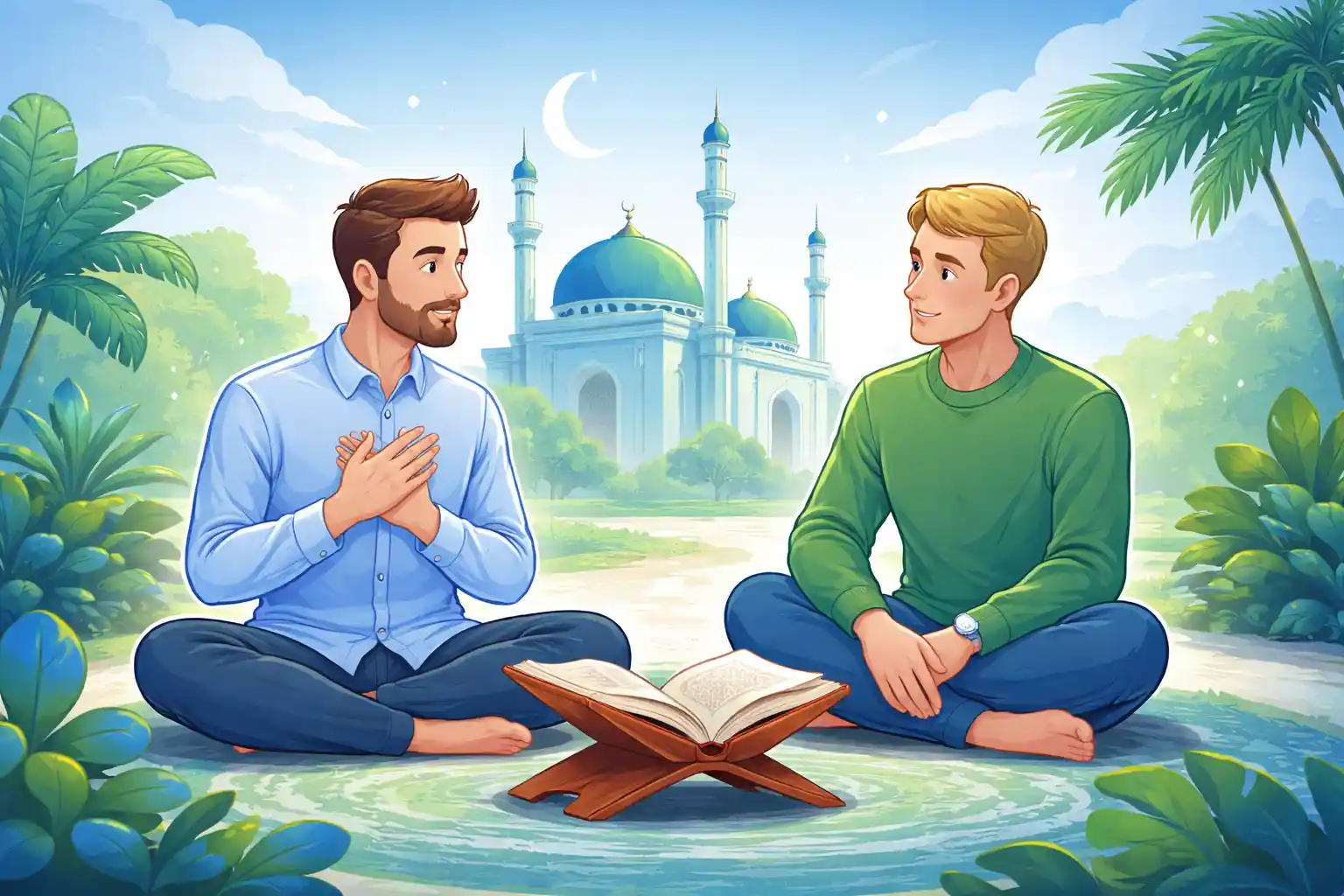
Can White People Become Muslim?
In a world full of diverse cultures and faiths, a question that occasionally arises is: “Can white people become Muslim?” The answer is a resounding yes. Islam is not confined to race, ethnicity, or nationality; it is a universal faith that invites all of humanity to worship one God. Any person, regardless of the color of their skin, can embrace Islam.
In this article, we will dispel the misconceptions that wrongly associate Islam with a single culture or region, explore the Qur’anic teachings and sayings of the Prophet Muhammad (peace be upon him) on the subject of equality, and highlight the rich diversity of Muslims worldwide. We will also examine historical and modern examples that demonstrate how Islam unites people from every background under a single message of faith.
The question that spread among non-Arab people considering Islam:
If I am a White Person, Can I Become Muslim?
Yes, absolutely; white people can become Muslims as well as people of all colors. One of the most important points to understand about Islam is that it is not bound to any race, ethnicity, or culture. While the religion originated in Arabia more than 1,400 years ago, its message was never meant to remain confined to one people or one region.
Islam is a universal faith that calls every human being to worship the One God, regardless of where they come from or what language they speak.
Quranic and Islamic Perspective on the Universality of the Quranic Message
The Qur’an itself emphasizes this universality of the Quranic Message:
“We have not sent you, [O Muhammad], except as a mercy to all mankind.” (Qur’an 21:107)
“O mankind, indeed We have created you from male and female and made you peoples and tribes that you may know one another. Indeed, the most noble of you in the sight of Allah is the most righteous of you.” (Qur’an 49:13)
This verse highlights that the Prophet Muhammad (peace be upon him) was sent with a message for all of humanity, not for Arabs alone, nor for any single ethnic group. Today, Islam is practiced by over 1.9 billion people across the globe, from Indonesia and Nigeria to the United States and Europe.
Muslims come from every continent, every skin color, and every cultural background.
This question often arises because of widespread misconceptions that associate Islam solely with Arab, Middle Eastern, or South Asian identities. However, this confusion stems from cultural association, not religious truth. Islam is not an ethnic identity; it is a spiritual choice and a way of life that transcends geography and color.
The Prophet Muhammad (peace be upon him) further emphasized this in his final sermon, where he proclaimed:
“No Arab is superior to a non-Arab, and no white is superior to a black, except in piety.”
From the very beginning of Islam, diversity was a defining feature of the Muslim community. Among the Prophet’s companions were people from all backgrounds:
- Salman the Persian, who came from Iran,
- Suhaib the Roman, from a European lineage,
- Bilal the Abyssinian, from Africa, was chosen as the first caller to prayer.
This early inclusivity showed that faith and righteousness, not skin color or origin, were what defined a Muslim.
Learn More About Islam
Discover the beauty, teachings, and wisdom of Islam in a clear and welcoming way. Start exploring and deepen your understanding today.
Learn MoreWell-known figures White People Became Muslims:
Today, that same spirit lives on. Across Europe, North America, and Australia, thousands of white men and women embrace Islam every year, professors, students, artists, and workers alike.
They discover in Islam not a foreign culture but a universal truth that connects them to their Creator and to a global family of believers. Among them are well-known figures whose stories continue to inspire others on their own spiritual journey, some of these examples:
1. Cat Stevens (Yusuf Islam) – a globally recognized musician
He embraced Islam in the late 1970s after a personal journey of searching for meaning. His story is a powerful reminder that Islam speaks to the human soul regardless of fame, culture, or background.
2. Lauren Booth – a British journalist and the sister-in-law of former UK Prime Minister Tony Blair
She converted to Islam after experiencing spiritual clarity during a visit to Palestine. Today, she is an advocate for interfaith understanding and social justice..
Many find comfort in Islam’s clarity, discipline, and deep sense of purpose. Others are drawn by its emphasis on equality, justice, and inner peace. For some, Islam becomes a spiritual home, a faith that answers the questions their hearts have long been asking.
If you are white and considering Islam, know this:
You will be welcomed as an equal member of the global Muslim community, a family that spans over 1.9 billion souls across every continent. In Islam, faith and character are what define a person, not the color of their skin.
Common Misconceptions About Islam and Race
Islam, as a universal religion, is often misunderstood due to stereotypes that confuse culture with faith. Two of the most widespread Islamic misconceptions are:
1. Islam Is “Only For Arabs” Or Limited To The Middle East
While Islam began in Arabia, it spread across continents and today is practiced by over 1.9 billion people worldwide. The largest Muslim-majority nation is Indonesia, not an Arab country, and Muslims are found in Africa, Asia, Europe, and the Americas. This proves that Islam is not tied to one race or region but embraces all of humanity.
2. Being Muslim Means Abandoning One’s Cultural Or Ethnic Identity
Accepting Islam does not require erasing culture or heritage. Instead, Islam provides spiritual and moral guidance while allowing people to maintain their traditions, as long as they do not contradict Islamic principles. A Muslim in Nigeria, Turkey, or the U.S. may express their faith differently, but all belong equally to the global ummah.
Learn More About Islam
Discover the beauty, teachings, and wisdom of Islam in a clear and welcoming way. Start exploring and deepen your understanding today.
Learn MoreBegin Your Journey of Islam Now!
If you are interested in learning more about Islam, we welcome you to the Salam Center. Our programs are open to people of all backgrounds who wish to understand the faith and its teachings.
Join us at the Salam Center to explore, ask questions, and discover the beauty of Islam.
Conclusion
Islam has never been limited by race, color, or nationality. It is a faith that opens its doors to every seeker of truth. White people, like people of all backgrounds, can and do become Muslim, finding peace in the same message that unites millions across the world. In Islam, what matters most is belief in God and living with sincerity, not the color of one’s skin.
Is Islam only for Arabs or Middle Eastern people?
No. While Islam began in Arabia, today it is practiced by more than 1.9 billion people worldwide. The largest Muslim population is in Indonesia, not an Arab country.
Do I have to change my culture to become Muslim?
Not necessarily. Islam encourages people to keep their cultural identity as long as it does not conflict with Islamic teachings. A Muslim in Africa, Europe, or America may express their faith in different cultural ways while still belonging to the same religion.
Where can I learn more about Islam?
You can visit a local mosque or the Salam Center, where classes, discussions, and resources are available for people of all backgrounds who wish to learn more about the faith.
Curious about Islam?
Journey towards clarity and purpose. Our team is here to support you in your search for truth and spiritual guidance.
Embrace the Truth