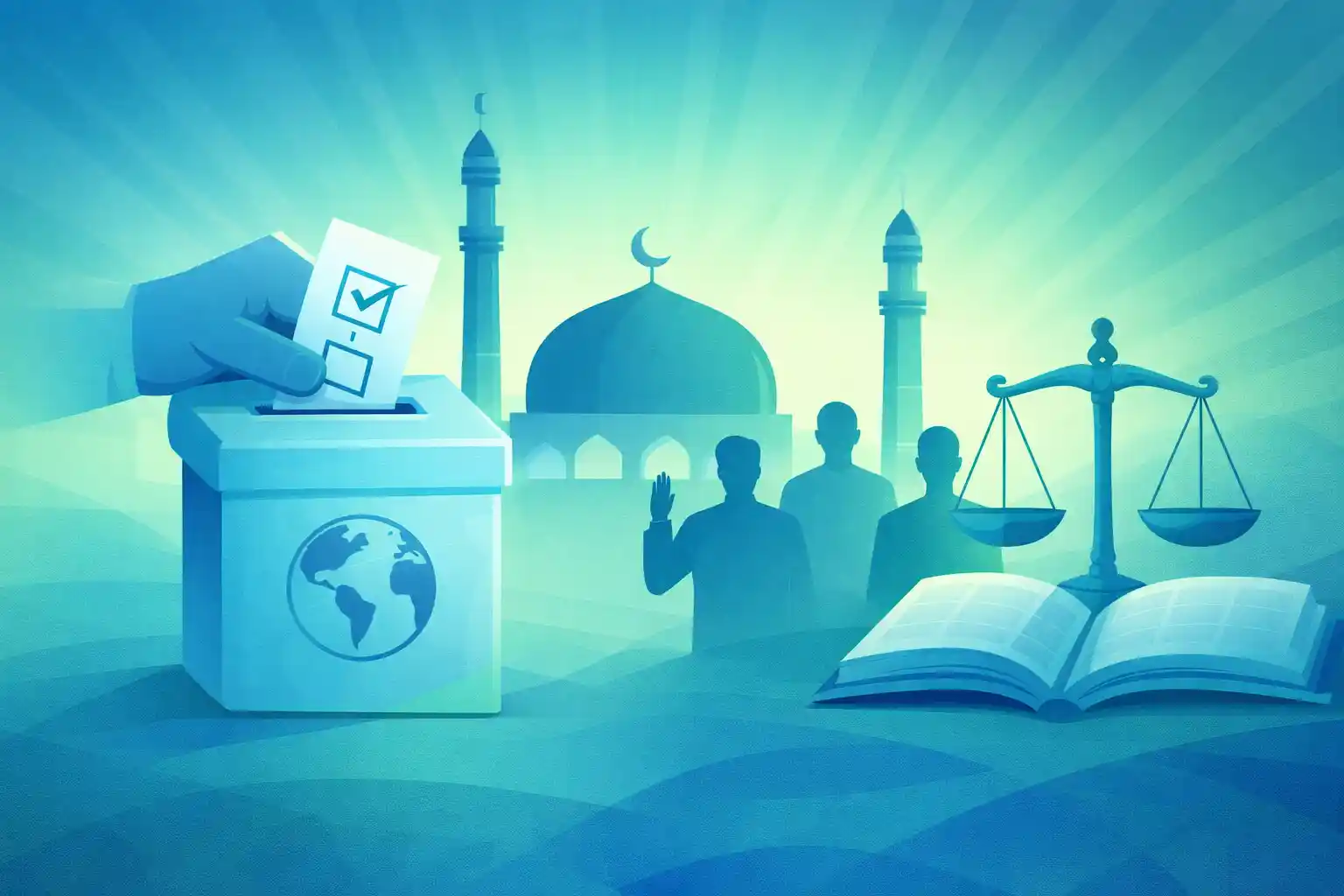
The Principles of Democracy in Islam
Islam arrived with a system of governance. Long before Enlightenment thinkers drafted social contracts, the Quran established the foundations of political life — accountability, justice, consultation, and the rule of law.
So when the question of the principles of democracy in Islam arises, it deserves more than a surface comparison. The answer requires understanding what Islam actually says about political authority, who holds it, and what limits it.
The relationship between Islamic governance and modern democracy is neither simple rejection nor wholesale adoption. There are genuine points of convergence. There are also fundamental differences that Islamic scholarship has always been clear about. Both deserve honest engagement.
Islam Established the Principle of Consultation Centuries Before Modern Democracy
The Quran did not leave governance to human improvisation. One of its clearest political directives is the principle of Shura — mutual consultation among those who hold authority and those affected by it.
وَأَمْرُهُمْ شُورَىٰ بَيْنَهُمْ
“And their affairs are [determined by] consultation among themselves.” (Quran 42:38)
This verse appeared alongside descriptions of the believers’ core characteristics — prayer, reliance on Allah, and charity. Governance by consultation was built into the identity of the Muslim community from the beginning.
The Prophet ﷺ himself modeled this. He consulted his companions on military strategy, on how to respond to crises, and on matters of communal welfare.
In the Battle of Uhud, he adopted the view of the majority of companions to march out and fight. That is Shura in practice.
Shura in Islamic Governance Means Accountability Flows Upward as Well as Downward
Shura was never ceremonial. The early caliphs understood themselves as servants of the community, not rulers above it.
Abu Bakr al-Siddiq, in his first address after being appointed, said: “Obey me as long as I obey Allah and His Messenger. If I disobey them, you owe me no obedience.”
That is accountability — not borrowed from any Western tradition, but rooted in the Islamic conception of leadership as a trust (amanah) rather than a privilege.
The Principles of Democracy in Islam Converge Around Justice as an Absolute Obligation
One area where Islamic governance and democratic theory find common ground is the rejection of arbitrary rule.
A ruler in Islam cannot legislate by whim, cannot exempt himself from the law, and cannot oppress the people without consequence — at least not without violating the explicit commands of Allah.
إِنَّ اللَّهَ يَأْمُرُ بِالْعَدْلِ وَالْإِحْسَانِ
“Indeed, Allah orders justice and good conduct.” (Quran 16:90)
Justice in Islam is not a political preference. It is a divine command that applies to rulers and ruled alike. The Quran even instructs Muslims to testify truthfully against themselves and their own families if justice demands it.
A political system built on Islamic principles, therefore, carries an internal check against tyranny that is theological — not merely constitutional.
The Prophet ﷺ warned explicitly about unjust rulers. He described oppressive leadership as one of the signs of a community in decline. And he established through his Sunnah that the strong have no advantage over the weak when it comes to legal accountability.
Protection of Rights in Islamic Governance Predates the Modern Human Rights Framework
The Maqasid al-Shariah — the objectives of Islamic law — include the protection of life, intellect, lineage, property, and religion. These were codified by classical scholars as the essential purposes of any legitimate governance.
Non-Muslims living under Islamic rule historically enjoyed legal protections, the right to practice their faith, and recourse in courts.
These are not concessions made to modernity. They are foundational Islamic principles.
Learn More About Islam
Discover the beauty, teachings, and wisdom of Islam in a clear and welcoming way. Start exploring and deepen your understanding today.
Learn MoreIslamic Democracy Diverge on the Question of Sovereignty
Modern democracy, in its theoretical core, holds that sovereignty belongs to the people — that the majority has the right to determine what is lawful, what is moral, and what the state may or may not do. Islamic governance holds a different view.
In Islam, sovereignty belongs to Allah alone. This principle means the exclusive legislative authority of Allah. Human beings are trustees and administrators, not ultimate legislators.
إِنِ الْحُكْمُ إِلَّا لِلَّهِ
“Legislation is not but for Allah.” (Quran 12:40)
This has a practical consequence. In a purely democratic framework, a legislative majority could theoretically legalize what Islam has prohibited or prohibit what Islam has permitted.
From an Islamic standpoint, that authority was never theirs to exercise in the first place. The community may consult, debate, and elect leaders — but within the framework Allah has established.
Islamic Governance Treats Divine Law as the Constitution Above All Constitutions
This is not a claim that every Muslim-majority government throughout history perfectly embodied Islamic governance. Many did not. The point is about the ideal — the standard Islamic political thought points toward.
A ruler’s legitimacy is derived from his commitment to governing by what Allah revealed. Departure from that was not mere policy failure — it was a departure from the mandate of governance itself.
Elections and Representation in Islamic Political Thought Have Deep Historical Precedent
Some assume that the concept of choosing leadership through community consent is a Western import into Islamic thinking. The historical record says otherwise.
The selection of Abu Bakr as the first caliph after the Prophet ﷺ involved consultation among the senior companions. Umar ibn al-Khattab was appointed with broad community acceptance. Uthman was selected through a council process.
These were not identical to modern elections — but the underlying principle that leadership requires community legitimacy was operative from the beginning of Islamic political history.
Ibn Khaldun, the 14th-century Islamic scholar and sociologist, theorized extensively about the relationship between leadership, community cohesion, and legitimacy in ways that resonate with modern discussions of representative governance — written centuries before Western political philosophy reached similar conclusions.
The Role of Scholars in Islamic Governance Provides a Structural Check on Power
One distinctive feature of Islamic political thought is the role of qualified religious scholars (ulama) as a check on executive authority.
Their function is to assess whether governance conforms to Islamic law — to advise, critique, and where necessary, to refuse compliance with illegitimate orders.
This structural element has no perfect equivalent in secular democracy, but it fulfills a similar function: preventing the concentration of unchecked power in a single ruler or body.
Democracy Principles in Islam Distinguishes Mechanisms from Foundations
Much of the confusion around this topic comes from conflating two separate things: the mechanisms of governance (elections, representation, deliberation) and the foundations of governance (who holds ultimate authority, and by what standard laws are made).
Islam has no objection in principle to elections as a mechanism for choosing leaders. Shura naturally lends itself to structured forms of community participation.
What Islam does not accept is the premise that the majority’s will replaces divine guidance as the standard for legislation.
Ready to Begin Your Journey to Islam?
Our team is here to support you with guidance, answers, and sincere advice. Reach out to us today and take your first step with confidence.
Contact Us NowExplore More About Islam on the Salam Platform
If this discussion has opened further questions — about Islamic governance, the political legacy of the Prophet ﷺ, or how Muslims navigate civic life in the West — the Salam blog is a space for exactly that kind of inquiry.
Each article is written to give you honest, grounded answers drawn from authentic Islamic sources, without simplification or distortion.
For questions that go beyond what you find in the articles — whether about Islamic teachings, your own spiritual journey, or taking the step toward Islam — our team is here to speak with you directly. Reach out through the contact page.
Every question is welcome. Every conversation is treated with sincerity.

Conclusion
The principles of democracy in Islam find their clearest expression in Shura — the Quranic mandate for consultation — combined with a deep commitment to justice that Islamic governance treats as a divine obligation, not a political preference derived from human consensus.
Where Islamic political thought parts from modern democratic theory is at the level of foundational sovereignty. Human participation in governance is valued and structured, but the authority to define what is lawful ultimately resides with Allah, whose guidance arrives through revelation rather than majority vote.
Engaging with this topic thoughtfully means recognizing that Islam brought a complete political vision long before modern democracies existed — one with its own internal logic, its own safeguards against tyranny, and its own account of what makes leadership legitimate. That tradition rewards serious study.
Curious about Islam?
Journey towards clarity and purpose. Our team is here to support you in your search for truth and spiritual guidance.
Embrace the Truth