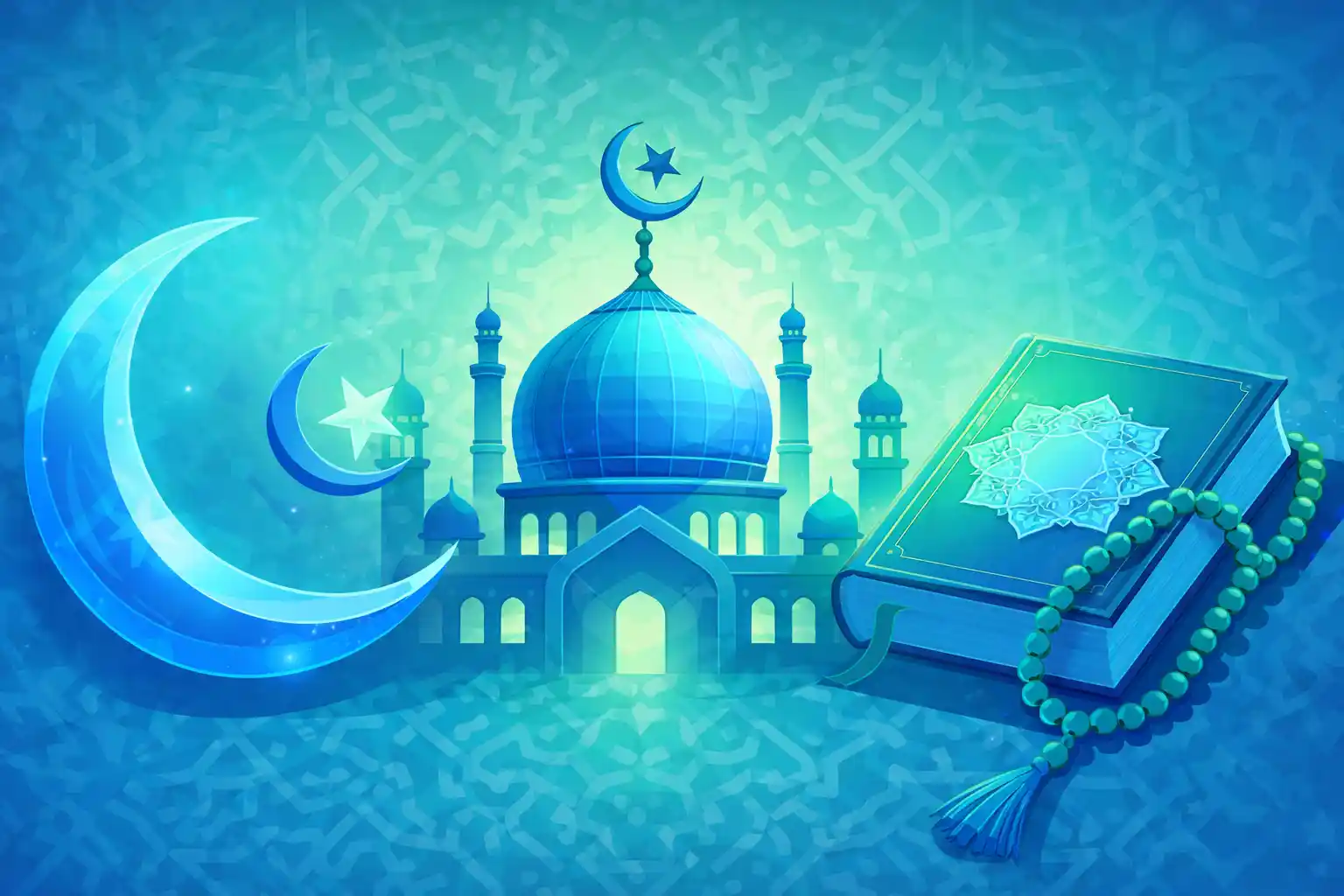
The Principal Symbols of Islam and What They Actually Mean
There is a crescent on the mosque. Green banners and Arabic script flowing across walls and flags. For the outside observer, these images have become shorthand for an entire civilization — but what do they actually represent, and which of them carry genuine religious weight in Islamic tradition?
That question deserves a careful answer, because not everything associated with Islam is equally Islamic.
Some symbols are rooted in deep theological meaning. Others are cultural inheritances absorbed over centuries of history. And a few are modern inventions that have been mistakenly read as ancient religious mandates.
The Principal Symbols of Islam Begin with the Written Word of Allah
Before any crescent or star, the most fundamental symbol in the Islamic world is the word itself — specifically, the Arabic script in which the Quran was revealed.
The phrase Bismillah ir-Rahman ir-Rahim (“In the name of Allah, the Most Gracious, the Most Merciful”) adorns homes, begins letters, and precedes meals and journeys. Visually, it has become one of the most recognized inscriptions on earth.
This primacy of the written word is not incidental. Islam came as a revelation — a recitation — and Arabic script became the vessel of the divine word. The Quran commands reflection on its verses constantly:
أَفَلَا يَتَدَبَّرُونَ الْقُرْآنَ
“Do they not reflect upon the Quran?” (Quran 4:82)
That orientation toward the word, rather than the image, shapes everything. Islamic art channeled its genius into calligraphy precisely because writing carries the message directly.
When you see flowing Arabic script on a mosque wall, you are seeing a civilization that chose meaning over iconography.
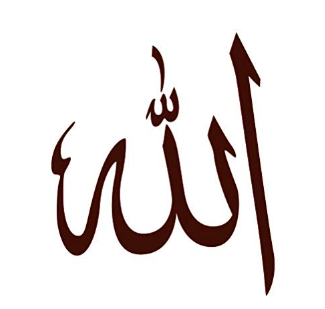
The Shahada as the Most Sacred Symbol of Islamic Identity
The declaration of faith — La ilaha illa Allah, Muhammadun Rasulullah (“There is no deity worthy of worship except Allah, and Muhammad is the Messenger of Allah”) — is the entry point into Islam and the defining statement of a Muslim’s life. It appears on flags, coins, architecture, and gravestones across the Muslim world.
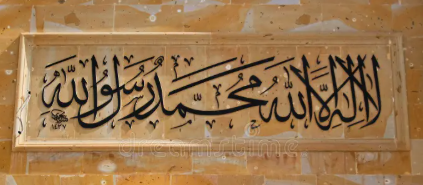
Its presence everywhere signals something theological: monotheism is the organizing principle of this religion, not a background assumption.
Every symbol, every practice, every visual element in Islam derives its legitimacy from how faithfully it reflects this declaration or serves the community built around it.
The Crescent Moon Holds Cultural Rather Than Divine Authority in Islamic Tradition
The crescent moon (hilal) is widely regarded as the symbol of Islam across the world. It appears on the flags of Turkey, Pakistan, Algeria, Tunisia, and many other Muslim-majority nations. It tops minarets. It appears on the emblems of Islamic organizations globally.
Yet there is no Quranic verse designating the crescent as a sacred symbol, and no authentic hadith instructing Muslims to venerate or adopt it as a religious emblem.
The crescent’s association with Islam developed gradually. The Ottoman Empire formalized its use on flags and military standards, and as Ottoman power spread across three continents, the symbol traveled with it.
Earlier, the crescent had been associated with Constantinople and other pre-Islamic civilizations. It was absorbed, not revealed.
What Islam does give the crescent moon is a practical and spiritual role — as a marker of time. The Islamic lunar calendar is built on moon sightings.
Ramadan begins and ends with the sighting of the new crescent. Hajj is timed by it. The Quran itself affirms this function:
يَسْأَلُونَكَ عَنِ الْأَهِلَّةِ قُلْ هِيَ مَوَاقِيتُ لِلنَّاسِ وَالْحَجِّ
“They ask you about the new moons. Say, ‘They are measurements of time for the people and for Hajj.'” (Quran 2:189)
The moon marks sacred time. Whether it symbolizes the religion itself is a different matter — one that Islamic scholarship has consistently approached with nuance.
Learn More About Islam
Discover the beauty, teachings, and wisdom of Islam in a clear and welcoming way. Start exploring and deepen your understanding today.
Learn MoreThe Color Green Carries Genuine Quranic Resonance as an Islamic Symbol
Green holds a special place in the Islamic imagination, and here the scriptural basis is more direct. The Quran describes the inhabitants of Paradise wearing garments of green silk and reclining on green cushions:
عَالِيَهُمْ ثِيَابُ سُنْدُسٍ خُضْرٌ وَإِسْتَبْرَقٌ
“Upon them will be garments of fine green silk and brocade.” (Quran 76:21)
Green does not function as a rigid religious emblem, but its Quranic associations with Paradise have given it an enduring place in Islamic visual culture — one that carries genuine, if not strictly doctrinal, weight.
The Star and Crescent Together Represent Political History More Than Religious Doctrine
The pairing of the crescent with a five or eight-pointed star is perhaps the most globally recognized image linked to Islam. It appears on the flags of nearly two dozen countries. Yet Islamic scholarship is largely agreed that this combination carries no theological basis whatsoever.
The star-and-crescent combination rose to prominence through Ottoman imperial use, spreading from Constantinople after the 15th century conquest.
Before that, the star had been used by various civilizations including the Byzantine Empire. The symbol was a political and imperial marker that Islam inherited through conquest and administration — not a divine designation.
This distinction matters, not to diminish the beauty of these symbols, but because Islam’s own self-understanding places theology above culture.
A Muslim who sees the crescent on a flag feels a sense of community and belonging — and that is real and valid. But the flag is not an object of reverence. The Quran is.
The Kaaba Stands as the Most Theologically Grounded Visual Symbol in All of Islam
If one image captures the essence of Islamic worship, it is the Kaaba — the black cube at the center of Masjid al-Haram in Mecca.
Built by Ibrahim (Abraham) and his son Ismail, as described in the Quran, the Kaaba serves as the qibla — the direction toward which every Muslim on earth turns in prayer, five times a day, from every corner of the globe.
وَإِذْ يَرْفَعُ إِبْرَاهِيمُ الْقَوَاعِدَ مِنَ الْبَيْتِ وَإِسْمَاعِيلُ
“And [mention] when Ibrahim was raising the foundations of the House and [with him] Ismail.” (Quran 2:127)
The Kaaba is not worshipped. Muslims do not pray to it — they pray toward it, as a unifying focal point that binds 1.8 billion people into a single direction of worship.
This is a symbol with divine command behind it, which places it in an entirely different category from the crescent or the star.
The tawaf — circumambulation of the Kaaba during Hajj and Umrah — is one of the most visually powerful acts of worship on earth: millions of believers moving in concentric circles around a single point, embodying the unity of the Ummah under the oneness of Allah.
The Mosque Architecture Itself Functions as a Living Symbol of Islamic Civilization
The minaret, the dome, the geometric tilework, the absence of figurative imagery — mosque architecture is not accidental. It is theology expressed in stone and space.
The minaret exists to carry the adhan — the call to prayer — into the surrounding city. Its height is functional: sound needs elevation.
But over centuries it became a marker of Muslim presence, a statement that this community prays, that prayer shapes public life, that time bends around worship.
The Prophet ﷺ said: “The most beloved of places to Allah are the mosques.” (Sahih Muslim)
The mosque as a symbol, then, carries full religious endorsement — not just as a building, but as a center of learning, community, and worship.
Understanding Which Islamic Symbols Carry Religious Authority Protects the Integrity of the Faith
A tradition that has produced one of history’s most intellectually rigorous civilizations has always distinguished between what is revealed and what is inherited. The principal symbols of Islam are not equally weighted.
The Shahada carries divine command.
The Quran itself is the supreme visual and linguistic presence in Muslim life. T
he Kaaba holds Quranic sanction as the qibla of the entire Ummah. Green carries genuine Quranic resonance.
The crescent and star, by contrast, belong to the living culture of Muslim peoples — meaningful, beloved, community-affirming — but not objects of religious obligation.
Understanding this hierarchy is itself an act of intellectual honesty that Islam has always encouraged.
A Muslim’s identity does not depend on a flag. It is inscribed in the Shahada. And that is precisely why the Shahada, not any geometric emblem, remains the truest symbol this tradition has ever produced.
Learn More About Islam
Discover the beauty, teachings, and wisdom of Islam in a clear and welcoming way. Start exploring and deepen your understanding today.
Learn MoreExplore More at Salam
If this article raised further questions — about Islamic practice, the meaning behind Muslim traditions, or anything else you’ve wondered about — the Salam blog is a space built for exactly that kind of inquiry.
Browse articles on Islamic beliefs, history, and common misconceptions, written for curious minds without prior knowledge required.
For questions not covered here, guidance on entering Islam, or any inquiries about Islamic teachings, reach out to us directly. We welcome every question, wherever you are on your journey.
Conclusion
The principal symbols of Islam span a wide range — from the divinely mandated direction of prayer toward the Kaaba to the culturally inherited crescent — and each one carries a different kind of authority within the tradition.
Calligraphy, the Shahada, and sacred architecture represent the living theological core of Islamic visual culture, rooted directly in Quranic command and Prophetic practice, with no ambiguity about their religious standing.
Approaching these symbols with clarity rather than assumption deepens appreciation for how Islam distinguishes revelation from tradition — a distinction that strengthens, rather than diminishes, the richness of Muslim civilization.
Curious about Islam?
Journey towards clarity and purpose. Our team is here to support you in your search for truth and spiritual guidance.
Embrace the Truth