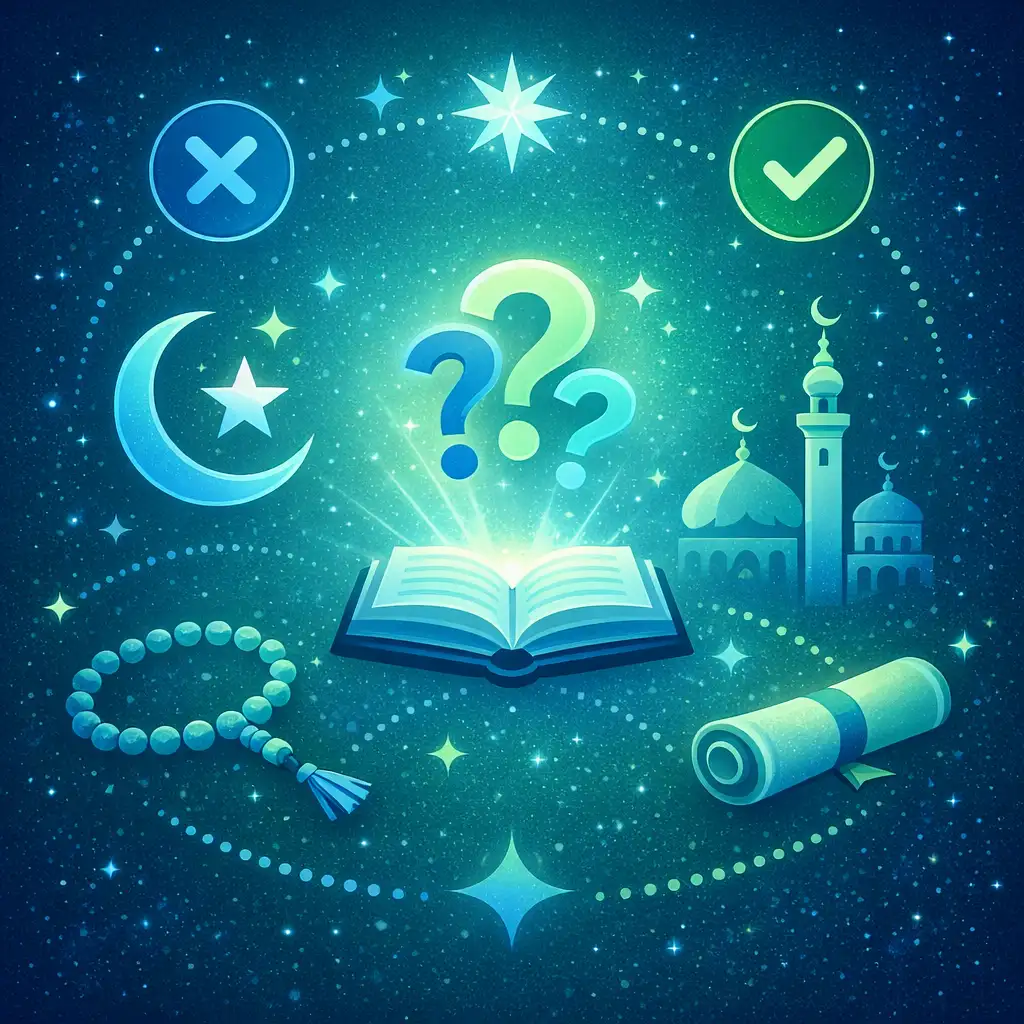
Do Humanists Believe in God?
| Key Takeaways |
| Most humanists do not believe in God; secular humanism explicitly rejects theism and grounds morality in human reason alone. |
| Humanism places humanity at the center of meaning and purpose, a position Islam attributes exclusively to Allah as the Creator and Sustainer. |
| Islam teaches that human reason, though valuable, is insufficient without divine revelation — the Quran provides the moral framework reason cannot generate on its own. |
| The Islamic concept of Tawhid (the absolute oneness of Allah) stands in direct contrast to humanism’s godless framework for ethics and human dignity. |
| A seeker comparing humanism and Islam will find that Islam answers the same questions humanism raises — about meaning, morality, and human worth — but roots them in divine truth rather than human consensus. |
Most humanists do not believe in God. Secular humanism, the dominant strand of the movement today, explicitly rejects theism and holds that human beings can live ethical, meaningful lives without any reference to a creator, a scripture, or divine law. That is the short answer — and it leads immediately to a deeper question: if humanism and Islam both care about human dignity and moral life, what separates them at the root?
The answer goes straight to the foundation. Islam teaches that human beings did not create themselves, cannot grant themselves ultimate meaning, and cannot — through reason alone — arrive at a complete and reliable moral framework. The Quran addresses this directly:
أَمْ خُلِقُوا مِنْ غَيْرِ شَيْءٍ أَمْ هُمُ الْخَالِقُونَ
“Or were they created by nothing, or were they the creators [of themselves]?” (Quran 52:35)
This single verse cuts to the heart of the humanist position. The rhetorical force is deliberate: the Quran does not merely assert Allah’s existence — it challenges the only alternatives. Either existence arose from nothing, or human beings produced themselves. Both options are rationally untenable. What remains is a Creator.
Do Humanists Believe in God?
Most humanists don’t believe in God. Modern secular humanism generally moves away from the idea of a creator or divine law, suggesting instead that we can lead good, meaningful lives guided by our own reason and ethics.
Secular humanism grounds human worth and moral life in reason and consensus, explicitly rejecting any divine source.
Secular Humanism Rejects Theism as Its Foundational Commitment
Humanism has several historical forms — Renaissance humanism, religious humanism, and secular humanism — but when people today ask “do humanists believe in God,” they are almost always referring to the secular variety.
The American Humanist Association defines humanism as “a progressive philosophy of life that, without theism or other supernatural beliefs, affirms our ability and responsibility to lead ethical lives of personal fulfillment.” The rejection of theism is explicit, not incidental.
Secular humanists locate the source of morality in human experience, empathy, and reason. There is no revealed law, no divine command, no scriptural authority.
The standards of right and wrong emerge from human consensus — which means they shift with culture, era, and majority opinion.
The Claimed Religious Humanism Is Also A Delusion That Has No Actual Relation To Faith In God
A minority strand called religious humanism does retain some notion of the sacred or transcendent, but even here, the divine is typically reframed as a human projection or a symbol of human potential — not a real, independent, all-knowing Creator. This is far from theism in any meaningful sense, and certainly far from the Islamic understanding of Allah.
The International Humanist and Ethical Union — the global umbrella body for humanist organizations — requires member groups to affirm a non-theistic worldview. Belief in God disqualifies an organization from full membership. That institutional standard makes the movement’s position clear.
Have Questions About Islam?
Our team is ready to answer your questions clearly and respectfully. Ask freely and receive honest guidance.
Ask Us NowRead Also: Can a Free Thinker Believe in God?
The Islamic View of Human Reason and Its Limits
Islam honors reason. The Quran repeatedly calls human beings to reflect, observe, and think. أَفَلَا تَعْقِلُونَ — “Will you not then reason?” — appears across multiple chapters. Rational inquiry in Islam is an act of worship when it leads the mind toward recognition of Allah.
The critical distinction is that reason in Islam functions as a tool, not an ultimate authority. The principles of Islamic belief establish that divine revelation — through the Quran and the authenticated Sunnah of the Prophet (PBUH) — provides the framework within which reason operates. Reason can identify that honesty is preferable to deception. It cannot, on its own, determine the full scope of human obligation, the purpose of existence, or what happens after death.
Humanism’s confidence in unaided reason is, from an Islamic perspective, an overestimation of a genuine but limited faculty. It is like trusting a compass without a map — the instrument works, but it cannot tell you where you need to go.
Tawhid is a Concept Humanism Has No Equivalent For
The Islamic doctrine of Tawhid (the absolute oneness of Allah) is not merely a theological statement about numbers. It is a complete orientation of the human being toward their Creator — the recognition that everything exists by Allah’s will, is sustained by Allah’s power, and will return to Allah’s judgment.
وَإِلَٰهُكُمْ إِلَٰهٌ وَاحِدٌ ۖ لَّا إِلَٰهَ إِلَّا هُوَ الرَّحْمَٰنُ الرَّحِيمُ
“And your God is one God. There is no deity [worthy of worship] except Him, the Entirely Merciful, the Especially Merciful.” (Quran 2:163)
Humanism has no equivalent concept. In its framework, there is no being to whom humans are accountable beyond one another. Moral seriousness exists — humanists are often genuinely ethical people — but the foundation beneath that morality is human agreement, not divine command.
Islam holds that a morality grounded in human agreement is, ultimately, only as stable as the humans agreeing.
Read also: Quotes on Belief in Allah
Human Dignity in Islam Comes From Allah, Not From Human Declaration
One of humanism’s strongest appeals is its robust commitment to human dignity. Humanists argue that every person has inherent worth — a powerful and admirable commitment. But the question Islam raises is this: where does inherent worth come from, and who guarantees it?
In Islamic theology, human dignity has a specific source. Allah created human beings with a special status:
وَلَقَدْ كَرَّمْنَا بَنِي آدَمَ
“And We have certainly honored the children of Adam.” (Quran 17:70)
This verse does not say that humanity declared itself honorable. It says Allah honored the children of Adam. Human dignity in Islam is a divine grant — fixed, guaranteed, and not subject to revision by any human authority or cultural shift.
Humanist dignity, by contrast, rests on human agreement. History shows how fragile that agreement can be. When enough people agreed that certain humans were less worthy — in colonial empires, in totalitarian states — the humanist framework provided no transcendent ground to stand on. The Islamic framework does.
To understand the full Islamic picture of faith in Allah and what it means for human life, the grounding becomes clear: belief in Allah is not a cultural add-on to an already-complete worldview. It is the foundation that makes everything else coherent.
Read also: Quotes About Believing in One God
The Quran Addresses the Humanist’s Core Questions
Someone drawn to humanism is usually asking sincere questions: Can I live morally without religion? Do I need God to find meaning? Is human reason enough? The Quran does not dismiss these questions — it answers them directly, and at depth.
On the question of meaning, the Quran is precise:
وَمَا خَلَقْتُ الْجِنَّ وَالْإِنسَ إِلَّا لِيَعْبُدُونِ
“And I did not create the jinn and mankind except to worship Me.” (Quran 51:56)
Worship here — ‘ibadah — encompasses far more than ritual. It means living in conscious alignment with Allah’s guidance: in relationships, in work, in thought, in conduct.
Purpose, in Islam, is not something a person constructs for themselves. It is something they discover — by recognizing what they were made for.
Anyone genuinely curious about what Muslims believe regarding the Quran will find that the Quran presents itself as the definitive guide for exactly the existential questions humanism tries to answer through philosophy alone.
Read also: The Belief In The Existence Of Only One God
The Islamic Response to Secular Ethics and Morality Without God
Can human beings be moral without believing in Allah? Muslims would say that humans can often behave decently through natural inclination (fitrah) and social pressure — but that this is different from a grounded moral system. The Prophet (PBUH) taught:
“Every child is born upon the fitrah.” (Jami` at-Tirmidhi)
The fitrah — the innate human disposition — inclines toward good, toward truth, toward the recognition of a Creator. When someone lives morally without formally believing, Islam understands them as acting in partial accordance with the fitrah they were born with, even if they have not yet followed it to its source.
The difference is that Islamic morality has an anchor. It does not shift because a society shifts. The prohibition of injustice, the obligation to honesty, the protection of the vulnerable — these are not negotiable based on cultural consensus. They are rooted in divine command, communicated through the Quran and the authenticated Sunnah.
Secular ethics, at its best, approximates what revelation already provides. At its worst, it justifies whatever the powerful decide to normalize.
Have Questions About Islam?
Our team is ready to answer your questions clearly and respectfully. Ask freely and receive honest guidance.
Ask Us NowContinue Gaining Authentic Knowledge with Salam
If these questions have opened something in you — curiosity, a desire to understand Islam more clearly, or a genuine search for answers — there is more waiting for you.
Explore the Salam blog for in-depth articles on Islamic belief, the nature of Allah, and how Islam addresses the deepest questions of human existence.
Visit the Salam Platform for a full library of resources designed for sincere seekers and curious minds.
Have a specific question not covered here — about entering Islam, Islamic teachings, or anything on your mind?
Reach out directly — we are here for honest conversation, with no pressure and no agenda beyond sharing what we know.
Frequently Asked Questions
Do humanists believe in God or any higher power?
Most humanists do not believe in God or any higher power. Secular humanism — the dominant form of humanism today — is explicitly non-theistic. It holds that human beings can live meaningful and ethical lives relying on reason, empathy, and human experience alone, without reference to a creator or divine revelation. The International Humanist and Ethical Union requires member organizations to affirm a non-theistic worldview as a condition of membership, which reflects how central godlessness is to the movement’s identity.
Can someone be both a humanist and a Muslim?
No, full secular humanism and Islamic belief are incompatible at their foundations. Secular humanism places human reason as the ultimate moral authority, while Islam holds that Allah alone is the ultimate authority and that revelation — the Quran and Sunnah — provides the framework within which reason operates. A Muslim who values human dignity, rational inquiry, and compassion — as Islam commands — is not a humanist. They are a Muslim, grounding those values in divine truth rather than human consensus.
What does Islam say about human dignity compared to humanism?
Islam and humanism both affirm human dignity, but Islam grounds it in a divine declaration while humanism grounds it in human consensus. The Quran states: وَلَقَدْ كَرَّمْنَا بَنِي آدَمَ — "And We have certainly honored the children of Adam" (Quran 17:70). This honor is a grant from Allah — not a right that humans bestowed upon themselves and can therefore revoke. In the Islamic view, the humanist foundation for dignity, however sincere, lacks permanence. When social consensus shifts — as it has repeatedly throughout history — humanist dignity has no transcendent anchor to hold it in place.
Curious about Islam?
Journey towards clarity and purpose. Our team is here to support you in your search for truth and spiritual guidance.
Embrace the Truth