
Can a Free Thinker Believe in God?
| Key Takeaways |
| A free thinker is someone who forms opinions through reason and evidence rather than inherited authority — and Islam fully embraces this standard. |
| The Quran invokes reason over 49 times, repeatedly challenging humanity with phrases like “Will you not then reflect?” and “Will you not use your intellect?” |
| Islam teaches that every human being is born upon the Fitrah — an innate disposition hardwired to recognize Allah — making belief in God the most natural conclusion of sincere reasoning. |
| When reason is exercised without distortion, without cultural bias, and without the suppression of conscience, it arrives at the same truth the Prophets carried: there is one Creator. |
Islam occupies a unique position in this conversation. The Quran asks for something demanding: think. Observe the heavens. Examine the earth. Look at your own existence. Then conclude.
The religion that commands this level of intellectual engagement is not threatened by free thinking — it invites it. And that invitation is fourteen centuries old.
Can a Free Thinker Believe in God?
Yes — a free thinker can absolutely believe in God. More than that: when reason is truly free — freed from social pressure, cultural conditioning, and inherited bias — it tends toward belief rather than away from it.
The real question is not whether reason and faith are compatible. It is whether the person exercising reason has the intellectual courage to follow their inquiry wherever it leads.
What Is a Free Thinker?
A freethinker is a person who forms opinions on the basis of reason independently of authority. The term carries a built-in assumption: that reason and religion are adversaries. That assumption deserves scrutiny.
Bertrand Russell wrote in his essay The Value of Free Thought that someone is considered a freethinker only if their beliefs are supported by evidence rather than bias, regardless of how odd their conclusions may seem. According to Russell, a freethinker is not necessarily an atheist or an agnostic, as long as they are free from “the force of tradition” and “the tyranny of their own passions.”
This is a crucial concession from one of the West’s most prominent secular philosophers. Russell’s own definition allows for a believer — provided that belief is grounded in honest inquiry rather than inherited habit.
Islam goes further. It actively commands this kind of thinking. The Quran’s word for reason — ‘Aql — and its derivatives appear across the text in an imperative mood, not a passive one.
The word “mind” or “reasoning” is mentioned 49 times in the Quran — in Arabic, Ta’qiloon 24 times, Ya’qiloon 22 times, and A’qal, Na’qil, and Ya’qil once each. These are divine calls to intellectual engagement.
The Quran Encourages Reason That Leads to Faith
Few things distinguish Islam more sharply from the popular image of religion than the Quran’s posture toward the human intellect. Rather than demanding submission before inquiry, the Quran presents its arguments and then challenges the reader to evaluate them.
The phrase أَفَلَا تَعْقِلُونَ (“Afala ta’qiloon” — “Will you not then use your reason?”) recurs across multiple surahs.
Islam encourages adherents to continuously think about their inner selves and all of Allah’s creation in the universe, as emphasized by Quranic phrases which frequently include: “Afalaa Tatafakkarun” (don’t you think?), “Afala Ta’qilun” (don’t you use your wits?), and “Wa fi Anfusikum, Afala Tubsirun” (and in yourselves, don’t you see?).
This is the intellectual framework of the Quran: the creation itself is evidence. The universe is a book written in signs (Ayat), and the one who refuses to read it is the one abandoning reason — not the believer.
Surah Ali ‘Imran delivers perhaps the most powerful expression of this:
إِنَّ فِي خَلْقِ السَّمَاوَاتِ وَالْأَرْضِ وَاخْتِلَافِ اللَّيْلِ وَالنَّهَارِ لَآيَاتٍ لِّأُولِي الْأَلْبَابِ
“Indeed, in the creation of the heavens and the earth and the alternation of the night and the day are signs for those of understanding.” (Quran 3:190)
When people look carefully at the order of the universe, it becomes clear to them that it is an order permeated by wisdom and intelligent purpose.
It is altogether inconsistent with wisdom that the man endowed with moral consciousness and freedom of choice, the man gifted with reason and discretion, should not be held answerable for his deeds — and this kind of reflection leads people to develop a strong conviction that the Afterlife is a reality.
The Quran, in other words, uses reason as its primary vehicle for arriving at Allah. It treats intellectual reflection — Tafakkur — as an act of worship in itself. The Arabic words فِکر (Fikr) and تَفَکُّر (Tafakkur) literally mean to ponder, to deliberate, and to think about something in an effort to arrive at its reality — and from this verse we find that this act of pondering is itself an act of worship, very much like the Dhikr (remembrance) of Allah.
Learn More About Islam
Discover the beauty, teachings, and wisdom of Islam in a clear and welcoming way. Start exploring and deepen your understanding today.
Learn MoreReason Affirms What the Soul Already Knows
Here lies the heart of Islam’s answer to the free thinker. It is not only that reason can arrive at God — it is that every human being already carries, embedded within their very nature, an innate recognition of Allah. This is the concept of the Fitrah.
The concept of Fitrah in Islam refers to the innate, natural disposition with which Allah creates every human being — the original state of purity, truth, and recognition of God that exists before external influences shape a person.
This is affirmed in Surah Ar-Rum with a verse that Islamic scholars across generations have cited as foundational to the theology of human nature:
فِطْرَتَ اللَّهِ الَّتِي فَطَرَ النَّاسَ عَلَيْهَا ۚ لَا تَبْدِيلَ لِخَلْقِ اللَّهِ
“[Adhere to] the Fitrah of Allah upon which He has created all people. No change should there be in the creation of Allah. That is the correct religion, but most of the people do not know.” (Quran 30:30)
And the Prophet Muhammad (PBUH) made this explicit in a hadith recorded in both Sahih Bukhari and Sahih Muslim:
كُلُّ مَوْلُودٍ يُولَدُ عَلَى الْفِطْرَةِ، فَأَبَوَاهُ يُهَوِّدَانِهِ أَوْ يُنَصِّرَانِهِ أَوْ يُمَجِّسَانِهِ
“Every child is born upon the Fitrah, then his parents make him a Jew, a Christian, or a Magian.” (Sahih Bukhari)
This hadith underscores the idea that humans are born in a state of Fitrah, but external influences — such as parents, society, or culture — can shape their beliefs and practices.
The implication is that the natural disposition to believe in the oneness of God and to follow a righteous path is universal, and deviations from it occur due to external factors, not due to the nature of the individual.
What does this mean for the free thinker?
It means that genuine free thinking — thinking stripped of societal conditioning, parental imprinting, and cultural noise — does not arrive at a blank slate. It arrives at recognition. The Fitrah is not religious indoctrination. It is the original human factory setting, and it points toward Allah.
The Quranic argument for God’s existence is not primarily philosophical but Fitri — it appeals to our innate instinct.
The story of Prophet Ibrahim rejecting the sun and moon is a demonstration of the Fitrah’s instinctual logic: the created cannot be the Creator.
This makes Da’wah less about implanting a new idea and more about awakening a dormant one.
Reason Has Limits — And Admitting That Is the Most Rational Move
A genuine free thinker understands something that overconfident rationalists often miss: reason is a tool, and every tool has a range of application. A hammer is not defective because it cannot measure temperature.
Reason is not defeated when it encounters questions beyond its grasp — it simply marks the boundary of where revelation becomes necessary.
The perception of the reality of the Divine Being and His Attributes is beyond human reason — deliberation of this aspect results in nothing but wonder. This is not intellectual defeat. It is intellectual precision.
The great scholar Imam al-Ghazali, in his landmark work Ihya ‘Ulum al-Din, argued precisely this: reason establishes the existence and unity of Allah with compelling force, but the details of how to live before that Allah come through Prophethood — a higher channel of knowledge, not a lower one.
Islam’s position on the relationship between reason and revelation
Islam’s position on the relationship between reason and revelation is one of the most sophisticated in any religious tradition. Reason does not contradict revelation; it establishes the credentials of the source from which revelation comes.
Once reason has confirmed that Muhammad (PBUH) is truly the Messenger of Allah — through historical evidence, the miracle of the Quran, and the coherence of the message — then submitting to that revelation is itself the rational choice.
You can learn more about this coherent framework in our article on faith in Islam, which explores how conviction is built on evidence, not assumption.
Free Thinking Within the Framework of the Islamic Scholarly Tradition
One of the most powerful responses to the claim that religion and free inquiry are incompatible is the history of Islamic civilization itself. The Golden Age of Islam produced scholars who were simultaneously men of deep faith and towering intellectual achievement — and the two did not conflict. They reinforced each other.
1. Avicenna
Ibn Sina (980–1037 CE), known in Latin as Avicenna, was a physician, philosopher, and scientist whose medical encyclopedia Al-Qanun fi al-Tibb remained the standard medical text in Europe for centuries.
It is not unusual to find examples of scientists of great stature, such as Ibn Sina and Al-Biruni, who prayed fervently to Allah and sought divine help to solve their scientific and philosophical problems.
For Ibn Sina, intellectual inquiry and devotion to Allah were not in tension — the former was an expression of the latter.
2. Averroes
Ibn Rushd (1126–1198 CE), known as Averroes, was the most systematic commentator on Aristotle in human history, and his philosophical works shaped European scholasticism for generations.
Ibn Rushd believed that Allah’s existence could be demonstrated through complex argument, and he was committed to the non-contradiction of reason and revelation.
His landmark work Fasl al-Maqal (On the Harmony of Religions and Philosophy) argued that philosophical inquiry is not only permitted in Islam — it is obligatory upon those qualified to engage in it.
3. Al-Biruni, al-Jahiz, al-Kindi
Polymaths such as al-Biruni, al-Jahiz, al-Kindi, Ibn Sina, Ibn Rushd, and thousands of other scholars are not an exception but the general rule in Muslim civilization — and the Islamic civilization of the classical period was remarkable for the number of polymaths it produced, seen as a testimony to Islamic philosophy’s emphasis on synthesis, interdisciplinary investigation, and multiplicity of methods.
These were not men who compartmentalized their faith and their intellect. They held them as one.
You can explore how modern scientists continue this tradition at the Salam Platform’s article on Nobel scientists who believe in God, and broader coverage of scientists who believe in God.
What Does Islam Actually Offer the Free Thinker?
The free thinker arrives at a crossroads with three possible paths: atheism, agnosticism, or theism. Islam speaks directly to the sincere inquirer at that crossroads — not with demands for blind submission, but with evidence.
The Quran itself is the primary evidence. Its linguistic inimitability, its internal consistency, its accurate description of embryological stages, of cosmic phenomena, of historical events — all of these are presented as signs (Ayat) for those who reflect.
You can explore why Muslims believe in the Quran and what the Quran says about other religions to see how the Book engages with the broadest possible range of human inquiry.
Islam’s concept of God — or more precisely, of Allah — is also uniquely coherent under rational examination.
Unlike theologies that present Allah as one god among many possibilities, Islamic monotheism presents Tawhid — the absolute oneness of Allah — as the only logically sustainable position.
A cause must predate its effects. A Creator must be uncreated. A source of contingent things must be necessary in itself. The nine core principles of Islam flow from this single foundational truth.
The free thinker who sets aside inherited assumptions and examines how Islam views the nature of God will find not a tribal deity, not a socially constructed deity, not a deity defined by political history — but a description of the Necessary Being that the greatest philosophers of every tradition have struggled to articulate.
When Reason Is Blocked — And What Gets in the Way
The Quran is honest about why many people — despite possessing the Fitrah, despite having access to reason — fail to reach the truth. It names the obstacles explicitly: arrogance (Kibr), desire (Hawa), imitation of forebears (Taqlid al-Aba), and spiritual disease (Marad al-Qalb).
وَمَا يَسْتَوِى ٱلْأَعْمَىٰ وَٱلْبَصِيرُ ﴿١٩﴾ وَلَا ٱلظُّلُمَٰتُ وَلَا ٱلنُّورُ ﴿٢٠﴾ وَلَا ٱلظِّلُّ وَلَا ٱلْحَرُورُ ﴿٢١﴾ وَمَا يَسْتَوِى ٱلْأَحْيَآءُ وَلَا ٱلْأَمْوَٰتُ ۚ إِنَّ ٱللَّهَ يُسْمِعُ مَن يَشَآءُ ۖ وَمَآ أَنتَ بِمُسْمِعٍ مَّن فِى ٱلْقُبُورِ ﴿٢٢﴾ إِنْ أَنتَ إِلَّا نَذِيرٌ ﴿٢٣﴾ إِنَّآ أَرْسَلْنَٰكَ بِٱلْحَقِّ بَشِيرًا وَنَذِيرًا ۚ وَإِن مِّنْ أُمَّةٍ إِلَّا خَلَا فِيهَا نَذِيرٌ
“Not equal are the blind and the seeing, (19) Nor are the darknesses and the light, (20) Nor are the shade and the heat, (21) And not equal are the living and the dead. Indeed, Allah causes to hear whom He wills, but you cannot make hear those in the graves. (22) You, [O Muhammad], are not but a warner. (23) Indeed, We have sent you with the truth as a bringer of good tidings and a warner. And there was no nation but that there had passed within it a warner.” (Quran 35:19–24)
The Quran also says: لَهُمْ قُلُوبٌ لَّا يَفْقَهُونَ بِهَا وَلَهُمْ أَعْيُنٌ لَّا يُبْصِرُونَ بِهَا — “They have hearts with which they do not understand, they have eyes with which they do not see.” (Quran 7:179)
The obstruction is not intellectual. It is moral. The person who refuses to follow reason wherever it leads — who stops the inquiry the moment it threatens their comfort — is not a free thinker.
They are a prisoner to their desires, merely dressed in the language of reason. True freedom of thought requires the courage to accept conclusions that demand personal transformation.
Islam does not just welcome the sincerely questioning mind. It says that mind, if it reasons honestly, will arrive home.
A Word to the Sincere Seeker
If you have arrived at this article as someone who prizes reason, who distrusts inherited opinion, and who wants to examine life’s deepest questions without being told what to conclude — Islam has a message for you: good.
That disposition is exactly what the Quran addresses. Bring your questions. Bring your doubts. Examine the evidence. The Salam Platform exists precisely for this conversation.
You may also find value in exploring how Islam views other religions and how it engages in comparison with traditions like Christianity and Judaism — not to dismiss them, but to understand how Islam situates itself within the broader human search for truth.
Learn More About Islam
Discover the beauty, teachings, and wisdom of Islam in a clear and welcoming way. Start exploring and deepen your understanding today.
Learn MoreTake the Next Step With the Salam Platform
If this article has opened a door for you, we invite you to walk through it — at whatever pace feels right.
The Salam Platform is here as your companion. Whether you have a question, a doubt, or a sincere desire to understand Islam more deeply, you will find substantive, evidence-grounded answers at the Salam blog and across the full Salam Platform.
If you are ready to go further, the Salam Center offers a direct point of connection. You can reach out here with any question — about Islam, about the process of embracing it, or simply to talk.

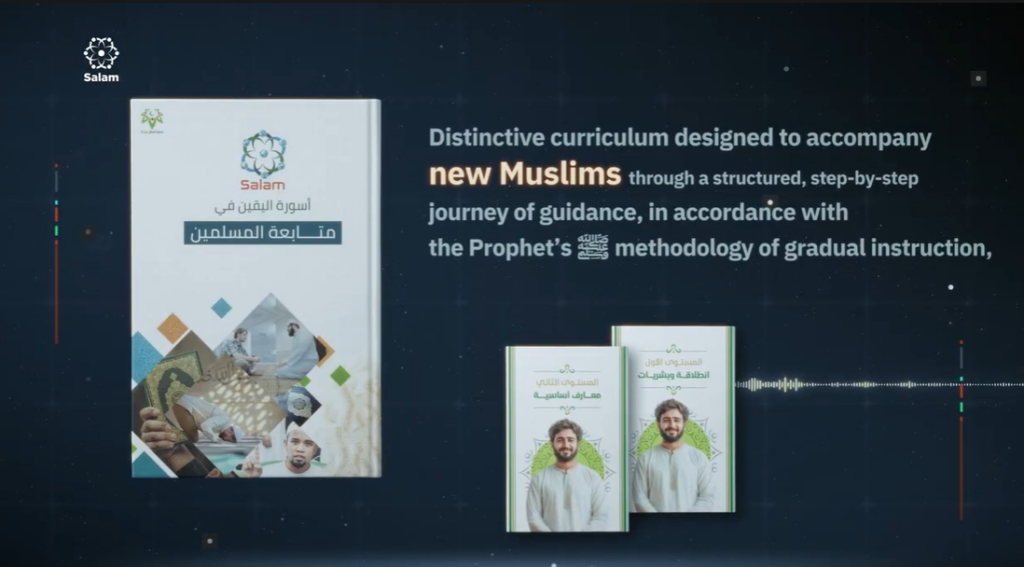
For those who have taken their Shahada and are looking for structured guidance to build their knowledge and practice, the Salam Center runs the Asawirat Al-Yaqeen (Bracelets of Certainty) program — a carefully designed four-stage curriculum for new Muslims:
- Stage One: The Foundations — Shahada, purification, daily prayer, and the pillars of faith
- Stage Two: Essential Construction — Zakat, fasting, Hajj, and the six pillars of Iman
- Stage Three: Consolidation — Tawbah, the Seerah of the Prophet (PBUH), and moral character
- Stage Four: Empowerment — Contemporary issues, Islamic theology, and a life framework rooted in Surah Al-Asr
The program has guided over 114,000 new Muslims across 140 countries. It is structured, compassionate, and built around the understanding that firm faith (Yaqeen) is built step by step — not demanded all at once.
Reach out directly to the Salam Center team to start the Asawirat Al-Yaqeen (Bracelets of Certainty) program for FREE.
Summary
The Quran addresses the intellect directly and repeatedly, presenting the universe as evidence, challenging humanity to reflect on the creation of the heavens and earth, and framing faith as the conclusion of sincere reasoning rather than its abandonment. Islamic scholarship’s Golden Age — from Ibn Sina’s medicine to Ibn Rushd’s philosophy — demonstrates that rigorous inquiry and deep conviction in Allah are not opposing forces.
Every human being also carries within them the Fitrah: an innate, pre-rational recognition of Allah that predates culture, upbringing, and opinion. When reason is exercised honestly, freed from arrogance and desire, it tends to affirm what the Fitrah already knows — that existence has a Necessary Source, that design implies a Designer, and that the universe’s order points toward the One who ordered it.
Frequently Asked Questions
Is free thinking compatible with believing in God?
Free thinking and belief in God are fully compatible. Bertrand Russell himself defined a freethinker as someone whose beliefs are supported by evidence, not bias — a standard belief in Allah can meet. Islam’s Quran repeatedly commands rational reflection as the path to recognizing Allah, making reason a vehicle for faith rather than an obstacle to it.
What does Islam say about using reason and intellect?
Islam strongly commands the use of reason. The Arabic root for intellect — ‘Aql — appears in various forms 49 times across the Quran. Phrases such as “Afala ta’qiloon” (Will you not use your reason?) and “Afala yatafakkaroon” (Will you not reflect?) recur throughout the text, treating intellectual reflection as both a religious duty and an act of worship.
What is the Fitrah in Islam and why does it matter?
The Fitrah is the innate, natural disposition Allah has placed in every human being — a hardwired recognition of the Creator that precedes culture and upbringing. The Prophet Muhammad (PBUH) said: “Every child is born upon the Fitrah, then his parents make him a Jew, a Christian, or a Magian” (Sahih Bukhari). This means belief in Allah is humanity’s original factory setting, not an acquired cultural preference.
Did great rational thinkers in Islamic history believe in God?
Yes. Ibn Sina (Avicenna, 980–1037 CE) and Ibn Rushd (Averroes, 1126–1198 CE) were among the most rigorous intellectual minds in human history — and both were devout Muslims who argued that reason and revelation harmonize rather than conflict. Ibn Rushd’s Fasl al-Maqal explicitly argues that philosophical inquiry is not only permitted in Islam but obligatory for those qualified to engage in it.
Can someone who questions religion still consider Islam?
Absolutely. The Quran itself invites questioning — it presents evidence, challenges the reader to examine it, and calls upon humanity to reflect on the signs within the universe and within themselves. Islam does not demand that inquiry stop at the door; it opens the door wider. The Salam Platform exists precisely for sincere seekers who want answers grounded in evidence rather than tradition alone.
Curious about Islam?
Journey towards clarity and purpose. Our team is here to support you in your search for truth and spiritual guidance.
Embrace the Truth