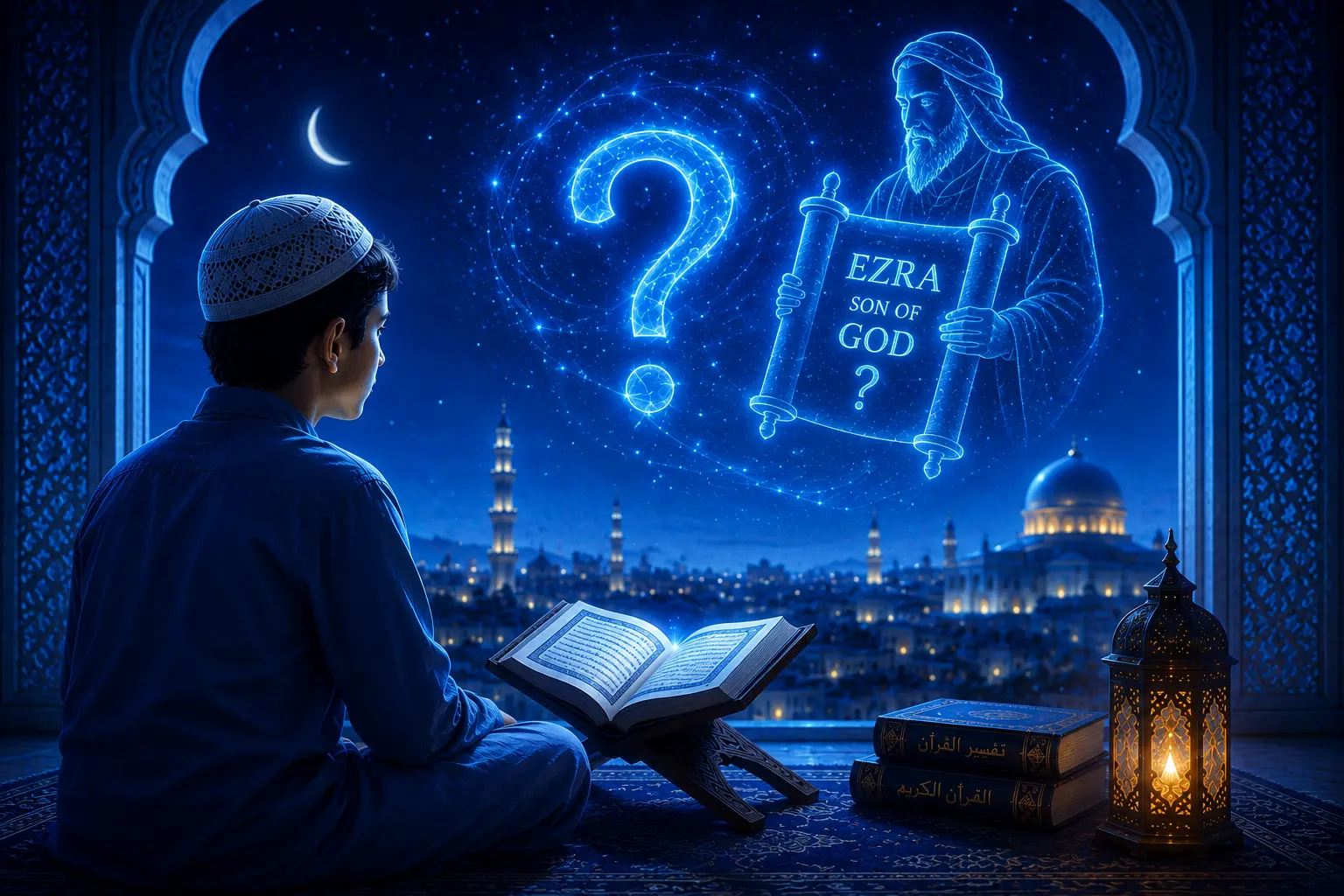
Does the Quran Say Ezra Is the Son of God?
| Key Takeaways |
| The Quran states in Surah At-Tawbah (9:30) that a group among the Jews said Ezra is the son of Allah, and the Quran condemns this statement as false. |
| The Quran does not claim all Jews held this belief; classical tafsir identifies it as the view of a specific sect that exalted Ezra excessively. |
| Ezra, known in Arabic as Uzair, is honored in Islamic tradition as a righteous man, and his story of resurrection appears separately in Surah Al-Baqarah (2:259). |
| The Quran places the Jewish claim about Ezra alongside the Christian claim about Jesus as son of Allah, rejecting both as shirk. |
| Ibn Kathir’s tafsir explains that reverence for Ezra as the reviver of the Torah led some Jewish groups to exaggerated, unwarranted claims about him. |
The Quran does mention that some Jews said Ezra is the son of Allah — but it records this as a false statement it firmly rejects, not as something the Quran itself teaches or endorses.
The verse appears in Surah At-Tawbah, and it places this claim directly beside the Christian claim that the Messiah is the son of Allah, condemning both in the same breath as departures from pure monotheism.
Does the Quran say Ezra is the son of God?
No. The Quran does not teach that Ezra is the son of Allah. It records that some Jews in Medina made this claim, then immediately denies it and condemns it as shirk.
The Quran quotes this belief “Ezra is the son of God” as something certain Jews said; it does not affirm it as true. In Surah At-Tawbah, verse 30, Allah describes a claim made by a portion of the Jewish community regarding Ezra, known in Arabic as Uzair, and immediately follows it with the parallel Christian claim about Jesus.
The verse then delivers Allah’s own judgment on both statements — that they are baseless, borrowed from the disbelief of earlier peoples, and deserving of condemnation.
What Quran 9:30 Actually States
وَقَالَتِ الْيَهُودُ عُزَيْرٌ ابْنُ اللَّهِ وَقَالَتِ النَّصَارَى الْمَسِيحُ ابْنُ اللَّهِ ۖ ذَٰلِكَ قَوْلُهُم بِأَفْوَاهِهِمْ ۖ يُضَاهِئُونَ قَوْلَ الَّذِينَ كَفَرُوا مِن قَبْلُ ۚ قَاتَلَهُمُ اللَّهُ ۚ أَنَّىٰ يُؤْفَكُونَ
“The Jews say, ‘Ezra is the son of Allah’; and the Christians say, ‘The Messiah is the son of Allah.’ That is their statement from their mouths; they imitate the saying of those who disbelieved [before them]. May Allah destroy them; how are they deluded?” (Quran 9:30)
Every phrase in this verse is doing precise theological work. Allah does not say “the Jews believe” as a settled article of faith across the whole community; He says “the Jews say,” a statement Allah frames as coming “from their mouths” — meaning it has no genuine scriptural or revealed basis, only the invention of speech.
The verse then draws a direct parallel to earlier disbelieving nations who exaggerated the status of righteous men and prophets until reverence collapsed into worship.
This same pattern, the Quran teaches, produced two parallel errors: one among a Jewish faction regarding Ezra, and one among Christians regarding Jesus.
What does classical tafsir say about this verse?
Ibn Kathir’s tafsir clarifies that the Quran is describing a specific faction, not the entire Jewish nation. In his commentary on this verse, Ibn Kathir explains that the extreme veneration directed at Ezra for reviving the Torah “misled some of the Jewish sects to make him ‘the son of God,'” while stressing that the Quran does not assert that all Jews were unanimous in this claim.
The point of the verse, in this reading, is that a corruption in correct belief about Allah had progressed far enough among some groups that they crossed into outright shirk.
This reading matters because it protects the verse from being misused as a blanket accusation against an entire faith community — something the Quran itself does not do here.
The Quran is precise: it names a claim, attributes it to those who actually said it, and condemns the claim itself as false, while leaving room, as classical scholarship affirms, for the reality that not every Jew held this view.
Learn More About Islam
Discover the beauty, teachings, and wisdom of Islam in a clear and welcoming way. Start exploring and deepen your understanding today.
Learn MoreWhy does the Quran say Jews believe Ezra is the son of God?
The Quran is documenting a historical claim made by a specific Jewish faction, not asserting that this belief defines Judaism as a whole. The wording in Surah At-Tawbah reflects a real theological drift that occurred among some Jews after the Babylonian exile, when reverence for Ezra’s role in restoring the Torah grew so intense that a portion of the community elevated him beyond his human status.
Ibn Kathir’s tafsir is explicit on this point, noting that this exaggerated devotion “misled some of the Jewish sects” into this claim, while clarifying that the Quran does not present it as a belief held by all Jews.
The Quran’s purpose in recording this is not to indict an entire people; it is to expose a pattern — excessive veneration curdling into shirk — that the very next verse shows repeating itself in a different form among Christians regarding the Messiah.
Who was Ezra, and why did some exalt him?
Ezra was a historical scribe deeply respected for restoring Jewish scripture and law after the Babylonian exile. Classical commentators explain that after the Israelites returned from captivity, much of their knowledge of the Torah, their traditions, and even the Hebrew language had been lost.
Ezra is remembered in this tradition as the man who rewrote and revived that lost law, and his community responded with such intense reverence that, according to the tafsir literature, a segment among them elevated him to divine or quasi-divine status.
This is the specific historical context the Quran is addressing — not a claim that mainstream Judaism as a whole, across all times and places, holds this belief.
How does this connect to the Quran’s story of Ezra’s resurrection?
Surah Al-Baqarah contains a separate account, widely linked by scholars to Ezra, describing a hundred-year death and resurrection as a sign of Allah’s power. This passage in Quran 2:259 is not about the son-of-Allah claim at all; it tells of a man who passed by a ruined town, questioned how Allah could bring it back to life, was made to die for a hundred years, and was then resurrected with his food and drink miraculously preserved.
Many classical commentators, including Ibn Kathir, identify this man with Uzair.
Read together, the two passages form a striking contrast: one verse rebukes a false exaltation of Ezra, and the other, in a completely different context, shows Allah honoring him with a personal sign of resurrection, precisely so that reverence for him would never eclipse worship due to Allah alone.
Read Also: What Does the Quran Say About Marrying a Non-Muslim?
Why does the Quran group the Jewish and Christian claims together?
The Quran treats both claims as expressions of the same underlying error: attributing a son to Allah. Immediately after naming the Ezra claim and the Messiah claim, the following verse addresses a further pattern — taking religious leaders as lords besides Allah.
وَاتَّخَذُوا أَحْبَارَهُمْ وَرُهْبَانَهُمْ أَرْبَابًا مِّن دُونِ اللَّهِ وَالْمَسِيحَ ابْنَ مَرْيَمَ وَمَا أُمِرُوا إِلَّا لِيَعْبُدُوا إِلَٰهًا وَاحِدًا ۖ لَّا إِلَٰهَ إِلَّا هُوَ ۚ سُبْحَانَهُ عَمَّا يُشْرِكُونَ
“They have taken their scholars and monks as lords besides Allah, and [also] the Messiah, the son of Mary. And they were not commanded except to worship one God; there is no deity except Him. Exalted is He above whatever they associate with Him.” (Quran 9:31)
This sequencing is deliberate. The Quran is not singling out one community for special criticism; it is describing a recurring human tendency — the elevation of a revered figure, whether a prophet, a scribe, or a religious authority, to a status that belongs to Allah alone.
The same critique that applies to the Ezra claim applies equally to the Christian doctrine of divine sonship, and the Quran addresses how Islam views other religions through this same consistent lens of protecting Tawheed.
Read Also: Does the Quran Say to Go to the People of the Book?
The Quran consistently rejects every claim that Allah has a son
The rejection of Ezra’s alleged divinity fits within a broader Quranic message that spans many chapters.
Whether the claim concerns Jesus, angels, righteous people, or anyone else, the principle never changes. Allah alone deserves worship, and no created being shares His divinity.
Allah says:
مَا كَانَ لِلَّهِ أَن يَتَّخِذَ مِن وَلَدٍ
“It is not for Allah to take a son.” (Quran 19:35)
Similarly, Allah says:
وَمَا يَنبَغِي لِلرَّحْمَٰنِ أَن يَتَّخِذَ وَلَدًا
“And it is not appropriate for the Most Merciful that He should take a son.” (Quran 19:92)
These verses establish a universal theological principle rather than addressing only one religious community. Every claim that grants divine status to a human being contradicts the central message of all the Prophets: worship Allah alone.
Read Also: Does the Quran Say to Follow the Bible?
Learn More About Islam
Discover the beauty, teachings, and wisdom of Islam in a clear and welcoming way. Start exploring and deepen your understanding today.
Learn MoreRead Also: What Does the Quran Say About Polygamy?
Learn More Authentic Knowledge About Islam & Quran with Salam
If verses like this one raise more questions than they answer on their own, that is completely natural. Understanding the Quran’s engagement with other faith traditions takes context, and the Salam Center has built exactly that kind of guided path.
- Explore more articles on the Salam Platform covering Quranic beliefs, the nature of Allah, and comparative faith questions
- Read further reflections and explainers on the Salam blog
If you are considering Islam, or simply want to ask a specific question about a verse or belief, reach out directly — no question is too basic or too skeptical

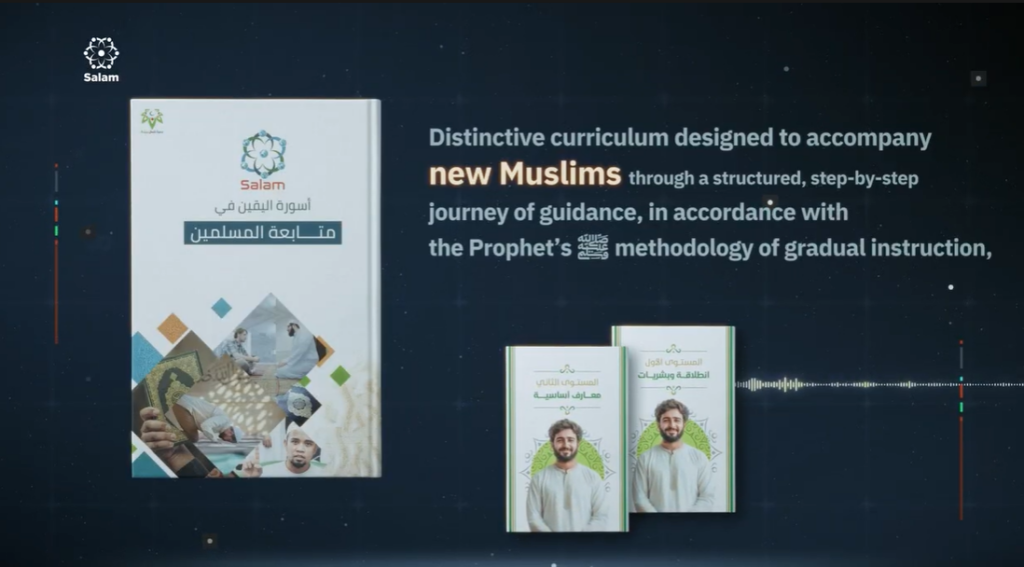
New Muslims can join Asawirat Al-Yaqeen (Bracelets of Certainty), a structured four-stage program covering:
- Foundational beliefs, the Shahada, and practical worship in Stage One
- Repentance and the life of Prophet Muhammad (PBUH) in Stage Two
- Moral and practical life guidance in Stage Three
- Contemporary questions, comparative theology, and a life roadmap in Stage Four
Reach out directly to the Salam Center team to start the Asawirat Al-Yaqeen (Bracelets of Certainty) program for FREE.
Summary
The Quran names a claim made by some Jews about Ezra and a parallel claim by Christians about Jesus, then firmly rejects both as shirk. Classical tafsir, including Ibn Kathir’s, clarifies this describes a specific sect, not universal Jewish belief.
Ezra’s honored status appears separately in Surah Al-Baqarah through his resurrection, showing reverence for him without crossing into worship. The verse ultimately anchors Islam’s core teaching that Allah alone deserves worship, without partner or offspring.
Frequently Asked Questions
Does the Quran say all Jews believe Ezra is the son of God?
No. The Quran attributes this claim to a specific group among the Jews, not to the entire community, as confirmed by Ibn Kathir’s tafsir on Quran 9:30, which notes the verse addresses a particular misled faction rather than universal Jewish doctrine.
What does “Uzair” mean, and is it the same as Ezra?
Uzair is the Arabic name used in the Quran, and classical commentators identify him with the biblical Ezra, the scribe who restored Jewish scripture and law after the Babylonian exile, as referenced in Surah At-Tawbah 9:30.
Why does the Quran mention both Jewish and Christian claims about sonship together?
The Quran groups both claims because they represent the same theological error: attributing a son to Allah, which the Quran condemns as shirk in Quran 9:30 and 9:31, regardless of which community makes the claim.
Is Ezra mentioned anywhere else in the Quran besides this verse?
Yes, many commentators, including Ibn Kathir, identify Ezra with the man resurrected after a hundred years in Quran 2:259, a separate passage demonstrating Allah’s power over life and death.
What is shirk, and why is this claim considered shirk?
Shirk is associating any partner or equal with Allah, and claiming Allah has a son violates the core belief in His absolute oneness, a principle central to Tawheed and explained further in Islamic teachings on monotheism.
Curious about Islam?
Journey towards clarity and purpose. Our team is here to support you in your search for truth and spiritual guidance.
Embrace the Truth