
What Does the Quran Say About Jihad?
The Quran uses the word jihad in three main senses: striving through speech and argument, striving through wealth and life in armed struggle, and striving through righteous deeds and self-discipline. Jihad appears 41 times in the Quran — 27 as a verb form and 14 as a noun — most frequently in Medinan surahs revealed after the Muslim community gained a state and an army.
The linguistic root of jihad (ج-ه-د) denotes exertion and hardship, not killing — the same root produces ijtihad, the scholarly effort to derive legal rulings.
What Does The Quran Say About Jihad?
The Quran presents jihad as struggle and exertion in the path of Allah, and it takes three distinct forms across the text: intellectual and verbal struggle, armed struggle, and the struggle of righteous living. This is the starting point for understanding a term that Western media often flattens into a single meaning.
The Linguistic Root of Jihad Means Exertion, Not Violence
Jihad comes from the Arabic root ج-ه-د (jahada), which means to exert effort under hardship — the same root that gives Arabic the word juhd (capacity), jahd (hardship), and ijtihad (independent legal reasoning).
Classical lexicographers describe al-mujhud as milk that has had its cream extracted — something obtained only through exertion.
Al-jihad, in bare linguistic terms, also described hard, compacted ground. Ibn Manzur’s Lisan al-Arab, the foundational dictionary of classical Arabic, defines the root around the idea of drawing out one’s full capacity, whether in physical effort, in argument, or in worship.
A scholar who exercises ijtihad — deriving a ruling from evidence — draws from the very same root as a soldier undertaking jihad. Both are described as exhausting their utmost capacity.
The word jihad itself is a masdar (verbal noun) on the pattern fi’al, a pattern that grammatically implies mutual engagement between two parties, unlike the simpler verb jahada which implies a single actor. This is a meaningful distinction: jihad, in its very grammatical shape, describes a contest or exchange, not a unilateral act.
That grammatical detail matters because it shows the Quran encodes reciprocity into the term from its root structure — jihad against something, not simply exertion in isolation.
How Many Times Jihad Appears in the Quran?
The word jihad and its derivatives occur 41 times in the Quran, 27 times as a verb and 14 times as a noun, concentrated overwhelmingly in the Medinan surahs revealed after the Muslim community had a state to defend. This distribution is itself instructive. Meccan surahs — revealed while Muslims were a persecuted minority with no political authority — contain almost none of the armed-struggle verses.
The pattern shifts only after the Prophet Muhammad’s (PBUH) migration to Medina and the establishment of a Muslim polity capable of self-defense.
First: jihad by speech and argument
Allah says in Surah Al-Furqan:
فَلَا تُطِعِ الْكَافِرِينَ وَجَاهِدْهُم بِهِ جِهَادًا كَبِيرًا
“So do not obey the disbelievers, and strive against them with the Qur’an, a great striving.” (Quran 25:52)
Al-Tabari explained this verse as striving against disbelievers through the Quran itself — with argument and proof — until they submit to what it establishes as obligatory upon them.
Many exegetes classify this as the jihad of evidence and proof (jihad al-hujjah wa’l-burhan), and note that it precedes and outranks the jihad of the sword.
Second: jihad by wealth and life — armed struggle
Surah An-Nisa states:
لَّا يَسْتَوِي الْقَاعِدُونَ مِنَ الْمُؤْمِنِينَ غَيْرُ أُولِي الضَّرَرِ وَالْمُجَاهِدُونَ فِي سَبِيلِ اللَّهِ بِأَمْوَالِهِمْ وَأَنفُسِهِمْ ۚ فَضَّلَ اللَّهُ الْمُجَاهِدِينَ بِأَمْوَالِهِمْ وَأَنفُسِهِمْ عَلَى الْقَاعِدِينَ دَرَجَةً
“Not equal are those believers remaining [at home] — other than the disabled — and the mujahideen, [who strive and fight] in the cause of Allah with their wealth and their lives. Allah has preferred the mujahideen through their wealth and their lives over those who remain [behind], by degrees.” (Quran 4:95)
The explicit phrase “with their wealth and their lives” ties this instance directly to the battlefield rather than to a metaphorical struggle.
This is the sense in which jihad occurs most frequently across the Quran, and it is this sense — combat undertaken by the Muslim community against an armed enemy — that classical fiqh regulated in careful detail, which the next section addresses directly.
Third: jihad by righteous deeds and self-discipline
Surah Al-‘Ankabut states:
“And whoever strives only strives for [the benefit of] himself.” (Quran 29:6)
Ibn Kathir compared this to the parallel verse in Surah Fussilat — whoever does righteous deeds does so for his own benefit, since Allah has no need of His servants’ actions.
A related verse in the same surah promises:
وَالَّذِينَ جَاهَدُوا فِينَا لَنَهْدِيَنَّهُمْ سُبُلَنَا — “And those who strive for Us — We will surely guide them to Our ways.” (Quran 29:69).
Al-Shawkani read “striving in Allah’s affair” here as seeking His pleasure and the good that lies with Him — the daily jihad of discipline, patience, and sincerity that every believer undertakes regardless of whether armed conflict is ever present in their life.
Read Also: What Does the Quran Say About Love and Relationships?
Learn More About Islam
Discover the beauty, teachings, and wisdom of Islam in a clear and welcoming way. Start exploring and deepen your understanding today.
Learn MoreRead Also: What Does the Quran Say About Killing in Self-Defense?
Is Jihad in the Quran Only About War?
No — the majority of the Quran’s usages of jihad relate to intellectual, verbal, and spiritual struggle, and even where jihad refers to armed conflict, the Quran ties it to specific conditions rather than open-ended violence. The confusion largely comes from translating jihad simply as “holy war,” a phrase that has no equivalent origin in Islamic scholarship.
Two related verses illustrate how broad the Quran’s use of the ja-ha-da root actually is, beyond the three primary senses above.
Surah At-Tawbah describes those with limited means:
وَالَّذِينَ لَا يَجِدُونَ إِلَّا جُهْدَهُمْ — “and [criticize] the ones who find nothing [to spend] except their effort,” (Quran 9:79),
referring to sincere believers who could only offer their physical exertion in charity, not their wealth.
Surah Al-An’am uses the same root for solemn oaths: وَأَقْسَمُوا بِاللَّهِ جَهْدَ أَيْمَانِهِمْ — “And they swear by Allah their strongest oaths” (Quran 6:109)
— describing people who exerted their utmost sincerity in an oath, with no relation to combat whatsoever.
These usages confirm that at the linguistic level, the Quran’s jihad vocabulary is about maximal effort in any righteous direction, not a fixed reference to warfare.
Read Also: How Does the Quran Say Muhammad Died?
Why Doesn’t Islam Attach Modifiers to the Word Jihad?
Jihad is a purely Islamic technical term with no precedent in pre-Islamic Arabic poetry or speech, and classical usage never attaches qualifiers to it — there is no “Islamic jihad” as distinct from some other jihad, no “lawful jihad” as distinct from an unlawful one, only jihad, defined by its own fixed conditions.
This matters for two reasons.
First, it means jihad should never be conflated with the general Arabic words for combat (qital) or war (harb), nor with the Western concept of “holy war,” a phrase that emerged from a different theological and historical context entirely and carries none of jihad’s legal precision.
Second, it means that any modern usage that modifies the term — “jihadist,” “jihadi terrorism,” treated as though these describe variations within a spectrum called jihad — is working with vocabulary the classical tradition itself does not recognize.
Jihad, in Ahlus Sunnah scholarship, is a fixed and bounded legal category, not an adjustable label anyone can attach to any act of violence they wish to justify.
Read Also: What Does the Quran Say About Greed?
Learn More About Islam
Discover the beauty, teachings, and wisdom of Islam in a clear and welcoming way. Start exploring and deepen your understanding today.
Learn MoreRead Also: Does the Quran Say How to Pray?
Discover More About Faith, Certainty, and the Journey to Islam
If these questions have opened up more than they answered, that’s the natural next step in a sincere search. The Salam Center team built this platform for exactly that kind of question.
Explore more on the Salam Platform or browse the Salam blog for related topics on Quranic teachings and Islamic belief
If you’re considering entering Islam or want to talk through your questions with someone directly, reach out directly — no pressure, just conversation
Reach out directly — our team is ready to listen, guide, and welcome you.

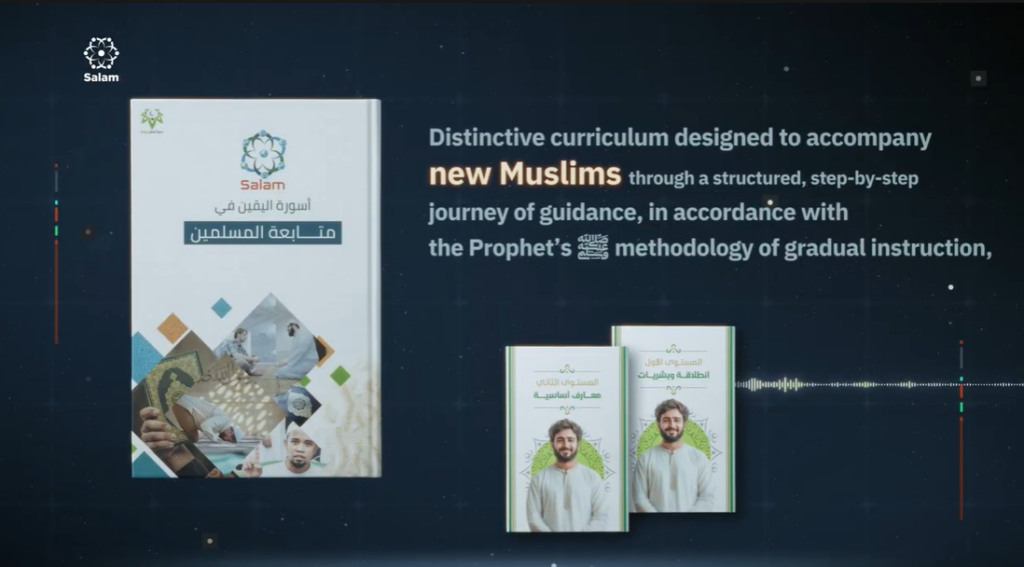
New Muslims are welcomed into Asawirat Al-Yaqeen (Bracelets of Certainty), a structured four-stage learning path:
- Stage One lays the foundation: the Shahada, prayer, and the core pillars
- Stage Two builds through the Prophet’s biography and the practice of repentance
- Stage Three consolidates character, etiquette, and daily life rulings
- Stage Four empowers you to engage confidently with contemporary questions
Reach out directly to the Salam Center team to start the Asawirat Al-Yaqeen (Bracelets of Certainty) program for FREE.
Summary
The Quran’s use of jihad spans intellectual argument, armed defense, and personal righteousness, with the majority of its 41 occurrences carrying meanings well beyond warfare. Classical fiqh regulated armed jihad carefully, distinguishing defensive obligation from a communal duty bound to legitimate state authority.
Understanding jihad on its own terms — through the Quran’s language and the scholarship of Ahlus Sunnah wal Jama’ah — replaces confusion with clarity. Sincere seekers are invited to keep exploring these foundations at their own pace, one honest question at a time.
Frequently Asked Questions
What is the difference between jihad and qital in Islam?
Jihad means striving or exertion in any righteous cause — verbal, spiritual, or physical. Qital specifically means armed fighting. Qital is one possible expression of jihad, but jihad is the broader term, covering argument, charity, self-discipline, and worship as well.
Can an individual Muslim declare jihad on their own?
No. Classical Sunni fiqh treats offensive jihad (jihad al-talab) as a communal duty requiring authorization from a legitimate Muslim ruler. No individual or private group has the authority to declare it independently under any of the four Sunni schools.
Is jihad the same as “holy war”?
No. “Holy war” is a Western historical term with no direct Islamic equivalent. Jihad is a distinct Arabic legal and spiritual concept governed by its own Quranic and juristic conditions, and Ahlus Sunnah scholarship never merges it with that separate category.
Curious about Islam?
Journey towards clarity and purpose. Our team is here to support you in your search for truth and spiritual guidance.
Embrace the Truth