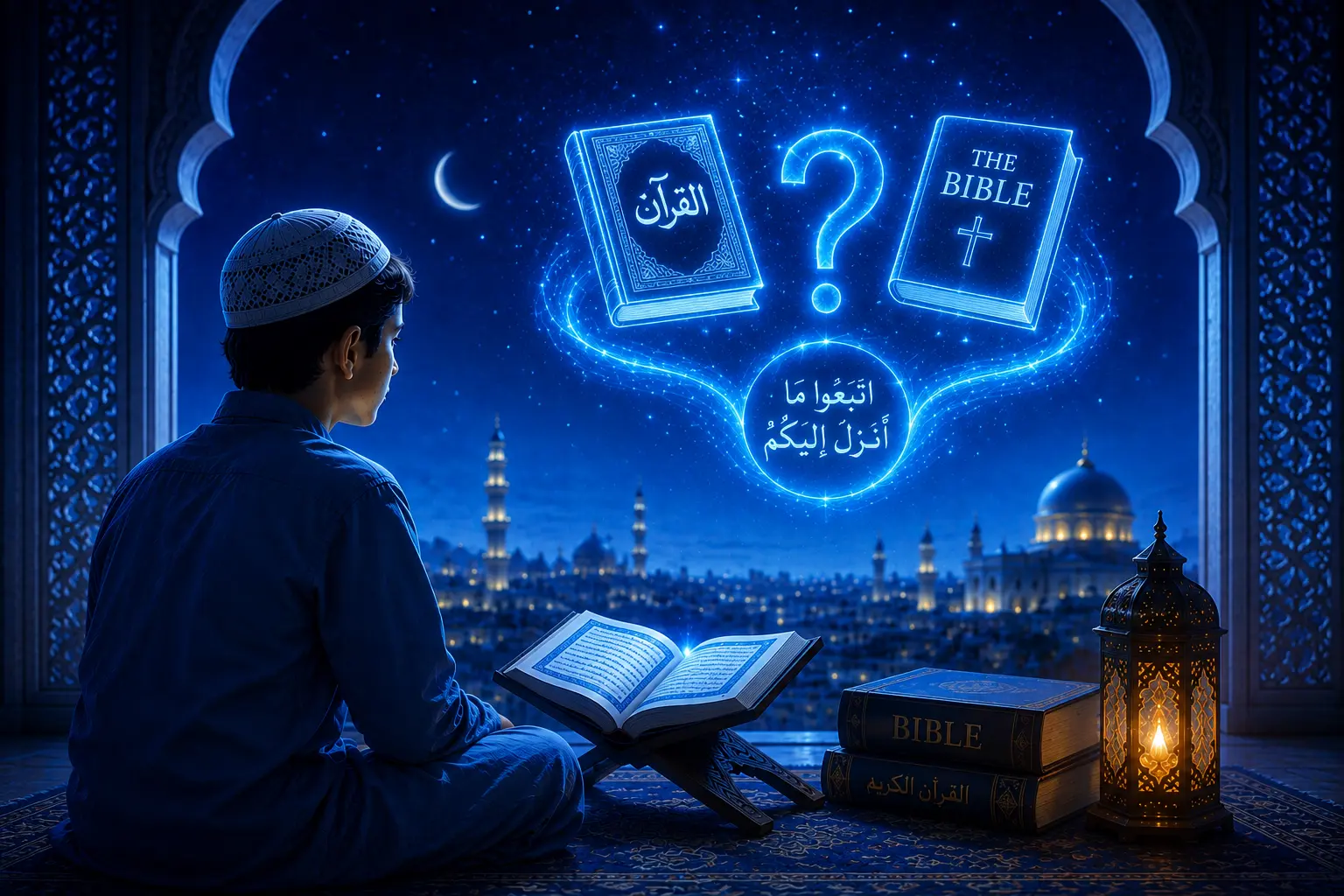
Does the Quran Say to Follow the Bible?
The Quran confirms that Allah originally revealed the Torah and the Gospel as authentic guidance before the Quran was sent down. The Quran instructs the People of the Gospel to judge by what Allah revealed to them in the original Gospel, but it does not command Muslims to follow the Bible as their scripture.
The Quran serves as a criterion (Al-Furqan) that judges and corrects what came before it. Prophet Muhammad (PBUH) instructed Muslims to neither blindly believe nor blindly reject what the People of the Book relate, per Sahih al-Bukhari.
Does the Quran Say to Follow the Bible?
No, the Quran does not instruct Muslims to follow the Bible as their source of law or worship. The Quran commands the original followers of Musa (Moses) and Isa (Jesus) to judge by what Allah originally revealed to them in their own time, while establishing itself as the final criterion that confirms, completes, and corrects the scriptures that came before it.
This distinction matters because it separates two different commands aimed at two different audiences. Allah addresses the People of the Gospel directly in Surah Al-Ma’idah, telling them to govern their affairs by what was genuinely revealed to them:
وَلْيَحْكُمْ أَهْلُ الْإِنجِيلِ بِمَا أَنزَلَ اللَّهُ فِيهِ
“And let the People of the Gospel judge by what Allah has revealed therein.” (Quran 5:47)
That command was directed at the followers of the Gospel regarding their own scripture at the time it was pure. It was never extended to Muslims as an instruction to adopt the Bible as it exists today.
In the very next verse, Allah tells Prophet Muhammad (PBUH) something entirely different about the Quran’s own role:
وَأَنزَلْنَا إِلَيْكَ الْكِتَابَ بِالْحَقِّ مُصَدِّقًا لِّمَا بَيْنَ يَدَيْهِ مِنَ الْكِتَابِ وَمُهَيْمِنًا عَلَيْهِ
“And We have revealed to you the Book in truth, confirming that which preceded it of the Scripture and as a criterion over it.” (Quran 5:48)
The word used here, muhaymin, means guardian, protector, and criterion. Allah does not place the Quran under the authority of the Bible; Allah places the Quran as the authority over the Bible. This single verse resolves the entire question.
A companion piece that Muslims must understand about what do Muslims believe about the Quran is precisely this role as final judge and preserver of divine truth.
The Quran Confirms the Original Torah and Gospel Came From Allah
Islam does not dismiss the Bible as fabricated from the outset. Muslims believe Allah genuinely revealed the Tawrat (Torah) to Musa and the Injeel (Gospel) to Isa, and this belief is a core part of faith in Islam itself.
نَزَّلَ عَلَيْكَ الْكِتَابَ بِالْحَقِّ مُصَدِّقًا لِّمَا بَيْنَ يَدَيْهِ وَأَنزَلَ التَّوْرَاةَ وَالْإِنجِيلَ
“He has sent down upon you, [O Muhammad], the Book in truth, confirming what was before it. And He revealed the Torah and the Gospel.” (Quran 3:3)
This verse confirms the divine origin of the original revelations. It does not confirm the current text of the Bible circulating today as an unaltered record of what Allah sent down.
Believing in a prophet’s original message and accepting a later, edited manuscript as equally authoritative are two separate matters entirely.
Why Don’t Muslims Treat the Present-Day Bible as Binding Scripture?
Islamic theology draws a sharp line between the divine revelation given to Musa and Isa and the compiled texts assembled generations later by different hands. The Quran itself describes human tampering with earlier scripture, which is central to understanding what does the Quran say about other religions.
فَوَيْلٌ لِّلَّذِينَ يَكْتُبُونَ الْكِتَابَ بِأَيْدِيهِمْ ثُمَّ يَقُولُونَ هَٰذَا مِنْ عِندِ اللَّهِ لِيَشْتَرُوا بِهِ ثَمَنًا قَلِيلًا
“So woe to those who write the Scripture with their own hands, and then say, ‘This is from Allah,’ in order to exchange it for a small price.” (Quran 2:79)
This is a direct, explicit warning against attributing human writing to divine revelation for worldly gain.
It is one of the clearest evidentiary bases in the Quran for why Muslims cannot treat every line of the current Bible as literally the unaltered word of Allah, even while respecting the genuine prophetic origin of the Torah and Gospel.
Learn More About Islam
Discover the beauty, teachings, and wisdom of Islam in a clear and welcoming way. Start exploring and deepen your understanding today.
Learn MoreAllah Positions the Quran as the Final Criterion Over Earlier Scriptures
Every religious tradition needs a standard by which conflicting claims are measured. In Islam, that standard is the Quran itself, described as Al-Furqan — the Criterion — in the very same passage that discusses the Torah and Gospel.
وَأَنزَلَ التَّوْرَاةَ وَالْإِنجِيلَ مِن قَبْلُ هُدًى لِّلنَّاسِ وَأَنزَلَ الْفُرْقَانَ
“And He revealed the Torah and the Gospel. (3) Before, as guidance for the people. And He revealed the Criterion (i.e., the Qur’an).” (Quran 3:3–4)
وَأَنزَلْنَا إِلَيْكَ الْكِتَابَ بِالْحَقِّ مُصَدِّقًا لِّمَا بَيْنَ يَدَيْهِ مِنَ الْكِتَابِ وَمُهَيْمِنًا عَلَيْهِ
“And We have revealed to you the Book in truth, confirming that which preceded it of the Scripture and as a criterion over it.” (Quran 5:48)
This structure matters. Allah reveals the earlier scriptures as guidance for their own era, and then reveals the Quran as the standard against which later disputes and discrepancies are judged. A criterion does not submit to what it evaluates; it evaluates what came before it.
This is why Islamic scholarship, understood through how does Islam view other religions, holds the Quran and not the Bible as the final legislative authority for Muslims.
Allah reinforces this preservation exclusively for the Quran in Surah Al-Hijr:
إِنَّا نَحْنُ نَزَّلْنَا الذِّكْرَ وَإِنَّا لَهُ لَحَافِظُونَ
“Indeed, it is We who sent down the Qur’an and indeed, We will be its guardian.” (Quran 15:9)
No equivalent divine guarantee of textual preservation is made in the Quran regarding the Bible’s transmission across the centuries.
This is a meaningful distinction rooted in why do Muslims believe in the Quran as the sole scripture preserved letter-for-letter since its revelation.
Read Also: What Does the Quran Say About Marrying a Non-Muslim?
Prophet Muhammad Instructed Muslims to Neither Blindly Accept Nor Reject the People of the Book
The Prophetic guidance on this matter is precise and balanced, avoiding both extremes of blind acceptance and blanket dismissal. This teaching comes from an authenticated hadith recorded by Imam al-Bukhari in his collection Sahih al-Bukhari, considered by Ahlus Sunnah wal Jama’ah to be the most rigorously verified book of hadith after the Quran.
Abu Huraira narrated that the People of the Book used to read the Torah in Hebrew and explain it in Arabic to the Muslims, prompting the Prophet (PBUH) to say:
“Do not believe the people of the Book, nor disbelieve them, but say, ‘We believe in Allah and whatever is revealed to us, and whatever is revealed to you.'” (Sahih al-Bukhari 7362)
This hadith appears in a chapter explicitly titled “Do not ask the People of the Scripture about anything,” underscoring the caution Islamic scholarship places on treating existing biblical text as a reliable independent source of religious law.
Muslims are instructed to evaluate what the People of the Book relate rather than accept it uncritically, a principle that also shapes how Islam approaches comparative religion more broadly, including discussions found in Islam vs. Christianity and Islam vs. Judaism.
Read Also: Does the Quran Say to Go to the People of the Book?
How Does This Fit Within the Broader Islamic View of Monotheism and Prior Scriptures?
The relationship between the Quran and earlier scriptures reflects Islam’s foundational commitment to strict monotheism. Every scripture Allah sent, from the Torah to the Gospel to the Quran, carried the same essential call: worship Allah alone without partners, a principle detailed further under Monotheism and contrasted against Polytheism.
Respected historical review of the manuscript tradition, including scholarship discussed in the history of the Quran, shows that the Quran was memorized and transcribed within the Prophet’s own lifetime and cross-verified by thousands of companions, a process distinct from how the biblical canon was compiled over centuries by councils long after Isa’s era.
This is also why the Quran’s own account of the Night Journey and other Prophetic events carries scholarly weight within Islam that later, redacted texts do not carry to the same degree.
Islam’s confidence on this point is not a matter of dismissing intellect for blind tradition. It sits comfortably alongside the observation that serious minds across history, including a number of Nobel scientists who believe in God and other scientists who believe in God, have found no contradiction between rigorous inquiry and belief in a single, preserved revelation.
Read Also: Does the Quran Say Ezra Is the Son of God?
Learn More About Islam
Discover the beauty, teachings, and wisdom of Islam in a clear and welcoming way. Start exploring and deepen your understanding today.
Learn MoreRead Also: What Does the Quran Say About Polygamy?
Learn More Authentic Knowledge About Islam & Quran with Salam
If this question opened a door, there is a great deal more waiting on the other side of it.
- Read more reflections and answers on the Salam blog
- Explore the foundational Islam principles that shape everything discussed here
- Curious about entering Islam or simply want to talk it through? Reach out directly — no pressure, just an honest conversation

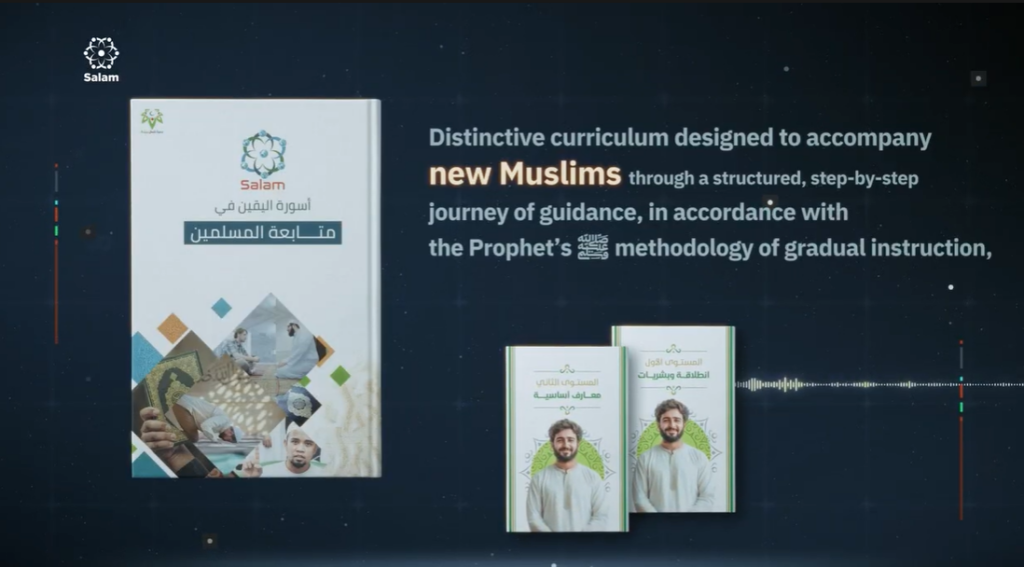
Already taken your Shahada? The Salam Center team built the Asawirat Al-Yaqeen (Bracelets of Certainty) program specifically for you:
- A structured four-stage journey from foundational worship to advanced theological grounding
- Personal guidance through prayer, fasting, the Seerah of the Prophet (PBUH), and daily Islamic living
- A supportive community walking the same path, with lessons paced for real, lasting understanding
Have a specific question about faith, practice, or history? The Salam Center welcomes it — send it our way anytime
Reach out directly to the Salam Center team to start the Asawirat Al-Yaqeen (Bracelets of Certainty) program for FREE.
Summary
The Quran instructs the original People of the Gospel to judge by their own revealed scripture, never commanding Muslims to adopt the Bible as legislative authority. Instead, the Quran positions itself as Al-Furqan, the guarded criterion confirming and correcting everything revealed before it.
Genuine respect for Musa and Isa remains central to Islamic belief, even as Muslims rely solely on the Quran and Sunnah for law and worship. This balance offers seekers a coherent, historically grounded path toward lasting Yaqeen.
Frequently Asked Questions
Does Islam consider the Bible a holy book?
Islam considers the original Torah and Gospel as genuine revelations from Allah to Musa and Isa. Muslims believe the present text has undergone human alteration, so the Quran alone serves as the preserved, binding scripture referenced in Quran 15:9.
Why don’t Muslims follow the Bible if it came from Allah?
Muslims honor the Bible’s prophetic origin but follow the Quran because Allah describes it as muhaymin, a guardian and criterion over earlier scripture, in Quran 5:48. The Quran alone carries Allah’s explicit guarantee of preservation.
Is the Bible mentioned by name in the Quran?
The Quran references the Tawrat (Torah) and Injeel (Gospel) by name, not “the Bible” as a single bound volume, since that compilation came later. Quran 3:3 confirms Allah revealed both as authentic guidance before the Quran.
Curious about Islam?
Journey towards clarity and purpose. Our team is here to support you in your search for truth and spiritual guidance.
Embrace the Truth