
Does the Quran Say the Universe Is Expanding?
Surah Adh-Dhariyat, verse 47, states that Allah built the heaven with might and is its musi’un — its expander. Classical scholars, including those recorded by Ibn Kathir, read musi’un as a statement of Allah’s vast power and provision. Some contemporary scholars and writers connect this verse to the 20th-century discovery of cosmic expansion.
The verse’s active participle form indicates continuous, ongoing action rather than a single completed event. Muslims hold the Quran’s cosmological statements as revelation from Allah, independent of whether later science appears to align with them.
Does the Quran say the universe is expanding?
Yes, a verse in the Quran describes heaven as continuously expanding. Surah Adh-Dhariyat 51:47 states that Allah built the heaven with strength and that He is musi’un — an active participle meaning “the One who expands” or “the One who is expanding it.”
Classical commentators read this primarily as a declaration of Allah’s power and generous provision.
In the modern period, following the scientific discovery that galaxies are moving apart from one another, some Muslim writers have pointed to this verse as an early textual statement that anticipates that finding.
What follows lays out the verse itself, how it has been understood across Islamic scholarship, and how Muslims frame the relationship between revelation and scientific discovery.
What does Surah Adh-Dhariyat 51:47actually say?
The verse reads: “And the heaven We constructed with strength, and indeed, We are [its] expander.” This is Surah Adh-Dhariyat, ayah 47 — the 51st chapter of the Quran, named “The Winnowing Winds.”
وَالسَّمَاءَ بَنَيْنَاهَا بِأَيْدٍ وَإِنَّا لَمُوسِعُونَ
“And it is We who constructed the heaven with strength, and indeed, We are [its] expander.” (Quran 51:47)
The verse appears in a passage that moves through several proofs of Allah’s power — the destruction of past nations, the vastness of the heaven, the spreading of the earth, and the pairing of all created things — each one offered as a sign pointing toward the reality of resurrection and the Hereafter.
The word rendered “expander,” musi’un, comes from the root w-s-‘, meaning to make wide, spacious, or capacious.
Its grammatical form is an active participle, which in Arabic typically signals an action that is ongoing rather than finished in the past.
How is the word “musi’un” built, and why does the grammar matter?
Arabic active participles (ism al-fa’il) generally describe a doer engaged in an action, and depending on context they can carry a durative sense — an action happening now and continuing. Applied to musi’un, the grammatical form supports reading the verse as describing continuous expansion rather than a single past act of construction that has since stopped.
This is part of why the verse draws attention in discussions of cosmology: the text does not simply say “We made the heaven vast,” using a completed past-tense verb. It uses a present, ongoing form.
What did classical scholars say this verse means?
Classical commentators overwhelmingly understood musi’un as a statement about Allah’s capacity, power, and generous provision — not as a cosmological claim in the modern scientific sense. This is the essential starting point for reading the verse honestly.
The tafsir compiled from early authorities — including the exegetical reports attributed to companions and early scholars such as Ibn Abbas, Mujahid, Qatadah, and al-Thawri, as preserved in the tafsir of Ibn Kathir — explains “with strength” (bi-aydin) as referring to Allah’s power in construction, and musi’un as Allah’s ability to extend and enrich what He created, or His vastness of provision.
This reading treats the verse as an argument for Allah’s omnipotence, situated within the surah’s larger case for the resurrection: if Allah built the heaven and can expand it further, how could He be unable to recreate what already exists?
Did any early scholar link this verse to physical expansion of the cosmos?
Some later exegetes, working after the classical period, did explore a physical reading of musi’un alongside the power-and-provision reading, noting that the word can also carry the sense of extending or enlarging something in a literal, spatial way.
This secondary sense existed in the semantic range of the word long before modern astronomy, even though it was not the primary emphasis in the earliest generation of commentary.
It’s this latent meaning within the word’s root — extension, breadth, capaciousness — that later writers draw on when connecting the verse to the scientific finding of cosmic expansion.
Learn More About Islam
Discover the beauty, teachings, and wisdom of Islam in a clear and welcoming way. Start exploring and deepen your understanding today.
Learn MoreHow does this verse relate to the modern discovery of cosmic expansion?
In 1929, astronomer Edwin Hubble published observations showing that distant galaxies are moving away from Earth, and that the farther a galaxy is, the faster it appears to be receding — a finding that became foundational evidence for an expanding universe. This observation, later developed into the standard cosmological model, established that the universe is not static but has been growing in scale since its earliest moments.
Some contemporary Muslim writers and scholars have noted the resemblance between this finding and the wording of 51:47, arguing that a text revealed in the seventh century describing the heaven with an ongoing, active sense of expansion sits comfortably alongside a scientific conclusion reached over a thousand years later.
This argument is typically presented as one example within a broader category sometimes called “scientific signs” (al-i’jaz al-‘ilmi) in the Quran — instances where verses are read as anticipating findings later confirmed by empirical science.
It is important to state plainly that this is an area of scholarly discussion rather than unanimous consensus. Muslims are not required to accept every proposed scientific correspondence to affirm the Quran’s truth; the Quran’s authority as revelation does not depend on matching contemporary science verse by verse.
Where a genuine correspondence exists, Muslims see it as a reminder of Allah’s knowledge encompassing all things — not as a reason the Quran needed later confirmation to be true.
Is the “expanding universe” verse considered a scientific miracle?
Many contemporary scholars and writers within the i’jaz ‘ilmi tradition include 51:47 among a set of verses discussed as scientific signs, though this categorization is not treated as binding doctrine and reasonable differences exist among scholars about how far such correspondences should be pressed.
The stronger and more universally held position remains the verse’s primary theological function: establishing Allah’s power over creation as an argument for the resurrection.
What else does the Quran say about the structure of the heavens?
The Quran addresses cosmological themes in more than one place, and 51:47 fits within a wider set of verses touching on the origin and nature of the created universe.
Surah Al-Anbya 21:30 speaks of the heavens and the earth having been a joined mass before being separated, a verse frequently discussed alongside 51:47 in conversations about Quranic cosmology.
Surah Al-An’am opens by describing Allah as the one who originated the heavens and the earth, a foundational statement about Islam’s principles regarding creation and Allah’s exclusive role as Creator.
| Verse | Core Statement | Common Classical Reading |
| Quran 51:47 | Allah built the heaven and is its expander | Divine power and provision; argument for resurrection |
| Quran 21:30 | The heavens and earth were a joined mass, then separated | Sign of Allah’s creative power |
| Quran 6:101 | Allah is the Originator of the heavens and the earth | Foundation of Allah’s exclusive role as Creator |
This pattern — cosmological statements folded into arguments about Allah’s power, knowledge, and the reality of the Hereafter — runs throughout the Quran.
It reflects a consistent Quranic method: pointing to the observable universe as evidence of the Creator, not as a standalone scientific treatise.
Read Also: What Does the Quran Say About Eating Pork?
Why does the Quran discuss the natural world at all?
The Quran repeatedly directs attention to creation — the heavens, the earth, the alternation of night and day, the pairing of living things — as signs (ayat) meant to move people toward reflection and gratitude.
Understanding faith in Islam requires recognizing that these signs function primarily as invitations to recognize Allah’s power and mercy, not as scientific proofs offered for their own sake.
This is consistent with how Islam views the nature of Allah — a Creator whose attributes include limitless power, knowledge, and generosity, all of which the natural world is described as reflecting.
Read Also: Does the Quran Say to Kill Enemies?
How should someone approach claims about science in the Quran?
A sound approach treats the Quran’s primary purpose as guidance and revelation, and treats any resemblance to scientific findings as a secondary reflection rather than the basis of faith. This protects both the integrity of the text and the honesty of the claim being made.
Muslims are taught to approach the Quran first as revelation — a book of guidance, law, and theology — and to hold scientific correspondences with appropriate caution and humility. What Muslims believe about the Quran centers on it being the literal, preserved speech of Allah, revealed to Prophet Muhammad (PBUH) over 23 years.
That belief does not rest on any single scientific correspondence; it rests on the Quran’s own claims to authority, its preservation, its linguistic character, and the testimony of the Prophet’s companions who received and transmitted it.
Readers interested in why Muslims believe in the Quran will find that the case for its authenticity does not depend on verses like 51:47 aligning with modern cosmology — though where such alignment appears, it is received as a welcome sign among many others.
It is also worth noting that a number of scientists across history have expressed belief in a Creator on the basis of the universe’s order and complexity — a separate line of reasoning from Quranic exegesis, but one that intersects with the same underlying question of how the cosmos came to be and what it points toward.
Read Also: What Does the Quran Say About Cheating on Your Wife?
Learn More About Islam
Discover the beauty, teachings, and wisdom of Islam in a clear and welcoming way. Start exploring and deepen your understanding today.
Learn MoreContinue Exploring With the Salam Center
If this raised more questions than it answered, that’s a good sign — sincere curiosity is exactly what this space is for.
Browse more reflections and explanations on the Salam Platform
Read further essays on faith, the Quran, and Islamic belief on the Salam blog
Have a specific question about Islam, the Quran, or the process of accepting faith? Reach out directly — a real person will respond.

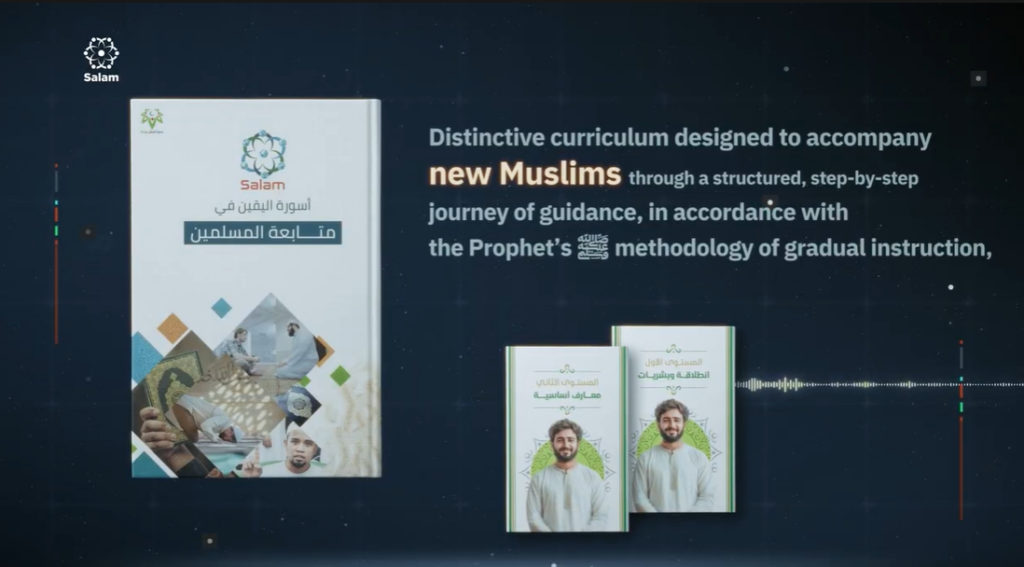
Already Muslim and looking for structured, guided learning? The Salam Center‘s Asawirat Al-Yaqeen (Bracelets of Certainty) program walks new Muslims through a four-stage journey:
- Stage One lays the foundation — the Shahada, prayer, purification, and the core pillars of Islam
- Stage Two builds on it — repentance, major sins to avoid, and a deep look at the life of Prophet Muhammad (PBUH)
- Stage Three strengthens daily practice — etiquette, family life, and practical rulings for everyday living
- Stage Four addresses harder questions — contemporary issues, comparative theology, and a life framework rooted in Surah Al-Asr
If any of that speaks to where you are, reach out and someone from the team will walk you through next steps.
Reach out directly to the Salam Center team to start the Asawirat Al-Yaqeen (Bracelets of Certainty) program for FREE.
Summary
Surah Adh-Dhariyat 51:47 describes Allah as having built the heaven with strength and being its ongoing expander, a reading grounded in the Arabic active participle musi’un. Classical commentary framed this primarily as a statement of divine power and provision, while some modern writers connect it to Hubble’s discovery of cosmic expansion.
Whether or not every proposed scientific correspondence holds up to scrutiny, the verse’s core message remains theological: Allah’s power over creation is total, ongoing, and sufficient grounds for trusting in the resurrection it was originally revealed to argue for.
Frequently Asked Questions
Does the Quran mention the Big Bang theory?
Surah Al-Anbya 21:30 states that the heavens and the earth were once a joined mass before Allah separated them, a description some readers connect to the Big Bang model of cosmic origin. Classical scholars primarily read the verse as a sign of Allah’s power to create and separate all things.
What does “musi’un” mean in Arabic?
Musi’un is an active participle from the root w-s-‘, meaning to widen or make vast. Classical tafsir, including the reports preserved by Ibn Kathir, primarily explains it as Allah’s power and generous provision; the word’s root also carries a literal sense of extension or expansion.
Is the expanding universe verse considered scientific proof of the Quran?
No single verse functions as scientific proof of the Quran’s divine origin. Muslims hold the Quran’s authority on the basis of revelation, preservation, and the Prophet Muhammad’s (PBUH) transmission — resemblances to later scientific findings, like Surah 51:47 and cosmic expansion, are received as additional signs, not foundational evidence.
Curious about Islam?
Journey towards clarity and purpose. Our team is here to support you in your search for truth and spiritual guidance.
Embrace the Truth