Does the Quran Say to Follow Hadith?
Quran 4:59 pairs obedience to Allah with obedience to the Messenger as a single command repeated twice — not once, for emphasis, but twice, as a distinct and independent obligation.
This single verse settles more of the “Quran alone” debate than most people realize, and the rest of the Quran reinforces it from a dozen different angles.
Anyone asking whether the Book that new Muslims are told to hold onto also tells them to hold onto the words and actions of the Messenger it was revealed through will find the answer sitting plainly in the text itself.
Does the Quran say to follow Hadith?
Yes, the Quran explicitly commands Muslims to follow the Hadith. The Quran commands obedience to the Prophet Muhammad (PBUH) in language that leaves no room for a “Quran-only” reading. The clearest statement comes in Surah An-Nisa:
قُلْ إِن كُنتُمْ تُحِبُّونَ اللَّهَ فَاتَّبِعُونِي يُحْبِبْكُمُ اللَّهُ
“Say, [O Muhammad], ‘If you should love Allah, then follow me, [so] Allah will love you.'” (Quran 3:31)
Following the Prophet is tied directly to loving Allah — not as a separate spiritual track, but as the proof of it.
The Quran does not ask believers to admire the Prophet from a distance while extracting rulings from the text alone. The Quran asks Muslims to follow Prophet Muhammad, and following a person means following what he said, did, and approved — the very definition of Hadith and Sunnah.
The obligation repeats in Surah An-Nisa with even sharper wording:
يَا أَيُّهَا الَّذِينَ آمَنُوا أَطِيعُوا اللَّهَ وَأَطِيعُوا الرَّسُولَ وَأُولِي الْأَمْرِ مِنكُمْ
“O you who have believed, obey Allah and obey the Messenger and those in authority among you.” (Quran 4:59)
Grammatically, Allah could have written “obey Allah and His Messenger” as one combined phrase.
Instead the verb “obey” (أَطِيعُوا) appears twice — once for Allah, once for the Messenger — a construction classical exegetes read as establishing the Messenger’s command as independently binding, not merely derivative of the Quran’s wording.
This matters for anyone examining the Islamic beliefs and faith in Islam that structure a Muslim’s relationship with revelation, because it shows obedience in Islam was never designed as a single-source system.
The Quran commands taking what the Messenger gives and leaving what he forbids
Surah Al-Hashr addresses the matter even more directly, in language that reads almost like a legal instruction:
وَمَا آتَاكُمُ الرَّسُولُ فَخُذُوهُ وَمَا نَهَاكُمْ عَنْهُ فَانتَهُوا
“And whatever the Messenger has given you – take; and what he has forbidden you – refrain from.” (Quran 59:7)
Here the command is not “follow what the Quran gives you.” It is “what the Messenger gives you – take it.”
The verse draws a distinction that Quran-only arguments tend to collapse: Allah’s revelation includes both the recited Quran and the Prophet’s own rulings, statements, and practices, and both carry the weight of divine instruction.
A well-known account regarding this verse, transmitted through Ibrahim al-Nakha’i, describes a companion citing it directly against someone who tried to dismiss a Prophetic ruling on the grounds that it was not written in the Quran’s text — illustrating how the earliest generation of Muslims themselves understood the verse to settle the question.
Learn More About Islam
Discover the beauty, teachings, and wisdom of Islam in a clear and welcoming way. Start exploring and deepen your understanding today.
Learn MoreThe Quran assigns the Prophet the role of explaining it
H3 Rule check — using standard heading here to match step-by-step format allowance.
A separate line of Quranic evidence addresses why Hadith exists at all. Surah An-Nahl states Allah’s purpose in sending the Prophet alongside the revealed text:
وَأَنزَلْنَا إِلَيْكَ الذِّكْرَ لِتُبَيِّنَ لِلنَّاسِ مَا نُزِّلَ إِلَيْهِمْ
“And We revealed to you the message that you may make clear to the people what was sent down to them.” (Quran 16:44)
The Quran describes itself here as needing clarification — not because it is deficient, but because a legal and spiritual text delivered to an entire nation across generations requires a living authority to demonstrate its application.
The Quran commands prayer; the Sunnah shows how many units, at which times, and in what manner.
The Quran commands zakat; the Sunnah specifies the thresholds and rates. Without this explanatory function, explicitly assigned by the verse above, entire categories of worship would be unpracticable from the Quranic text alone.
The Prophet’s life is presented as the model to follow
Surah Al-Ahzab states this role even more personally:
لَقَدْ كَانَ لَكُمْ فِي رَسُولِ اللَّهِ أُسْوَةٌ حَسَنَةٌ
“There has certainly been for you in the Messenger of Allah an excellent pattern.” (Quran 33:21)
The word used, uswah hasanah, denotes a complete model of conduct — not a set of abstract principles to reinterpret, but a lived example to imitate.
A pattern can only be followed by observing what a person actually did, and the record of what the Prophet Muhammad (PBUH) did, said, and approved of is precisely what the science of Hadith preserves.
This is the same principle discussed in relation to what Muslims believe about the Quran and why Muslims believe in the Quran — the text and the example were never designed to be separated.
The Prophet’s own words confirm the Quran and Sunnah were given together
The Prophet Muhammad (PBUH) described his own role and authority in terms that directly address this question. In an authenticated hadith recorded in Sunan Abi Dawud, he said:
“Beware! I have been given the Qur’an and something like it along with it, yet the time is coming when a man replete on his couch will say: Keep to the Qur’an; what you find in it to be permissible treat as permissible, and what you find in it to be prohibited treat as prohibited.” (Sunan Abi Dawud 4604)
This hadith is remarkable because it predicts, by name, the exact objection raised today — that a person will recline comfortably and declare the Quran sufficient on its own, rejecting anything beyond it.
The Prophet identifies this stance as a future deviation rather than sound doctrine, describing his own teachings as revelation “like” the Quran in authority, even where the wording differs.
Scholars of Ahlus Sunnah wal Jama’ah classify this as one of two forms of divine revelation given to the Prophet: wahy matluww (recited revelation, the Quran) and wahy ghayr matluww (unrecited revelation, the authentic Sunnah) — two channels, one divine source.
Read Also: What Does the Quran Say About Forcing Religion on Others?
Why do some people question following Hadith today?
The idea that Muslims should follow “Quran alone” is a modern position, associated with movements that emerged in the nineteenth and twentieth centuries, and it stands outside the historical consensus of the Muslim scholarly community across all four Sunni legal schools.
Classical scholars of tafsir, including Ibn Kathir in his commentary on Surah An-Nisa, understood verse 4:59 as establishing the Sunnah’s authority precisely because separating the two would make correct practice of Islam impossible to determine with any consistency.
The methodology of authenticating Hadith — examining chains of narration, cross-referencing narrators, and grading reports as sahih, hasan, da’if, or fabricated — developed specifically to guard against the fabrication the Quran itself warns against, ensuring that what is attributed to the Prophet can be trusted with scholarly rigor.
Read Also: What Does the Quran Say About Forgiveness?
What this means for new Muslims building a foundation in faith
For someone newly entering Islam, this question often surfaces early, sometimes prompted by online debates rather than genuine scholarly disagreement. The reassurance here is structural, not just textual: the Quran and Sunnah were never meant to compete for authority.
They were revealed together, function together, and are studied together in every reliable center of Islamic learning, including institutions such as Al-Azhar University, one of the oldest continuously operating centers of Sunni Islamic scholarship.
A new Muslim building foundational Islamic principles does not need to choose between the Book and the Messenger who delivered it — the Quran itself removes that choice.
Read Also: Does the Quran Say to Follow Prophet Muhammad?
Learn More About Islam
Discover the beauty, teachings, and wisdom of Islam in a clear and welcoming way. Start exploring and deepen your understanding today.
Learn MoreGet Guidance And Support From Salam Platform
Questions about the Quran and Sunnah rarely stop at one verse — and that’s exactly how it should be. If this raised more questions than it answered, that’s a good sign you’re engaging seriously with the sources.
Explore more on the Salam Platform, where every article is grounded in the Quran and authentic Hadith.
Browse the Salam blog for deeper dives into Islamic beliefs, the Seerah, and comparative religion.
Reach out directly — our team is ready to listen, guide, and welcome you.

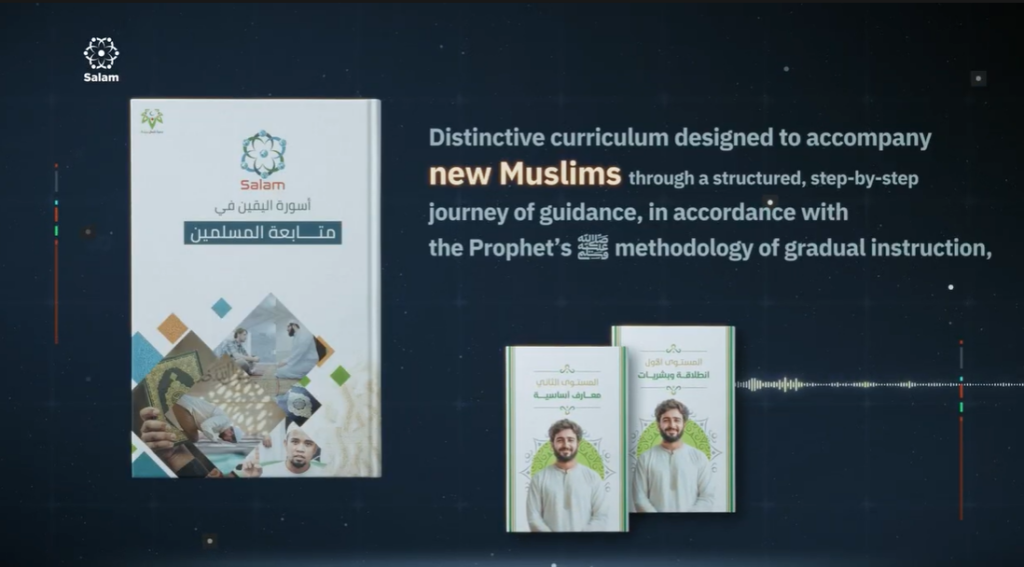
Curious about entering Islam, or want structured guidance as a new Muslim? The Salam Center team built the Asawirat Al-Yaqeen (Bracelets of Certainty) program specifically for this journey:
- A four-stage curriculum moving from foundational belief through practical rulings to advanced understanding
- Covers the Shahada, prayer, fasting, the Seerah of the Prophet, family rulings, and contemporary Islamic issues
- Grounded in the creed of Ahlus Sunnah wal Jama’ah, taught with structured lessons and interactive assessments
Reach out directly to the Salam Center team to start the Asawirat Al-Yaqeen (Bracelets of Certainty) program for FREE.
Summary
The Quran commands obedience to the Prophet Muhammad (PBUH) as a distinct obligation alongside obedience to Allah, most explicitly in verses 4:59 and 59:7. Hadith preserves the practical explanation the Quran itself assigns the Prophet to deliver.
Scholars developed rigorous authentication methods precisely to protect this relationship from fabrication, not to weaken it. Understanding the Quran and Sunnah as one unified source, rather than competing ones, brings genuine clarity to new Muslims and sincere seekers alike.
Frequently Asked Questions
Does the Quran explicitly command Muslims to follow Hadith?
Yes. Quran 4:59 commands believers to “obey Allah and obey the Messenger” as two distinct commands, and Quran 59:7 instructs Muslims to “take” whatever the Messenger gives them. Both verses use direct, obligatory language rather than optional suggestion.
What is the difference between the Quran and Hadith?
The Quran is Allah’s directly recited word, preserved verbatim in Arabic. Hadith records the sayings, actions, and approvals of Prophet Muhammad (PBUH), transmitted through chains of narration and authenticated by scholars using rigorous criteria for reliability.
Can Islam be practiced correctly using only the Quran?
No. classical school of Sunni scholarship has held this position historically. Quran 16:44 assigns the Prophet the task of explaining revelation, and practices like prayer’s exact form rely on Hadith for their detail, since the Quran commands them without specifying every step.
Are all Hadiths considered equally reliable?
No. Scholars classify Hadiths by authenticity — sahih (authentic), hasan (good), da’if (weak), and mawdu’ (fabricated) — through the science of Hadith criticism. Only sahih and hasan narrations from collections like Sahih Bukhari and Sahih Muslim carry legal weight in mainstream jurisprudence.
Why did Islamic scholars develop a science to verify Hadith?
Because early Muslims recognized the danger of false attribution to the Prophet. The chain-of-narration (isnad) system was developed to trace every report back to its source, cross-check narrators’ honesty and memory, and filter out fabricated or weak reports — a safeguard the Quran-only position sometimes overlooks.
Curious about Islam?
Journey towards clarity and purpose. Our team is here to support you in your search for truth and spiritual guidance.
Embrace the Truth