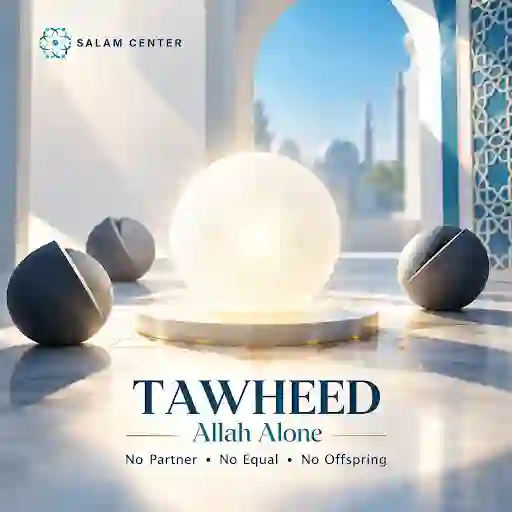
The core teaching of Islam is Tawheed, the belief that Allah alone is God, without partner, equal, or offspring.
Tawheed rests on three foundations: Allah’s sole lordship over creation, His exclusive right to worship, and His unique names and attributes.
Every prophet in the Quran’s account, from the earliest to the last, delivered the same central message of worshipping Allah alone.
The opposite of Tawheed is shirk, associating partners with Allah, which Islam identifies as the one sin outside the scope of automatic forgiveness.
Islamic monotheism differs from other monotheistic traditions in refusing any form of incarnation, sonship, or intermediary between the Creator and the creation.
Ask a hundred people what Islam is really about, and you’ll get a hundred answers — prayer, fasting, a headscarf, a set of rules. Almost none of them will name the actual center of gravity. Every ritual, every ethical demand, every line in the Quran about the unseen world eventually traces back to one claim, and that claim is what this article is about.
What Is the Core Teaching of Islam?
Tawheed is the core teaching of Islam. It is the belief that there is one God, Allah, with no partner, no equal, and no offspring, and that He alone deserves to be worshipped.
Every other Islamic teaching — the five daily prayers, fasting, charity, the moral code, belief in the afterlife — exists as an expression of this single idea rather than as a separate rule sitting beside it.
The word Tawheed comes from the Arabic root meaning “to make one” or “to declare one.” It is not merely a headcount of deities. It is a total claim about reality: that one uncaused, self-sufficient being created and sustains everything else that exists, and that nothing in creation shares in His essence, His authority, or His right to be worshipped.
This is the meaning packed into the Quran’s shortest and most memorized chapter:
“Say, ‘He is Allah, [who is] One, Allah, the Eternal Refuge. He neither begets nor is born, nor is there to Him any equivalent.'”(Quran 112:1-4)
Scholars have long noted that this short surah is said to carry the weight of a third of the Quran’s meaning, precisely because it compresses the entire creed into four lines.
The same claim is repeated in plainer language elsewhere, so that no reader is left guessing at the point:
“That is Allah—your Lord! There is no god ˹worthy of worship˺ except Him. ˹He is˺ the Creator of all things, so worship Him ˹alone˺.” (Quran 6:102)
If you understand these two verses, you understand what separates Islamic belief from every competing account of God.
1. Allah Alone Created And Sustains Everything That Exists
Nothing in the universe came into being by accident, and nothing sustains itself. This is the first branch of Tawheed, known among scholars as Tawheed ar-Rububiyyah, the oneness of lordship. It means Allah alone brings things into existence, provides for them, and governs every event, down to the smallest.
The Quran points to ordinary creation as evidence a thinking person can verify for themselves — the design of an animal, the structure of the sky, the stability of mountains — rather than asking for blind acceptance.
The same verse quoted above continues past creation into a claim about care: Allah is described as “the Creator of all things” and, in the same breath,
“the Maintainer of everything” (Quran 6:102), meaning creation was never a one-time act followed by divine withdrawal.
This connects directly to how Islam frames the nature of God: not as a distant force that set the universe running and stepped back, but as an active, involved Sustainer who remains engaged with what He made, moment to moment.
2. Worship Belongs To Allah Alone With No Exceptions
Directing any act of worship toward someone other than Allah violates the core of Islamic belief, no matter how sincere the intention behind it. This second branch, Tawheed al-Uluhiyyah, is where Tawheed becomes practical rather than theoretical. Prayer, sacrifice, vows, and asking for help in matters beyond human power are acts reserved for Allah.
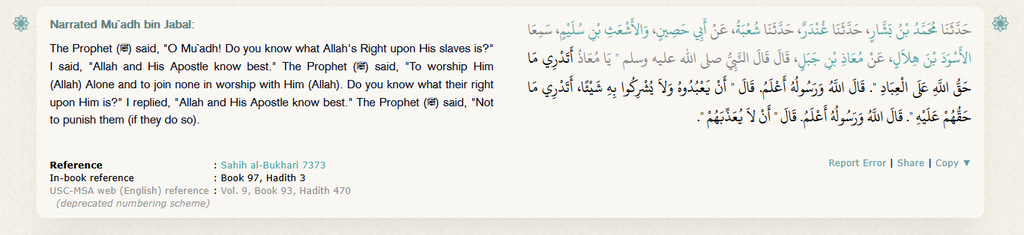
This is the dimension the Prophet Muhammad (PBUH) emphasized when he sent Mu’adh ibn Jabal to Yemen, instructing him to first call people to testify that none has the right to be worshipped but Allah, before mentioning any other obligation. The Prophet later asked Mu’adh directly:
“Do you know what Allah’s right upon His servants is? … That they worship Him and associate nothing with Him.” (Sahih al-Bukhari 7373)
The Quran makes the same demand even more pointedly when it comes to objects people have historically revered as sacred in themselves:
“Do not prostrate to the sun or the moon, but prostrate to Allah, Who created them ˹all˺, if you ˹truly˺ worship Him ˹alone˺.” (Quran 41:37)
The logic is deliberate: even the sun and moon, awe-inspiring as they are, are created things. Worship belongs only to what created them, never to the created objects themselves — a principle that extends to anything a person might be tempted to revere in place of, or alongside, Allah.
3. Sincerity Of Devotion Is The Condition Allah Places On Worship
An act of worship stops being worship of Allah the moment part of it is performed to please someone else. This is why the Quran does not simply command worship — it repeatedly qualifies the command with the word “sincere,” ruling out worship performed for show, for social approval, or to gain nearness to Allah through an intermediary.
أَلَا لِلَّهِ ٱلدِّينُ ٱلْخَالِصُ ۚ
“Indeed, sincere devotion is due ˹only˺ to Allah.” (Quran 39:3)
The verse continues by naming the exact error this rules out: people who direct worship toward intermediaries, reasoning that these intermediaries might bring them closer to Allah.
The same requirement appears again in one of the Quran’s later chapters, addressed to earlier communities as well as this one:
“They were only commanded to worship Allah ˹alone˺ with sincere devotion to Him in all uprightness.” (Quran 98:5)
Taken together, these verses mean Tawheed is not satisfied by directing worship at Allah while also treating something else as a channel toward Him. The sincerity has to be total, with nothing shared.
4. Tawheed Rejects Any Notion Of God Having A Son Or Partner
A belief system built on one God cannot logically make room for a divine offspring, a co-equal, or a junior partner in creation. The Quran addresses this directly and repeatedly, since it is the point where Islamic monotheism diverges most sharply from other traditions that use the language of monotheism while permitting a plural or triune Godhead.
وَقَالُوا اتَّخَذَ اللَّهُ وَلَدًا ۗ سُبْحَانَهُ
“And they say, ‘Allah has taken a son.’ Glory be to Him!” (Quran 2:116)
The same theme returns from a different angle in Surah Al-Anbiya, where the Quran argues that plural godhead is not just false but structurally impossible:
“Had there been other gods besides Allah in the heavens or the earth, both ˹realms˺ would have surely been corrupted.” (Quran 21:22)
The reasoning is straightforward: competing wills governing one universe would produce contradiction, not order. The coherence of the natural world is itself treated as evidence against divine plurality.
This is one reason a careful comparison between Islam and Christianity so often returns to this single question of divine sonship rather than to secondary matters of ritual or law.
Learn More About Islam
Discover the beauty, teachings, and wisdom of Islam in a clear and welcoming way.
Start exploring and deepen your understanding today.
5. Every Prophet Sent By Allah Delivered The Same Core Message
Tawheed is not a teaching unique to the Prophet Muhammad (PBUH); the Quran presents it as the single message every prophet before him was sent to deliver. This matters because it means Islamic monotheism is framed as a restoration of one continuous message, not an entirely new claim introduced in the seventh century.
“We surely sent a messenger to every community, saying, ‘Worship Allah and shun false gods.'” (Quran 16:36)
Whatever else varied between the messages given to different prophets — details of law, ritual, and circumstance — the Quran holds that this one instruction never changed.
It is part of why Islamic teaching treats Prophet Muhammad (PBUH) as the final link in a single prophetic chain rather than the founder of a new religion, a continuity explored further in his family tree traced back to Prophet Abraham.
6. Allah’s Names And Attributes Belong To Him Uniquely
No created being shares in Allah’s knowledge, power, or perfection, even when human language borrows the same words to describe both. This third branch, Tawheed al-Asma was-Sifat, affirms that Allah describes Himself with attributes like hearing, seeing, and mercy, but that the way these apply to Him is nothing like how they apply to a human being.
“There is nothing like Him, and He is the All-Hearing, All-Seeing.” (Quran 42:11)
This single verse closes off two errors at once: denying Allah has any real attributes, and imagining His attributes resemble those of His creation.
Ayat al-Kursi, discussed further below, builds on this same idea by listing specific attributes — life, self-sufficiency, freedom from fatigue — that belong to Allah in a form no creature could ever possess.
7. Everything In The Universe Points Back To One Creator
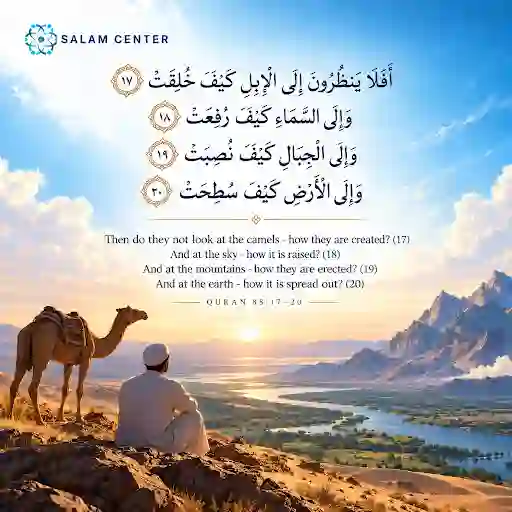
Design implies a designer, and a coordinated universe implies a single coordinating will rather than competing ones. The Quran repeatedly asks its listeners to look outward at creation as a form of evidence, not as poetry.
“Then do they not look at the camels – how they are created? (17) And at the sky – how it is raised? (18) And at the mountains – how they are erected? (19) And at the earth – how it is spread out?” (Quran 88:17-20)
The verse from Al-Anbiya cited above extends this same argument from a single creature to the entire cosmic order, pointing to the absence of disorder in the heavens and the earth as proof of a single governing will rather than several.
8. Ayat Al-Kursi Summarizes The Entire Doctrine In One Verse
A single verse in the second chapter of the Quran is widely regarded by scholars as the greatest verse in the entire book, precisely because it condenses Tawheed into one uninterrupted statement. Known as Ayat al-Kursi, the Throne Verse, it describes Allah’s eternal life, His freedom from fatigue or sleep, and His total sovereignty over the heavens and the earth.
“Allah! There is no god ˹worthy of worship˺ except Him, the Ever-Living, All-Sustaining. Neither drowsiness nor sleep overtakes Him. To Him belongs whatever is in the heavens and whatever is on the earth. Who could possibly intercede with Him without His permission? He ˹fully˺ knows what is ahead of them and what is behind them, but no one can grasp any of His knowledge—except what He wills ˹to reveal˺. His Seat encompasses the heavens and the earth, and the preservation of both does not tire Him. For He is the Most High, the Greatest.” (Quran 2:255)
What makes this verse function almost like a creed in miniature is how much ground it covers in a few lines — Allah’s existence, His uniqueness, His total ownership of creation, and His unmatched knowledge — without a single wasted phrase.
9. Tawheed Reframes The Entire Purpose Of Human Existence
If Allah alone deserves worship, then human life finds its coherence in that single orientation rather than in scattered, competing goals. The Quran states the purpose of creation in direct terms:
“I did not create jinn and humankind except to worship Me.” (Quran 51:56)
Worship here is broader than ritual. It includes honesty in work, justice in dealings, and care for other people, whenever any of these is done with Allah in mind. This is part of what shapes how a person comes to faith in Islam more broadly, not as a checklist, but as an entire orientation of the self.
10. Shirk Is The One Sin Islam Treats As Categorically Different
Associating partners with Allah is the only sin the Quran singles out as outside the normal scope of forgiveness for someone who dies without repenting from it. This is the direct consequence of Tawheed: if oneness is the foundation, then compromising it is not a minor lapse but a structural fracture.
“Indeed, Allah does not forgive associating others with Him, but He forgives anything else of whoever He wills.” (Quran 4:48)
Read alongside the earlier verse about prostrating only to Allah rather than the sun or moon (Quran 41:37), the pattern becomes clear: shirk is not limited to carving idols. It covers any act of ultimate reverence, dependence, or worship redirected away from Allah, however grand or ordinary the object of that redirection might be.
This is precisely why Islam maintains such a firm line against polytheism in any of its forms, whether ancient idol worship or its more modern, subtler equivalents.
Learn More About Islam
Discover the beauty, teachings, and wisdom of Islam in a clear and welcoming way.
Start exploring and deepen your understanding today.
If Tawheed raises more questions than it answers right now, that’s a normal part of taking any idea seriously.
Explore more on the Salam Platform or browse the Salam blog for related topics — the nature of Allah, the Quran’s claims about itself, and how Islam addresses other faiths.
If you’d rather talk something through with a real person, you’re welcome to reach out directly. There’s no pressure and no script — just an honest conversation about whatever is actually on your mind.
For those ready to take the step of embracing Islam, or who want to understand what that step involves, our team can walk you through it directly, with no judgment attached.
Reach out directly— our team is ready to listen, guide, and welcome you.
Summary
Tawheed anchors every Islamic teaching in one claim: Allah alone creates, sustains, and deserves worship, with no partner, equal, or offspring sharing in His nature.
This single principle unites every prophet’s message, distinguishes Islamic monotheism from other traditions, and gives ordinary human life a coherent center it would otherwise lack.
Frequently Asked Questions
What is the difference between Tawheed and monotheism?
Monotheism broadly means belief in one God, but Tawheed is more specific: it insists Allah has no partner, son, or equal in any respect. (Quran 112:1–4) A tradition can call itself monotheistic while still permitting doctrines Tawheed explicitly rules out, such as incarnation or a divine son.
Why is shirk considered the worst sin in Islam?
Shirk, associating partners with Allah, is treated as categorically different because it contradicts the very foundation the rest of the religion is built on. The Quran states Allah “does not forgive associating others with Him” for one who dies unrepentant from it (Quran 4:48), while all other sins remain subject to His will to forgive.
Does Tawheed mean Allah is impersonal or distant?
No. Tawheed affirms that Allah alone sustains creation and hears every prayer directly, without any intermediary. The Quran describes Him as “the Ever-Living, All-Sustaining” who never tires of maintaining the heavens and the earth (Quran 2:255), and as “the Maintainer of everything” He created (Quran 6:102).
How does Tawheed shape a Muslim’s daily life?
Tawheed reframes ordinary actions — work, honesty, kindness — as worship when done with Allah in mind, since the Quran states humanity’s purpose is to worship Him alone (Quran 51:56). It also removes fear of people and material things, since only Allah is understood to control real outcomes.
Is the Christian Trinity compatible with Islamic Tawheed?
No. Islamic Tawheed explicitly rejects any plurality within the Godhead, including the concept of a divine son. The Quran states Allah “has never had offspring, nor was He born” (Quran 112:3) and separately argues that multiple gods would have brought corruption to the heavens and the earth (Quran 21:22), making this one of the clearest points of departure between Islam and Trinitarian Christianity.
Curious about Islam?
Journey towards clarity and purpose. Our team is here to support you in your search for truth and spiritual guidance.