
How Did The Teachings Of Islam Spread?
| Key Takeaways |
| The core teaching of Tawheed, absolute belief in one Allah, dissolved centuries of tribal and idol-based division across the Arabian Peninsula. |
| Prophet Muhammad’s (PBUH) reputation as a trustworthy merchant, earned during his years leading caravans for Khadijah (RA), gave his later message of Islam immediate credibility. |
| Islamic teachings on justice, equality, and the rights of the poor drew converts from tribes that had no prior reason to unite. |
| The Hausa and Fulani peoples of West Africa remain two of the ethnic groups most deeply shaped by centuries of Islamic teaching and practice. |
| Sufi missionaries carried Islamic teachings into West Africa and Southeast Asia largely through trade, personal example, and adaptation to local custom rather than conquest. |
| The Quran’s universal address to “mankind” rather than to a single tribe positioned Islam from its very first revelations as a faith meant to expand beyond Arabia. |
Teachings do the work that armies cannot. A sword can conquer land, but it cannot convince a heart, and the historical record of Islam’s spread across Arabia, then across three continents within a century, rests overwhelmingly on the second kind of persuasion.
Islam’s teachings helped it spread because they answered questions the pre-Islamic world had never resolved — questions about human worth, the nature of Allah, and the purpose of a single life — with clarity, consistency, and a moral seriousness that ordinary people could recognize immediately.
How Did the Teachings Help Islam Spread?
Islam’s teachings helped it spread primarily through their content, not through force: the doctrine of one Allah eliminated the endless hierarchy of tribal idols and priest-classes that divided pre-Islamic Arabia, while the teaching that all believers stand equal before Allah regardless of race or wealth attracted the poor, the enslaved, and the socially marginalized who had no path to dignity under the old order.
The Quran’s teachings on justice in trade, kindness to orphans, and the sanctity of every human life gave converts a complete ethical framework rather than a set of rituals, which meant new Muslims did not simply adopt a religion — they adopted an entire way of ordering a life and a society.
Prophet Muhammad’s (PBUH) own character, witnessed directly by the Meccans who named him Al-Amin, the Trustworthy, before he ever claimed prophethood, gave the message a living proof that words alone could not supply.
Historians and Islamic scholars alike point to this combination — theological clarity, social equality, ethical completeness, and prophetic character — as the actual engine behind Islam’s expansion from a single household in Mecca to a civilization spanning Spain to Central Asia within roughly a century of the Prophet’s death.
That is the short version. The fuller picture requires looking at what these teachings actually said, and why they landed the way they did.
1. The Doctrine of One Allah Dismantled a Fractured Spiritual Order
Pre-Islamic Arabia was not short on gods. The Kaaba itself reportedly held hundreds of idols before the Prophet Muhammad (PBUH) removed them following the conquest of Mecca. Every tribe protected its own deity, and religious loyalty tracked tribal loyalty almost exactly — which meant faith divided people rather than uniting them.
Islam’s teaching of pure monotheism, Tawhid, replaced that entire fractured system with a single, coherent claim: there is no god but Allah. This was not a minor doctrinal adjustment. It removed the intermediary priest classes, the competing tribal shrines, and the endless hierarchy of lesser deities that had structured Arabian religious life for centuries. The Quran states this directly:
قُلْ هُوَ اللَّهُ أَحَدٌ
“Say, ‘He is Allah, [who is] One.'” (Quran 112:1)
A concept this simple traveled easily. It did not require years of study to grasp, and it gave converts an immediate answer to a question the old religion had never resolved: which god actually deserves worship?
Understanding how Islam views the nature of God helps explain why this single teaching did more to unify early converts than any political alliance could have.
This same clarity extended to how Islam positioned itself alongside the older monotheistic traditions.
Rather than dismissing Judaism and Christianity outright, the Quran affirmed a shared lineage of prophets while correcting what it identified as later theological distortions — a framework explored further in how Islam views other religions.
Learn More About Islam
Discover the beauty, teachings, and wisdom of Islam in a clear and welcoming way. Start exploring and deepen your understanding today.
Learn More2. The Rejection of Polytheism Gave the Message Moral Urgency
Islam did not simply propose an alternative to polytheism; it identified polytheism, shirk, as the gravest possible error a person could make.
That urgency mattered. It transformed the call to Islam from a philosophical suggestion into something that demanded a response.
People who had spent their lives navigating a spiritually chaotic system — one god for rain, another for war, ancestral spirits requiring appeasement — encountered in Islam a message that finally simplified the entire cosmos into a single, comprehensible relationship between Creator and creation.
The contrast between monotheism and polytheism as competing worldviews is one the Quran addresses repeatedly, precisely because the stakes of getting it right were framed as eternal.
3. Human Equality Under Allah Reached People the Old Social Order had Abandoned
Seventh-century Arabia ran on lineage. Your tribe determined your protection, your marriage prospects, your legal standing, and often your survival. Slaves, orphans, women, and the poor occupied the lowest rungs of a system with no mechanism for upward movement.
Islam’s teaching that human worth comes from taqwa, righteousness before Allah, rather than bloodline, wealth, or tribal standing, offered these exact groups something the old system structurally could not: dignity that did not depend on birth. The Quran states this without qualification:
يَا أَيُّهَا النَّاسُ إِنَّا خَلَقْنَاكُم مِّن ذَكَرٍ وَأُنثَىٰ وَجَعَلْنَاكُمْ شُعُوبًا وَقَبَائِلَ لِتَعَارَفُوا ۚ إِنَّ أَكْرَمَكُمْ عِندَ اللَّهِ أَتْقَاكُمْ
“O mankind, indeed We have created you from male and female and made you peoples and tribes that you may know one another. Indeed, the most noble of you in the sight of Allah is the most righteous of you.” (Quran 49:13)
This is why some of Islam’s earliest and most celebrated converts came from the very bottom of Meccan society.
Bilal ibn Rabah, an enslaved Abyssinian man, became the first muezzin of Islam and one of the Prophet’s closest companions — a social elevation that would have been structurally impossible under the tribal system he was born into.
The teaching was not abstract encouragement; it produced immediate, visible social change that observers could not ignore.
4. Justice in Trade and Daily Conduct Made Islam Livable, Not Just Believable
Belief that stays confined to the heart rarely spreads on its own. What gave Islam’s teachings traction was that they governed ordinary transactions — how a merchant weighed goods, how a husband treated his wife, how a stranger was greeted — turning faith into a visible, daily practice rather than a private conviction.
Arabia’s trade routes ran through Mecca and Medina, and honest dealing under Islamic teaching became something merchants and travelers noticed and carried with them to distant markets.
This is a large part of why Islam’s early expansion moved along trade networks stretching into East Africa, Persia, and eventually as far as Southeast Asia, long before any organized military campaign reached those regions.
The principles of Islam laid out a complete ethical system precisely so that belief and conduct could not be separated from one another.
5. The Gentleness Commanded in Prophetic Teaching Drew People Rather Than Repelling Them
Prophet Muhammad (PBUH) explicitly instructed his companions to make faith accessible, not burdensome, and this single instruction shaped the entire early character of Islamic outreach. It is authentically narrated:
“Make things easy and do not make them difficult. Give glad tidings and do not repel people.” (Sahih al-Bukhari, 39)
This teaching produced a method of da’wah built on patience rather than pressure. When the Prophet (PBUH) wrote to Heraclius, the Byzantine emperor, inviting him to Islam, the letter itself modeled this approach — an invitation stated plainly, without threat, leaving the response to the recipient’s own conscience.
Heraclius, upon questioning Abu Sufyan (who was still a pagan opponent of the Prophet at the time) about the character of this new prophet, heard a description of prayer, honesty, chastity, and promise-keeping and concluded:
“These are really the qualities of a prophet.” (Sahih al-Bukhari, 7)
That a hostile witness, questioned under conditions designed to expose any lie, could not find fault with the Prophet’s character is itself a form of evidence the earliest generation of Muslims relied on.
Prophet Muhammad’s own biography, including how he became the Prophet of Islam and his recognized reputation for honesty, functioned as a living demonstration of what the teachings actually produced in a person.
6. The Doctrine of Universal Mercy Widened Who the Message Was For
Islam did not present itself as a tribal religion for Arabs alone. The Quran states that Prophet Muhammad (PBUH) was sent as a mercy to all of creation, not to a single people, and this universal framing shaped Islam’s teachings from the outset as something meant to cross every border it eventually did cross.
وَمَا أَرْسَلْنَاكَ إِلَّا رَحْمَةً لِّلْعَالَمِينَ
“And We have not sent you, [O Muhammad], except as a mercy to the worlds.” (Quran 21:107)
A message built with this scope from the beginning naturally expanded past Mecca, past Arabia, past the Arabic-speaking world entirely — because nothing in its own teaching restricted it to those origins. This universalism also shaped how Islam approached the People of the Book.
Rather than demanding wholesale rejection of prior revelation, the Quran affirmed a shared prophetic lineage while calling for correction on specific theological points, a nuanced position examined in what the Quran says about other religions and in comparative treatments like Islam vs. Christianity and Islam vs. Judaism.
7. The Quran Functioned as an Intellectual and Linguistic Argument for the Faith
Arabia in the seventh century placed enormous cultural value on eloquence. Poetry contests were a central feature of tribal life, and linguistic mastery carried real social authority. The Quran’s arrival in this environment as a text of unmatched linguistic power gave early Muslims an argument that operated on the audience’s own terms — a literary and rhetorical case for revelation that Meccan poets, who prided themselves on mastery of the language, could not dismiss or replicate.
This is part of why understanding what Muslims believe about the Quran and why Muslims believe in the Quran requires looking past translation into the actual claim being made: that the text itself, in its original Arabic, stood as evidence of its divine source.
The history of the Quran’s preservation, compiled and transmitted with a rigor unusual for its era, reinforced this claim generation after generation, giving converts a textual foundation that did not depend on secondhand report.
The Prophet’s own biography carried similar evidentiary weight. Accounts like the Night Journey and his documented family lineage tracing back to Abraham gave early converts a sense that this prophetic mission connected to something far older than seventh-century Arabia — a continuation of a single divine plan rather than an isolated new claim.
Learn More About Islam
Discover the beauty, teachings, and wisdom of Islam in a clear and welcoming way. Start exploring and deepen your understanding today.
Learn MoreHow Did the Teachings of Islam Unite the People of the Arabian Peninsula?
Islamic teachings unified the Arabian Peninsula by replacing tribal loyalty with a shared moral and legal system rooted in justice, equality, and accountability to Allah. Before Islam, disputes between tribes were settled through blood feuds that could stretch across generations. The Quran introduced a different standard entirely:
يَا أَيُّهَا الَّذِينَ آمَنُوا كُونُوا قَوَّامِينَ بِالْقِسْطِ شُهَدَاءَ لِلَّهِ وَلَوْ عَلَىٰ أَنفُسِكُمْ أَوِ الْوَالِدَيْنِ وَالْأَقْرَبِينَ ۚ إِن يَكُنْ غَنِيًّا أَوْ فَقِيرًا فَاللَّهُ أَوْلَىٰ بِهِمَا ۖ فَلَا تَتَّبِعُوا الْهَوَىٰ أَن تَعْدِلُوا ۚ وَإِن تَلْوُوا أَوْ تُعْرِضُوا فَإِنَّ اللَّهَ كَانَ بِمَا تَعْمَلُونَ خَبِيرًا
“O you who have believed, be persistently standing firm in justice, witnesses for Allah, even if it be against yourselves or parents and relatives. Whether one is rich or poor, Allah is more worthy of both. So follow not [personal] inclination, lest you not be just. And if you distort [your testimony] or refuse [to give it], then indeed Allah is ever, with what you do, Acquainted.” (Quran 4:135)
A command that demands justice even against one’s own family or tribe was unprecedented in Arabian tribal culture. It gave believers a shared legal and moral standard that no longer depended on which clan held the most swords.
This is precisely why the Constitution of Medina, drafted shortly after the Hijra, was able to bind Muslims, Jews, and other Medinan tribes into a single political community — something tribal custom alone had never achieved in that city’s history.
The Prophet’s (PBUH) Farewell Sermon crystallized this teaching for the whole Ummah at once, declaring that distinction among people rests only on righteousness, not race or lineage — a principle explored further in the principles of Islam that continue to shape Muslim ethical life today.
Zakat Turned Wealth Into A Tool Of Unity Rather Than Division
Pre-Islamic Arabia had no systemic mechanism for redistributing wealth across tribal lines. Zakat changed that permanently.
By obligating believers to give a fixed portion of wealth to those in need, Islam built economic solidarity directly into religious practice.
A wealthy Meccan trader and a poor Bedouin herder now shared not just a God, but a functioning economic relationship rooted in that shared belief.
How Did Muhammad’s Interactions as a Trader Directly Influence the Teachings of Islam?
Prophet Muhammad’s (PBUH) years as a caravan trader gave him firsthand exposure to diverse cultures, languages, and belief systems across the Arabian trade routes, and his reputation for honesty in that trade became the foundation of trust that later carried his prophetic message.
Long before the first revelation, Muhammad (PBUH) worked as a merchant, traveling with Quraishi caravans and eventually leading trade expeditions to Syria on behalf of the wealthy businesswoman Khadijah bint Khuwaylid (RA).
These journeys were not incidental biographical detail — they shaped both the man and the message that followed him.
Muhammad’s (PBUH) conduct in trade earned him the title Al-Amin, “the Trustworthy,” a name given to him by the very Meccan society that would later reject his prophethood. He never manipulated weights, never deceived a customer, and never broke a commercial agreement — remarkable qualities in a mercantile city where such manipulation was common.
This reputation meant that when he began preaching Islam, even his fiercest opponents could not credibly accuse him of dishonesty, because they had trusted him with their own goods and money for years. His trading journeys also exposed him to Christian and Jewish communities along the Syrian trade routes, giving him direct, lived familiarity with the monotheistic traditions that Islam would later affirm and complete.
His encounter with the Christian monk Bahira during a boyhood journey with his uncle Abu Talib is recorded in early Islamic biographical literature as an early sign of recognition from outside Arabia itself.
Readers curious about this period of his life can explore his childhood before prophethood in greater depth, including how these formative years directly shaped the mercy and justice that would later define his teaching.
Honesty In Commerce Became A Model For Islamic Business Ethics
The Prophet’s (PBUH) personal conduct as a trader became more than biography — it became doctrine. Islamic teaching on commerce, contracts, and fair dealing draws directly on the standard he set as Al-Amin.
This connection between his lived example and later Islamic law is one reason converts across trading cultures, from the Arabian Peninsula to the Silk Road, found Islamic commercial ethics immediately credible: the faith’s founder had already proven those standards workable in his own life.
Which Two Major Ethnic Groups Are Heavily Influenced by the Teachings of Islam?
The Hausa and Fulani peoples of West Africa are consistently identified as two major ethnic groups whose culture, law, and daily life have been deeply shaped by centuries of Islamic teaching. Islam reached the Hausa states of what is now northern Nigeria and southern Niger through trade networks beginning around the eleventh century, gradually becoming the dominant faith of Hausa urban centers by the fifteenth and sixteenth centuries.
The Fulani, a historically pastoral people spread across the Sahel, absorbed Islamic teaching through similar trade and scholarly contact, and it was a Fulani religious reformer, Usman dan Fodio, who led the nineteenth-century jihad that established the Sokoto Caliphate and cemented Islamic law across much of Hausaland.
Centuries of intermarriage, shared trade, and shared religious practice have bound these two groups so closely that they are frequently referred to together as Hausa-Fulani in modern Nigerian society.
Sharia continues to inform legal and social life across several northern Nigerian states today, a direct legacy of the Islamic teachings that took root there over a thousand years ago.
This history illustrates something important about how Islam actually spreads: not through a single dramatic conversion moment, but through generations of trade, scholarship, intermarriage, and the gradual, voluntary adoption of Islamic teaching by entire communities.
The same principle of divine oneness explored in monotheism took root in West African soil the same way it took root in Arabia — because it answered fundamental human questions, not because it was imposed by force alone.
The Sufis Were Missionaries Who Spread the Teachings of Islam
Sufi missionaries played a central role in carrying Islamic teachings into regions far beyond the Arabian Peninsula, particularly West Africa and Southeast Asia, largely through personal example, trade relationships, and deliberate adaptation to local custom rather than military conquest. Sufism developed within the early centuries of Islam as a tradition emphasizing personal devotion, spiritual discipline, and closeness to Allah.
Sufi orders, or tariqas, established lodges known as zawiyas that functioned simultaneously as centers of worship, education, and community support.
In West Africa, Sufi traders and scholars moving along trans-Saharan trade routes introduced Islamic teaching gradually, often winning entire communities through the example of their personal conduct rather than through confrontation. I
n Southeast Asia, historical research indicates that Muslim merchants, some connected to Sufi orders, introduced Islam along the coasts of the Malay Archipelago beginning in the thirteenth century, with conversion generally moving from ruling elites down through their populations over the following two centuries.
This missionary approach worked precisely because it mirrored the same principle that had unified Arabia centuries earlier: Islamic teaching persuaded through its coherence and moral seriousness, not merely through political power.
It is a pattern the Quran itself addresses when discussing how sincere faith is meant to be conveyed to others — through clarity, patience, and example.
What Does This Pattern Reveal About the Nature of Islamic Teaching Itself?
Looking across fourteen centuries and multiple continents, a consistent pattern emerges. Islamic teaching spreads most effectively wherever it is allowed to simply be seen clearly: its insistence on one God, its demand for justice even at personal cost, its structural care for the poor and vulnerable, and its refusal to rank human beings by lineage or wealth.
This was true in seventh-century Mecca among competing tribes. It was true among the Hausa and Fulani peoples of West Africa. It was true along the coastal trade routes of Southeast Asia.
The Quran itself frames this expansive character as intentional from the outset, addressing humanity broadly rather than a single tribe or people — a universalism explored further in how Islam views other religions and the wider human family it was revealed to guide.
Read Also: Islam’s Teachings on an Eye for an Eye
Learn More About Islam
Discover the beauty, teachings, and wisdom of Islam in a clear and welcoming way. Start exploring and deepen your understanding today.
Learn MoreYour Path to Deeper Authentic Knowledge Starts Here with Salam
If these questions have opened up more of them, that is exactly what this space is for.
Explore more on the Salam Platform for a wider look at Islamic belief, history, and practice.
Read further on the Salam blog for in-depth articles on the Prophet’s (PBUH) life, the Quran, and the foundations of Islamic faith.
Have a specific question, or want to know more about entering Islam? Reach out directly — every sincere question deserves a sincere answer.

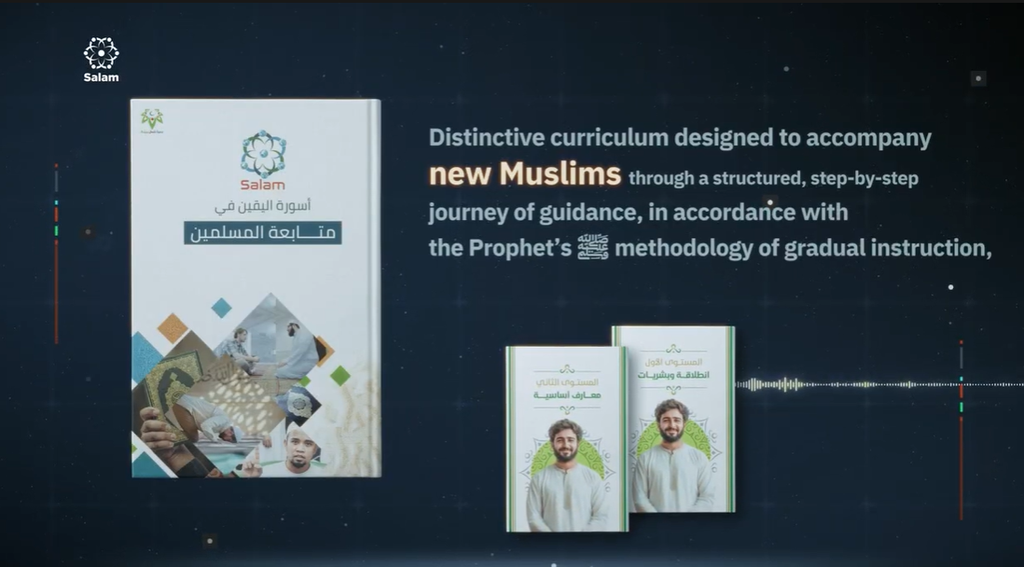
For those who have already taken the step of becoming Muslim, the Salam Center also offers the Asawirat Al-Yaqeen (Bracelets of Certainty) program — a structured, four-stage learning journey built specifically for new Muslims:
- Stage One (Foundation): the Shahada, the pillars of Islam, and the basics of prayer and purification
- Stage Two (Construction): repentance, major sins to avoid, and the Seerah of Prophet Muhammad (PBUH)
- Stage Three (Consolidation): heart-centered worship, women’s etiquette, and practical rulings for family and daily life
- Stage Four (Empowerment): contemporary issues, comparative theology, and a life roadmap rooted in Surah Al-Asr
If you are a new Muslim looking for structured, compassionate guidance, this program was built with you specifically in mind.
Reach out directly to the Salam Center team to start the Asawirat Al-Yaqeen (Bracelets of Certainty) program for FREE.
Summary
Islam spread across Arabia because its teachings on Tawheed and justice dissolved centuries of tribal division, giving disparate peoples one shared faith and legal standard. Prophet Muhammad’s (PBUH) own trading history built the trust that let his message travel further than politics alone could carry it.
Beyond Arabia, Sufi missionaries carried these same teachings into West Africa and Southeast Asia through persuasion rather than force, shaping peoples like the Hausa and Fulani for centuries. The pattern remains consistent: wherever Islamic teaching is seen clearly, it continues to resonate across cultures and generations.
Frequently Asked Questions
What was the main teaching that helped Islam spread across Arabia?
Tawheed, the belief in the absolute oneness of Allah, was the primary teaching behind Islam’s spread across Arabia. It replaced the region’s fractured, tribal-based idol worship with a single, shared object of devotion, dissolving the theological basis for tribal division. This unifying belief is detailed further in the Quran’s declaration: “Say, ‘He is Allah, [who is] One, Allah, the Eternal Refuge.'” (Quran 112:1)
How did Muhammad’s (PBUH) work as a trader help spread Islam later on?
His years leading trade caravans earned him the title Al-Amin, “the Trustworthy,” from the very society that would later hear his prophetic message. That established reputation for honesty gave his call to Islam immediate credibility, since his character had already been tested and proven over years of commercial dealings across Arabia and Syria.
Which African ethnic groups were most shaped by Islamic teaching?
The Hausa and Fulani peoples of West Africa are widely recognized as two ethnic groups whose culture, law, and identity have been deeply shaped by Islamic teaching, particularly following the nineteenth-century Sokoto Caliphate established under the Fulani reformer Usman dan Fodio.
Did Sufis spread Islam through force or through persuasion?
Historical evidence indicates Sufi missionaries spread Islam primarily through persuasion, personal example, and adaptation to local custom rather than through force. This approach was especially effective in West Africa and Southeast Asia, where Sufi traders and scholars won communities gradually through demonstrated character and teaching.
Why did Islamic teachings appeal to people outside Arabia?
Islamic teachings on justice, human equality, and accountability before Allah addressed universal human concerns that transcended any single culture or region. The Quran’s own framing of its message as addressed to all of humanity, not one tribe, positioned Islam from its earliest revelations to resonate across vastly different societies.
Curious about Islam?
Journey towards clarity and purpose. Our team is here to support you in your search for truth and spiritual guidance.
Embrace the Truth