
How Is the Quran Organized?
| Key Takeaways |
| The Quran contains 114 chapters (Surahs), each composed of individual verses called Ayat, revealed to Prophet Muhammad (PBUH) over approximately 23 years. |
| Surahs are arranged neither chronologically by revelation nor thematically by topic — their precise order was divinely guided and established by the Prophet (PBUH). |
| The Quran is divided into 30 equal parts called Juz’, a practical system that allows Muslims worldwide to complete its recitation across any consistent schedule. |
| Each Surah carries a distinct name, a designation of Meccan or Medinan origin, and an opening — with all but one beginning with Bismillah ir-Rahman ir-Raheem. |
The Quran contains 114 chapters, known as Surahs, arranged in a precise sequence established under the direct guidance of Prophet Muhammad (PBUH) — making its organization itself an act of revelation.
The Quran’s arrangement does not follow the calendar of revelation, nor does it sort its content by legal ruling, story, or theme.
1. The Quran Has 114 Chapters Called Surahs
A Surah is the foundational unit of the Quran’s organization. The word Surah (سورة) in classical Arabic carries the meaning of an elevated rank or enclosure — a complete, bounded unit of divine speech.
Each Surah contains a varying number of Ayat (verses). The shortest Surah is Surah Al-Kawthar (Chapter 108), with only 3 Ayat. The longest is Surah Al-Baqarah (Chapter 2), containing 286 Ayat and addressing creed, law, worship, and narrative across its extraordinary length.
The total number of Ayat in the Quran is 6,236 according to the most widely accepted scholarly count.
All but one Surah opens with the Basmala:
بِسْمِ اللَّهِ الرَّحْمَٰنِ الرَّحِيمِ — “In the name of Allah, the Most Gracious, the Most Merciful.”
The exception is Surah At-Tawbah (Chapter 9), whose opening without the Basmala has been the subject of rich scholarly discussion, with the majority of scholars explaining it reflects the Surah’s tone of declared accountability.
Learn More About Islam
Discover the beauty, teachings, and wisdom of Islam in a clear and welcoming way. Start exploring and deepen your understanding today.
Learn More2. The Arrangement of Surahs Was Divinely Guided, Not Arbitrary
The sequence of the 114 Surahs was not determined by the companions of the Prophet (PBUH) after his death, according to a widely accepted scholarly count. The arrangement was established by the Prophet (PBUH) himself, acting on divine instruction from Angel Jibreel (Gabriel).
The Prophet (PBUH) would direct his scribes exactly where each newly revealed passage belonged within the growing body of scripture.
To understand how the Quran is divided is to recognize that the structure itself is part of what Muslims believe was revealed — as the Salam Center’s exploration of what Muslims believe about the Quran details in its broader discussion of the scripture’s divine character.
3. Meccan and Medinan Surahs Are the Two Great Categories
Every Surah in the Quran belongs to one of two categories based on the period and location of its revelation: Makki (Meccan) or Madani (Medinan).
Makki Surahs were revealed before the Prophet’s (PBUH) migration (Hijra) to Madinah in 622 CE. They typically address the foundations of faith — the existence and Oneness of Allah, the reality of the Day of Judgment, the nature of prophethood, and the struggles of earlier nations. Their verses tend to be shorter and more rhythmically intense, suited to the urgent call of early Da’wah.
Madani Surahs were revealed after the Hijra. They typically address the Muslim community as an established society — covering legislation, family law, inter-community relations, and detailed worship rulings. Their Ayat tend to be longer and more discursive.
4. The Quran Is Divided Into 30 Parts Called Juz’
Beyond the Surah and Ayah structure, the Quran is divided into 30 roughly equal sections called Ajza’ (singular: Juz’, جزء). This division is not a division of meaning — it is a practical recitation system.
By completing one Juz’ per day, a Muslim can finish the entire Quran within a single month, a practice especially common during Ramadan.
Each Juz’ contains approximately 20 pages in the standard Mushaf (Quranic text) printed according to the Uthmani script.
The Juz’ system is further subdivided:
- Each Juz’ is split into two Hizb (حزب), giving 60 Hizbs total across the Quran
- Each Hizb is divided into four Rub’ al-Hizb (quarter sections), giving 240 quarters total
These subdivisions appear as small markers in the margins of printed Qurans and serve as guidance markers for regular, structured recitation.
Read Also: Scientific Errors in the Quran Answered
Learn More About Islam
Discover the beauty, teachings, and wisdom of Islam in a clear and welcoming way. Start exploring and deepen your understanding today.
Learn MoreLearn More About Islam and the Quran with Salam
The Quran’s organization is a starting point — what lies within each chapter is a lifetime of discovery.
If you are exploring Islam with sincere questions, the Salam Platform is here to walk alongside you. Visit the Salam blog for carefully researched articles on Islamic beliefs, the Quran, and what Islam truly teaches — free from distortion and media noise.
Have a specific question or want to speak with someone directly? Reach out to the Salam Center team — our team is ready to listen and respond with knowledge and care.

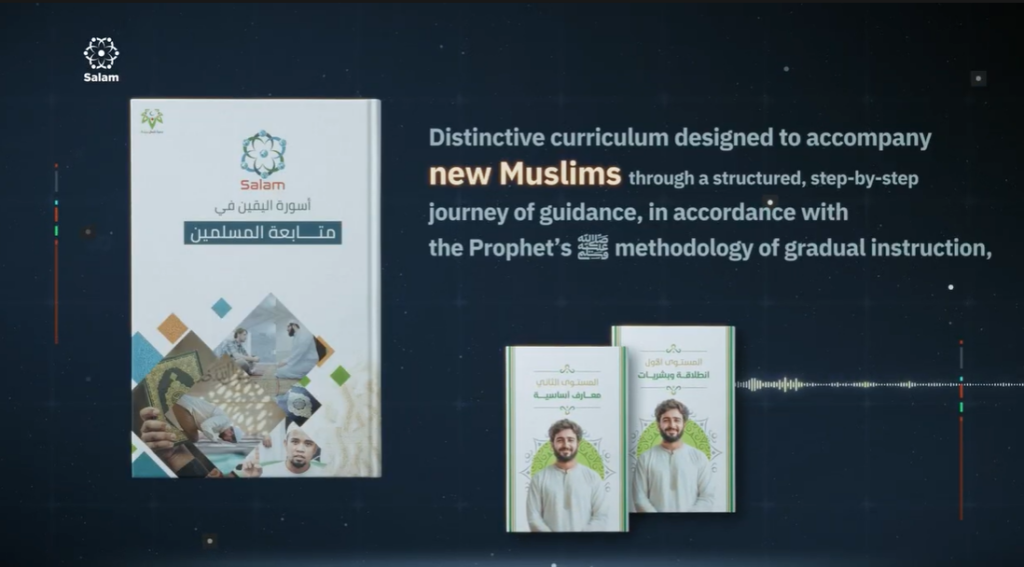
For those who have already taken their Shahada and are building their foundation in Islam, we warmly invite you to join the Asawirat Al-Yaqeen (Bracelets of Certainty) program — a structured post-conversion curriculum implemented with over 114,000 new Muslims across 140 countries. The program guides you through four progressive stages:
- Stage One: The Foundations — Shahada, pillars of Islam, prayer, and purification
- Stage Two: The Construction Phase — Pillars of Iman, fasting, Zakat, Hajj, and the Prophet’s biography
- Stage Three: The Consolidation Phase — Moral character, repentance, family rulings, and daily life
- Stage Four: The Empowerment Phase — Contemporary issues, theological foundations, and a life roadmap
Reach out directly to the Salam Center team to start the Asawirat Al-Yaqeen (Bracelets of Certainty) program for FREE.
Summary
The Quran contains 114 Surahs and 6,236 Ayat, organized in a divinely guided sequence established by Prophet Muhammad (PBUH) under direct instruction — not assembled by his companions after his death. Its 30 Juz’ division enables consistent recitation, while the Meccan and Medinan classification deepens understanding of each chapter’s context and purpose.
Frequently Asked Questions
How many chapters are in the Quran?
The Quran contains exactly 114 chapters, called Surahs. They range from the 3-verse Surah Al-Kawthar to the 286-verse Surah Al-Baqarah. Each Surah has a distinct name, a classification as Meccan or Medinan, and a fixed position established by the Prophet (PBUH).
How is the Quran divided into 30 parts?
The Quran is divided into 30 equal sections called Ajza’ (singular: Juz’). This system allows Muslims to complete the entire Quran in 30 days by reading one Juz’ daily — a practice widely observed during Ramadan. Each Juz’ is further split into two Hizbs and four Rub’ al-Hizb quarter sections.
Why are the Quran’s chapters not arranged in the order they were revealed?
The Quran’s arrangement is tawqifi — meaning it was fixed by divine guidance conveyed through the Prophet (PBUH), not organized by chronology of revelation or human editorial decision.
What is the difference between Meccan and Medinan Surahs?
Meccan Surahs were revealed before the Prophet’s migration to Madinah and focus on monotheism, prophethood, and the Hereafter. Medinan Surahs were revealed afterward and address community law, worship rulings, and social ethics. Every Surah carries one of these two designations, though individual Ayat within a Surah may differ from its primary classification.
Curious about Islam?
Journey towards clarity and purpose. Our team is here to support you in your search for truth and spiritual guidance.
Embrace the Truth