Did Anyone From The Message Movie Convert To Islam?
Moustapha Akkad, the Syrian-American director who brought The Message to screens in 1976, was a Muslim before a single frame was shot. He carried that identity across an ocean when, at 18 years old, he left Aleppo for the United States with $200 and a copy of the Quran his father pressed into his hands at the airport.
In an interview with the Washington Post, Akkad described his motivation plainly: “Being a Muslim myself who lived in the West, I felt that it was my obligation, my duty, to tell the truth about Islam.”
So the question of whether The Message led anyone to Islam begins not with the actors, but with the man who made the whole thing possible — and he was already there.
Did Anyone from The Message Movie Convert to Islam?
No confirmed, documented conversion of any cast or crew member directly attributable to working on The Message exists in the verified historical record. The one person on the production who was unambiguously Muslim was the director himself. Moustapha Akkad was a practicing Muslim before a single frame was shot — his faith was the reason the film existed at all.
What is documented and real is the film’s impact on its viewers. Individuals across decades have credited The Message with sparking the curiosity that eventually led them to the Shahada.
The Da’wah power of the film operated through its audiences, not through a transformation of its cast.
Did Anthony Quinn Actually Convert to Islam After Filming The Message?
No, the claim that Anthony Quinn converted to Islam is a widely circulated rumor without verified evidentiary support.
A public conversion by someone of Quinn’s stature would have been widely known — much like the documented conversion of Cat Stevens (Yusuf Islam) — but no such record exists.
Quinn brought deep reverence to his portrayal of Hamza ibn Abd al-Muttalib, one of Islam’s greatest companions, but artistic devotion to a role and religious conversion are distinct realities.
Did The Wider Cast of The Message Movie Convert to Islam?
We do not know of any confirmed, documented conversion among the cast or crew of The Message Movie. That absence of confirmed record is not proof it did not happen — private conversions happen every day, and a person’s faith is theirs alone to declare or keep quiet. But it means we cannot say it happened either.
The international ensemble cast included Irene Papas, Michael Ansara, Johnny Sekka, Michael Forest, André Morell, Garrick Hagon, Damien Thomas, and Martin Benson.
Of these, no formally documented conversion to Islam linked directly to their work on the film exists in any verified public record.
London-based actor Garrick Hagon, who played Ammar — one of the Prophet’s (PBUH) companions — offered one of the more candid reflections. “At that time, we didn’t know much about Islam,” he said. His comment suggests that for the Western cast members, the production was an education — a window into a civilization and a Prophetic tradition they had not encountered deeply before.
Some unverified viewer commentary has claimed that “most of the cast converted,” and this claim appears in a few IMDB user reviews. One review stated that “I have read that most of the cast/crew involved did so” — but immediately acknowledged there was no verifiable source.
Treating unverified, anonymous online claims as historical record would be precisely the kind of intellectual dishonesty this platform refuses to practice.
Was Moustapha Akkad a Muslim When he Made The Message?
Yes. Moustapha Akkad was a practicing Muslim before, during, and after the making of The Message.
Akkad was born in Aleppo, Syria. When he left for the United States, his father gave him the money for the ticket and a copy of the Quran, telling him it was all he could manage. That Quran traveled with him to UCLA, to USC, to Hollywood, and eventually to the deserts of Morocco and Libya where The Message was filmed.
For Akkad, all the crises in the world could be linked to the failure to understand the universal messages of the Prophet Muhammad (PBUH). He believed that in order to understand the Prophet’s message, one needed to understand his life.
At the time of his death, Akkad was in the process of producing an $80 million film featuring Sean Connery about Saladin and the Crusades. He had said: “Right now, Islam is portrayed as a terrorist religion. Because a few terrorists are Muslims, the whole religion has that image. If there ever was a religious war full of terror, it was the Crusades. But you can’t blame Christianity because a few adventurers did this.”
Islam’s Invitation Has Always Been Open
The question “did anyone from The Message convert to Islam?” points toward something deeper that the questioner is really asking: does this religion actually change people? Does engaging with the story of the Prophet (PBUH) — even through the medium of film — do something to a person?
The answer from both history and lived experience is yes. But it follows a pattern that has always been true of Islam: guidance comes when the heart is sincere, when truth is presented with clarity and dignity, and when Allah opens a door. It cannot be manufactured by proximity to a film set.
What The Message did — in the hands of a Muslim filmmaker, with Al-Azhar’s blessing, telling the story of the first community to say the Shahada — was present the truth plainly. The core principles of Islam, the reality of monotheism (Tawhid), the testimony that there is no god worthy of worship but Allah and that Muhammad is His Messenger: these truths were woven into every scene.
As for the Quran — the unchanged word of Allah that first came to the Prophet (PBUH) through the angel Jibreel — The Message made many viewers curious about it for the first time.
If you want to understand what Muslims believe about the Quran and why they believe it, those are conversations worth having — and this platform exists precisely for that.
Thinking About Converting to Islam?
We are here to guide you step by step with sincerity, knowledge, and care. Reach out and begin your journey with confidence.
Start Your JourneyLearn More Authentic Knowledge About Islam with Salam
Whether The Message brought you here, or sincere curiosity did, you are in the right place.
The Salam Platform — the content arm of the Salam Center for Da’wah and Dialogue — exists to serve seekers honestly and new Muslims faithfully.
Browse our full library on the Salam Platform or read more focused articles on the Salam blog.
Have a question you want a real answer to? Reach out directly.

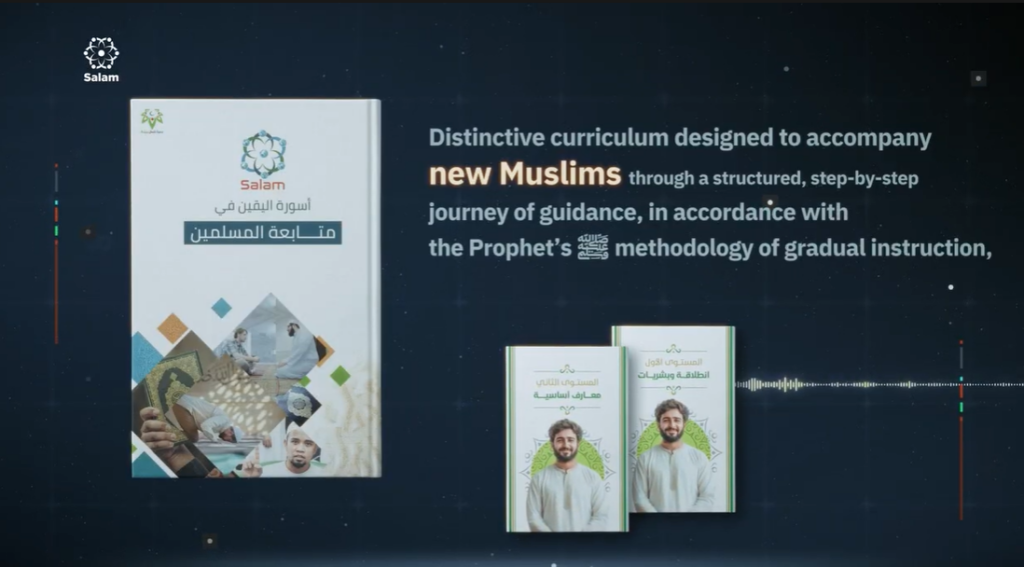
If you are already Muslim and want to build your knowledge and certainty on a firm foundation, the Asawirat Al-Yaqeen (Bracelets of Certainty) program is for you:
- A structured, four-stage curriculum designed specifically for new Muslims
- Grounded in the methodology of gradual instruction and the creed of Ahlus Sunnah wal Jama’ah
- Covers Shahada, Salah, Iman, Seerah, Islamic ethics, family rulings, and contemporary Islamic thought
- Implemented with over 114,000 new Muslims across 140 countries
- Available in multiple languages, with a smart app and interactive website in development
- Taught with a compassionate, therapeutically grounded approach that meets you where you are
Reach out directly to the Salam Center team to start the Asawirat Al-Yaqeen (Bracelets of Certainty) program for FREE.
Conclusion
Moustapha Akkad, the Syrian-American Muslim director of The Message (1976), entered the production already a practicing Muslim. His faith, not his filmmaking, was the origin of the project — a point confirmed by Al-Azhar University’s scholarly endorsement of the film’s historical accuracy.
Anthony Quinn, whose portrayal of Hamza captivated audiences across generations, was widely rumored to have entered Islam after filming. His autobiography and burial record confirm he remained Christian — a reminder that proximity to sacred truth does not automatically translate into faith, and that guidance belongs to Allah alone.
The film’s most documented conversions occurred in its audiences, not on its set. Viewers who encountered the story of early Islam through Akkad’s respectful production found their hearts moved — a living testimony to the Quran’s principle that truth, when presented with dignity, carries its own power across any medium.
Frequently Asked Questions
Did the making of The Messagelead viewers to convert to Islam?
Yes — documented viewer accounts confirm this. Individual viewers, including people who left written testimonies, have described watching The Message as the experience that first opened their hearts to Islam and led them to further research and ultimately the Shahada.
Why is the Prophet Muhammad (PBUH) not shown in The Message?
Islamic scholarship holds that depicting the Prophet (PBUH) in a visual medium — reducing his sacred personhood to an actor’s performance — diminishes the spiritual dignity of prophethood and risks becoming a form of idolatry or misrepresentation.
This ruling is rooted in the creed of Ahlus Sunnah wal Jama’ah and has been affirmed by major Islamic scholarly bodies. Director Moustapha Akkad honored this fully. The camera was mounted to represent the Prophet’s viewpoint, and companions spoke directly to the lens — a cinematically brilliant solution that preserved both the story’s coherence and the Islamic principle of reverential restraint.
Can watching The Messagebe a starting point for learning about Islam?
The Message can be a meaningful introduction to the historical emergence of Islam, and many people have found it an emotionally compelling entry point. However, films are not authoritative sources of Islamic knowledge — they are artistic interpretations.
For grounded, evidence-based learning about God in Islam, the Quran, Islamic beliefs, and what Muslims actually practice, the Salam Platform’s dedicated articles and the Asawirat Al-Yaqeen (Bracelets of Certainty) curriculum — which draws exclusively on the Quran, authenticated Hadith, and established scholarship — are far stronger foundations for anyone genuinely seeking truth.
Curious about Islam?
Journey towards clarity and purpose. Our team is here to support you in your search for truth and spiritual guidance.
Embrace the Truth