The Prophet Muhammad’s Family Tree From Abraham
| Key Takeaways |
| Prophet Muhammad (PBUH) is a direct descendant of Abraham (Ibrahim) through his son Ishmael (Ismail), making their lineage one of the most documented in religious history. |
| The Quran explicitly identifies Abraham as a prophet and ancestor of Muhammad (PBUH), connecting Islam to the original monotheistic covenant. |
| Muhammad’s (PBUH) lineage passes through Adnan, a universally agreed-upon ancestor, then continues through Ishmael back to Abraham — a chain affirmed by Islamic scholars across centuries. |
| This genealogical connection establishes Muhammad (PBUH) as the fulfillment of Abraham’s prayer for a prophet to arise among his Arab descendants. |
Prophet Muhammad (PBUH) descends directly from Abraham (Ibrahim, peace be upon him) through the line of Ishmael (Ismail). This is a genealogical fact recorded in Islamic scholarship, affirmed by the Quran, and corroborated by centuries of historical documentation from Arab and Islamic sources alike.
The chain runs from Abraham to Ishmael, then through a series of Arab ancestors culminating in the tribe of Quraysh, the clan of Banu Hashim, and finally to Muhammad ibn Abdullah (PBUH), born in Mecca in 570 CE. Every serious scholar of Islamic history, from Ibn Hisham to Ibn Kathir, has documented this lineage with precision and care.
Abraham Is the Common Root of All Three Abrahamic Traditions
Abraham stands at the junction of Judaism, Christianity, and Islam — and the Quran establishes his position with unmistakable clarity. He is called Khalilullah, the intimate friend of Allah:
وَاتَّخَذَ اللَّهُ إِبْرَاهِيمَ خَلِيلًا
“And Allah took Abraham as an intimate friend.” (Quran 4:125)
Abraham had two sons who became founders of prophetic lineages. Isaac (Ishaq) was born to his wife Sarah, and from Isaac came Jacob (Yaqub), and from Jacob came the twelve tribes of Israel — the line through which Moses, David, Solomon, and Jesus all descended. Ishmael was born earlier, to Hagar, and from Ishmael came the Arab prophetic line — culminating in Muhammad (PBUH).
This bifurcation is neither an accident nor a source of tension in Islamic theology. The Quran presents both sons as recipients of revelation and blessings, and frames the entire Abrahamic family as unified under the banner of monotheism — the belief in one Allah, undivided and without partners.
Abraham’s Prayer for a Prophet Among the Arabs
The genealogical connection between Abraham and Muhammad (PBUH) carries prophetic weight. When Abraham and Ishmael built the Kaaba in Mecca, Abraham made a specific supplication recorded in the Quran:
رَبَّنَا وَابْعَثْ فِيهِمْ رَسُولًا مِّنْهُمْ يَتْلُو عَلَيْهِمْ آيَاتِكَ وَيُعَلِّمُهُمُ الْكِتَابَ وَالْحِكْمَةَ وَيُزَكِّيهِمْ
“Our Lord, and send among them a messenger from themselves who will recite to them Your verses and teach them the Book and wisdom and purify them.” (Quran 2:129)
The Prophet Muhammad (PBUH) himself recognized this connection when he said: “I am the answer to my father Ibrahim’s supplication.” (Musnad Ahmad) — a statement that ties his prophethood directly to this moment at the Kaaba, linking his birth not merely to a bloodline but to a divine plan centuries in the making.
The Verified Genealogical Chain from Abraham to Muhammad (PBUH)
Islamic scholarship divides the Prophet’s (PBUH) lineage into two segments. The first — from Muhammad (PBUH) back to Adnan — is considered historically verified and universally agreed upon among scholars.
The second — from Adnan back to Ishmael and then to Abraham — is accepted on strong traditional authority, even if individual links in that portion are not recorded with the same precision as the first.
1. From Muhammad (PBUH) to Adnan — The Agreed-Upon Chain
Here is the lineage as recorded by the great biographer Ibn Hisham in Al-Sira al-Nabawiyya, drawing from the earlier work of Ibn Ishaq:
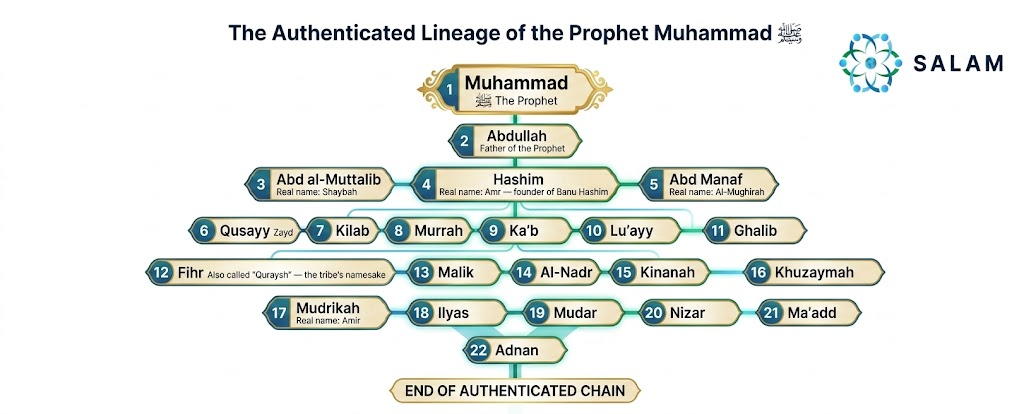
Muhammad ibn Abdullah ibn Abdul-Muttalib ibn Hashim ibn Abd Manaf ibn Qusayy ibn Kilab ibn Murra ibn Ka’b ibn Lu’ayy ibn Ghalib ibn Fihr ibn Malik ibn al-Nadr ibn Kinanah ibn Khuzaymah ibn Mudrikah ibn Ilyas ibn Mudar ibn Nizar ibn Ma’add ibn Adnan
Every name in this chain is documented and traceable. This is the segment scholars like Ibn Kathir — the 14th-century Damascene scholar and author of Al-Bidaya wa al-Nihaya — describe as reliable and authenticated by the consensus of Arab genealogists and Islamic historians.
2. From Adnan to Ishmael to Abraham
Beyond Adnan, the chain continues upward to Ishmael (Ismail), son of Abraham (Ibrahim). The precise number of generations between Adnan and Ishmael varies across narrations, which is why classical scholars exercised caution about naming each individual link.
What they affirm unanimously is the destination: Adnan descends from Ishmael, and Ishmael is the son of Abraham.
The Quran confirms Ishmael’s prophetic rank and his role alongside his father:
وَإِسْمَاعِيلَ وَإِدْرِيسَ وَذَا الْكِفْلِ كُلٌّ مِّنَ الصَّابِرِينَ
“And [mention] Ishmael and Idrees and Dhul-Kifl — all were of the patient.” (Quran 21:85)
The Tribe of Quraysh and the Clan of Banu Hashim
Within the long genealogical chain, two names stand out for their historical and religious significance: Quraysh and Hashim.
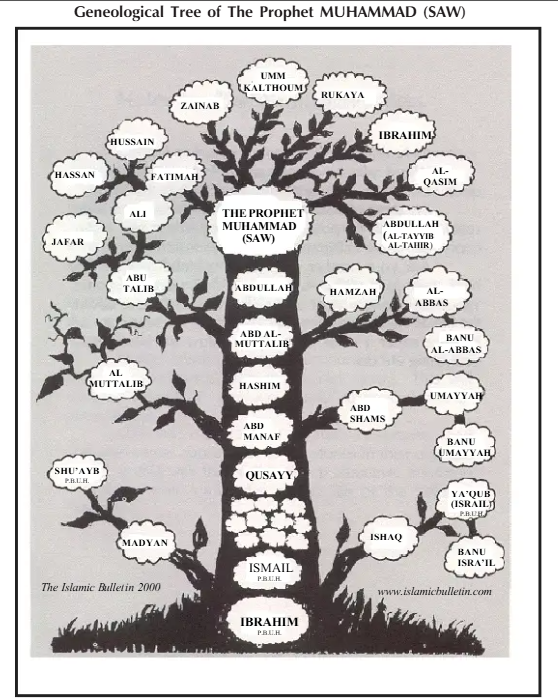
Fihr ibn Malik — appearing in the chain above — is considered the ancestor from whom the tribe of Quraysh derives its name. Quraysh became the dominant tribe of Mecca, custodians of the Kaaba, and the most prestigious lineage in Arabia.
Being Qurayshi meant something tangible: social standing, responsibility for the sacred house, and a position at the heart of Arab civilization.
Within Quraysh, the clan of Banu Hashim — named after Hashim ibn Abd Manaf, the Prophet’s great-grandfather — held particular distinction.
Hashim was known for his generosity and his role in establishing trade routes for Mecca. His son Abdul-Muttalib became a revered figure who rediscovered the Well of Zamzam and stood firm against the army of Abraha that sought to destroy the Kaaba in the Year of the Elephant — the year Muhammad (PBUH) was born.
The Prophet (PBUH) himself acknowledged the significance of his lineage:
“Allah chose Kinanah from the sons of Ishmael, and He chose Quraysh from Kinanah, and He chose Banu Hashim from Quraysh, and He chose me from Banu Hashim.” (Jami` at-Tirmidhi 3606)
This hadith frames the entire genealogical chain not as an accident of birth but as a sequence of divine selections — each generation chosen, each tribe elevated, until the final prophet arrived.
Learn More About Islam
Discover the beauty, teachings, and wisdom of Islam in a clear and welcoming way. Start exploring and deepen your understanding today.
Learn MoreIshmael’s Role in Mecca and the Arab Prophetic Tradition
Ishmael’s story is central to understanding why Muhammad (PBUH) emerged specifically among the Arabs of the Hijaz. After Abraham brought Ishmael and his mother Hagar to the valley of Mecca — an act of divine command — Ishmael grew up there, learned Arabic from the tribe of Jurhum, married among them, and became the ancestor of the Arab northern tribes.
He and his father Abraham later built the Kaaba together, establishing the first house of worship dedicated to the pure monotheism in Islam that the Quran describes:
وَإِذْ يَرْفَعُ إِبْرَاهِيمُ الْقَوَاعِدَ مِنَ الْبَيْتِ وَإِسْمَاعِيلُ
“And [mention] when Abraham was raising the foundations of the House and [with him] Ishmael.” (Quran 2:127)
This moment is the geographical and spiritual anchor of the entire Muhammadan lineage. The house Abraham and Ishmael built became the direction Muslims face in prayer. The city they consecrated became the birthplace of the final prophet. The lineage they began became the chain through which Allah’s final message arrived.
For readers interested in how Islam understands the nature of Allah and His relationship with creation, this moment at the Kaaba — father and son raising the walls together — captures something essential: that monotheism, in Islam’s understanding, is not a new idea Muhammad (PBUH) introduced, but the original, primordial religion of all the prophets.
What is the Significance of Knowing Prophet Muhammad’s (PBUH) Lineage?
A common misunderstanding — particularly in Western audiences encountering Islam for the first time — is that Islam arrived as something entirely new, disconnected from the religious history that preceded it. The Prophet’s family tree from Abraham dismantles that assumption at its root.
Muhammad (PBUH) did not introduce a foreign religion to Arabia. The Quran explicitly frames his message as a restoration of the religion of Abraham — the original, uncorrupted monotheism that Abraham himself practiced and transmitted:
مَا كَانَ إِبْرَاهِيمُ يَهُودِيًّا وَلَا نَصْرَانِيًّا وَلَٰكِن كَانَ حَنِيفًا مُّسْلِمًا
“Abraham was neither a Jew nor a Christian, but he was one inclining toward truth, a Muslim [submitting to Allah]. And he was not of the polytheists..” (Quran 3:67)
The word Muslim here carries its root meaning: one who submits to Allah. In Islamic understanding, all the prophets — from Adam to Noah to Abraham to Moses to Jesus to Muhammad — were Muslims in this sense, calling people back to the same fundamental truth.
This is why Islam’s view of other religions, particularly Judaism and Christianity, is neither dismissive nor uncritical. They emerged from the same prophetic root. Their deviation — as Islam understands it — is historical, not essential. The original message was always one.
For readers who want to explore how Islam understands faith and its relationship to prophethood, this framework is the starting point: one Allah, one message, carried across history by a series of prophets, with Muhammad (PBUH) as the final, completing messenger.
What Does the Quran Say About the Prophetic Chain from Abraham?
The Quran does not present genealogy as mere history. It presents it as evidence — of divine design, of the continuity of revelation, and of the unity underlying the prophetic tradition.
Several verses specifically link Muhammad (PBUH) to Abraham’s legacy:
إِنَّ أَوْلَى النَّاسِ بِإِبْرَاهِيمَ لَلَّذِينَ اتَّبَعُوهُ وَهَٰذَا النَّبِيُّ وَالَّذِينَ آمَنُوا
“Indeed, the most worthy of Abraham among the people are those who followed him [in submission to Allah] and this prophet, and those who believe.” (Quran 3:68)
The verse makes a striking claim. Proximity to Abraham is measured first by following his religion, then by prophetic lineage. Muhammad (PBUH) qualifies on both grounds — by blood and by message.
This is part of why the Quran is so insistent on naming Abraham across dozens of suras. His story is not background context. It is the architecture of the entire prophetic mission, and Muhammad (PBUH) is its completion.
Learn More About Islam
Discover the beauty, teachings, and wisdom of Islam in a clear and welcoming way. Start exploring and deepen your understanding today.
Learn MoreContinue Gaining Authentic Knowledge About Islam and the Prophet with Salam
If this family tree has opened more questions than it answered — about the prophets, the Quran, or what Muslims actually believe at the foundation of their faith — the Salam blog has a growing library of articles written for exactly this kind of inquiry.
You might find it valuable to explore how Islam understands God and what Islamic beliefs actually consist of at their core. The question of lineage connects directly to the question of message — and that message, Islam teaches, belongs to everyone.
For questions not covered here — whether about entering Islam, understanding a specific teaching, or simply wanting to talk —Reach out directly. The Salam Platform exists to answer them, without judgment and without pressure.

Frequently Asked Questions
Is the Prophet Muhammad’s lineage from Abraham confirmed in the Quran?
No, the Prophet Muhammad’s lineage from Abraham is not confirmed in the Quran. The Quran affirms Abraham and Ishmael as prophets, confirms their building of the Kaaba in Mecca, and records Abraham’s supplication for a messenger to arise among his Arab descendants — a supplication the Prophet (PBUH) explicitly identified as referring to himself. The Quran also states in Surah 3:68 that the most worthy of Abraham’s legacy are those who follow his religion and "this prophet," directly linking Muhammad (PBUH) to the Abrahamic line. The genealogical specifics are detailed in authenticated biographical sources, particularly Ibn Hisham and Ibn Kathir.
Are Muslims, Jews, and Christians all descendants of Abraham?
In religious terms, yes — all three traditions trace their prophetic origins to Abraham. In Islam’s understanding, Abraham had two sons through whom distinct prophetic lines descended: Ishmael, ancestor of the Arab prophets including Muhammad (PBUH), and Isaac, ancestor of the Israelite prophets including Moses and Jesus. Islam honors all these prophets and considers their original messages consistent in their call to faith in one Allah. The differences between the three traditions, from an Islamic perspective, arise from later historical changes to the earlier revelations — not from the original message itself.
Why did the Prophet Muhammad (PBUH) emerge from the Arabs specifically?
The Prophet Muhammad (PBUH) emerged from the Arabs specifically as a divine selection, not a geographical coincidence. The Prophet (PBUH) himself said: "Allah chose Kinanah from the sons of Ishmael, and chose Quraysh from Kinanah, and chose Banu Hashim from Quraysh, and chose me from Banu Hashim." (Sahih Muslim) Ishmael’s settlement in Mecca, his building of the Kaaba with Abraham, and his becoming the ancestor of the Arab tribes — all of this created the lineage and the sacred geography from which the final prophet would emerge. It was the fulfillment of Abraham’s own prayer at that very site centuries earlier.
Curious about Islam?
Journey towards clarity and purpose. Our team is here to support you in your search for truth and spiritual guidance.
Embrace the Truth