Prophet Muhammad’s Family Tree and Lineage — Charts, Diagrams & Full PDF Guide
| Key Takeaways |
| Prophet Muhammad (PBUH) descends from a noble lineage traced with certainty to Adnan, a descendant of Prophet Ishmael (Isma’eel), son of Prophet Abraham (Ibrahim). |
| Islamic scholars unanimously agree on the Prophet’s lineage from Muhammad to Adnan — comprising 21 generations — with no scholarly dispute on any name in this chain. |
| Beyond Adnan, the lineage connects to Ishmael and Abraham through approximately 9 to 40 intermediate ancestors, with scholarly differences only on the precise names and number of generations. |
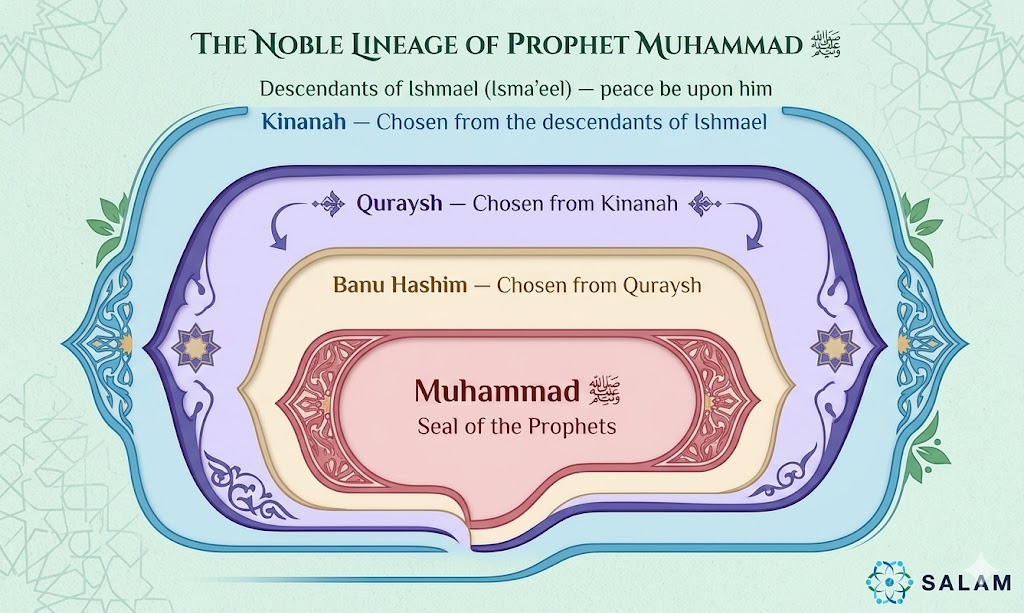
| Allah chose the Prophet’s lineage with divine selection at every level: from the descendants of Ishmael, He chose Kinanah; from Kinanah, Quraysh; from Quraysh, Banu Hashim; and from Banu Hashim, Muhammad (PBUH). |
| The Prophet’s progeny continued exclusively through his grandsons Al-Hasan and Al-Husayn, sons of Ali ibn Abi Talib and Fatimah al-Zahra — making every descendant of the Prophet traceable to these two. |
Who was Prophet Muhammad (PBUH) in terms of origin, ancestry, and bloodline? The answer matters — not merely as biography, but as a matter of faith, history, and the understanding of how divine selection operates across generations.
Allah did not send His final Messenger from an ordinary background. He chose him from the most noble lineage among the most noble peoples of the earth, through a chain of selection that began with Prophet Abraham (Ibrahim, peace be upon him) himself.
Islamic scholarship divides the Prophet’s family tree into three distinct segments: a fully authenticated chain from Muhammad to Adnan, a reported but debated chain from Adnan to Ishmael, and a traditional narrative from Ishmael back to Adam. This article traces all three segments clearly — with diagrams, structured charts, and explanatory commentary — so that you can follow the full prophetic lineage with confidence and understanding.
The Divine Selection Behind Prophet Muhammad’s Lineage
Before mapping the family tree, it is essential to understand why the lineage matters in Islamic theology. The Prophet (PBUH) himself articulated the principle of divine selection in a hadith recorded by Imam Muslim in his Sahih:
إِنَّ اللَّهَ اصْطَفَى كِنَانَةَ مِنْ وَلَدِ إِسْمَاعِيلَ، وَاصْطَفَى قُرَيْشًا مِنْ كِنَانَةَ، وَاصْطَفَى مِنْ قُرَيْشٍ بَنِي هَاشِمٍ، وَاصْطَفَانِي مِنْ بَنِي هَاشِمٍ
“Indeed, Allah chose Kinanah from the descendants of Ishmael, and chose Quraysh from Kinanah, and chose Banu Hashim from Quraysh, and chose me from Banu Hashim.” (Sahih Muslim, 2276)
This hadith reveals a layered, purposeful divine selection — not hereditary privilege for its own sake, but a preparation across millennia for the emergence of the Seal of the Prophets.
This also helps us understand the principles of Islam more deeply — that Islam is not an arbitrary religion but one rooted in a coherent divine plan unfolding through history.
The diagram below shows this selection structure before we trace the full family tree:
1. The Authenticated Chain From Prophet Muhammad to Adnan (21 Generations)
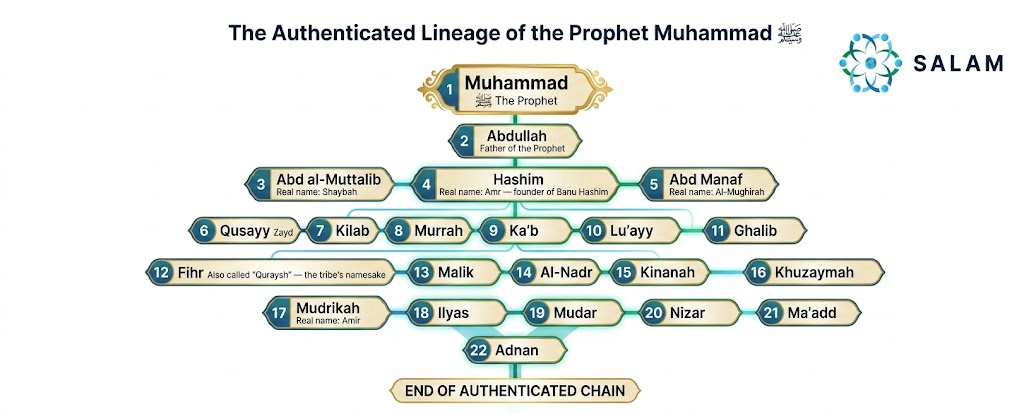
This is the fully agreed-upon segment of the Prophet’s lineage. Ibn al-Qayyim al-Jawziyyah (may Allah have mercy on him), the renowned 14th-century Hanbali scholar whose works remain standard references in Islamic scholarship, stated explicitly in Zad al-Ma’ad: “Up to this point the lineage is known with certainty, agreed upon by genealogists, with no disagreement whatsoever. What lies above Adnan is disputed.”
The chain is as follows, with the real names of ancestors noted where their common titles differ:
| # | Name | Note |
| 1 | Muhammad | The Prophet ﷺ |
| 2 | Abdullah | Father of the Prophet |
| 3 | Abd al-Muttalib | Real name: Shaybah |
| 4 | Hashim | Real name: Amr — founder of Banu Hashim |
| 5 | Abd Manaf | Real name: Al-Mughirah |
| 6 | Qusayy | Real name: Zayd |
| 7 | Kilab | |
| 8 | Murrah | |
| 9 | Ka’b | |
| 10 | Lu’ayy | |
| 11 | Ghalib | |
| 12 | Fihr | Also called “Quraysh” — the tribe’s namesake |
| 13 | Malik | |
| 14 | Al-Nadr | |
| 15 | Kinanah | |
| 16 | Khuzaymah | |
| 17 | Mudrikah | Real name: Amir |
| 18 | Ilyas | |
| 19 | Mudar | |
| 20 | Nizar | |
| 21 | Ma’add | |
| 22 | Adnan | End of authenticated chain |
Now the full visual chart of this authenticated chain:
2. The Lineage of Prophet Muhammad From Adnan to Ishmael
Beyond Adnan, Islamic scholars agree on the destination — Ishmael son of Abraham — but differ on the intermediate names and the number of generations.
Imam al-Dhahabi, one of the foremost hadith scholars and biographers in Islamic history, recorded this disagreement in his Siyar A’lam al-Nubala’ (Biographies of Noble Figures): scholars have placed between 9 and 40 generations between Adnan and Ishmael, with the most commonly cited opinion being around 9 to 15.
Abu Amr ibn Abd al-Barr, the great Maliki scholar of 11th-century Andalusia whose Al-Isti’ab remains a primary reference in the biographies of the Companions, cited what he considered the most supported version:
Adnan → Udd → Muqawwam → Nahur → Teerah → Ya’rub → Yashjub → Nabit → Ishmael (Isma’eel)
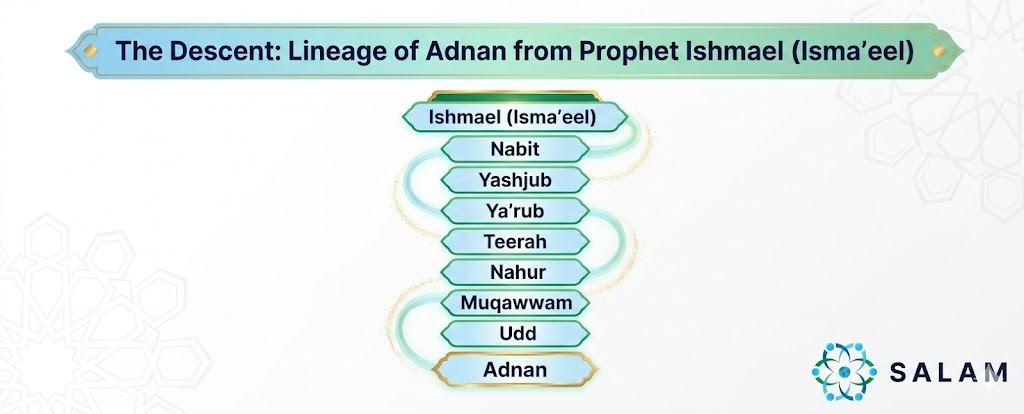
This is 8 generations from Adnan to Ishmael. This is the chain adopted by Muhammad ibn Ishaq, the earliest and most authoritative compiler of the Prophetic biography (Seerah).
Scholars like Urwah ibn al-Zubayr (nephew of Aishah and one of the seven great jurists of Madinah) said plainly: “We found no one who knows what lies beyond Adnan and Qahtan except through speculation.”
Ibn Sa’d, author of Al-Tabaqat al-Kubra, the encyclopedic biographical dictionary of early Islam, concluded: “The correct position for us is to stop at Adnan regarding what lies between him and Ishmael.”
This scholarly caution reflects a core principle of Islamic epistemology — affirm what is certain, acknowledge uncertainty for what is not. Understanding faith in Islam means accepting both what is established and admitting what remains in the realm of transmitted reports.
Learn More About Islam
Discover the beauty, teachings, and wisdom of Islam in a clear and welcoming way. Start exploring and deepen your understanding today.
Learn More3. The Lineage of The Prophet Muhammad From Ishmael to Adam
The third segment of the Prophet’s lineage connects Ishmael all the way back to Adam through the chain of prophets. This portion is narrated in Islamic historical sources but categorized by scholars as riwayah (transmitted narration from scriptures), not tawatur (mass-authenticated historical chain). The Quran confirms the existence of these prophets individually, and this chain accords with the Abrahamic tradition found across the People of the Book.
The chain as recorded by Ibn Ishaq and cited by Ibn Abd al-Barr:
Ishmael → Abraham (Ibrahim) → Azar (Tarih) → Nahur → Saru’ → Ra’u → Falikh → Aybar → Shalikh → Arfakhshad → Sam → Noah (Nuh) → Lamk → Mutwashlak → Akhnukh → Yarid → Mahlail → Qaynan → Yanish → Shith → Adam
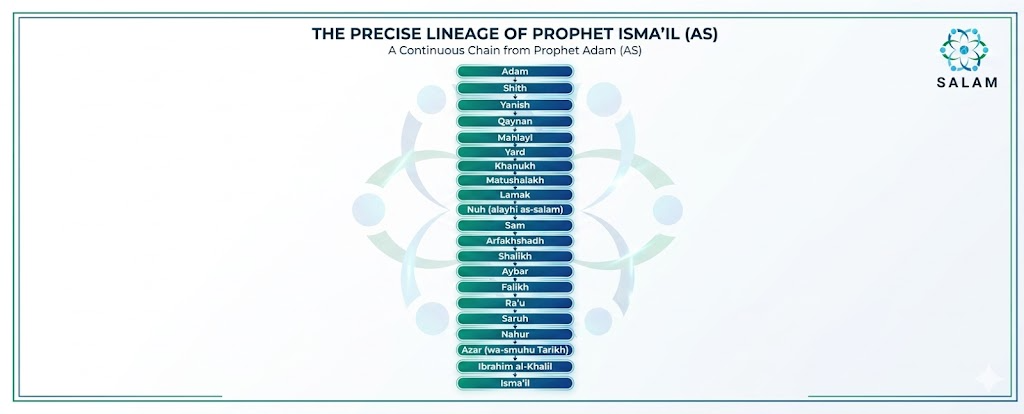
The Complete Prophet Muhammad’s Family Tree to Adam
To consolidate all of the above, here is a single overview chart showing all three segments of the Prophet’s lineage:
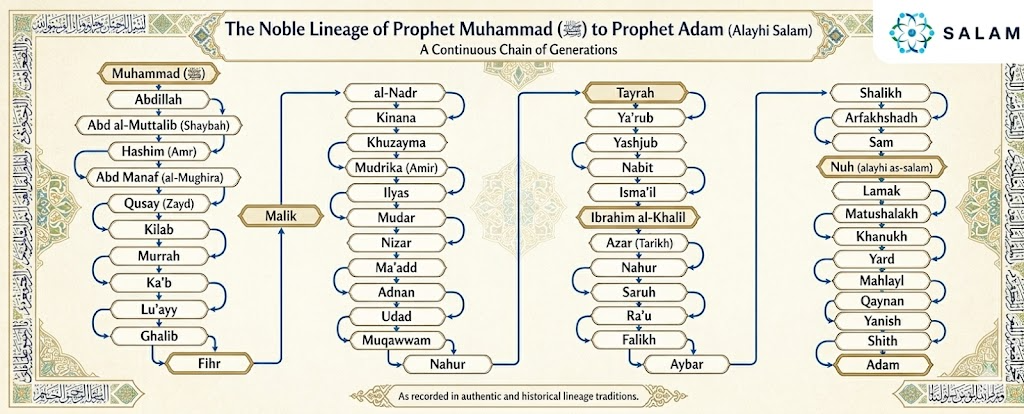
The Simple Prophet Muhammad Family Tree Chart
The simplified chain runs: Muhammad → Abdullah → Abd al-Muttalib → Hashim → Abd Manaf → Qusayy → Kilab → Murrah → Ka’b → Lu’ayy → Ghalib → Fihr (Quraysh) → Malik → Al-Nadr → Kinanah → Khuzaymah → Mudrikah → Ilyas → Mudar → Nizar → Ma’add → Adnan → [reported chain] → Ishmael → Abraham. This covers the authenticated segment plus the first well-known ancestor beyond it.
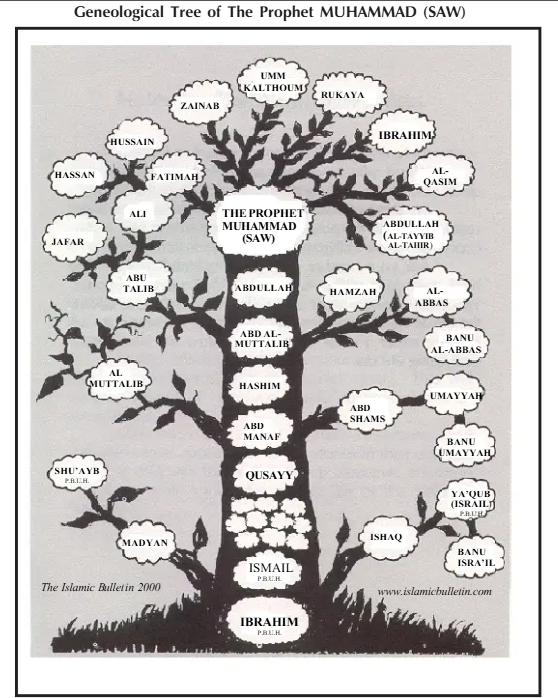
The Prophet’s Parents and Immediate Family
Understanding the Prophet’s lineage also means understanding his immediate family. His father, Abdullah, died before the Prophet’s birth. His mother, Aminah bint Wahb, was from the Banu Zuhrah clan of Quraysh — herself from a noble and well-regarded lineage.
The Prophet (PBUH) described his noble origin through both parental lines in the hadith recorded by al-Hakim and authenticated by Imam al-Dhahabi:
“I am the servant of Allah and the Seal of the Prophets, while my father was still forming in clay. I will tell you about this: I am the supplication of my father Ibrahim, the glad tidings of my brother Isa, and the vision of my mother Aminah — for she saw, when she gave birth to me, a light that illuminated the palaces of Syria.”
This hadith appears in Al-Mustadrak of al-Hakim — one of the supplementary hadith compilations accepted by Sunni scholars alongside the six primary collections.
The Prophet’s position as both the da’wah (call) of Abraham and the bushra (glad tidings) of Jesus (peace be upon him) connects his coming to the broader Abrahamic prophetic mission.
Read also: The Splitting of the Moon by Prophet Muhammad
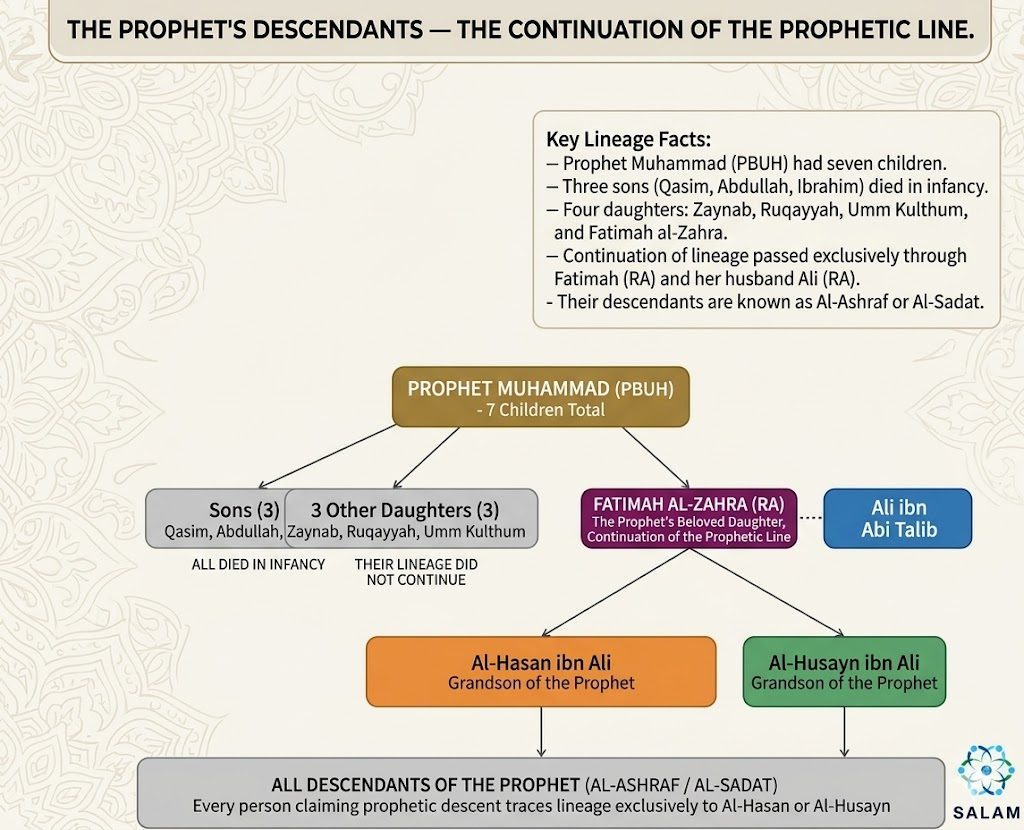
The Prophet’s Descendants — The Continuation of the Prophetic Line
Prophet Muhammad (PBUH) had seven children — six from his first wife Khadijah, and one son Ibrahim from Maria al-Qibtiyyah. All his sons died in infancy. His daughters were: Zaynab, Ruqayyah, Umm Kulthum, and Fatimah al-Zahra.
The continuation of his lineage passed exclusively through Fatimah al-Zahra and her husband Ali ibn Abi Talib (may Allah be pleased with them).
Their two sons — Al-Hasan and Al-Husayn — are the two branches through whom every descendant of the Prophet traces their lineage. These descendants are called Al-Ashraf or Al-Sadat in the Islamic world.
Read also: Archaeological Evidence of Prophet Muhammad
Family Tree of Prophet Muhammad PDF
For those who prefer a printable or downloadable reference, a PDF of the Prophet’s family tree is available below. The document presents the full lineage — from Muhammad (PBUH) to Adnan — in a clean, structured format suitable for personal study, classroom use, or sharing with seekers and new Muslims.
The PDF mirrors the authenticated chain documented in this article, drawing on the same scholarly sources: the consensus of Islamic genealogists from Ibn Ishaq through Imam al-Dhahabi, with clear visual distinctions between the three segments of the lineage and their respective levels of scholarly authentication.
📄 Download the Prophet Muhammad Family Tree PDF
Whether you are a new Muslim working through the Asawirat Al-Yaqeen (Bracelets of Certainty) curriculum, a seeker researching Islam’s prophetic tradition, or an educator preparing materials for a study circle, this PDF is designed to serve as a lasting reference — one you can return to, print, and share freely.
Consider joining the Asawirat Al-Yaqeen (Bracelets of Certainty) program — a four-stage curriculum designed specifically for you:
- Stage One (The Foundation): Understanding the Shahada, pillars of Islam, prayer, and purification
- Stage Two (The Construction): The six pillars of faith, fasting, Zakat, Hajj
- Stage Three (The Consolidation): Repentance, the Seerah of the Prophet, Islamic ethics and conduct
- Stage Four (The Empowerment): Contemporary issues, creed of Ahlus Sunnah, a life roadmap from Surah Al-Asr
The program has served 114,588 new Muslims across 140 countries. You are not alone on this path.
Reach out directly to the Salam Center team to start the Asawirat Al-Yaqeen (Bracelets of Certainty) program for FREE.
The Prophetic Lineage as Evidence for Islam’s Coherence
The family tree of Prophet Muhammad (PBUH) is not merely genealogical data. It is a theological statement about how Allah works in history — selecting, purifying, and preparing across generations for the emergence of His final Messenger.
The Prophet described himself as the du’a (supplication) of Abraham, who prayed:
“Our Lord, send among them a messenger from themselves who will recite to them Your verses and teach them the Book and wisdom and purify them.” (Quran 2:129)
Allah answered that prayer thousands of years later through the lineage documented in this article.
This lineage also connects directly to the Quranic concept of monotheism — that all the prophets from Adam to Muhammad carried one message: the oneness of Allah.
Every ancestor in the chain was part of a world that would eventually receive the final and complete revelation. Understanding Allah in Islam — His oneness, His attributes, and His interaction with creation through prophets — provides the theological context that makes the prophetic lineage meaningful rather than merely historical.
Learn More About Islam
Discover the beauty, teachings, and wisdom of Islam in a clear and welcoming way. Start exploring and deepen your understanding today.
Learn MoreLearn More Authentic Knowledge About Islam with Salam
The story of Prophet Muhammad’s lineage is a doorway into the broader world of Islamic knowledge, Seerah (prophetic biography), and faith.
If this article opened something in you — a question, a curiosity, or a step toward understanding Islam more deeply — the Salam Center is here to walk with you.
📖 Explore more articles at the Salam Platform and the Salam Blog
💬 Have a specific question about Islam? Reach out directly — our team is available to respond personally.
Conclusion
Prophet Muhammad’s lineage divides into three scholarly-defined segments. The chain from Muhammad to Adnan — 22 generations — is unanimously authenticated by all Islamic genealogists with no scholarly dispute on any single name. Beyond Adnan, the chain reaches Ishmael through approximately 9 to 15 intermediate ancestors in the most accepted scholarly view.
Allah’s divine selection of the Prophet’s lineage operated across multiple levels: from Ishmael’s descendants He chose Kinanah, from Kinanah came Quraysh, from Quraysh rose Banu Hashim, and from Banu Hashim emerged Muhammad (PBUH). This selection reflects Islam’s understanding of prophetic history as purposeful and coherent, not coincidental.
The Prophet’s progeny continued solely through his daughter Fatimah al-Zahra and his two grandsons, Al-Hasan and Al-Husayn. Every person today who traces their lineage to the Prophet does so through these two noble sons — a living, unbroken thread connecting the present to the light of the final Messenger.
Frequently Asked Questions
How many generations are there between Prophet Muhammad and Adam?
The total chain from Muhammad (PBUH) to Adam, combining all three segments, is approximately 56 to 75 generations depending on the scholarly source. The first 22 generations — from Muhammad to Adnan — are authenticated with certainty. The remaining generations, from Adnan through Ishmael, Abraham, Noah, and back to Adam, are drawn from Islamic historical narrations and Abrahamic scriptures. Scholars accept this broader chain as transmitted tradition while noting that only the chain to Adnan carries full authentication.
Who are the descendants of Prophet Muhammad alive today?
All living descendants of the Prophet trace their lineage through Al-Hasan ibn Ali or Al-Husayn ibn Ali — the two grandsons born to Fatimah al-Zahra and Ali ibn Abi Talib (may Allah be pleased with them). These descendants are called Ashraf (nobles) or Sadat (masters). They exist in large numbers across the Muslim world, particularly in countries with historically Arab-Islamic heritage. Lineage claims are verified by genealogical councils in several Muslim countries, including the Naqabat al-Ashraf institutions present in many Arab lands.
Is Prophet Muhammad’s lineage traceable to Adam in the Quran?
The Quran does not present a complete genealogical chain from Muhammad to Adam. Rather, it confirms individual prophets mentioned in that chain — among them Adam, Idrees, Noah, Abraham, and Ishmael — as real prophets sent by Allah. The full chain from Muhammad to Adam is found in Islamic historical sources, particularly the Seerah works of Ibn Ishaq. The Quran’s confirmation of faith in Allah and His messengers supports the theological coherence of this lineage, even where it does not enumerate every ancestor by name.
Why does Islamic scholarship stop with confidence at Adnan?
Ibn al-Qayyim al-Jawziyyah and Imam al-Dhahabi — among the most authoritative scholars in Islamic biographical tradition — both concluded that genealogical transmission before Adnan does not meet the standard of historical certainty. Urwah ibn al-Zubayr, one of the seven great jurists of Madinah and a major Companion-generation scholar, stated that no one could verify the chain beyond Adnan and Qahtan except through conjecture. This reflects the Islamic scholarly ethic of intellectual honesty: affirm what is verified, suspend judgment on what is not.
Curious about Islam?
Journey towards clarity and purpose. Our team is here to support you in your search for truth and spiritual guidance.
Embrace the Truth