
Do Muslims Believe in Polygamy?
| Key Takeaways |
| Islam permits polygamy with a strict maximum of four wives, subject to binding conditions of justice, financial capacity, and physical ability. |
| The Quran explicitly ties the permission to marry multiple women to the near-impossible standard of perfect fairness, making monogamy the practical default. |
| Islamic polygamy was legislated for specific social purposes — protecting widows, orphans, and unmarried women — rather than as a license for personal indulgence. |
| Justice in treatment (housing, maintenance, and time) is mandatory; equality in emotional love is acknowledged as beyond human control. |
| Failing to maintain justice between wives carries severe consequences according to the Prophet Muhammad (PBUH), making the practice a weighty religious responsibility. |
Yes, Muslims believe polygamy is permitted — but the permission comes wrapped in conditions so stringent that Islamic scholars have long emphasized monogamy as the safer, sounder choice for most men.
The Quran does not celebrate multiple marriages as an ideal; it regulates an existing human reality with a framework built on fairness, responsibility, and care for vulnerable women.
To understand the Islamic position clearly, you have to separate it from two distorted images that tend to dominate Western conversations: the fantasy version that treats it as unchecked license, and the dismissive version that treats it as inherent oppression.
The actual ruling sits in neither place. It is a carefully bounded permission — not a blanket freedom — rooted in divine wisdom and shaped by centuries of scholarly deliberation.
Do Muslims Believe in Polygamy?
Yes, Muslims believe polygamy is permitted in Islam. Islamic law permits a man to marry up to four wives, and this permission carries a condition. Polygamy in Islam carries a Quranic permission bounded by a Quranic condition — justice between wives.
The Quranic Foundation for Polygamy in Islam
The primary source for the Islamic ruling on polygamy is Surah An-Nisa, the fourth chapter of the Quran. The verse does not open with an invitation to take multiple wives — it opens with a concern for orphans and justice:
وَإِنْ خِفْتُمْ أَلَّا تُقْسِطُوا فِي الْيَتَامَىٰ فَانكِحُوا مَا طَابَ لَكُم مِّنَ النِّسَاءِ مَثْنَىٰ وَثُلَاثَ وَرُبَاعَ ۖ فَإِنْ خِفْتُمْ أَلَّا تَعْدِلُوا فَوَاحِدَةً
“And if you fear that you will not deal justly with the orphan girls, then marry those that please you of other women, two or three or four. But if you fear that you will not be just, then marry only one.” (Quran 4:3)
The verse’s logic is unmistakable. The permission to marry more than one woman arrives alongside two explicit conditions: the capacity for justice, and the acknowledgment that fear of injustice should drive a man toward one wife alone. The structure of the verse is its own ruling: justice is the gate through which any man must pass before the permission applies to him.
Classical Quranic exegete Ibn Kathir, in his landmark Tafsir al-Quran al-Azim, explains that this verse was revealed in a social context where the guardian of an orphan girl might marry her to access her wealth without treating her fairly.
The permission for polygamy, in that context, was simultaneously a protection for women — directing men toward legitimate, regulated marriage rather than exploitative arrangements.
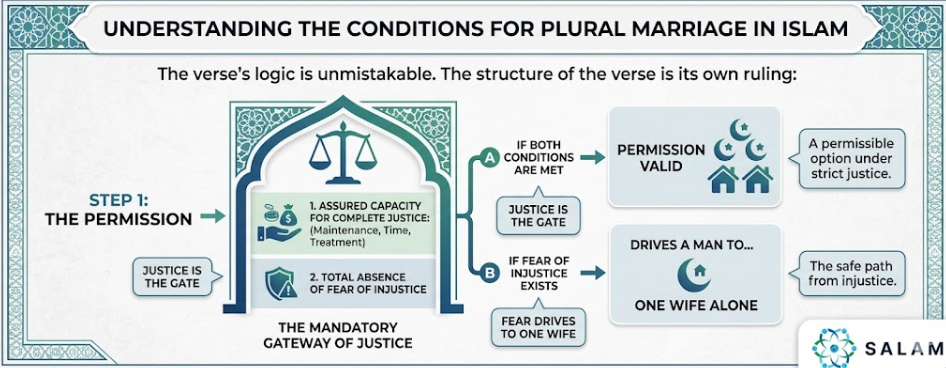
What Are The Conditions That Make Polygamy Lawful in Islam?
Islamic jurisprudence does not treat polygamy as an open door. The International Islamic Fiqh Academy, which represents the scholarly consensus of the Muslim world’s leading jurists, affirms that the permission is bound by conditions without which it does not apply.
1. Financial Capacity Is a Prerequisite
A man who wishes to marry a second, third, or fourth wife must be able to provide fully for each household. Housing, clothing, food, medical care — all must be maintained at a reasonable standard for every wife.
A man who cannot meet this threshold has no valid basis for a second marriage. The classical position of the four major schools of Islamic law — Hanafi, Maliki, Shafi’i, and Hanbali — is unanimous on this point.
2. Justice in Treatment Is Obligatory
The Arabic word used in the Quran is ‘adl — justice. In the practical sense of polygamy, ‘adl covers three domains: equal time (the rotation of nights between wives), equal financial provision, and equal quality of general treatment.
Scholars have specified that each wife is entitled to her complete turn with her husband, without interruption, unless she herself willingly waives that right.
The Prophet (PBUH) modeled this with remarkable precision. It is narrated from ‘Aisha (may Allah be pleased with her) that he used to divide his time equally among his wives, and would supplicate:
“اللَّهُمَّ هَذِهِ قِسْمَتِي فِيمَا أَمْلِكُ، فَلَا تَلُمْنِي فِيمَا تَمْلِكُ وَلَا أَمْلِكُ”
“O Allah, this is my division in what I possess — so do not blame me for what You possess and I do not.” (Sunan Abu Dawud)
The supplication itself reveals something profound. Even the Prophet (PBUH) — the most balanced of men — acknowledged that the heart has inclinations beyond human control.
The Quran speaks to this directly:
وَلَن تَسْتَطِيعُوا أَن تَعْدِلُوا بَيْنَ النِّسَاءِ وَلَوْ حَرَصْتُمْ
“And you will never be able to be equal [in feeling] between wives, even if you should strive [to do so].” (Quran 4:129).
The scholars explain that emotional love — what the heart feels — is not what is obligated. What is obligated is outward, measurable, equal treatment.
3. The Limit of Four
No Islamic tradition, school of thought, or scholarly body disputes the ceiling: four wives at one time is the absolute maximum permitted.
Have Questions About Islam?
Our team is ready to answer your questions clearly and respectfully. Ask freely and receive honest guidance.
Ask Us NowRead also: Does Islam Believe In Magic?
The Social Wisdom Behind the Permission of Polygamy in Islam
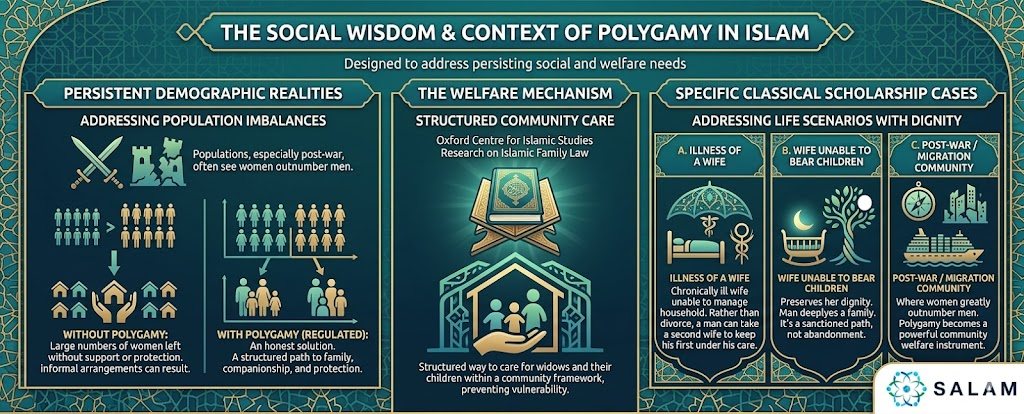
A recurring question from Western audiences is: why permit it at all? The answer sits in social realities that Islamic law was designed to address — realities that, in various forms, persist across human societies to this day.
Across most populations and especially in the aftermath of wars, women outnumber men.
A strict legal prohibition on polygamy does not resolve this demographic reality; it simply leaves large numbers of women without the protection, companionship, and family that marriage provides.
Islamic law chose a regulated, honest solution over a situation where women are left without support or driven into informal arrangements.
The Oxford Centre for Islamic Studies has noted in its research on Islamic family law that the Quranic permission for polygamy historically functioned as a welfare mechanism — a structured way to care for widows and their children within a community framework, rather than leaving them socially and economically vulnerable.
Consider the cases the classical scholars enumerated:
A wife who becomes chronically ill and can no longer maintain the household — rather than divorcing her and leaving her alone, a man may take a second wife and keep his first under his care.
A wife who is unable to bear children while her husband deeply desires a family — rather than abandonment, he has a sanctioned path that preserves her dignity.
A community where wars or migration have produced far more women than men — polygamy, in that context, becomes a community welfare instrument.
These are not theoretical edge cases. They represent the actual social contexts in which this permission was legislated.
What the Prophet Muhammad (PBUH) Said About Injustice Between Wives?
The weight Islamic law places on justice is perhaps best measured by the severity of the warning attached to injustice. The Prophet (PBUH) said:
“إِذَا كَانَ عِنْدَ الرَّجُلِ امْرَأَتَانِ فَلَمْ يَعْدِلْ بَيْنَهُمَا جَاءَ يَوْمَ الْقِيَامَةِ وَشِقُّهُ سَاقِطٌ”
“When a man has two wives and does not deal justly between them, he will come on the Day of Resurrection with one of his sides drooping.” (Sunan al-Tirmidhi)
This Hadith is not a peripheral warning — it appears across multiple authenticated collections and was taken with the utmost seriousness by Islamic jurists.
The physical image of a man arriving before Allah with half his body collapsed is a vivid, deliberate description of moral ruin.
It makes clear that a man who enters polygamy and fails to maintain justice has not exercised a right — he has committed a wrong.
Read also: Does Islam Believe In Reincarnation?
How Islamic Polygamy Compares to Western Assumptions
When Western audiences hear “polygamy,” the images that surface are usually drawn from tabloid reporting or historical caricature — harems, coercion, women treated as possessions.
The Islamic framework is a different institution entirely.
Each wife in an Islamic marriage holds full, independent legal personhood. She has rights to her own property, her own inheritance, her own say in the terms of her marriage contract.
A woman may, if she chooses, include a condition in her marriage contract stipulating that her husband may not take a second wife without her consent — and this condition is legally valid and enforceable under classical Islamic jurisprudence.
The fourth-century Hanbali jurist Ibn Qudama documented this position in Al-Mughni, affirming that such conditions, once agreed upon, are binding.
This contrasts sharply with an assumption that polygamy in Islam is imposed on women without their input. The actual legal tradition gives women more contractual leverage than is commonly understood. Understanding the broader framework of faith in Islam — including the principle that every ruling is grounded in mercy and purposeful design — helps make sense of why these protections exist within the permission itself.
Read also: Does Islam Believe In Rebirth?
Why Did Islam Not Prohibit Polygamy Entirely?
The question sometimes posed by thoughtful skeptics is: if fairness is so difficult, why not simply prohibit it? The answer lies in a principle running through all of Islamic law — that Allah legislates for the full range of human conditions, not only the ideal ones.
Prohibition creates its own harms
A man with a chronically ill wife, unable to care for a household, would face a binary choice under prohibition: remain celibate indefinitely, or divorce a vulnerable woman.
Neither outcome serves justice. Islam chose a third path: a regulated, rights-preserving alternative that keeps the first wife protected and the second wife in a legitimate, dignified relationship.
This reflects the broader character of Islam’s principles — a legal and moral system that engages with human reality as it exists, not as an abstract ideal, and builds justice into the structure of its permissions, not merely into its prohibitions.
And fundamentally, as Muslim scholars consistently point out: the One who permitted it is Allah, who knows His creation more completely than any human legal theorist.
The permission carries divine authority, and the conditions it carries reflect divine wisdom — a wisdom that encompasses both the individual and the community in every ruling it produces.
This understanding of who Allah is and how He relates to humanity is central to how Islam views the nature of God.
Have Questions About Islam?
Our team is ready to answer your questions clearly and respectfully. Ask freely and receive honest guidance.
Ask Us NowExplore More With Salam
If this topic raised further questions for you — about Islamic family law, the wisdom behind Quranic rulings, or how Islam approaches human relationships — the Salam blog is a growing library of thoughtful, evidence-based articles on exactly these topics.
Whether you’re researching out of curiosity, navigating a specific question, or exploring Islam more seriously, Salam Platform is here for you.
For questions not covered in our articles — including guidance on entering Islam, personal inquiries about Islamic teachings, or requests for specific scholarly resources — reach out to us directly. Every question deserves a real, honest answer.

Frequently Asked Questions
Do Muslims believe polygamy is required or encouraged?
Polygamy in Islam is a conditional permission — it carries no obligation and receives no particular encouragement. The Quran’s explicit instruction is that a man who fears he cannot be just should marry only one wife, and classical Islamic scholarship treats monogamy as the default and the safer path. Most Muslim men throughout history have been monogamous, and the tradition does not present multiple marriages as a mark of piety or religious virtue.
What are the Islamic conditions for a man to take a second wife?
Islamic law stipulates three binding conditions: financial capacity to provide fully for each wife’s household, physical ability to fulfill the responsibilities of multiple marriages, and genuine confidence in one’s ability to treat all wives with equal justice in time, maintenance, and treatment. If any of these conditions cannot be met, the permission does not apply. The Quran states directly that fear of injustice should lead a man to one wife only.
Does a Muslim wife have any say if her husband wants to remarry?
A Muslim woman has several avenues of protection. She may include a condition in her marriage contract requiring her husband’s first wife’s consent — or her own consent — before any subsequent marriage takes place. This condition, once agreed upon, is legally binding under Islamic jurisprudence. Beyond the contract, Islamic law obligates her husband to inform her of any new marriage, and she retains her full legal rights including divorce if she finds the situation untenable.
How does Islam justify polygamy when it causes emotional pain to women?
Islam acknowledges the emotional difficulty — the Quran itself states that complete emotional equality between wives is beyond human capacity. The justification rests not on dismissing that pain but on weighing it against broader social goods: protecting women who would otherwise have no marriage, no financial security, and no family. The alternative to a regulated permission, in many historical and demographic contexts, is not satisfied monogamy — it is informal arrangements, abandonment of vulnerable women, or relationships that carry no legal protections at all. Islam chose the path that extends legal dignity and protection to more women, not fewer.
Is polygamy common among Muslims today?
Polygamy among Muslims today is statistically uncommon. The conditions Islamic law attaches to it — financial sufficiency, physical capacity, and demonstrable justice — make it a significant undertaking that most Muslim men do not pursue. In many Muslim-majority countries, additional legal regulations govern or restrict it further. Where it does occur, it tends to be in specific social or demographic contexts. The image of widespread polygamy as a defining feature of Muslim life does not reflect the actual practice of Muslim communities globally.
Curious about Islam?
Journey towards clarity and purpose. Our team is here to support you in your search for truth and spiritual guidance.
Embrace the Truth