Does Islam Believe In Rebirth?
| Key Takeaways |
| Islam does not believe in rebirth or reincarnation — the soul lives once in this world, then passes to an eternal afterlife. |
| The Quran explicitly states that each soul dies once and faces Allah’s judgment after a single earthly life. |
| Islamic theology holds that the soul is a divine trust, unique and unrepeatable, created for one lifetime of accountability. |
| The concept of reincarnation contradicts core Islamic beliefs about divine justice, individual accountability, and the nature of the soul. |
| Islamic scholars across centuries have reached unanimous consensus (ijma’) that rebirth has no basis in the Quran or authentic Sunnah. |
The concept of rebirth, familiar from Hindu and Buddhist traditions, rests on assumptions about the soul, justice, and existence that Islam addresses head-on — and resolves differently.
Understanding why Islam rejects reincarnation clarifies something far more important than a comparative religion exercise: it reveals the Islamic understanding of what a human life actually is, what it’s for, and why it can only happen once.
Does Islam Believe in Rebirth?
No, Islam does not believe in rebirth, reincarnation, or any form of transmigration of the soul. Every human soul lives exactly one earthly life, dies once, enters a transitional state called the Barzakh, and then faces resurrection and divine judgment on the Day of Qiyamah. That is the complete arc — no returns, no second lives, no cycling back.
The Quran Establishes a Single Life Followed by Eternal Accountability
The Quran does not leave this question ambiguous. Death is appointed once for every soul, and after it comes the encounter with Allah — no loop, no reset, no new body in a new century.
كُلُّ نَفْسٍ ذَائِقَةُ الْمَوْتِ ثُمَّ إِلَيْنَا تُرْجَعُونَ
“Every soul will taste death. Then to Us will you be returned.” (Quran 29:57)
The phrase every soul will taste death — singular, once — runs as a consistent refrain across multiple chapters. It is reinforced elsewhere with striking directness:
وَمِن وَرَائِهِم بَرْزَخٌ إِلَىٰ يَوْمِ يُبْعَثُونَ
“And behind them is a barrier until the Day they are resurrected.” (Quran 23:100)
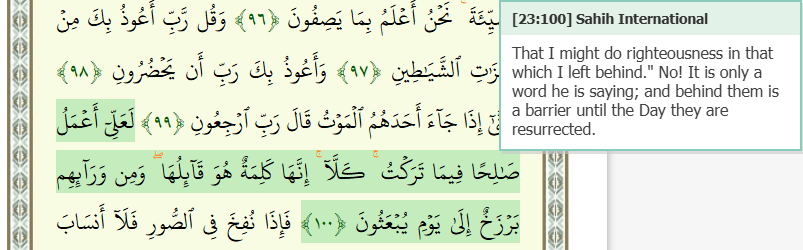
This verse comes immediately after describing the plea of a dying person who begs to be sent back to do good deeds. The answer from Allah is final: the Barzakh — an intermediate realm — now separates that soul from the world until resurrection.
There is no returning. The request itself, poignant in its desperation, is evidence that returning is not possible.
The structure of Quranic eschatology — the science of last things in Islamic theology — is linear, not cyclical. Life → Death → Barzakh → Resurrection → Judgment → Eternal destination. Each stage is distinct, sequential, and unrepeatable.
The Islamic Understanding of the Soul Makes Rebirth Theologically Impossible
To understand why Islam rejects rebirth, you have to understand the Islamic concept of the soul — the ruh. The ruh is not a cosmic fragment floating through bodies on a journey toward purity. The ruh is a created, individual, sacred trust from Allah, breathed into each human being at a specific moment.
وَيَسْأَلُونَكَ عَنِ الرُّوحِ قُلِ الرُّوحُ مِنْ أَمْرِ رَبِّي
“And they ask you about the soul. Say, ‘The soul is of the affair of my Lord.'” (Quran 17:85)
The soul belongs to Allah’s domain — His direct creation, under His direct authority. It is not a self-propelled spiritual entity working out its own karma across lifetimes. Each ruh is uniquely tied to one person, one life, one set of choices, and one day of reckoning.
This theological grounding matters because the reincarnation framework rests on a fundamentally different premise: that the soul is essentially on its own cosmic journey, accumulating or shedding spiritual debt across multiple lives until it reaches liberation or merges with the divine.
Islam replaces that entire framework with something else — divine mercy, divine justice, and one accountable life in which every moment carries weight precisely because it cannot be revisited.
The Islamic concept of faith in Islam encompasses belief in the unseen, including the nature of the soul and the certainty of what comes after death — and all of these point in one direction: forward, never back.
Have Questions About Islam?
Our team is ready to answer your questions clearly and respectfully. Ask freely and receive honest guidance.
Ask Us NowIslamic Scholars Have Unanimously Rejected Reincarnation
There is no scholarly minority position on this issue. The rejection of reincarnation (tanasukh in Arabic) is among the clearest points of ijma’ — scholarly consensus — in Islamic thought.
Ibn Hazm al-Andalusi, the 11th-century Andalusian scholar and one of the most rigorous legal and theological minds in Islamic history, addressed tanasukh directly in his encyclopedic work Al-Fasl fil-Milal wal-Ahwa’ wal-Nihal, classifying belief in the transmigration of souls as a clear deviation from authentic monotheism. He traced its origins to pre-Islamic philosophical traditions and demonstrated its incompatibility with the Quranic worldview.
Ibn al-Qayyim al-Jawziyyah, the 14th-century scholar and student of Ibn Taymiyyah, elaborated extensively on the soul’s journey after death in his work Kitab al-Ruh — a work so detailed in its treatment of the afterlife that it remains a primary reference today. His analysis of the Barzakh and the resurrection leaves no conceptual space for the soul to re-enter a new earthly body. The soul’s movement after death, in his framework, is irreversibly onward.
Contemporary scholarly authority echoes this consensus. Contemporary scholars have addressed questions about reincarnation in their fatwa, affirming clearly that belief in the transmigration of souls (tanasukh al-arwah) contradicts established Islamic creed and is rejected by the Quran and Sunnah without exception.
Read also: Does Islam Believe In Magic?
Divine Justice in Islam Requires One Life, Not Many
One of the most common intuitions behind belief in reincarnation is moral: how can a single life be sufficient for justice, given its inequalities, its brevity, its suffering? The person born into poverty and the person born into privilege — how can one life account for both? The answer, in reincarnation-based frameworks, is more lives: adjustment, return, karmic balancing across cycles.
Islam addresses the same moral intuition with a different, and ultimately more profound, resolution.
First, Islamic theology holds that Allah’s knowledge is complete. He knows every soul’s circumstances — every hardship, every advantage, every hidden intention. No injustice escapes Him, and no suffering goes unwitnessed.
Second, the Day of Judgment is precisely the mechanism through which cosmic justice is administered — fully, perfectly, and finally. Every individual will stand before Allah with their complete record. The scale (mizan) will measure every atom’s weight of good and evil.
فَمَن يَعْمَلْ مِثْقَالَ ذَرَّةٍ خَيْرًا يَرَهُ وَمَن يَعْمَلْ مِثْقَالَ ذَرَّةٍ شَرًّا يَرَهُ
“So whoever does an atom’s weight of good will see it, and whoever does an atom’s weight of evil will see it.” (Quran 99:7-8)
Third, and perhaps most powerfully: the value of this life in Islam comes precisely from its singularity. Because there is no second chance, every prayer matters. Every act of kindness carries weight.
Every moment of patience in hardship is recorded. The urgency and the meaning of a human life flow directly from the fact that it is one.
Reincarnation, in a sense, dilutes the stakes. Islam concentrates them — and in doing so, honors every life as unrepeatable and irreplaceable. This is one of the foundational Islam principles that distinguishes Islamic theology from Eastern religious frameworks.
Read also: Do Muslims Believe in Polygamy?
What Happens After Death in Islam?
Since Islam firmly closes the door on rebirth, it opens a detailed account of what actually happens to the soul after death. This is not a vague afterlife theology — it is specific, structured, and sourced.
1. The Barzakh — the Intermediate Realm
Immediately after death, the soul enters the Barzakh — a transitional realm between this life and the resurrection. The soul is not unconscious, not in a void, and not wandering toward a new body. It exists in a state determined by its deeds.
The Prophet Muhammad (PBUH) described the moment of death and the questioning of the soul in the grave in detail:
“When the deceased is buried… two angels come to him and ask: ‘Who is your Lord? What is your religion? Who is this man?'” (Sahih al-Bukhari, 1338)
The answers to those questions — or the inability to answer them — determine the nature of the soul’s experience in the Barzakh: either expansion and light, or constriction and trial.
2. The Resurrection and the Day of Judgment
Every soul will be raised on the Day of Qiyamah — bodily, in full personhood — to stand before Allah for final reckoning. The Quran describes this with striking precision:
يَوْمَ تَجِدُ كُلُّ نَفْسٍ مَّا عَمِلَتْ مِنْ خَيْرٍ مُّحْضَرًا وَمَا عَمِلَتْ مِن سُوءٍ
“The Day every soul will find what it has done of good present before it and what it has done of evil.” (Quran 3:30)
After judgment, souls go to their eternal destination — Jannah (Paradise) or Jahannam (the Fire). The journey is complete. The story of each individual soul reaches its final chapter.
Understanding what do Muslims believe about the Quran is essential here — because the Quran is the primary source through which Muslims understand the soul’s journey, and its account of death and resurrection leaves no room for reincarnation.
Read also: Does Islam Believe In Reincarnation?
What is The Difference Between Islamic Afterlife Belief and Eastern Concepts of Rebirth?
Some seekers notice surface-level similarities between Islam’s afterlife and Eastern religious frameworks — and wonder whether they might be saying the same thing in different language. They are not.
Reincarnation, as taught in Hinduism and Buddhism, posits that the soul (or a stream of consciousness) passes through multiple lives in successive bodies, driven by karma, until it achieves liberation (moksha or nirvana). The body is essentially temporary housing; the soul keeps moving.
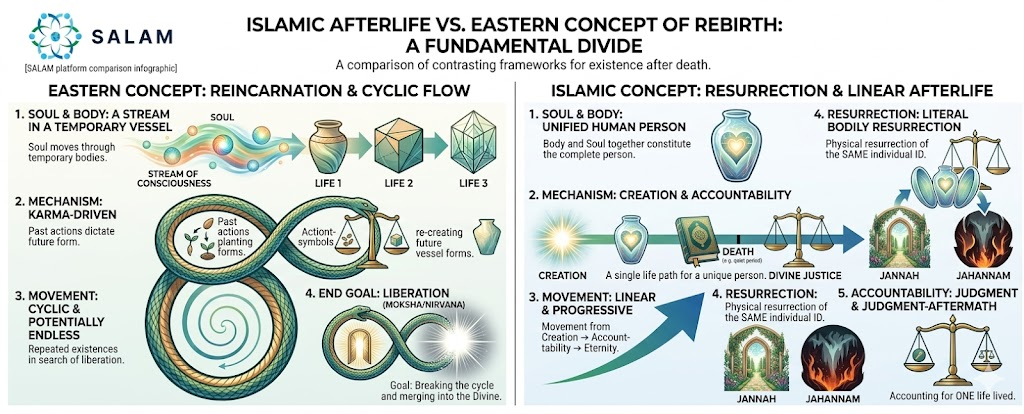
Islam teaches that the body and soul together constitute the full human person. The resurrection is bodily — the same person, with the same identity, raised to account for the same life they lived. This is not a metaphor. It is a literal, physical event described in the Quran with deliberate clarity.
Furthermore, the direction of movement is fundamentally different. Reincarnation cycles — potentially endlessly. Islamic eschatology moves linearly from creation to accountability to eternity. The two frameworks rest on completely different conceptions of time, justice, the human person, and the nature of Allah.
How does Islam view the nature of Allah is directly relevant here — because Islamic monotheism teaches that Allah is the sole sovereign over life, death, and what follows. No soul moves without His will, and His design for each soul is one life, one death, and one eternal outcome.
How Does Islam Respond to the Appeal of Reincarnation?
It is worth understanding why reincarnation appeals to people — because Islam does not dismiss that appeal, it answers it.
People are drawn to reincarnation for three primary reasons: the desire for second chances, the longing for cosmic fairness, and the hope that loved ones persist. Islam addresses all three.
Second chances? In Islam, the door of repentance (tawbah) is open until the moment of death. Every person can return to Allah at any point in their one life — and Allah’s mercy is wider than any number of reincarnations could offer.
قُلْ يَا عِبَادِيَ الَّذِينَ أَسْرَفُوا عَلَىٰ أَنفُسِهِمْ لَا تَقْنَطُوا مِن رَّحْمَةِ اللَّهِ
“Say, ‘O My servants who have transgressed against themselves, do not despair of the mercy of Allah.'” (Quran 39:53)
Cosmic fairness? The Day of Judgment fulfills this completely — with perfect knowledge and perfect scales, administered by the One who sees every hidden tear and every secret deed.
Loved ones persisting? The Barzakh and Paradise reunite believers with those they loved. The Quran speaks of believers entering Paradise with their families:
وَالَّذِينَ آمَنُوا وَاتَّبَعَتْهُمْ ذُرِّيَّتُهُم بِإِيمَانٍ أَلْحَقْنَا بِهِمْ ذُرِّيَّتَهُمْ
“And those who believed and whose descendants followed them in faith — We will join with them their descendants.” (Quran 52:21)
Everything reincarnation promises, Islam addresses — with sourced, clear, and more complete answers. The Oxford Centre for Islamic Studies at Oxford University, one of the leading academic centers for Islamic scholarship in the West, has noted in its research programs that Islamic eschatology represents one of the most developed and internally consistent afterlife theologies in world religious thought.
Have Questions About Islam?
Our team is ready to answer your questions clearly and respectfully. Ask freely and receive honest guidance.
Ask Us NowExplore More on the Salam Platform
If this question led you here, there’s likely much more you’re curious about — and that curiosity is worth following.
The Salam blog covers a wide range of topics for those genuinely exploring Islam: the nature of Allah, the Prophet Muhammad (PBUH), common misconceptions, and the foundations of Islamic belief — all written for the curious, the sincere, and the seeking.
If you have a specific question about Islam, want to understand more about entering the faith, or simply need someone to speak with, the Salam Platform team is here — without pressure, without judgment, and with genuine care.
Reach out to us directly — we’re here to help, with no pressure and no agenda.

Frequently Asked Questions
Does Islam believe in any form of reincarnation or rebirth?
Islam does not accept reincarnation, rebirth, or the transmigration of souls in any form. The Quran establishes clearly that each soul dies once and is then resurrected on the Day of Judgment — not returned to another body in another life. The Arabic term for reincarnation, tanasukh al-arwah, has been rejected by Islamic scholars across all major schools of jurisprudence throughout history. It has no basis in the Quran or in any authentic Hadith.
What does the Quran say about life after death?
The Quran describes a detailed, sequential afterlife: death, the Barzakh (an intermediate realm where the soul resides until resurrection), the Day of Judgment, and an eternal destination in either Jannah or Jahannam. كُلُّ نَفْسٍ ذَائِقَةُ الْمَوْتِ — "Every soul will taste death" (Quran 3:185) — followed by a return to Allah for reckoning. There is no stage in this sequence that involves returning to earthly life in a new form.
Can a Muslim believe in reincarnation?
Why does Islam believe the soul only lives once?
The soul’s singular life is tied directly to the principle of individual accountability. Every person is responsible for their own choices in their one earthly life — not the accumulation of multiple lifetimes. This is both a theological position and a moral one: it means every action carries real weight, every moment of repentance is meaningful, and divine justice on the Day of Judgment is perfectly calibrated to one individual’s one life. The singularity of life is what gives it gravity and meaning in the Islamic worldview.
What is the Barzakh and how is it different from reincarnation?
The Barzakh is the intermediate realm where souls reside after death, separated from the world by a barrier they cannot cross — as stated in Quran 23:100.
Unlike reincarnation, the soul in the Barzakh does not re-enter the physical world or inhabit a new body. It awaits resurrection in a conscious state, experiencing either comfort or trial based on its deeds. The Barzakh is a waiting state before eternal judgment, not a transition into a new life cycle.
How does Islam explain the apparent unfairness of some people having harder lives than others if there is no rebirth?
Islam resolves this through divine knowledge and perfect judgment on the Last Day. Allah knows every circumstance — every hardship, every privilege, every hidden struggle — with complete precision.
The Day of Judgment is the mechanism through which all inequalities are addressed: فَمَن يَعْمَلْ مِثْقَالَ ذَرَّةٍ خَيْرًا يَرَهُ — "Whoever does an atom’s weight of good will see it" (Quran 99:7). No injustice goes unaccounted for. Patience in hardship, gratitude in blessing, and sincere faith all carry immense weight in the final reckoning — making every life, however unequal it appears, fully accounted for before Allah.
Curious about Islam?
Journey towards clarity and purpose. Our team is here to support you in your search for truth and spiritual guidance.
Embrace the Truth