Does Islam Believe In Reincarnation?
| Key Takeaways |
| Islam categorically rejects reincarnation — the soul lives once in this world, then proceeds to the afterlife after death. |
| The Quran explicitly states that each soul will be resurrected once and held accountable for its single earthly life. |
| Islamic theology distinguishes clearly between the Barzakh (the intermediate realm between death and resurrection) and the concept of rebirth into a new body. |
| The rejection of reincarnation is directly tied to Islam’s doctrine of divine justice — every soul answers for its own deeds, once. |
| Belief in resurrection and the Day of Judgment is one of the six pillars of faith in Islam, making reincarnation incompatible with Islamic theology at a foundational level. |
The question of what happens after death sits at the center of how any religion understands justice, morality, and the purpose of human existence. For Islam, that answer is precise and non-negotiable.
Understanding why Islam rejects reincarnation — and what it affirms instead — opens a window into the coherence and depth of the Islamic understanding of the human soul.
Does Islam Believe in Reincarnation?
No, Islam does not believe in reincarnation. The idea that a soul cycles through multiple bodies across successive lifetimes — whether as a human, animal, or any other form — has no basis in the Quran, the authenticated Sunnah, or the scholarly consensus of Islamic theology.
The Islamic worldview offers something entirely different: one life, one death, one resurrection, and one judgment before Allah.
1. The Quran Leaves No Ambiguity on Death and What Follows
The Islamic position on reincarnation begins with the Quran, and the Quran is direct. Allah says:
كُلُّ نَفْسٍ ذَائِقَةُ الْمَوْتِ ۗ وَإِنَّمَا تُوَفَّوْنَ أُجُورَكُمْ يَوْمَ الْقِيَامَةِ
“Every soul will taste death, and you will only be given your [full] compensation on the Day of Resurrection.” (Quran 3:185)
The structure of this verse is itself theological architecture. Death is singular — every soul tastes it once. Compensation comes at a specific, defined moment: the Day of Resurrection. There is no room in this framework for interim returns, second lives, or successive cycles of rebirth.
Elsewhere, Allah makes the finality of death even more explicit:
حَتَّىٰ إِذَا جَاءَ أَحَدَهُمُ الْمَوْتُ قَالَ رَبِّ ارْجِعُونِ ﴿٩٩﴾ لَعَلِّي أَعْمَلُ صَالِحًا فِيمَا تَرَكْتُ ۚ كَلَّا ۚ إِنَّهَا كَلِمَةٌ هُوَ قَائِلُهَا ۖ وَمِن وَرَائِهِم بَرْزَخٌ إِلَىٰ يَوْمِ يُبْعَثُونَ
“Until, when death comes to one of them, he says, ‘My Lord, send me back so that I might do righteousness in that which I left behind.’ No! It is only a word he is saying; and behind them is a barrier (Barzakh) until the Day they are resurrected.” (Quran 23:99–100)
This passage directly confronts the wish for a return — and refuses it. The soul at the moment of death pleads for another chance.
The answer from Allah is a firm negation: Kallā — absolutely not.
Between death and resurrection lies the Barzakh, a realm of waiting and spiritual consequence, not a gateway to a new earthly life.
Anyone who has seriously studied the Islam principles that govern Islamic eschatology will recognize immediately that these verses close every door reincarnation tries to open.
2. The Islamic Understanding of the Soul Contradicts Reincarnation at Its Root
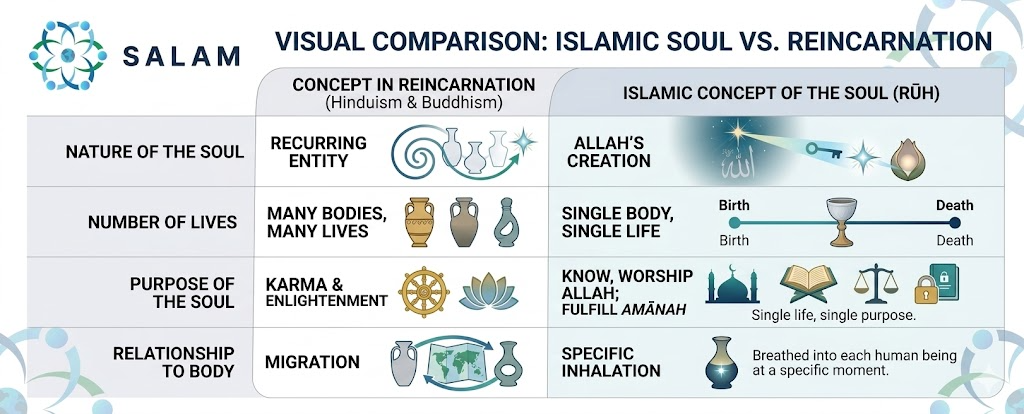
Reincarnation, as taught in Hinduism and Buddhism, rests on a specific understanding of the soul: that it is a recurring entity, migrating from body to body as it works through karma or seeks enlightenment. The Islamic understanding of the soul (rūh) is categorically different.
In Islam, the soul is a creation of Allah, breathed into each human being at a specific moment. It belongs to a single body, in a single life, for a single purpose: to know Allah, to worship Him, and to fulfill the trust (amānah) placed upon it.
The Prophet Muhammad (PBUH) was asked directly about the nature of the soul. Allah responded in the Quran:
وَيَسْأَلُونَكَ عَنِ الرُّوحِ ۖ قُلِ الرُّوحُ مِنْ أَمْرِ رَبِّي وَمَا أُوتِيتُم مِّنَ الْعِلْمِ إِلَّا قَلِيلًا
“And they ask you, [O Muhammad], about the soul. Say, ‘The soul is of the affair of my Lord. And mankind has not been given of knowledge except a little.'” (Quran 17:85)
The soul is amr rabbī — belonging to the command and dominion of Allah. Its nature, its journey, and its destination are under divine authority. What that divine authority has revealed is a linear journey — not a cycle. Birth, life, death, Barzakh, resurrection, judgment, and then either Paradise or Hell. No iteration. No reset.
This linear structure of existence is inseparable from the broader Islamic understanding of the nature of God in Islam — a God who is perfectly just, perfectly aware, and perfectly capable of holding every soul accountable without requiring it to cycle through multiple lives to settle cosmic debts.
Have Questions About Islam?
Our team is ready to answer your questions clearly and respectfully. Ask freely and receive honest guidance.
Ask Us Now3. Islamic Divine Justice Requires No Reincarnation
One of the most common reasons people find reincarnation intuitively appealing is the question of fairness. How can a person be judged on the basis of one life — especially a short or difficult one? Reincarnation seems to offer a solution: souls accumulate experience and moral consequence across many lives until they are ready for a final reckoning.
Islam answers this question from a completely different premise. Divine justice in Islam does not require multiple lives because it is absolute and infinitely precise. Allah does not miss a single atom of a soul’s intention, action, or circumstance:
فَمَن يَعْمَلْ مِثْقَالَ ذَرَّةٍ خَيْرًا يَرَهُ ﴿٧﴾ وَمَن يَعْمَلْ مِثْقَالَ ذَرَّةٍ شَرًّا يَرَهُ
“So whoever does an atom’s weight of good will see it, and whoever does an atom’s weight of evil will see it.” (Quran 99:7–8)
Every injustice suffered, every deed performed, every moment of hardship endured — all of it is fully known to Allah and fully accounted for in a judgment that is comprehensive beyond human imagination.
People are not judged identically; circumstances, capacities, and the degree of access to truth are all considered.
The oppressed are not simply resigned to another cycle — they will see justice, completely, on a Day that no soul will escape.
Islamic scholars throughout history, including the great 14th-century exegete Ibn Kathir in his monumental work Tafsir al-Quran al-Adhim, have consistently identified the Day of Resurrection as the axis of divine justice in Islam — the event that makes one life fully sufficient for a complete and just reckoning.
Read also: Does Islam Believe In Rebirth?
4. The Barzakh is Islam’s Intermediate Realm After Death
When we discuss what happens between death and resurrection in Islam, we speak of the Barzakh — a word the Quran itself uses. The Barzakh is real, substantive, and consequential. It should not be confused with purgatory, limbo, or any form of reincarnation.
In the Barzakh, the soul remains in a state that reflects its earthly deeds.
The Prophet Muhammad (PBUH) described the condition of the believing soul after death in terms of profound peace, and he described the punishment of the rebellious soul as a genuine, painful reality — even while the body lies in the grave. He (PBUH) said:
“The grave is either a garden from the gardens of Paradise or a pit from the pits of Hell.” (Sunan al-Tirmidhi, Hadith 2460)
This description of the grave as a place of either bliss or suffering establishes that the soul’s journey after death is forward-moving.
The Barzakh is a phase of consequence and waiting — not a preparation for another earthly life. The soul awaits the resurrection in a condition shaped by what it did in its one life. There are no do-overs built into this system.
Read also: Do Muslims Believe in Polygamy?
5. Reincarnation in Hinduism and Buddhism Compared to Islamic Teaching
It is worth understanding the doctrines Islam is being compared to, precisely because the differences are so fundamental. In Hinduism, the concept of samsara holds that the soul (atman) transmigrates through a cycle of birth, death, and rebirth until it achieves moksha — liberation and union with Brahman.
Karma governs the quality of each rebirth. In Buddhism, the doctrine is more complex — there is no permanent self, yet a stream of consciousness continues through rebirths until nirvana is attained.
Both frameworks assume that a single human life is morally insufficient for complete accountability or spiritual development. Islam rejects this assumption entirely.
One life is enough — not because it is simple, but because the Being judging it is infinite in knowledge and justice. The Quran affirms that Allah sees and knows what no human court could ever process.
Those exploring how Islam views other religions will find that Islamic theology engages with these traditions respectfully while maintaining the clarity of its own revealed teaching.
Acknowledging the sincerity of those who believe in reincarnation is fully compatible with maintaining that the Islamic revelation corrects this understanding.
Read also: Does Islam Believe In Magic?
6. The Resurrection — Islam’s Actual Doctrine of Return
If reincarnation asks “will this soul live again in another body?” — Islam answers with a different and grander truth: every soul will be resurrected, in its own body, on the Day of Judgment. The return Islam teaches is not a private, gradual cycle of rebirth — it is a universal, simultaneous event that includes every human being who has ever lived.
وَنُفِخَ فِي الصُّورِ فَإِذَا هُم مِّنَ الْأَجْدَاثِ إِلَىٰ رَبِّهِمْ يَنسِلُونَ
“And the Horn will be blown; and at once from the graves to their Lord they will hasten.” (Quran 36:51)
This resurrection is bodily, final, and singular. The same self — the person who lived, made choices, loved, sinned, and worshipped — will stand before Allah. Identity is preserved, not dissolved and recycled.
Accountability is personal and complete. This doctrine, which forms one of the central pillars of faith in Islam, gives human existence its ultimate weight and meaning.
The Islamic understanding of what Muslims believe about the Quran makes clear that these eschatological teachings are not metaphorical or symbolic — they are literal articles of faith, revealed by Allah and confirmed by the Prophet Muhammad (PBUH).
The reasons Muslims believe in the Quran as divine revelation are themselves relevant here: if the Quran is the word of Allah, then what it says about death, the soul, and the afterlife is not open to reinterpretation by human preference or cross-cultural borrowing.
Have Questions About Islam?
Our team is ready to answer your questions clearly and respectfully. Ask freely and receive honest guidance.
Ask Us NowContinue Gaining Authentic Knowledge with Salam
If this article opened more questions than it answered — that is a good sign. The Islamic understanding of the soul, death, and the afterlife is rich, precise, and deeply connected to how Islam understands God in Islam and the purpose of human existence.
Explore more on the Salam blog — articles written to address real questions about Islam with clarity and honesty.
Have a question about Islam that you haven’t found answered? Want to understand more about what it means to enter Islam? Reach out to us directly through the Salam Platform — we’re here to help, with no pressure and no agenda.

Frequently Asked Questions
Does Islam have any concept that resembles reincarnation?
Islam has no doctrine that resembles reincarnation. The Barzakh — the realm the soul enters after death — is sometimes misunderstood as a form of interim existence analogous to rebirth, but it is fundamentally different. The Barzakh is a waiting period between death and resurrection, not a transition into a new body or a new life. The soul remains itself, in its own post-death state, until the Day of Judgment. There is no cycling, no new incarnation, and no karma-based system governing what comes next.
Can a Muslim believe in reincarnation?
How does Islam explain the differences in human circumstances if not through past-life karma?
Islam attributes the diversity of human circumstances — wealth, poverty, health, hardship — to the wisdom and decree (qadar) of Allah, who is fully aware of every soul’s situation and will account for all of it with absolute precision on the Day of Judgment.
The Quran states that not even an atom’s weight of good or evil escapes the divine record (Quran 99:7–8). The oppressed will receive justice. The privileged will be questioned. No karmic cycle is needed when the Judge is Allah — infinitely just, infinitely aware.
What does Islam say about the soul after death?
After death, the soul enters the Barzakh — an intermediate realm described by the Prophet Muhammad (PBUH) as a state of either peace or punishment, depending on one’s deeds in life. The Prophet (PBUH) described the grave as "either a garden from the gardens of Paradise or a pit from the pits of Hell" (Sunan al-Tirmidhi, Hadith 2460). The soul remains in this state until the Day of Resurrection, when all souls are raised, reunited with their bodies, and brought before Allah for judgment. This is the complete Islamic map of the soul’s journey after death.
Is the Islamic concept of the afterlife similar to Eastern religious afterlife beliefs?
No. The Islamic concept of the afterlife shares a surface similarity with Eastern traditions only in affirming that something continues after death. Beyond that, the frameworks diverge completely. Hinduism and Buddhism describe cyclical, soul-migrating systems governed by karma and aimed at liberation from the cycle itself. Islam describes a linear, singular journey — one life, one death, one resurrection, one judgment — governed by divine revelation and culminating in Paradise or Hell. The purpose of life in Islam is not escape from a cycle but fulfillment of a divine covenant and return to Allah. Anyone exploring how Islam views other religions will find that Islam engages this comparison honestly without either dismissing other traditions condescendingly or absorbing their doctrines uncritically.
Where does the Islamic position on reincarnation come from?
The Islamic position comes directly from the Quran and the authenticated Hadith of the Prophet Muhammad (PBUH). The Quran explicitly states that after death, the soul enters the Barzakh and will not return to earthly life (Quran 23:99–100). The resurrection on the Day of Judgment — not a cycle of rebirths — is what the Quran promises. This teaching has been the unanimous position of Islamic scholarship from the earliest generations of Muslims to the present day, affirmed by institutions including the International Islamic Fiqh Academy.
Curious about Islam?
Journey towards clarity and purpose. Our team is here to support you in your search for truth and spiritual guidance.
Embrace the Truth