
The Belief In The Existence Of Only One God
| Key Takeaways |
| The belief in the existence of only one god is called Tawhid in Islam, and it is the absolute foundation upon which every Islamic teaching rests. |
| Tawhid encompasses three inseparable dimensions: the oneness of Allah’s lordship, the oneness of His divine names and attributes, and the exclusive right to worship Him alone. |
| The Quran affirms Tawhid in over 200 verses, making monotheism the most repeated doctrinal assertion in Islamic scripture. |
| Islamic scholars across fourteen centuries have maintained that Tawhid is not merely a theological position but a complete worldview that shapes ethics, law, and human purpose. |
| Shirk — associating partners with Allah — is identified in the Quran as the one sin Allah does not forgive if a person dies without repenting from it. |
When a Muslim says La ilaha illa Allah — “There is no god but Allah” — they are making a metaphysical claim about the nature of reality: that behind every created thing, every force in the universe, every moment of existence, there is one and only one ultimate source. No partners. No equals. No rivals.
This is the heartbeat of Islam. Every other belief — in the prophets, in the angels, in the Day of Judgment — flows from this single conviction. Remove Tawhid, and the entire structure collapses.
What is the Belief in the Existence of One God?
The belief in the existence of only one god is called Tawhid (توحيد) in Islam. The word derives from the Arabic root meaning “to unify” or “to make singular,” and it refers to the absolute oneness of Allah in His lordship, His right to be worshipped, and His divine names and attributes. Tawhid is the foundational creed of Islam — every Muslim’s faith begins with its declaration in the Shahada: La ilaha illa Allah, “There is no god but Allah.”
Tawhid Means Declaring Allah Alone as the One True God
The word Tawhid itself does not appear in the Quran by name — but the concept saturates every page of it. Allah declares His own oneness directly, repeatedly, and in terms that leave no interpretive room for ambiguity.
The most concentrated expression of Tawhid in the entire Quran is Surah Al-Ikhlas, a chapter so dense with theological meaning that the Prophet Muhammad (PBUH) described it as equivalent to one-third of the Quran:
قُلْ هُوَ اللَّهُ أَحَدٌ اللَّهُ الصَّمَدُ لَمْ يَلِدْ وَلَمْ يُولَدْ وَلَمْ يَكُن لَّهُ كُفُوًا أَحَدٌ
“Say, ‘He is Allah, [who is] One, Allah, the Eternal Refuge. He neither begets nor is born, nor is there to Him any equivalent.'” (Quran 112:1–4)
Four short verses. Every single one dismantles a different form of false belief about Allah — that He has partners, that He has needs, that He has offspring, that anything in creation resembles Him. This is the core of what Tawhid asserts.
For a broader understanding of how Islam views the nature of Allah, including His attributes and relationship to creation, the Islamic theological tradition offers a rich and carefully reasoned body of knowledge built on exactly this foundation.
What Are The Three Dimensions That Define The Belief in the Existence of One God?
Islamic scholars did not leave Tawhid as a vague feeling of “believing in one god.” They developed a precise, systematic framework for understanding what that belief actually requires.
The classical scholarly tradition, particularly as articulated by Ibn al-Qayyim al-Jawziyyah (the 14th-century Hanbali scholar and student of Ibn Taymiyyah) and later formalized across the major schools of aqeedah, identifies three inseparable categories of Tawhid.
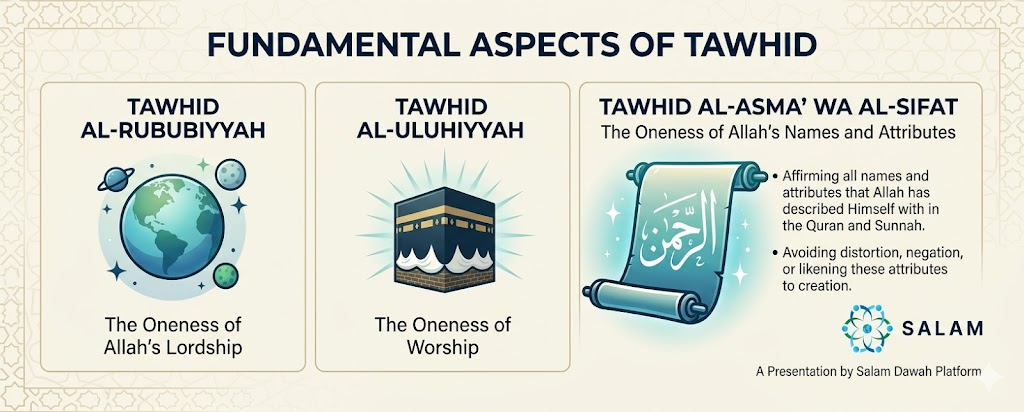
1. Tawhid al-Rububiyyah — The Oneness of Allah’s Lordship
This dimension holds that Allah alone is the Creator, Sustainer, and Master of all that exists. He alone controls life and death, causes rain to fall and crops to grow, governs the movements of galaxies and the beating of hearts.
Remarkably, the Quran notes that even the polytheists of Arabia acknowledged this level of Tawhid — they knew Allah was the Creator:
وَلَئِن سَأَلْتَهُم مَّنْ خَلَقَ السَّمَاوَاتِ وَالْأَرْضَ لَيَقُولُنَّ اللَّهُ
“And if you asked them who created the heavens and earth, they would surely say, ‘Allah.'” (Quran 31:25)
Belief in Allah’s lordship is the starting point — but it is not sufficient on its own to constitute the Tawhid Islam demands.
2. Tawhid al-Uluhiyyah — The Oneness of Worship
This is where the real weight falls. Tawhid al-Uluhiyyah means directing every act of worship — prayer, supplication, sacrifice, hope, fear, reliance — exclusively to Allah and no one else.
The polytheists who denied the Prophet (PBUH) believed Allah created the universe. What they refused was this: routing all their worship to Him alone, without intermediaries, without saints, without idols. The Quran addresses their logic directly:
وَالَّذِينَ اتَّخَذُوا مِن دُونِهِ أَوْلِيَاءَ مَا نَعْبُدُهُمْ إِلَّا لِيُقَرِّبُونَا إِلَى اللَّهِ زُلْفَىٰ
“Those who take protectors other than Allah say, ‘We only worship them so they may bring us closer to Allah.'” (Quran 39:3)
Islam categorically rejects this reasoning. There are no intermediaries between the human being and Allah. Every person prays directly to Him, calls upon Him directly, and needs no created being to bridge that connection.
This is what makes monotheism in Islam so radically direct — the relationship between the servant and the Lord has no gatekeepers.
3. Tawhid al-Asma’ wa al-Sifat — The Oneness of Allah’s Names and Attributes
Allah possesses divine names and attributes that are perfect, unique, and belong to Him alone. He is Al-Rahman (the Entirely Merciful), Al-Alim (the All-Knowing), Al-Qadir (the All-Powerful).
These attributes are real and true — but they bear no resemblance to human qualities carrying the same names.
لَيْسَ كَمِثْلِهِ شَيْءٌ ۖ وَهُوَ السَّمِيعُ الْبَصِيرُ
“There is nothing like unto Him, and He is the Hearing, the Seeing.” (Quran 42:11)
This verse simultaneously affirms Allah’s attributes and negates any comparison with creation.
Scholars of aqeedah — Islamic creedal theology — have devoted centuries to explaining this balance, which represents one of the most sophisticated contributions of Islamic intellectual tradition to the philosophy of religion.
Have Questions About Islam?
Our team is ready to answer your questions clearly and respectfully. Ask freely and receive honest guidance.
Ask Us NowRead also: Can You Believe in God and Not Be Religious?
The Opposite of Tawhid Is Shirk
Shirk (شرك) is the act of associating partners with Allah in worship, lordship, or attributes. The Quran describes it as the gravest of all injustices:
إِنَّ الشِّرْكَ لَظُلْمٌ عَظِيمٌ
“Indeed, associating others with Allah is a great injustice.” (Quran 31:13)
And Allah declares in the Quran that He may forgive any sin — but dying in a state of Shirk is the one transgression He does not forgive:
إِنَّ اللَّهَ لَا يَغْفِرُ أَن يُشْرَكَ بِهِ وَيَغْفِرُ مَا دُونَ ذَٰلِكَ لِمَن يَشَاءُ
“Indeed, Allah does not forgive association with Him, but He forgives what is less than that for whom He wills.” (Quran 4:48)
The seriousness of this ruling reflects the logic of Tawhid itself: if Allah is truly the only creator and sustainer, then directing worship to anything else is not just a religious error — it is a fundamental distortion of reality.
For a deeper exploration of how Islam addresses polytheism and its theological critique, the Quranic arguments against Shirk are remarkably comprehensive and philosophically rigorous.
Read also: Quotes on Belief in Allah
Tawhid Has Been the Call of Every Prophet, Not Just Muhammad (PBUH)
One of the most powerful aspects of the Islamic understanding of Tawhid is its universality across time. The Quran presents monotheism as the consistent message of every prophet Allah ever sent — from Adam to Noah, from Abraham to Moses, from Jesus to Muhammad (PBUH).
وَمَا أَرْسَلْنَا مِن قَبْلِكَ مِن رَّسُولٍ إِلَّا نُوحِي إِلَيْهِ أَنَّهُ لَا إِلَٰهَ إِلَّا أَنَا فَاعْبُدُونِ
“And We sent not before you any messenger except that We revealed to him that, ‘There is no deity except Me, so worship Me.'” (Quran 21:25)
This means Tawhid predates Islam as a historical movement — it is the eternal call of all divine revelation. The Prophet Muhammad (PBUH) did not introduce a new idea. He renewed and completed the oldest idea in human spiritual history.
Jabir ibn Abdullah (may Allah be pleased with him) reported that the Prophet (PBUH) said:
“The best remembrance is ‘La ilaha illa Allah’ (There is no god but Allah), and the best supplication is ‘Al-hamdu lillah’ (All praise is due to Allah).”
— Sunan Ibn Majah, Hadith 3800
This declaration — La ilaha illa Allah — is the verbal expression of Tawhid. It is the first thing whispered into a newborn’s ear in Muslim families and the last words a dying Muslim is encouraged to say. It bookends a Muslim’s entire life.
What is the Entry Point Into the Belief in the Existence of Only One God?
The formal declaration of Islamic faith — the Shahada — is the lived expression of Tawhid. Ash-hadu an la ilaha illa Allah, wa ash-hadu anna Muhammadan rasul Allah: “I bear witness that there is no god but Allah, and I bear witness that Muhammad is the Messenger of Allah.”
The first half is pure Tawhid. The second half establishes the means by which Tawhid is correctly understood and practiced — through the Prophet (PBUH) who received and transmitted the revelation.
The Prophet Muhammad (PBUH) said:
“Islam is built upon five [pillars]: testifying that there is no god but Allah and that Muhammad is the Messenger of Allah, establishing prayer, giving Zakat, making pilgrimage to the House, and fasting in Ramadan.”
Every one of these pillars is an expression of Tawhid in action. Prayer is directed to Allah alone. Zakat acknowledges that all wealth ultimately belongs to Him. Hajj commemorates the Tawhid of Prophet Ibrahim (Abraham), who rejected idolatry and submitted entirely to Allah. Fasting is an act of pure worship of which Allah says, in a sacred Hadith (Hadith Qudsi): “It is for Me, and I shall reward for it.”
Understanding faith in Islam in its full depth means seeing how every act of devotion connects back to this single root: the belief that only Allah deserves worship.
Read Also: Can a Free Thinker Believe in God?
Tawhid Shapes How Muslims See the Universe, Human Dignity, and Social Justice
Tawhid is not confined to theology. It radiates outward and shapes an entire worldview.
Because all human beings are equally servants of one Allah, no race, tribe, class, or lineage can claim inherent superiority over another.
The Prophet (PBUH) declared in his Farewell Sermon: “An Arab has no superiority over a non-Arab, nor does a non-Arab have superiority over an Arab; a white has no superiority over a black, nor does a black have superiority over a white — except through piety.”
Because sovereignty belongs to Allah alone, no human ruler, institution, or ideology has the right to claim absolute obedience. Justice is a divine command, not a negotiable social contract.
Because all of creation belongs to Allah, the natural world carries a sacred quality — it is a trust (amanah), not a commodity.
The principles of Islam across law, ethics, family, and community are unified by exactly this logic: when you submit to one Master, you are freed from submission to everything else.
Read also: Quotes About Believing in One God
How Does Tawhid Distinguish Islam from Christianity and Judaism?
Islam’s Tawhid differs in significant ways from mainstream Christian and Jewish theological positions.
Christianity, in its dominant Trinitarian formulation, holds that the one God exists as three persons: Father, Son, and Holy Spirit. Islam respectfully but clearly identifies this as a departure from pure monotheism. The Quran addresses this directly:
لَّقَدْ كَفَرَ الَّذِينَ قَالُوا إِنَّ اللَّهَ ثَالِثُ ثَلَاثَةٍ ۘ وَمَا مِنْ إِلَٰهٍ إِلَّا إِلَٰهٌ وَاحِدٌ
“They have certainly disbelieved who say, ‘Allah is the third of three.’ And there is no god except one God.” (Quran 5:73)
The Islamic position is that Jesus (‘Isa, peace be upon him) was a noble prophet and messenger — one of the greatest human beings who ever lived — but a human being nonetheless, created by Allah, not an aspect or incarnation of Allah Himself.
This is not a polemical point made to diminish other faiths. The Quran acknowledges that Jews and Christians received divine revelation from the same Allah — but maintains that revelation was altered over time, and that Islam came to restore the original, uncorrupted Tawhid that all prophets preached.
For readers curious about how Islam views other religions, this historical and theological context is essential.
The Quran and Hadith Together Establish the Evidence for The Belief in the Existence of Only One God
The intellectual foundations of Tawhid rest on the Quran as the primary source and the authenticated Sunnah as its explanation. Together, they constitute the complete evidential basis for every dimension of Islamic monotheism.
The Quran itself presents rational arguments for Tawhid — it does not merely assert it. One of the most striking is the Burhan al-Tamanu’ (the Argument from Mutual Exclusion), found in:
لَوْ كَانَ فِيهِمَا آلِهَةٌ إِلَّا اللَّهُ لَفَسَدَتَا
“Had there been within them [the heavens and earth] gods besides Allah, they would have been ruined.” (Quran 21:22)
The argument is elegant in its logic: if two gods of equal power existed, their conflicting wills would inevitably create cosmic chaos. The observable order, consistency, and harmony of the universe is itself evidence of a single unifying will behind it.
Scholars at institutions like Al-Azhar University, the world’s oldest and most authoritative Islamic institution of higher learning, have elaborated on this argument extensively within Islamic philosophy and kalam (theological reasoning), demonstrating that Tawhid is as intellectually compelling as it is spiritually essential.
For those exploring why Muslims believe in the Quran as the word of Allah, the Quran’s internal coherence and its defense of Tawhid across dozens of stylistic and argumentative modes is itself part of the answer.
Have Questions About Islam?
Our team is ready to answer your questions clearly and respectfully. Ask freely and receive honest guidance.
Ask Us NowContinue Your Exploration of Islam with Salam
If this topic has raised more questions than it answered — that is a good sign.
The question of who Allah is, what He demands from us, and why that should matter to anyone living in the 21st century deserves more than a single article.
Explore deeper on the Salam blog — a library of carefully researched articles addressing Islam’s core beliefs, its intellectual tradition, and the questions that thoughtful people actually ask.
Start with God in Islam — what Muslims actually believe about Allah, or explore the broader landscape of Islamic beliefs and their foundations.
Have a question that goes beyond what’s written here — about Tawhid, about entering Islam, or about anything the articles haven’t addressed?
Reach out directly — the Salam Platform team is here to answer, not to judge.

Frequently Asked Questions
How is Tawhid different from the monotheism of other religions?
Tawhid makes more precise and comprehensive claims than a general belief in "one god." It asserts not only that Allah is one numerically, but that He has no partners, no equals, no offspring, no intermediaries, and no resemblance to created things whatsoever. Where Trinitarian Christianity holds that one God exists in three persons, Islam maintains that this formulation compromises pure oneness. The Quran explicitly addresses this in Quran 112:1–4 and Quran 5:73. Tawhid also requires that worship be directed exclusively to Allah — not to saints, prophets, or any created being.
What are the three types of Tawhid in Islamic theology?
Islamic scholars identify three inseparable categories of Tawhid. The first is Tawhid al-Rububiyyah — acknowledging that Allah alone is the Creator and Sustainer of all existence. The second is Tawhid al-Uluhiyyah — directing all acts of worship exclusively to Allah, with no intermediaries. The third is Tawhid al-Asma’ wa al-Sifat — affirming Allah’s unique divine names and attributes without comparing them to human qualities or denying them. A Muslim’s faith is complete only when all three dimensions are upheld together.
What happens in Islam if someone associates partners with Allah?
Shirk — the act of associating partners with Allah — is identified in the Quran as the gravest of all sins. Allah declares in Quran 4:48 that He forgives all sins except Shirk when a person dies without repenting from it.
Did all prophets before Muhammad (PBUH) preach Tawhid?
Every prophet sent by Allah — from Adam through Noah, Abraham, Moses, and Jesus — called humanity to Tawhid. The Quran states this explicitly: "We sent not before you any messenger except that We revealed to him that there is no deity except Me, so worship Me" (Quran 21:25). Islam’s position is that monotheism is not a new teaching — it is the original and perennial message of all divine revelation. Prophet Muhammad (PBUH) completed and preserved what all his predecessors taught.
Curious about Islam?
Journey towards clarity and purpose. Our team is here to support you in your search for truth and spiritual guidance.
Embrace the Truth