
Can You Believe in God and Not Be Religious?
| Key Takeaways |
| Believing in God without following a religion is a false philosophical position. |
| Allah created human beings with a natural disposition (fitrah) to worship Him — and worship, by definition, requires a structured path. |
| The Quran makes clear that acknowledgment of Allah alone does not fulfill the covenant between the Creator and His creation. |
| Islam holds that Allah sent prophets and revealed scriptures precisely because belief requires guidance — not just feeling. |
| Rejecting organized religion while claiming belief in God is a modern Western phenomenon largely shaped by cultural individualism, not divine guidance. |
| The only path to Allah’s acceptance, according to the Quran and authenticated Sunnah, is Islam — the religion He has chosen for humanity. |
The phrase “I’m spiritual but not religious” has become something of a badge in the contemporary world. Millions of people across Europe, North America, and increasingly elsewhere say they believe in a higher power — in God, in some divine force behind the universe — while simultaneously rejecting organized religion as unnecessary, corrupt, or simply too demanding.
The sentiment is understandable. Religious institutions have disappointed people. Dogma has been weaponized. Rules feel constraining.
But the question deserves an honest answer rooted in something more than personal comfort: does believing in God without religious practice actually mean anything? Does it fulfill what Allah expects of a human being? Islam’s answer is firm, compassionate, and rooted in centuries of scholarship and divine revelation.
Can You Believe in God and Not Be Religious?
No — you cannot truly believe in God in a way that fulfills your purpose before Him without following a religion He has sanctioned. This is the clear, unambiguous answer Islam gives to one of the most common questions circulating in modern Western culture.
The Human Soul Was Built to Worship, Not Just to Believe
Islam teaches that every human being is born with a fitrah — an innate, primordial disposition toward the recognition of Allah. This is not metaphor. The Prophet Muhammad (PBUH) stated:
“كُلُّ مَوْلُودٍ يُولَدُ عَلَى الْفِطْرَةِ”
“Every child is born upon the fitrah (the natural disposition).” (Sahih Muslim, 2658)
The fitrah means that the pull toward Allah is not learned — it is woven into human nature. Anyone who has stood at the edge of an ocean, held a newborn, or faced death has felt something pull at them from beyond the visible world. That pull is real. That pull is the fitrah.
But here is the critical distinction Islamic scholarship draws: acknowledging the existence of a Creator is the beginning of belief, not its completion.
The Quran reminds us that even the people who opposed the Prophet (PBUH) most fiercely — the idol-worshippers of Mecca — acknowledged Allah as Creator. They just refused to worship Him alone and according to His guidance.
وَلَئِن سَأَلْتَهُم مَّنْ خَلَقَ السَّمَاوَاتِ وَالْأَرْضَ لَيَقُولُنَّ اللَّهُ
“And if you ask them who created the heavens and earth, they will surely say, ‘Allah.'” (Quran 31:25)
Acknowledgment without submission is not belief in the sense Allah requires. It is partial recognition — like knowing a king exists but refusing to honor him in his court.

Why Does Belief Without Religion Leave the Most Important Question Unanswered?
The person who says “I believe in God but follow no religion” has answered one question and avoided another. The first question — does God exist? — they have answered. The second question — what does God want from me? — they have left entirely open.
And that second question is the one that matters most.
Allah does not leave human beings to figure out His will through personal intuition alone. Allah sends prophets. He reveals scriptures. He establishes clear guidance. This is an act of divine mercy, not divine control.
The Quran describes this prophetic chain as a mercy to humanity:
وَمَا أَرْسَلْنَاكَ إِلَّا رَحْمَةً لِّلْعَالَمِينَ
“And We have not sent you, [O Muhammad], except as a mercy to the worlds.” (Quran 21:107)
To say “I believe in God but need no religion” is to claim that human intuition is sufficient to know what the Creator of the universe wants — without His own instruction.
The intellectual humility that often motivates people to believe in God in the first place should lead them to also ask: has He spoken? Has He guided? And if so, where?
Faith in Islam is precisely this recognition — that real belief (iman) is not a feeling, but an orientation of the whole person toward Allah, enacted through worship, conduct, and surrender.
The Covenant Allah Made With Every Human Soul
There is a passage in the Quran that speaks to the very roots of this question — before birth, before time in the world as we know it. Allah gathered all human souls and asked them a single question:
أَلَسْتُ بِرَبِّكُمْ ۖ قَالُوا بَلَىٰ
“Am I not your Lord?” They said, “Yes, we testify.” (Quran 7:172)
Every soul — yours included — already testified to Allah’s lordship. The fitrah is the echo of that testimony reverberating through a human life.
But that covenant was not simply “acknowledge Me.” It was “submit to Me.” Islam itself means submission — complete, conscious orientation toward Allah.
Monotheism in Islam is not merely the belief that one God exists. It is Tawhid: the affirmation of Allah’s oneness, His uniqueness, His exclusive right to be worshipped — and the living out of that affirmation in every dimension of life.
A person who believes in one God but structures their worship however they personally feel like, or doesn’t worship at all, has accepted part of Tawhid and left the rest.
Have Questions About Islam?
Our team is ready to answer your questions clearly and respectfully. Ask freely and receive honest guidance.
Ask Us NowWhat Allah Says About the Religion He Has Chosen
The Quran leaves no ambiguity about which religion Allah accepts from human beings after the coming of the Prophet Muhammad (PBUH):
إِنَّ الدِّينَ عِندَ اللَّهِ الْإِسْلَامُ
“Indeed, the religion in the sight of Allah is Islam.” (Quran 3:19)
And again:
وَمَن يَبْتَغِ غَيْرَ الْإِسْلَامِ دِينًا فَلَن يُقْبَلَ مِنْهُ
“And whoever desires other than Islam as religion — never will it be accepted from him.” (Quran 3:85)
These are not verses open to creative interpretation. The nature of Allah in Islam — His absolute sovereignty, His perfection, His mercy — is precisely what makes these verses coherent. A God who is truly sovereign would not leave His creation to invent their own paths to Him. He would show them the path He accepts.
Islam’s core principles organize this submission into a complete way of life — not a Sunday practice, not an identity label, but a living covenant between the believer and Allah.
Read also: Quotes About Believing in One God
The Modern Illusion of “Personal Spirituality”
The rise of “spiritual but not religious” is a historically recent development, concentrated primarily in post-Enlightenment Western societies where individual autonomy has been elevated to the highest value. When the self becomes the supreme authority, religion naturally begins to feel like an imposition.
But this framework deserves scrutiny.
If God exists and has revealed guidance, then individual preference cannot override divine instruction. The question is not whether religion feels personally comfortable — the question is whether it is true and divinely ordained.
Ibn Taymiyyah, the 13th–14th century Islamic scholar and theologian whose works on creed remain foundational in Islamic scholarship, addressed the philosophical roots of rejecting religious guidance directly. His argument, consistent across Islamic scholarship, is that human reason has limits, and divine revelation exists precisely to illuminate what reason alone cannot reach.
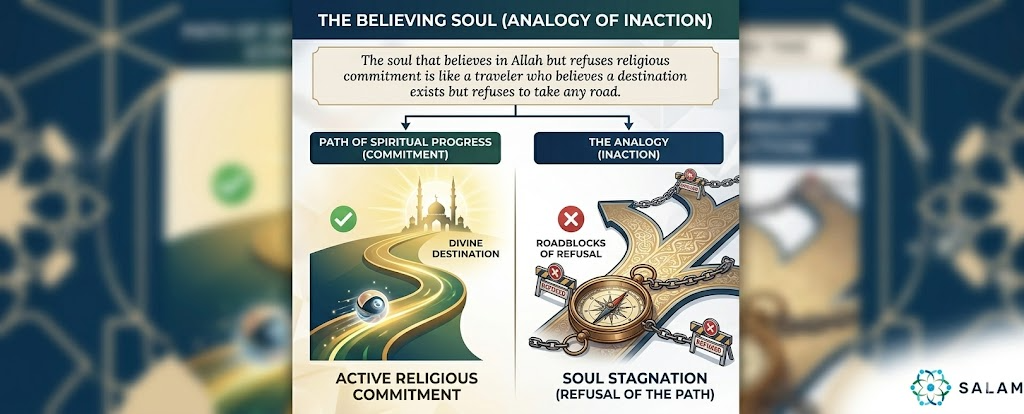
The soul that believes in Allah but refuses religious commitment is like a traveler who believes a destination exists but refuses to take any road.
The conviction, however sincere, does not move them forward. And in this journey, standing still is not neutral — every day passed without submission is a day of the covenant left unfulfilled.
Read also: Do Humanists Believe in God?
How Does Islam View Sincerity and the Seeker Who Has Not Yet Found the Path?
A question that naturally arises: what about the person who sincerely believes in one God, lives a moral life, and genuinely searches — but has not yet found Islam or understood it correctly? Islam does not treat all situations identically.
The overarching principle in Islamic jurisprudence is that hujjah — the proof and the message — must reach a person before full accountability applies. The Prophet (PBUH) said:
“وَالَّذِي نَفْسِي بِيَدِهِ، لَا يَسْمَعُ بِي أَحَدٌ مِنْ هَذِهِ الأُمَّةِ يَهُودِيٌّ وَلَا نَصْرَانِيٌّ، ثُمَّ يَمُوتُ وَلَمْ يُؤْمِنْ بِالَّذِي أُرْسِلْتُ بِهِ، إِلَّا كَانَ مِنْ أَصْحَابِ النَّارِ”
“By Him in Whose hand is my soul, there is no one from this Ummah who hears of me — whether a Jew or a Christian — and then dies without believing in what I have been sent with, except that he will be among the people of the Fire.” (Sahih Muslim, 153)
This Hadith makes the stakes unmistakably clear for anyone who has genuinely heard the message. The sincere seeker who truly does not know is in a different category from the one who has encountered Islam and turned away from it out of preference for a personally comfortable spirituality.
The person reading this article is, in all likelihood, someone who has now heard.
Have Questions About Islam?
Our team is ready to answer your questions clearly and respectfully. Ask freely and receive honest guidance.
Ask Us NowRead also: The Belief In The Existence Of Only One God
Explore Further Authentic Knowledge About Islam With Salam
If this article has stirred questions — about Islam, about the nature of belief, about what it means to truly know and submit to your Creator — the Salam blog is a space built for exactly that kind of exploration. You’ll find in-depth articles on God in Islam,polytheism and its refutation, and the full range of Islamic belief — written for seekers, skeptics, and anyone curious enough to ask real questions.
For questions this article hasn’t answered — about taking the step into Islam, about a specific concern, or simply about wanting to learn more — the Salam Platform team is here. Reach out directly and a knowledgeable guide will respond with care, without pressure, and without judgment.
The door is open.
Frequently Asked Questions
Can someone believe in God and still go to Heaven without following a religion?
No, the path to Allah’s acceptance after the final message of Prophet Muhammad (PBUH) is Islam. The Quran states explicitly that no religion other than Islam will be accepted from any person (Quran 3:85). Belief in God’s existence, while a necessary starting point, does not fulfill the covenant Allah established with every human soul. Heaven — Jannah — is the reward for those who believe and submit, not for those who acknowledge and remain uncommitted.
Is "spiritual but not religious" a valid way to approach God according to Islam?
No. Sincerity without correct submission is like water without a vessel — it cannot be held. The fitrah draws a person toward Allah, and Islam is the path that fulfills and completes that draw. "Spiritual but not religious" is a culturally modern construct that elevates personal feeling above divine guidance. Islam gently but firmly insists that feelings need to be anchored in revelation, not the other way around.
What is the difference between believing in God and having faith (iman) in Islam?
In Islam, iman — faith — is a complete state that encompasses belief in the heart, declaration with the tongue, and action with the limbs. Faith in Islam is not simply an internal feeling or intellectual conviction. It requires the whole person. Believing that Allah exists satisfies only one dimension of iman. Without the remaining dimensions — testimony, worship, and righteous conduct guided by revelation — iman remains incomplete.
If someone is looking for God sincerely, where should they start?
Start with the question of revelation. Does God exist? Most seekers already believe He does. The next question is: has He spoken? This leads directly to the Quran — the most textually preserved, linguistically extraordinary, and spiritually compelling document in human history. Reading the Quran with an open heart, understanding what do Muslims believe about the Quran, and engaging with a knowledgeable Muslim community are the three most natural first steps for any sincere seeker.
Curious about Islam?
Journey towards clarity and purpose. Our team is here to support you in your search for truth and spiritual guidance.
Embrace the Truth