Islam vs Buddhism – Full Guide
| Key Takeaways |
| Islam is a divinely revealed religion with the Quran as its authenticated scripture, while Buddhism is a human philosophical system with no claim to divine revelation. |
| Islam establishes the absolute oneness of Allah (Tawhid) as its foundational principle; Buddhism either denies a Creator God or treats the concept as irrelevant to its teachings. |
| The Buddha was a human being whose followers later deified him — a form of shirk (associating partners with Allah) that Islam categorically rejects. |
| Islam offers a complete and preserved system of belief, worship, ethics, and law; Buddhism offers a philosophical framework centered on self-liberation through human effort alone. |
| The concept of salvation in Islam is rooted in divine mercy and accountability before Allah; Buddhist “liberation” (Nirvana) is a self-achieved state with no personal God involved. |
| Islam affirms the resurrection, divine judgment, Paradise, and Hellfire as absolute realities; Buddhism has no parallel to individual resurrection or divine reckoning. |
Islam and Buddhism share a surface-level reputation for promoting peace, compassion, and inner discipline — and at that surface, many observers stop looking. But when the foundational questions are asked — Who created existence? Is there a God? What is the human being? What happens after death? Who has the authority to define right and wrong? — the two paths diverge completely and irreconcilably.
Islam answers every one of those questions with revelation from Allah, preserved in the Quran and authenticated through the Sunnah of Prophet Muhammad (PBUH).
Buddhism answers them, where it answers them at all, through the philosophical reflections of a human being who lived in 5th-century India — reflections his own followers later contradicted, mythologized, and divided over.
1. Islam vs Buddhism on the Question of God
The single most defining difference between Islam and Buddhism is the question of whether a Creator God exists — and the two answers could not be further apart.
Islam declares, with complete certainty and without qualification:
قُلْ هُوَ اللَّهُ أَحَدٌ اللَّهُ الصَّمَدُ لَمْ يَلِدْ وَلَمْ يُولَدْ وَلَمْ يَكُن لَّهُ كُفُوًا أَحَدٌ
“Say, ‘He is Allah, [who is] One, Allah, the Eternal Refuge. He neither begets nor is born, nor is there to Him any equivalent.'” (Quran 112:1–4)
Tawhid — the absolute oneness of Allah — is the axis around which all of Islam revolves. Allah is the Creator, the Sustainer, the One who alone deserves worship, the One who sent messengers, revealed scriptures, and will judge every soul.
This is not abstract theology. It is the lived foundation of every Muslim’s prayer, every moral decision, every act of worship. The nature of God in Islam is personal, knowable, and intimately present to the believer.
Classical Buddhism, as taught by Siddhartha Gautama himself, does not affirm a Creator God. The original Buddhist texts record the Buddha declining to answer metaphysical questions about the origin of the universe or the existence of a supreme deity — a position scholars term “noble silence” or pragmatic agnosticism.
Some Buddhist schools developed later into forms of deity-worship, including the explicit deification of the Buddha himself, but these represent a departure from — not a fulfillment of — the original teaching.
The absence of God in classical Buddhism means there is no Creator to be grateful to, no Lord to be accountable before, no divine law to govern conduct, and no personal relationship between the human being and the source of existence. This is not a minor theological gap. It is a foundational rupture with reality as Islam defines it.
Monotheism in Islam is not one feature among many — it is the very definition of correctness in belief. And polytheism, including the later Buddhist practice of worshipping the Buddha as a deity, is the gravest deviation a human being can commit.
2. Divine Revelation Against Human Philosophy
Islam’s scripture is the Quran — the literal, preserved word of Allah, revealed to Prophet Muhammad (PBUH) over twenty-three years, memorized by thousands during his lifetime, and transmitted through an unbroken chain of authenticated narration to the present day. The Quran itself states:
إِنَّا نَحْنُ نَزَّلْنَا الذِّكْرَ وَإِنَّا لَهُ لَحَافِظُونَ
“Indeed, it is We who sent down the Quran and indeed, We will be its guardian.” (Quran 15:9)
The divine guarantee of preservation is unique to the Quran among all religious texts. No other scripture makes this claim — and no other scripture has fulfilled it. Muslims understand why the Quran deserves belief: it is linguistically inimitable, historically authenticated, and internally consistent across fourteen centuries.
Buddhist scriptures occupy an entirely different category. The Tripitaka — the primary Buddhist canonical collection — was not written during the Buddha’s lifetime. His followers convened after his death in approximately 483 BCE to collectively recall and record his teachings from memory.
Over subsequent centuries, Buddhist texts multiplied, diverged, and were rewritten differently across the Northern (Mahayana) and Southern (Theravada) schools.
Northern Buddhist scriptures, written in Sanskrit, contain significantly more mythological elaboration about the Buddha’s nature than the Southern Pali texts, which are themselves already far removed from a verified original.
Buddhist scholars openly acknowledge that the canon is a product of community construction, not divine transmission.
There is no claim — and no evidence — that any Buddhist scripture represents the word of God. The texts are, by the tradition’s own admission, recorded opinions, dialogues, parables, and philosophical frameworks attributed to a human teacher.
This is a categorical distinction. Revelation and philosophy are not the same category of knowledge. The Quran speaks with the authority of the Creator. The Tripitaka speaks with the authority of human memory and interpretation.
Have Questions About Islam?
Our team is ready to answer your questions clearly and respectfully. Ask freely and receive honest guidance.
Ask Us Now3. Prophethood Against Deification
Islam teaches that Prophet Muhammad (PBUH) was a human being — the final messenger of Allah, the most noble of creation, the exemplar of perfect character — but always and unambiguously a man. The Quran is explicit:
وَمَا مُحَمَّدٌ إِلَّا رَسُولٌ قَدْ خَلَتْ مِن قَبْلِهِ الرُّسُلُ
“Muhammad is not but a messenger. [Other] messengers have passed on before him.” (Quran 3:144)
This clarity protects the believer from the gravest of errors — elevating a human being to the status of divinity. When Abu Bakr (may Allah be pleased with him) announced the Prophet’s death, he recited this verse to the companions, grounding their grief in correct belief. The humanity of the Prophet (PBUH) is not a limitation — it is a theological safeguard that Islam preserves with absolute care.
The Buddha’s history took the opposite trajectory. Siddhartha Gautama was born a prince in a region bordering present-day Nepal around 560 BCE. His original teaching, by the account of even secular Buddhist historians, centered on human ethics and self-discipline, not divine claims. But after his death, his followers progressively mythologized him.
The Mahayana school — dominant in China, Japan, and Tibet — developed an elaborate theology in which the Buddha becomes a cosmic, eternal, omniscient being, a savior figure who carries the sins of his followers, who was born of a virgin through the descent of a divine spirit, whose birth was announced by a star, and whom angels celebrated at birth.
These are not incidental parallels to other religious traditions. They represent a systematic mythologization of a historical human figure into a deity — and this process is precisely what Islam identifies as one of the most dangerous deviations of religious communities across history.
4. Vicegerency Against Self-Annihilation
Islam defines the human being with extraordinary dignity. Allah created the human being from clay, breathed His spirit into him, placed him as a khalifah (vicegerent) on earth, and honored him above much of creation:
وَإِذْ قَالَ رَبُّكَ لِلْمَلَٰٓئِكَةِ إِنِّى جَاعِلٌ فِى ٱلْأَرْضِ خَلِيفَةً
And [mention, O Muhammad], when your Lord said to the angels, “Indeed, I will make upon the earth a successive authority.” (Quran 2:30)
وَلَقَدْ كَرَّمْنَا بَنِي آدَمَ
“And We have certainly honored the children of Adam.” (Quran 17:70)
The human being in Islam has a soul, free will, moral responsibility, and a direct relationship with Allah. Life is a trust — meaningful, purposeful, and accountable. Every human action carries weight because every human being will stand before Allah on the Day of Judgment.
Classical Buddhism approaches the human being from a radically different angle. One of its foundational doctrines is anatta — the teaching that there is no permanent, essential self.
What humans experience as an “I” is, in Buddhist philosophy, a composite of transient mental and physical processes with no enduring substance. The goal of Buddhist practice is not to fulfill the self before God, but to dissolve the illusion of selfhood — a process culminating in Nirvana.
Nirvana — the Buddhist concept of ultimate liberation — is described in varying ways across schools, but its consistent meaning involves the extinguishing of desire, the cessation of the cycle of rebirth, and release from suffering.
It is not union with a personal God. It is not entry into a divine paradise. In many formulations, it is closer to the dissolution of individual existence than to any Islamic conception of the afterlife.
Islam teaches that individual souls persist after death, that they experience the consequences of their earthly choices, and that Allah’s justice and mercy are both expressed in what follows death. Paradise (Jannah) is described in vivid, personal terms — a reality of joy, nearness to Allah, and fulfilled longing. Hellfire (Jahannam) is equally real, the consequence of persistent rejection of the truth.
The contrast in how each tradition views what a human being fundamentally is shapes every downstream difference — in ethics, in worship, in the purpose of life, and in what awaits after it ends.
5. Divine Command Against Human Reasoning
Both Islam and Buddhism emphasize ethical conduct — and this is one of the most common reasons people perceive them as similar. The Buddha’s moral teachings include prohibitions on killing, stealing, lying, and intoxication, alongside strong encouragement of compassion, generosity, and self-discipline. These overlap, at the level of behavior, with Islamic ethics.
But the source of moral authority in the two traditions is entirely different — and that difference matters enormously.
Islamic ethics derives from Allah’s command, transmitted through revelation. The Quran and the authenticated Sunnah of the Prophet (PBUH) define what is lawful and what is forbidden, what is praiseworthy and what is blameworthy.
Moral reasoning in Islam operates within the framework of divine guidance — human intellect is honored and engaged, but it does not override revelation. The principles of Islam reflect a comprehensive, divinely structured system that governs every dimension of human life.
Buddhist ethics derives from human philosophical reflection on what reduces suffering and promotes liberation. The Buddha’s moral prescriptions are reasoned arguments from human experience, not commands from a Creator.
When Buddhist scholars of different schools disagree on ethical questions — and they disagree substantially — there is no divine text to arbitrate. The resolution comes through philosophical debate, school tradition, or the authority of senior monastics.
This means Buddhist ethics, however sincere, rests on a foundation that can shift. A human philosophical framework, no matter how refined, is subject to the limitations of its author and the interpretive communities that inherit it.
Islamic ethics rests on the command of the One who created the human being, knows his nature, and has no limitation of knowledge, wisdom, or justice.
Read Also: The Creation Story in Islam and Christianity
6. Islam vs Buddhism on Salvation
Perhaps the most theologically significant comparison between Islam and Buddhism lies in what each tradition promises as the ultimate human goal — and how that goal is reached.
Islam teaches that every human being is accountable before Allah on the Day of Resurrection. Salvation — in the sense of entering Paradise and being saved from the Fire — is achieved through sincere belief (Iman), righteous action, and above all, the mercy of Allah.
The Prophet Muhammad (PBUH) said:
“None of you will enter Paradise by his deeds alone.” They said: “Not even you, O Messenger of Allah?” He said: “Not even me, unless Allah envelops me in His mercy.” (Sahih)
This hadith captures the Islamic understanding of salvation with precision: human effort is real and required, but it is the mercy of a personal, knowing, caring God that ultimately determines the outcome. The believer is never alone in the journey.
Buddhism offers no such relationship. The classical Buddhist path to liberation is a personal undertaking — the Noble Eightfold Path, through which the practitioner disciplines thought, speech, action, and meditation until the conditions for rebirth are extinguished and Nirvana is achieved.
There is no divine grace in classical Buddhism, no forgiving God who responds to sincere repentance, no mercy that covers what human effort cannot reach.
Later Mahayana Buddhism introduced the concept of the Bodhisattva — a being who delays his own Nirvana to assist others toward liberation — and some schools developed elaborate devotional practices directed at Bodhisattvas or the Buddha himself.
But these innovations are later theological constructions built on top of an original teaching that had no place for them, and they represent a move away from the Buddha’s own philosophical framework rather than a fulfillment of it.
The Islamic framework of salvation addresses the full reality of the human condition: the sincere struggle, the inevitable shortcoming, the genuine repentance, and the encompassing mercy of Allah — who described Himself in the Quran as:
وَرَحْمَتِي وَسِعَتْ كُلَّ شَيْءٍ
“My mercy encompasses all things.” (Quran 7:156)
A Comparative Overview: Islam vs Buddhism
| Dimension | Islam | Buddhism |
| Nature of the tradition | Divine revelation from Allah | Human philosophical system |
| Existence of God | Absolute — Allah is the sole Creator and Lord | Denied or irrelevant in classical teaching |
| Scripture | The Quran — preserved, revealed word of Allah | Tripitaka — recorded human memory, no divine claim |
| The founder | Prophet Muhammad (PBUH) — final messenger, human | Siddhartha Gautama — later mythologized into a deity |
| Human nature | Soul with dignity, free will, and divine vicegerency | No permanent self (anatta); selfhood is illusion |
| Purpose of life | Worship of Allah, moral accountability, preparing for the Hereafter | Escape the cycle of rebirth; attain Nirvana |
| Moral authority | Allah’s command through Quran and Sunnah | Human philosophical reasoning |
| The afterlife | Resurrection, divine judgment, Paradise or Hellfire | Rebirth cycle (samsara); Nirvana as cessation |
| Salvation | By belief, deeds, and the mercy of Allah | By personal effort through the Eightfold Path |
| Worship | Prayer, fasting, pilgrimage — acts directed to Allah alone | Meditation, ethical discipline — no divine recipient |
| Attitude toward other religions | Islam is the final, complete, and preserved truth | Inclusive philosophical framework with no absolute truth claim |
Have Questions About Islam?
Our team is ready to answer your questions clearly and respectfully. Ask freely and receive honest guidance.
Ask Us NowRead Also: Islam vs Hinduism
Your Questions About Islam Deserve Real Answers
If this comparison has raised questions — about Allah, about the Quran, about what Islam truly teaches — you deserve direct, thoughtful answers grounded in authentic Islamic scholarship.
Explore more on the Salam Platform, where every article is written with one purpose: your genuine benefit.
Read more on the Salam blog — a growing library of clear, evidenced content on Islamic belief, comparative religion, and the questions seekers actually ask.
Have a specific question, want to learn more about Islam, or are you considering taking your Shahada?
Reach out directly — our team is ready to listen, guide, and welcome you.
Read Also: Islam vs Judaism

Read Also: Sunni Islam vs Shia Islam
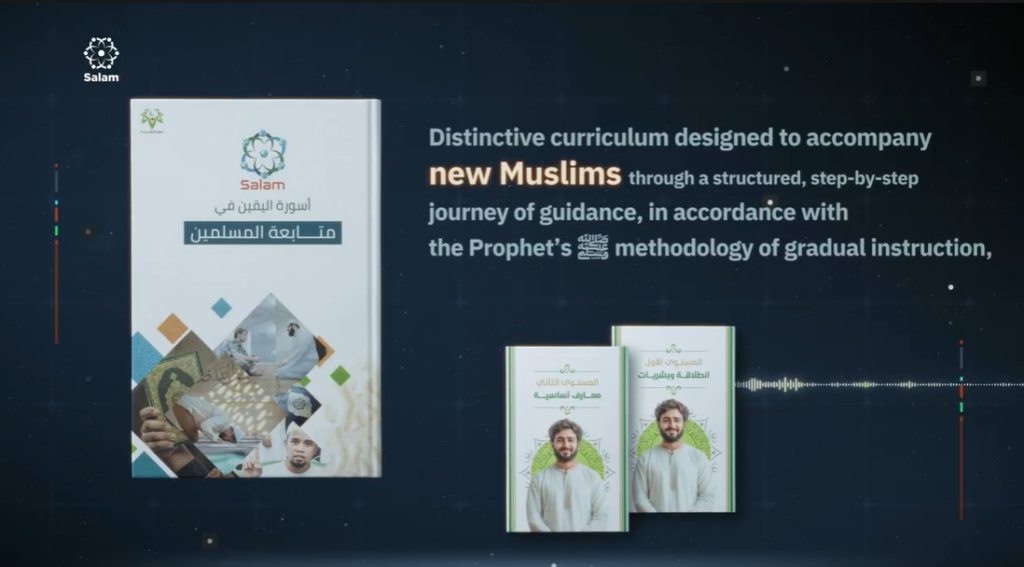
And if you have already embraced Islam, or are ready to begin a structured journey of knowledge and certainty, consider joining the Asawirat Al-Yaqeen (Bracelets of Certainty) program — the Salam Center‘s flagship curriculum for new Muslims, implemented with over 114,000 Muslims across 140 countries:
- Stage One — The Foundation: the pillars of Islam, the meaning of the Shahada, Tawhid in practice
- Stage Two — The Construction Phase: the pillars of Iman, the Seerah of the Prophet (PBUH)
- Stage Three — The Consolidation Phase: spiritual character, practical life rulings, and moral grounding
- Stage Four — The Empowerment Phase: contemporary issues, theological clarity, and a life roadmap
The program combines compassionate guidance with rigorous scholarship — progressive, structured, and built specifically for the journey you are on.
Reach out directly to the Salam Center team to start the Asawirat Al-Yaqeen (Bracelets of Certainty) program for FREE.
Read Also: Islam vs. Christianity
Summary
Islam and Buddhism diverge at every foundational level: Islam is a divinely revealed religion centered on the absolute oneness of Allah, while Buddhism is a human philosophical framework with no Creator God, no divine revelation, and no preserved scripture of divine origin.
The deification of the Buddha by later Buddhist schools exemplifies the very pattern of religious deviation that Islam warns against — elevating a human figure to divine status, a corruption that has historically destroyed the original monotheistic message of prophetic traditions.
Seekers comparing Islam and Buddhism will find that Islam addresses every essential human question — about God, the self, moral authority, death, and eternity — with divine clarity and preserved revelation, offering not just a philosophy for living, but a complete path to the mercy of Allah.
Frequently Asked Questions
Do Islam and Buddhism worship the same God?
No. Islam is founded on Tawhid — the absolute oneness of Allah — who is the personal Creator, Sustainer, and Judge of all existence. Classical Buddhism does not affirm a Creator God at all. Later Buddhist schools deified the Buddha, which Islam identifies as shirk, the gravest sin a human being can commit.
Does Buddhism have a scripture equivalent to the Quran?
No. The Buddhist Tripitaka was compiled from human memory after the Buddha’s death, has no claim to divine authorship, diverges significantly between Northern and Southern schools, and has been openly shaped by philosophical interpretation across centuries. The Quran, by contrast, is the preserved, authenticated, divinely revealed word of Allah.
What does Islam say about Buddhist ethics and compassion?
Islam recognizes that Buddha’s original ethical teachings contained valuable moral principles such as honesty, compassion, and self-discipline. However, ethics detached from divine command and accountability before Allah lack the authority and completeness of Islamic law. Good behavior is not sufficient for salvation without correct belief in Allah.
Curious about Islam?
Journey towards clarity and purpose. Our team is here to support you in your search for truth and spiritual guidance.
Embrace the Truth