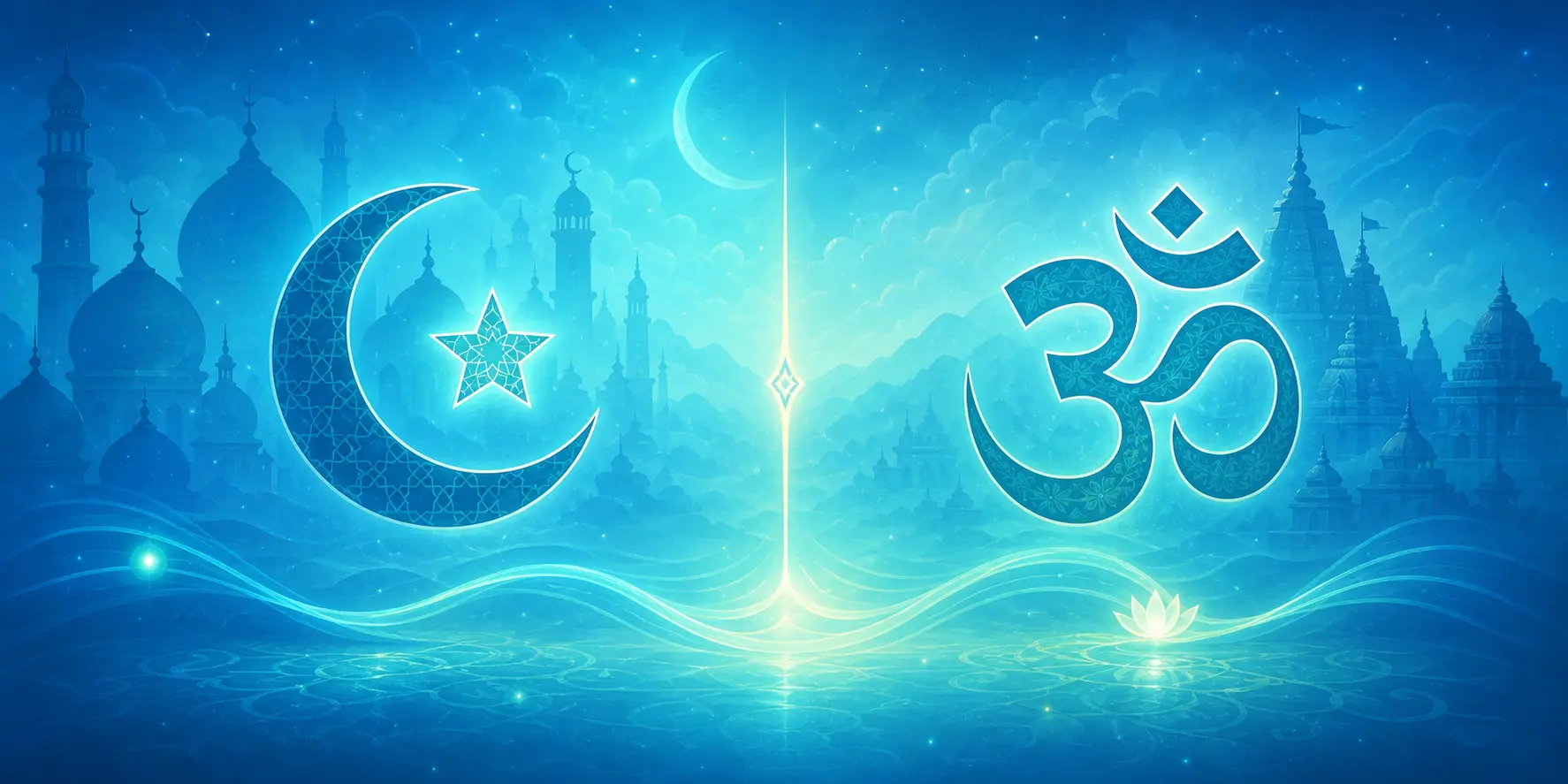
Islam vs Hinduism – Full Guide
| Key Takeaways |
| Islam is built on pure monotheism — the absolute oneness of Allah — while Hinduism embraces polytheism, with many deities worshipped across its traditions. |
| The Islamic concept of Allah as the sole Creator and Sustainer stands in direct contrast to Hinduism’s Trimurti: Brahma, Vishnu, and Shiva as three aspects of one divine reality. |
| Islam affirms the resurrection of both body and soul for divine judgment, while Hinduism teaches reincarnation (transmigration of souls) through endless cycles governed by karma. |
| The caste system in Hinduism assigns human worth by birth — a reality Islam dismantled by establishing radical human equality before Allah. |
| Islamic scripture — the Quran — is preserved in its original Arabic text, with an unbroken chain of transmission, while Hindu scriptures emerged anonymously over centuries with no defined authorship. |
| Islam provides a complete, accessible way of life for all humanity; Hinduism is predominantly practiced by the people of the Indian subcontinent and remains culturally inseparable from its geographic origin. |
When people sincerely ask about Islam vs Hinduism, they are asking one of the most profound questions a human being can ask: what is the truth about the One who created us, and how should we live? The comparison touches the deepest questions of existence — Who is Allah? What happens when we die? Are all humans equal? What is the purpose of this life?
Islam answers these questions with a clarity that has guided over 1.8 billion people across every race, language, and continent. Hinduism — the world’s oldest surviving religious tradition, with roots stretching back to the Aryan migrations into the Indian subcontinent around the 15th century BCE — offers a vastly different set of answers.
1. Islam vs Hinduism in the Concept of God
The most fundamental distinction between Islam and Hinduism begins with the nature of the divine.
In Islam, the foundation of all belief is Tawheed — the absolute, indivisible oneness of Allah. Allah has no partners, no sons, no equals, and no rivals. He was not born and does not die. He does not take on human form, and He does not merge with creation.
قُلْ هُوَ اللَّهُ أَحَدٌ اللَّهُ الصَّمَدُ لَمْ يَلِدْ وَلَمْ يُولَدْ وَلَمْ يَكُن لَّهُ كُفُوًا أَحَدٌ
“Say, ‘He is Allah, [who is] One, Allah, the Eternal Refuge. He neither begets nor is born, nor is there to Him any equivalent.'” (Quran 112:1–4)
This is the irreducible core of faith in Islam. Every pillar of Islamic practice flows from it.
Hinduism, by contrast, is rooted in a layered and internally diverse tradition of polytheism. Hindu scriptures — primarily the Rigveda, Yajurveda, Samaveda, and Atharvaveda — present a vast cosmos populated with countless deities: Indra, Agni, Varuna, Surya, and thousands more.
Each deity governs a domain of nature or human life. The Rigveda, which scholars trace to roughly 3,000 years before the Common Era, already contains hymns addressed to dozens of distinct gods with distinct attributes and functions.
In the 9th century BCE, Hindu priests synthesized many of these deities into the Trimurti — a trinity comprising Brahma (the creator), Vishnu (the preserver), and Shiva (the destroyer).
This framework held that worshipping any one of the three was equivalent to worshipping all three, and ultimately, the one supreme reality behind them. This theological move toward a form of qualified monotheism is notable, but it remains categorically different from Islamic Tawheed.
Islam’s position on polytheism is unambiguous. Associating partners with Allah — called shirk — is the gravest possible deviation from truth.
إِنَّ اللَّهَ لَا يَغْفِرُ أَن يُشْرَكَ بِهِ وَيَغْفِرُ مَا دُونَ ذَٰلِكَ لِمَن يَشَاءُ
“Indeed, Allah does not forgive association with Him, but He forgives what is less than that for whom He wills.” (Quran 4:48)
To understand the Islamic position more fully on how Islam views the nature of God is to understand why this comparison matters so deeply.
2. Preserved Revelation Versus Anonymous Tradition
The Quran was revealed to Prophet Muhammad (PBUH) over 23 years through the Angel Jibreel (Gabriel), beginning in the year 610 CE. Every verse is attributed to a known occasion.
Every chain of transmission is documented. The Quran exists today in precisely the same Arabic text as it was revealed — not a single letter has been altered.
إِنَّا نَحْنُ نَزَّلْنَا الذِّكْرَ وَإِنَّا لَهُ لَحَافِظُونَ
“Indeed, it is We who sent down the Reminder, and indeed, it is We who will be its guardian.” (Quran 15:9)
Millions of Muslims across the world have memorized the Quran in its entirety — a phenomenon without parallel in human religious history.
Those who want to understand what Muslims believe about the Quran will find a tradition of preservation that is meticulous, documented, and continuous.
Hindu scriptures emerged over an enormous span of time — from the 15th century BCE through the medieval period — with no identified authors for most texts.
The Vedas, the Upanishads, the Mahabharata, the Ramayana, and the Puranas were composed, edited, and transmitted through generations of priests and sages whose identities are largely unknown.
The Manu Smriti (Laws of Manu), which codified Hindu social law in roughly the 3rd century BCE, likewise lacks a single verifiable author.
This distinction carries significant weight. Islam grounds its claim to divine truth in a book whose every word is traceable, preserved, and historically authenticated. Why Muslims believe in the Quran is a question answered through evidence — linguistic, historical, and miraculous — not merely through tradition.
Have Questions About Islam?
Our team is ready to answer your questions clearly and respectfully. Ask freely and receive honest guidance.
Ask Us Now3. The Brotherhood of Faith Versus the Caste System
Perhaps no contrast between Islam and Hinduism is more stark — or more consequential in lived human experience — than their respective positions on human equality.
Islam declared the absolute equality of all human beings before Allah from the first moments of its revelation.
Race, lineage, language, and social origin carry no weight in the scales of divine judgment. The only measure of human worth before Allah is taqwa — conscious awareness and fear of Him.
يَا أَيُّهَا النَّاسُ إِنَّا خَلَقْنَاكُم مِّن ذَكَرٍ وَأُنثَىٰ وَجَعَلْنَاكُمْ شُعُوبًا وَقَبَائِلَ لِتَعَارَفُوا ۚ إِنَّ أَكْرَمَكُمْ عِندَ اللَّهِ أَتْقَاكُمْ
“O mankind, indeed We have created you from male and female and made you peoples and tribes that you may know one another. Indeed, the most noble of you in the sight of Allah is the most righteous of you.” (Quran 49:13)
Prophet Muhammad (PBUH) confirmed this in his farewell sermon — one of the most significant addresses in human history:
“No Arab has any superiority over a non-Arab, nor does a non-Arab have any superiority over an Arab, nor does a white man have any superiority over a black man, or the black man over the white man, except by the degree of taqwa.”
Hinduism, as it developed through the Manu Smriti, institutionalized the opposite. The caste system divides humanity into four permanent, birth-determined social categories:
| Caste | Origin (According to Manu Smriti) | Role |
| Brahmins | Created from Brahma’s mouth | Priests, judges, teachers |
| Kshatriyas | Created from Brahma’s arms | Warriors, rulers |
| Vaishyas | Created from Brahma’s thighs | Farmers, traders |
| Shudras | Created from Brahma’s feet | Servants of the upper castes |
Below even the Shudras sit the untouchables — those declared outside the caste system entirely, condemned by birth to the most degrading conditions.
The Manu Smriti specifies that the penance for killing a dog, a cat, a frog, a crow, an owl — and a man from the untouchable class — is equivalent. A Brahmin child of ten years surpasses a Shudra of a hundred years, the text states, as a father surpasses his son.
These are not peripheral details. They are the codified law of a religious system. Gandhi himself — who attempted to soften the edges of caste discrimination — was ultimately unable to dismantle the structure, and many historians note he fell victim to the very tensions his reform efforts generated.
It is precisely this lived oppression that led countless Indians from the untouchable class to find, in Islam, the dignity and brotherhood they had been denied for centuries.
Many embraced Islam, recognizing in its teachings of equality the humanity that their birth religion had stripped from them.
4. Divine Judgment in the Afterlife Versus the Cycle of Reincarnation
The Islamic understanding of what happens after death is precise and anchored in revelation. Every soul will die. Every soul will then be resurrected — body and soul together — and stand before Allah on the Day of Judgment. That day, every deed, intention, and word will be weighed on the divine scale.
Those whose scales are heavy with righteousness will enter Jannah (Paradise); those whose scales tilt otherwise will face the Fire.
كُلُّ نَفْسٍ ذَائِقَةُ الْمَوْتِ ۗ وَإِنَّمَا تُوَفَّوْنَ أُجُورَكُمْ يَوْمَ الْقِيَامَةِ
“Every soul will taste death, and you will only be given your [full] compensation on the Day of Resurrection.” (Quran 3:185)
Hinduism’s framework for the afterlife is built on three interconnected concepts:
Karma: The law of cosmic moral justice — every action in this life produces consequences that must be met, either in this life or in a future one.
Reincarnation (Samsara): When the body dies, the soul transmigrates into a new body — human, animal, or otherwise — determined by the accumulated karma of the previous life. This cycle continues indefinitely.
Moksha: The ultimate goal — liberation from the cycle of rebirth, achieved when the soul is purged of all desire and merges with Brahman, the supreme impersonal reality. Crucially, the path most favored for reaching moksha is radical passivity: freedom from all desire and attachment, which Hindu philosophers valued above righteous action.
The theological implications are serious. Islam teaches that this life is a single, sacred, non-repeatable trust — an amanah — in which every human being is accountable for their choices.
Each soul’s standing before Allah is its own, earned in one lifetime, judged with absolute justice. Reincarnation dissolves individual moral accountability into an endless loop where consequences are deferred indefinitely and justice is never conclusively rendered.
5. Islam vs Hinduism on the Status of Women
Islam established rights for women at a time when the ancient world offered them none.
Women in Islam possess full legal personhood — the right to own property, to inherit, to initiate divorce, to conduct business, and to be financially supported without any obligation to contribute to household expenses.
These rights were not conceded reluctantly; they were revealed as divine obligations.
وَلَهُنَّ مِثْلُ الَّذِي عَلَيْهِنَّ بِالْمَعْرُوفِ
“And due to the wives is similar to what is expected of them, according to what is reasonable.” (Quran 2:228)
The Prophet (PBUH) said:
“The best of you are those who are best to their wives.” (Sunan Ibn Majah, 1977)
The Manu Smriti‘s treatment of women — particularly widows — stands in painful contrast. A woman whose husband dies is forbidden from remarrying.
She is expected to live in permanent grief, subject to social contempt, occupying a rank lower than a household servant. Hindu texts recorded that widows sometimes burned themselves alive on their husbands’ funeral pyres — a practice known as sati — to escape the suffering awaiting them.
This practice was outlawed in modern India, but its roots reach deep into a religious framework that treated a woman’s worth as entirely contingent on her husband’s life.
Child marriage was also sanctioned by classical Hindu law — the Manu Smriti permitted the betrothal of children barely old enough to walk, resulting in girls becoming widows before they had lived.
Modern Indian law has since prohibited this, but the religious sanction behind it originated within this tradition.
Islam vs Hinduism on Core Questions
| Question | Islam | Hinduism |
| Who is God? | Allah — One, without partners, forms, or equals | Multiple deities; Trimurti (Brahma, Vishnu, Shiva) or abstract Brahman |
| What is the sacred scripture? | The Quran — preserved, authored by Allah, transmitted with verified chains | The Vedas, Upanishads, Epics — authored anonymously over centuries |
| What happens after death? | Resurrection of body and soul; divine judgment; Jannah or Jahannam | Reincarnation (Samsara) governed by karma; eventual moksha |
| Are all humans equal? | Yes — absolutely equal before Allah regardless of race or birth | No — the caste system assigns permanent, birth-determined hierarchy |
| What is the purpose of life? | To worship Allah, fulfil His commands, and prepare for the Hereafter | To fulfil one’s caste duty (dharma) and progress toward liberation |
| What is the status of women? | Full legal personhood; dignity, rights, and protection | Widow condemned to suffering; worth tied to husband’s survival |
| How is the divine known? | Through revealed scripture and prophetic guidance | Through ritual, meditation, and priestly intermediaries |
| Is the religion universal? | Yes — sent for all humanity across all times and places | Primarily rooted in Indian subcontinent culture and ethnicity |
How Does Islam View Other Religions?
Islam’s relationship with other religious traditions is one of clarity without hostility. The Quran confirms that Allah sent messengers to every nation, all calling to the same truth — pure monotheism and submission to the One Creator.
وَلَقَدْ بَعَثْنَا فِي كُلِّ أُمَّةٍ رَّسُولًا أَنِ اعْبُدُوا اللَّهَ وَاجْتَنِبُوا الطَّاغُوتَ
“And We certainly sent into every nation a messenger, [saying], ‘Worship Allah and avoid Taghut [false deities].'” (Quran 16:36)
The deviation of Hinduism from pure monotheism — the association of partners with Allah, the caste system’s dehumanization, the rejection of individual accountability before a personal Creator — is not a peripheral concern.
It is a departure from the primordial truth that every human being is born with an innate recognition of (fitrah). How Islam views other religions reflects this framework — acknowledging the original guidance that preceded them while being honest about the distortions that accumulated over time.
The principles of Islam — from Tawheed to accountability, from justice to compassion — represent not one cultural option among many, but the restored, preserved message of humanity’s original religion.
Monotheism — the worship of Allah alone — is the thread connecting every prophet from Adam (AS) to Muhammad (PBUH), and it is the truth that Hinduism, despite containing ancient spiritual intuitions, ultimately obscures beneath layers of polytheism, ritual, and social stratification.
God in Islam is personal, accessible, merciful, and just. He does not require priestly intermediaries. He does not incarnate in human form.
He does not merge with creation. Every human being — regardless of caste, ancestry, or circumstance — can turn to Him directly, at any moment, and be heard.
Read Also: Sunni Islam vs Shia Islam
Have Questions About Islam?
Our team is ready to answer your questions clearly and respectfully. Ask freely and receive honest guidance.
Ask Us NowRead Also: Islam vs. Christianity
Your Path to Deeper Knowledge Starts Here with Salam
If this comparison has prompted sincere questions — about Islam, about the concept of Allah, about what it means to live in full surrender to the One Creator — the Salam Center exists precisely for you.
Browse the full library of articles at the Salam Platform and explore Islam’s answers to the deepest questions of human existence.
Read, learn, and reflect at the Salam blog — a growing resource for seekers and new Muslims alike.
If you are ready to take the next step, reach out directly — whether to ask a question, to declare the Shahada, or simply to speak with someone who can guide you further.
Read Also: Islam vs Buddhism
Read Also: Islam vs Judaism
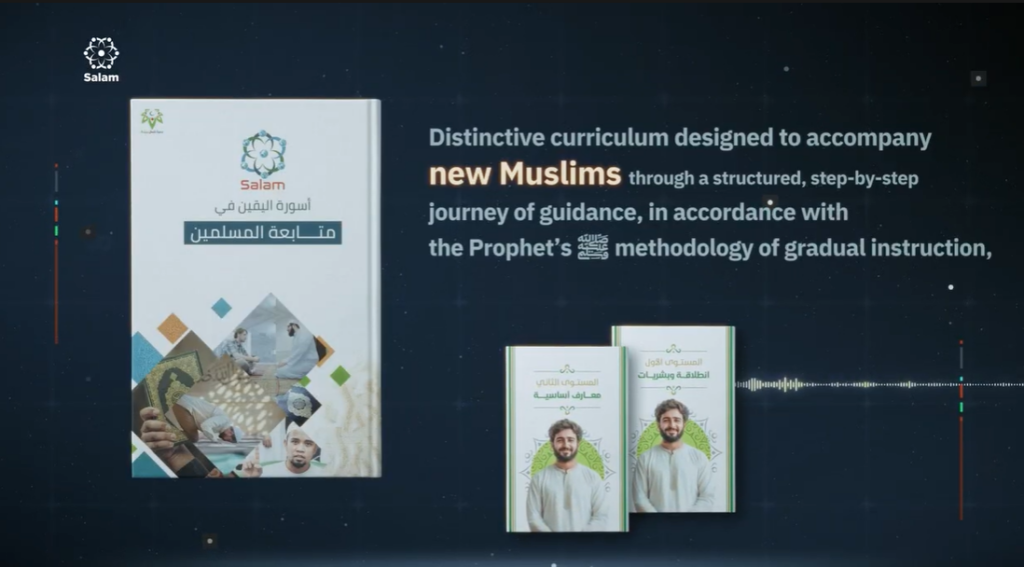
For those who have already entered Islam, the Salam Center offers the Asawirat Al-Yaqeen (Bracelets of Certainty) program — a structured, compassionate, and evidence-grounded curriculum for new Muslims:
- Stage One: The foundation — Shahada, prayer, purification, and the pillars of Iman
- Stage Two: Essential knowledge — tawbah, the Seerah of the Prophet (PBUH), fasting, and zakat
- Stage Three: Spiritual and moral consolidation — ethics of the heart, practical life rulings, and Islamic etiquette
- Stage Four: Empowerment — contemporary issues, theological foundations, and a life roadmap rooted in Surah Al-Asr
The program has already guided 114,588 new Muslims across 140 countries. It was designed to walk with you — not to rush you — through every stage of your journey to Yaqeen (certainty).
Reach out directly to the Salam Center team to start the Asawirat Al-Yaqeen (Bracelets of Certainty) program for FREE.
Summary
Islam establishes Allah as the sole, eternal, indivisible Creator — a truth preserved without alteration in the Quran across fourteen centuries. Hinduism’s polytheistic framework, with its countless deities and its qualified Trimurti trinity, represents a fundamental departure from the primordial monotheism that every messenger of Allah brought.
Human equality in Islam is not a philosophical ideal — it is a divine command, confirmed in revelation and embodied in the Prophet’s Sunnah. The Hindu caste system, codified in the Manu Smriti, assigned human worth by birth and sanctioned the permanent degradation of millions across generations.
Every sincere seeker who has looked honestly at these two traditions has found, in Islam, a completeness that answers the deepest human questions — with clarity, with mercy, and with the preserved word of the One who created us all.
Frequently Asked Questions
Does Islam and Hinduism share any common beliefs?
No, Islam and Hinduism diverge fundamentally: Islam affirms one God, individual resurrection, and universal human equality — all of which Hinduism’s mainstream traditions reject.
What does Islam say about the Hindu concept of karma and reincarnation?
Islam rejects reincarnation entirely. Each soul lives one earthly life, dies, and is then resurrected for divine judgment before Allah. The Quran states clearly in Quran 3:185 that every soul will taste death and be fully recompensed on the Day of Resurrection — individual accountability before Allah cannot be deferred across multiple lifetimes.
Why did many Hindu untouchables convert to Islam historically?
The caste system condemned the untouchable class to lives of institutionalized degradation, with no religious path to equality within Hinduism. Islam’s declaration that all humans are equal before Allah — regardless of birth, race, or lineage — offered them the dignity their own tradition had denied. Many embraced Islam specifically because they found in it the brotherhood and justice absent from the caste hierarchy.
Does Hinduism believe in one God or many gods?
Classical Hinduism is polytheistic, worshipping millions of deities associated with natural forces, human activities, and cosmic functions. The Trimurti (Brahma, Vishnu, Shiva) represents a later theological synthesis, but even this framework involves three distinct divine persons — categorically different from Islamic monotheism, which holds that Allah is absolutely and indivisibly one.
Curious about Islam?
Journey towards clarity and purpose. Our team is here to support you in your search for truth and spiritual guidance.
Embrace the Truth