
When Was the Quran Written?
| Key Takeaways |
| The Quran was revealed to Prophet Muhammad (PBUH) gradually over approximately 23 years, beginning in 610 CE and concluding in 632 CE. |
| The Quran was never “written” by a human author — it was transmitted verbally by Angel Jibreel (Gabriel) directly to the Prophet (PBUH) as Divine revelation. |
| During the Prophet’s lifetime, companions memorized every verse and scribes wrote revelations onto available materials including parchment, bone, and stone. |
| The first official compiled written Mushaf was produced under Caliph Abu Bakr As-Siddiq (RA) in approximately 633 CE, following the Battle of Yamama. |
| Caliph Uthman ibn Affan (RA) standardized the Quran into a single unified written text around 650 CE — the same text Muslims read worldwide today. |
| The Quran’s preservation combines oral memorization (Hafiz tradition) and written compilation, making it the most meticulously preserved text in human history. |
The Quran was not written in the way human books are written. It was revealed by Allah to Prophet Muhammad (PBUH) through Angel Jibreel across 23 years — from 610 CE until the Prophet’s final year of life in 632 CE.
The word “written” misses something essential about the Quran’s nature: it arrived as a living oral recitation, memorized by thousands, simultaneously recorded by scribes, and finally compiled into a single unified text within decades of the Prophet’s death.
When exactly was the Quran written down for the first time?
The Quran was written down from the very first revelation in 610 CE, with appointed scribes recording each verse as it descended upon the Prophet (PBUH). However, it was compiled into a single bound book (Mushaf) for the first time under Caliph Abu Bakr As-Siddiq (RA) in approximately 633 CE, as documented in Sahih Al-Bukhari.
The Quran Was Revealed in 610 CE and Continued for 23 Years
The first revelation of the Quran descended on Prophet Muhammad (PBUH) in the Cave of Hira, near Makkah, in 610 CE — during the blessed month of Ramadan. The Prophet was 40 years old. Angel Jibreel appeared and commanded him with the opening words of what would become Surah Al-Alaq:
اقْرَأْ بِاسْمِ رَبِّكَ الَّذِي خَلَقَ
“Recite in the name of your Lord who created.” (Quran 96:1)
This single command — Iqra, read or recite — launched a revelation that would continue for 23 years. The Prophet received verses in Makkah for the first 13 years (the Makkan period), then in Madinah for the remaining 10 years (the Madinan period) after the Hijra in 622 CE.
The Makkan revelations focused on foundational beliefs: the Oneness of Allah, accountability, the afterlife, and the nature of prophethood — matters central to faith in Islam.
The Madinan revelations addressed practical legislation, community ethics, and social structure.
The final verse of the Quran was revealed in 632 CE, shortly before the Prophet’s passing.
How Was the Quran Recorded During the Prophet’s Lifetime?
During the Prophet’s lifetime, the Quran was preserved through two parallel channels: oral memorization and written documentation. Both were systematic, supervised, and meticulous — and both operated simultaneously from the very earliest revelations.
1. Oral Preservation of the Quran Through the Huffaz Tradition
The Arab culture of the 7th century had an extraordinarily developed tradition of oral transmission. Poets memorized thousands of verses. The Companions of the Prophet (PBUH) brought this same capacity to the Quran — and surpassed it.
Hundreds of Companions memorized the entire Quran during the Prophet’s lifetime. These memorizers are called Huffaz (singular: Hafiz), and this tradition continues unbroken to this day, with millions of Muslims worldwide having memorized every single word of the Quran.
The Prophet (PBUH) himself would recite the entire Quran to Jibreel every Ramadan for review. In the final year of his life, he recited it twice — a sign, the Companions understood, that the revelation was complete.
2. Written Documentation of the Quran Through the Scribes of Revelation
The Prophet (PBUH) appointed dedicated scribes — known as Kuttab Al-Wahy (Writers of the Revelation) — who recorded each verse as it was revealed. Among the most notable were Zayd ibn Thabit, Ubay ibn Ka’b, Mu’adh ibn Jabal, and Ali ibn Abi Talib (may Allah be pleased with them all).
Writing materials of the time included flat stones, palm-leaf stalks, camel shoulder bones, and parchment.
Critically, each verse’s exact position within its chapter was dictated by the Prophet (PBUH) himself. The arrangement of the Quran was not a later editorial decision — it was specified by divine instruction relayed through the Prophet.
To learn more about what Muslims believe about the Quran and why it holds the authority it does, these foundations matter profoundly.
Learn More About Islam
Discover the beauty, teachings, and wisdom of Islam in a clear and welcoming way. Start exploring and deepen your understanding today.
Learn MoreWhen Was the Quran First Compiled Into a Single Written Book?
The first complete written compilation of the Quran was produced in approximately 633 CE — one year after the Prophet’s death — under the authority of Caliph Abu Bakr As-Siddiq (RA).
The immediate catalyst was the Battle of Yamama in 633 CE, in which approximately 70 Huffaz — memorizers of the entire Quran — were martyred.
Umar ibn Al-Khattab (RA) approached Abu Bakr with urgent concern: if key memorizers continued to fall in battle without a single written master copy existing, there was risk to the Quran’s textual continuity.
Abu Bakr initially hesitated — he was reluctant to do something the Prophet (PBUH) had not explicitly done. But after reflection and consultation, he recognized the preservation of the Quran as an obligation that fell within the spirit of Islamic principles. As narrated by Zayd ibn Thabit (RA) in Sahih Al-Bukhari:
“Abu Bakr said to me: ‘You are a wise young man and we do not have any suspicion about you, and you used to write the Divine Inspiration for Allah’s Messenger. So you should search for (the fragmentary scripts of) the Quran and collect it (in one book).'”
Zayd ibn Thabit led the compilation. His methodology was rigorous: he accepted no written material unless it was verified by at least two Companion witnesses who confirmed it was written in the Prophet’s presence.
The result was a single bound text — called the Mushaf — kept first with Abu Bakr, then with Umar (RA), and then with Umar’s daughter and the Prophet’s widow, Hafsa (RA).
Uthman ibn Affan and the Standardized Quran
The definitive standardized Quran that Muslims use today was established by Caliph Uthman ibn Affan (RA) around 644–650 CE — approximately 18 years after the Prophet’s death.
By this time, Islam had spread across vast territories with diverse Arab dialects. Different regions had begun using slightly variant copies, and minor dialectal discrepancies created concern among senior Companions.
Hudhayfah ibn Al-Yaman (RA), returning from military campaigns in Armenia and Azerbaijan, came to Uthman alarmed at the differences he witnessed. He said:
“Save this Ummah before they differ about the Book the way the Jews and Christians differed.”
Uthman acted. He formed a committee of four senior scholars — led again by Zayd ibn Thabit (RA), alongside Abdullah ibn Al-Zubayr, Sa’id ibn Al-As, and Abd Al-Rahman ibn Al-Harith — to produce a standardized master text. They used Hafsa’s Mushaf (the Abu Bakr compilation) as the primary base and cross-referenced it with the memorization of the Companions.
Several identical copies were produced and distributed to the major Islamic cities — Makkah, Madinah, Kufa, Basra, and Syria — and Uthman ordered all other variant compilations to be discontinued to prevent confusion.
This standardized text is the Uthmanic Mushaf. Every Quran printed in the world today — whether in Cairo, Istanbul, Riyadh, Jakarta, or London — is a direct descendant of this same text.
This is precisely why Muslims believe in the Quran as unchanged: its transmission chain is documented, named, and unbroken.
Read Also: What Does the Quran Say About Jesus?
Learn More About Islam
Discover the beauty, teachings, and wisdom of Islam in a clear and welcoming way. Start exploring and deepen your understanding today.
Learn MoreRead Also: Does the Quran Mention the Bible?
Learn More Authentic Knowledge About Islam & Quran with Salam
If this history of the Quran has sparked deeper questions — about Islam, about faith, about what it means to believe — the Salam Center is here for you.
Explore a growing library of evidence-based, compassionate Islamic content on the Salam Platform and the Salam blog.
Have a question about Islam, or are you considering taking the next step? Reach out directly — our team is ready to speak with you personally.

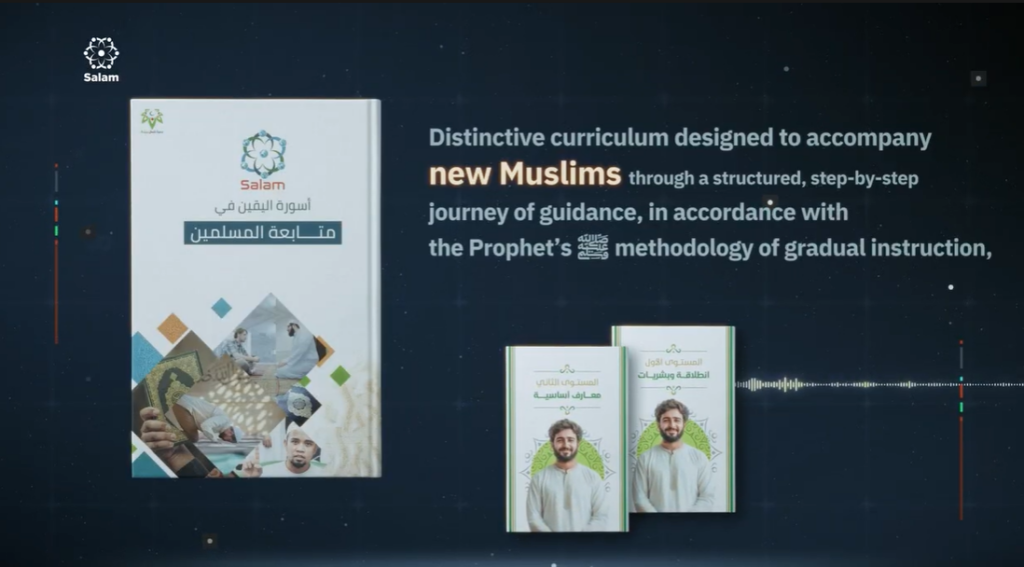
For those who have already embraced Islam, the Salam Center offers the Asawirat Al-Yaqeen (Bracelets of Certainty) program — a structured, four-stage curriculum designed specifically for new Muslims:
- Guided learning across four stages — from foundational beliefs and worship to advanced life rulings and intellectual empowerment
- Progressive levels built on the Prophetic tradition and the pure creed of Ahlus Sunnah wal Jama’ah
- Interactive assessments and professionally designed lessons that maintain your focus and build lasting certainty
- Implemented with over 114,000 new Muslims across 140 countries
- Available in multiple languages, with a smart application and interactive website in development
This program walks with you from your first days in Islam to confident, grounded practice. It is free, structured, and built by people who understand exactly what new Muslims need.
Reach out directly to the Salam Center team to start the Asawirat Al-Yaqeen (Bracelets of Certainty) program for FREE.
Summary
The Quran was revealed to Prophet Muhammad (PBUH) starting in 610 CE and completed in 632 CE — a 23-year divine transmission memorized by Companions and recorded by appointed scribes simultaneously. The first compiled written copy was produced under Caliph Abu Bakr in 633 CE.
Caliph Uthman ibn Affan standardized the text into a single authoritative Mushaf around 650 CE, which became the direct ancestor of every Quran in existence today. Material evidence, including the Birmingham Quran Manuscript carbon-dated to within the Prophet’s era, confirms the Islamic account of early Quranic documentation.
Frequently Asked Questions
When was the Quran revealed to Prophet Muhammad?
The first revelation came to Prophet Muhammad (PBUH) in 610 CE, in the Cave of Hira near Makkah, when he was 40 years old. Revelation continued for 23 years until 632 CE. The first words revealed were the opening verses of Surah Al-Alaq (Quran 96:1–5).
When was the Quran compiled into its final form?
The Quran was compiled into its final standardized form under Caliph Uthman ibn Affan (RA) around 644–650 CE. His committee — led by Zayd ibn Thabit (RA) — produced multiple identical copies distributed to Islamic cities. Every Quran printed worldwide today descends from this Uthmanic standardization.
Who wrote the Quran down during the Prophet’s lifetime?
The Prophet (PBUH) appointed dedicated scribes known as Kuttab Al-Wahy (Writers of Revelation), including Zayd ibn Thabit, Ubay ibn Ka’b, Ali ibn Abi Talib, and others. They recorded revelations onto parchment, flat stones, and palm leaves under the Prophet’s direct supervision, with each verse’s placement specified by divine instruction.
Curious about Islam?
Journey towards clarity and purpose. Our team is here to support you in your search for truth and spiritual guidance.
Embrace the Truth