
When Was the Quran Revealed?
| Key Takeaways |
| The Quran’s revelation began in 610 CE during the month of Ramadan, when Angel Jibreel (Gabriel) delivered the first verses to Prophet Muhammad (PBUH) in the Cave of Hira near Makkah. |
| The total period of revelation spanned approximately 23 years — 13 years in Makkah and 10 years in Madinah, ending just before the Prophet’s death in 632 CE. |
| The Quran was not revealed all at once; it descended gradually in portions, responding to events, answering questions, and guiding the early Muslim community step by step. |
| The Quran’s gradual revelation was a deliberate divine wisdom — to strengthen the heart of the Prophet (PBUH), facilitate memorization, and provide context-specific guidance as circumstances arose. |
Understanding when and how the Quran was revealed is fundamental to understanding what the Quran is. The Quran was not delivered as a single book handed down from the heavens in one moment. The Quran descended in portions — verse by verse, passage by passage — across more than two decades of prophethood.
When Was the Quran Revealed?
The Quran was first revealed to Prophet Muhammad (PBUH) in 610 CE, during the blessed nights of Ramadan, in a cave on the mountain of Jabal al-Nour outside Makkah. The complete revelation of the Quran took approximately 23 years — a precise, divinely orchestrated timeline that profoundly shaped the Muslim community, the Arabic language, and human civilization itself.
That gradual descent is not incidental. It is itself one of the Quran’s most significant features, encoded directly in the divine text:
وَقُرْآنًا فَرَقْنَاهُ لِتَقْرَأَهُ عَلَى النَّاسِ عَلَىٰ مُكْثٍ وَنَزَّلْنَاهُ تَنزِيلًا
“And [it is] a Quran which We have separated [by intervals] that you might recite it to the people over a prolonged period. And We have sent it down progressively.” (Quran 17:106)
The First Revelation Descended in Ramadan of 610 CE
The first revelation descended in Ramadan of 610 CE, when Muhammad ibn Abdullah (PBUH) was 40 years old. He had developed the habit of retreating to the Cave of Hira for extended periods of solitary contemplation and worship. It was during one such retreat that Angel Jibreel appeared to him and commanded:
اقْرَأْ بِاسْمِ رَبِّكَ الَّذِي خَلَقَ
“Recite in the name of your Lord who created.” (Quran 96:1)
These opening verses of Surah Al-Alaq became the first words of the Quran — and with them, 23 years of continuous divine revelation began.
The account of this first encounter is narrated in full detail in Sahih al-Bukhari. The hadith, narrated by the Mother of the Believers Sayyidah Aisha (may Allah be pleased with her), describes the Prophet (PBUH) returning to Sayyidah Khadijah trembling, saying: “Cover me, cover me.”
The specific night on which revelation began is identified in authentic traditions as one of the odd nights of the last ten days of Ramadan — most likely the 23th, 21st, or 27th night, with scholarly preference for the Night of Decree (Laylat al-Qadr). The Quran itself confirms this:
شَهْرُ رَمَضَانَ الَّذِي أُنزِلَ فِيهِ الْقُرْآنُ
“The month of Ramadan [is that] in which was revealed the Quran.” (Quran 2:185)
How Long Did the Full Revelation of the Quran Take?
The complete revelation of the Quran took 23 years in scholarly literature. The revelation divided into two distinct geographical phases:
The Makkan Period: 13 Years of Foundational Faith
The first phase lasted 13 years — from 610 CE until the Hijra (migration) to Madinah in 622 CE. The Makkan revelations focused primarily on:
Establishing the absolute Oneness of Allah (Tawhid), which you can explore further through the Salam platform’s detailed treatment of monotheism in Islam
Affirming prophethood and the reality of the Hereafter
Building the spiritual and moral character of the early believers
Refuting polytheism, which the platform examines at length in its discussion of polytheism and its contrast with Islam’s pure creed
Makkan surahs tend to be shorter, more rhythmically intense, and focused on the unseen realities — because the audience was largely resistant and the need was to pierce hearts.
The Madinan Period: 10 Years of Legislative Completion
After the Hijra, revelation continued for 10 more years until the Prophet’s death in 632 CE (11 AH). The Madinan revelations expanded in scope to address:
The detailed legal framework of Islamic life — prayer, fasting, zakat, Hajj, marriage, inheritance, and commerce
Relations between Muslims and other communities, including how Islam views other religions and how the Quran addresses them directly in passages you can explore at what does the Quran say about other religions
The organization of the Muslim state and community (Ummah)
Madinan surahs are generally longer and more detailed — because the audience had accepted faith and now needed the architecture of a complete way of life.
Learn More About Islam
Discover the beauty, teachings, and wisdom of Islam in a clear and welcoming way. Start exploring and deepen your understanding today.
Learn MoreWhy Was the Quran Revealed Gradually and Not All at Once?
The disbelievers of Makkah once challenged the Prophet (PBUH) on precisely this point. The Quran records their objection and responds directly:
وَقَالَ الَّذِينَ كَفَرُوا لَوْلَا نُزِّلَ عَلَيْهِ الْقُرْآنُ جُمْلَةً وَاحِدَةً ۚ كَذَٰلِكَ لِنُثَبِّتَ بِهِ فُؤَادَكَ ۖ وَرَتَّلْنَاهُ تَرْتِيلًا
“And those who disbelieve say, ‘Why was the Quran not revealed to him all at once?’ Thus [it is] that We may strengthen thereby your heart. And We have spaced it distinctly.” (Quran 25:32)
The scholars of Islam identified several profound wisdoms in this gradual descent (al-tanjīm):
1. To strengthen the heart of the Prophet (PBUH)
Continuous revelation meant continuous divine connection — a source of reassurance during periods of immense trial and opposition.
2. To facilitate memorization and comprehension
The early Muslim community was predominantly oral. Revelation in portions allowed the Companions (Sahabah) to memorize, internalize, and embody each passage before the next arrived.
The Companions would not move to the next ten verses until they had mastered the knowledge and practice of the preceding ones.
3. To respond to actual circumstances and questions
Many verses were revealed as direct divine responses to specific events — a question posed to the Prophet, a new situation facing the community, or a ruling needed for the emerging Islamic state.
This made revelation immediate, living, and profoundly connected to human reality.
4. To enable gradual legal reform
The prohibition of alcohol, for example, came in stages — each verse adjusting community behavior incrementally before the final prohibition was revealed. This wisdom of gradual change mirrors the natural psychology of human transformation.
What Were the Two Modes of Quranic Revelation?
Islamic scholarship distinguishes between two senses in which the Quran “descended”:
1. The first descent: from the Preserved Tablet to the Lowest Heaven
The Quran descended in its entirety from the Preserved Tablet (al-Lawh al-Mahfuz) to the House of Honor (Bayt al-Izzah) in the lowest heaven on Laylat al-Qadr, as established through traditions recorded by scholars including Ibn Abbas (may Allah be pleased with him), narrated by al-Hakim and al-Bayhaqi.
2. The second descent: from the heavens to the Prophet (PBUH)
This is the piecemeal descent across 23 years — the one humans experienced and witnessed.
The 14th-century scholar Imam Badr al-Din al-Zarkashi, in his foundational work Al-Burhan fi Ulum al-Quran (The Proof in the Sciences of the Quran), meticulously documented this distinction and the scholarly evidence supporting it. His work remains among the most authoritative references in Quranic sciences.
Read Also: 30 Facts About the Quran
How Was the Quran Preserved During the Revelation Period?
From the very first revelation, Prophet Muhammad (PBUH) employed a dual system of preservation that was unprecedented in ancient history.
1. Memorization by the Companions
Hundreds of Companions committed the Quran to memory in its entirety during the Prophet’s lifetime. Among the most prominent Huffaz (memorizers) were Abdullah ibn Masoud, Ubayy ibn Kab, Muadh ibn Jabal, and Zayd ibn Thabit (may Allah be pleased with them all).
2. Written recording
The Prophet (PBUH) appointed dedicated scribes — the Kuttab al-Wahy (scribes of revelation) — who wrote each new revelation on whatever materials were available: shoulder blades, palm leaves, leather, and smooth stones.
Zayd ibn Thabit served as the chief scribe and later led the compilation of the Quran into a single bound volume (mushaf) under the Caliph Abu Bakr al-Siddiq after the Prophet’s death.
A full account of the history of the Quran — from the era of revelation through the standardization of the Uthmanic mushaf — is available on the Salam platform, and it demonstrates why Muslim scholars and Western academics alike consider the Quran’s chain of transmission historically unmatched.
For those curious about what Muslims believe the Quran to be and why they trust it, the platform’s dedicated resources on what do Muslims believe about the Quran and why do Muslims believe in the Quran address these questions in depth.
Read Also: How Old Is Islam According to the Quran?
Learn More About Islam
Discover the beauty, teachings, and wisdom of Islam in a clear and welcoming way. Start exploring and deepen your understanding today.
Learn MoreRead Also: Why Is the Quran the Holy Book of Islam?
Learn More Authentic Knowledge About Islam & Quran with Salam
If the history of the Quran’s revelation has stirred something within you — a curiosity, a question, or a sense that there is more to explore — the Salam Center is here to walk with you.
Visit the Salam Platform for in-depth, evidence-grounded articles on Islam’s core beliefs, scripture, and prophetic history.
Browse the Salam blog for carefully produced content answering the questions seekers and new Muslims ask most.
Have a personal question about Islam? Want to learn more about entering the faith? Reach out directly — our team is here to support you with warmth and knowledge.

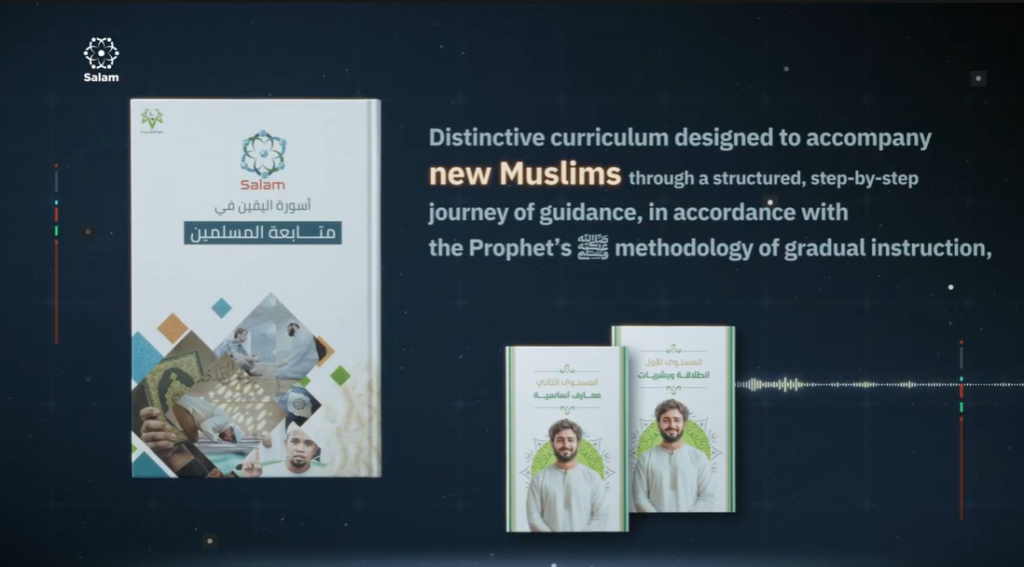
For new Muslims especially, the Salam Center offers the Asawirat Al-Yaqeen (Bracelets of Certainty) program — a complete post-conversion curriculum designed to ground you in the essential knowledge of Islam, stage by stage:
- Stage One establishes your foundational practice: the Shahada, prayer, purification, and the pillars of faith
- Stage Two builds your understanding of Iman, fasting, zakat, and repentance
- Stage Three nurtures your character through ethics, spiritual practice, and practical life rulings
- Stage Four equips you with theological clarity, a life roadmap based on Surah Al-Asr, and the tools to engage the contemporary world with confidence
The program has guided 114,588 new Muslims across 140 countries. You are not on this journey alone.
Reach out directly to the Salam Center team to start the Asawirat Al-Yaqeen (Bracelets of Certainty) program for FREE.
Summary
The Quran was first revealed to Prophet Muhammad (PBUH) in Ramadan 610 CE and continued descending over 23 years across two phases — 13 Makkan years focused on faith’s foundation, and 10 Madinan years completing the legislative and moral framework of Islamic life. Its gradual revelation was a deliberate divine mercy, strengthening the Prophet (PBUH), enabling memorization, and addressing the lived realities of a growing community.
From the first command “Recite” in the Cave of Hira to the final declaration of religion’s perfection at the Farewell Pilgrimage, the Quran’s timeline of revelation reflects the profound wisdom of Allah — a scripture revealed through history, preserved within it, and addressed to all of humanity across every age that follows.
Frequently Asked Questions
When exactly was the Quran first revealed to Prophet Muhammad (PBUH)?
The Quran’s first revelation occurred in 610 CE during Ramadan, when Angel Jibreel delivered the opening verses of Surah Al-Alaq to Prophet Muhammad (PBUH) in the Cave of Hira near Makkah. The Prophet was 40 years old at the time. This event is established through multiple narrations in Sahih al-Bukhari.
How long did it take for the entire Quran to be revealed to Muhammad?
The complete revelation of the Quran spanned approximately 23 years, from 610 CE to 632 CE. The first 13 years of revelation occurred in Makkah, addressing foundational beliefs. The final 10 years occurred in Madinah, completing the legal and social framework of the religion. This is the established position of classical Islamic scholarship.
Why was the Quran revealed gradually instead of all at once?
The Quran itself answers this: gradual revelation was a divine mercy to strengthen the Prophet’s heart, enable memorization, and provide timely guidance for each emerging situation (Quran 25:32 and 17:106). Imam al-Zarkashi in Al-Burhan fi Ulum al-Quran identifies additional wisdoms including the facilitation of legal reform and the deepening of believers’ comprehension and practice.
Was the Quran written down during the Prophet’s lifetime?
Yes — the Quran was both memorized and written down simultaneously during the Prophet’s own lifetime. He appointed dedicated scribes (Kuttab al-Wahy), including Zayd ibn Thabit, to record each revelation immediately. Combined with the hundreds of Companions who memorized the entire text, the Quran’s dual preservation system during the prophetic era is unmatched by any other ancient scripture.
Curious about Islam?
Journey towards clarity and purpose. Our team is here to support you in your search for truth and spiritual guidance.
Embrace the Truth