
What Does the Quran Say About Polygamy?
| Key Takeaways |
| The Quran permits a man to marry up to four wives in Surah An-Nisa 4:3, but only on the strict condition of equal justice between them. |
| Pre-Islamic Arabia had no limit on the number of wives a man could take; the Quran introduced the first legal ceiling — four — where none had existed before. |
| Authentic Hadith warns that a husband who favors one wife over another unjustly will be held accountable on the Day of Judgment. |
The Quran permits polygamy — but as a conditional allowance hedged by strict justice, not as an open license. Surah An-Nisa, verse 3, allows a man to marry up to four women at once, provided he can treat each of them with full fairness. That single condition changes the entire shape of the ruling.
Understanding what the Quran says about polygamy means looking past the surface permission and into the legal and ethical architecture Allah built around it — a structure of accountability, historical correction, and genuine care for women who, before Islam, had no such protections at all.
What Does the Quran Say About Polygamy?
The Quran addresses polygamy directly in Surah An-Nisa, verse 3, permitting marriage to up to four wives on the explicit condition that a man can deal justly with all of them. This is not a vague suggestion tucked into a broader passage. It is a specific, legally binding verse that both permits and restricts at the same time.
وَإِنْ خِفْتُمْ أَلَّا تُقْسِطُوا فِي الْيَتَامَىٰ فَانكِحُوا مَا طَابَ لَكُم مِّنَ النِّسَاءِ مَثْنَىٰ وَثُلَاثَ وَرُبَاعَ ۖ فَإِنْ خِفْتُمْ أَلَّا تَعْدِلُوا فَوَاحِدَةً
“And if you fear that you will not deal justly with the orphan girls, then marry those that please you of [other] women, two or three or four. But if you fear that you will not be just, then [marry only] one.” (Quran 4:3)
The verse grants permission for plural marriage, and it immediately narrows that permission with a condition so demanding that the same passage tells a man to default back to one wife if he cannot meet it.
Allah is not commanding polygamy, encouraging it, or presenting it as an ideal state for a Muslim man to pursue.
The verse describes a conditional allowance, bound to justice, and the surrounding context of the chapter makes clear this allowance exists to protect vulnerable people — specifically orphaned women — rather than to satisfy male desire.
This matters for anyone trying to understand what do Muslims believe about the Quran as a source of law. The Quran does not deal in vague spiritual platitudes when it comes to social legislation. It specifies numbers, conditions, and consequences — and 4:3 is a clear example of that precision.
Learn More About Islam
Discover the beauty, teachings, and wisdom of Islam in a clear and welcoming way. Start exploring and deepen your understanding today.
Learn MoreWhat is the Historical Context Behind the Revelation of The Quranic Verse of Polygamy?
The Quran did not descend into a vacuum. It responded to real conditions in 7th-century Arabia, and Surah An-Nisa 4:3 responded to a specific injustice involving orphaned girls.
‘Urwa ibn al-Zubayr, a well-known scholar among the generation following the Companions, once asked his aunt ‘Aisha, the wife of the Prophet Muhammad (PBUH), what this verse meant. Her answer, recorded in Sahih al-Bukhari, explains the circumstances directly:
“This Verse has been revealed in connection with an orphan girl under the guardianship of her guardian who is attracted by her wealth and beauty and intends to marry her with a Mahr less than what other women of her standard deserve.” (Sahih al-Bukhari)
Guardians in pre-Islamic Arabia would sometimes marry the orphaned girls under their care specifically to control their inheritance, offering them a dowry far below what was fair.
The verse tells such men: if you cannot treat these orphan girls with justice, direct your attention to other women you may marry — up to four, and only with the same condition of fairness attached.
Pre-Islamic Arabia Had No Limit On The Number Of Wives A Man Could Take
Before this revelation, Arab men faced no ceiling whatsoever on the number of wives they could marry. Some married far beyond what any household could sustain, whether financially or ethically.
The classical exegete Ibn Kathir documents a striking case involving a man named Ghaylan ibn Salamah, the chief of Ta’if, who accepted Islam while still married to nine women. The Prophet Muhammad (PBUH) instructed him directly:
“Choose any four of them.” (Tafsir Ibn Kathir on Quran 4:3) Ghaylan was required to release the rest.
A second Companion, Nawfal ibn Mu’awiyah, had five wives upon accepting Islam and was ordered to divorce one to bring the number down to four.
Where Jahiliyyah-era Arabia recognized no boundary at all, the Quran introduced the first one, and the Prophet Muhammad (PBUH) enforced it in practice, not merely in theory.
Justice Between Wives Is a Non-Negotiable Condition
The word “justice” (‘adl) appears in Quran 4:3 as the hinge on which the entire permission turns. Allah does not say a man may marry multiple wives and then separately mention justice as a virtue to strive for. The text structures the verse so that failing to meet the condition of justice removes the permission itself:
“then [marry only] one.”
This structure carries real legal weight in Islamic jurisprudence. A man is not simply encouraged toward fairness between wives — he is instructed that plural marriage without the capacity for justice falls outside what Allah has permitted.
The Quran defines this justice in concrete, measurable terms: equal time, equal financial support, equal housing, and equal basic treatment.
It does not ask for equal love, because the Quran itself acknowledges that emotional equality between multiple people is not something a human being can fully control.
Read Also: What Does the Quran Say About Marrying a Non-Muslim?
Quran 4:129 Clarifies What Kind Of Equality Is Actually Required
A later verse in the same chapter addresses a question that naturally follows from 4:3: what happens when a man genuinely cannot feel equally toward each wife?
وَلَن تَسْتَطِيعُوا أَن تَعْدِلُوا بَيْنَ النِّسَاءِ وَلَوْ حَرَصْتُمْ ۖ فَلَا تَمِيلُوا كُلَّ الْمَيْلِ فَتَذَرُوهَا كَالْمُعَلَّقَةِ
“And you will never be able to be equal [in feeling] between wives, even if you should strive [to do so]. So do not incline completely [toward one] and leave another hanging.” (Quran 4:129)
Allah acknowledges here that a man’s heart will naturally lean toward one wife over another — this is simply human nature and carries no sin in itself.
What the verse prohibits is allowing that natural inclination to translate into visible, practical neglect of another wife, leaving her in a state of limbo where she is neither properly married nor free to seek another marriage.
Justice, then, is measured in actions: how time, resources, and basic dignity are distributed. The heart’s private inclinations are not what the ruling holds a man accountable for.
Read Also: Does the Quran Say to Go to the People of the Book?
Authentic Hadith Establish Severe Consequences For Failing The Standard of Justice Between Wives
The Quran’s condition of justice is reinforced directly by authentic prophetic teaching. The Prophet Muhammad (PBUH) did not leave the matter as an abstract principle — he described the consequence of neglecting it in stark terms:
“When a man has two wives and he is inclined to one of them, he will come on the Day of Resurrection with a side hanging down.” (Sunan Abi Dawud 2133)
Islamic scholars, including Ibn Hajar al-‘Asqalani, classified the chain of narrators for this hadith as sound, and it is cited widely across classical works of Islamic jurisprudence as clear evidence that unjust favoritism between wives is a serious matter before Allah, carrying consequences into the Hereafter.
The image is deliberately visceral: a man who tilts toward one wife in this life will himself be tilted, unbalanced, on the Day of Judgment. The punishment mirrors the sin.
This hadith, read alongside Quran 4:3 and 4:129, closes any interpretive gap. The permission for plural marriage was never separated from strict accountability. A man who takes a second, third, or fourth wife accepts a serious trust before Allah — one that many classical scholars treated with real caution.
Read Also: Does the Quran Say to Follow the Bible?
The Prophet’s Own Household Modeled This Standard In Practice
The wives of the Prophet Muhammad (PBUH) themselves provide the clearest historical record of how this justice was applied day to day. ‘Aisha, one of his wives, described how he managed the rotation between his households:
“Whenever Allah’s Messenger intended to go on a journey, he would draw lots amongst his wives and would take with him the one upon whom the lot fell.” (Sahih al-Bukhari)
Drawing lots removed personal preference from a decision that could easily have caused resentment, replacing it with a neutral, verifiably fair method. This same care shaped how gifts, visits, and nightly turns were distributed among his wives, and it stands as a lived demonstration — not just a legal theory — of what Quran 4:3’s condition of justice looks like when actually practiced.
Read Also: Does the Quran Say Ezra Is the Son of God?
Learn More About Islam
Discover the beauty, teachings, and wisdom of Islam in a clear and welcoming way. Start exploring and deepen your understanding today.
Learn MoreLearn More Authentic Knowledge About Islam & Quran with Salam
Questions about Quranic rulings often lead to deeper questions about faith in Islam as a whole, and that is exactly the kind of conversation the Salam Center exists to have.
If this article raised more questions than it answered, that is completely normal — and welcome.
- Reach out directly with any specific question about polygamy, marriage, or any other Islamic ruling
- Ask about the practical process of entering Islam, at whatever pace feels right
- Explore the Salam blog for further honest, sourced explorations of Islamic belief
Reach out directly — our team is ready to listen, guide, and welcome you.

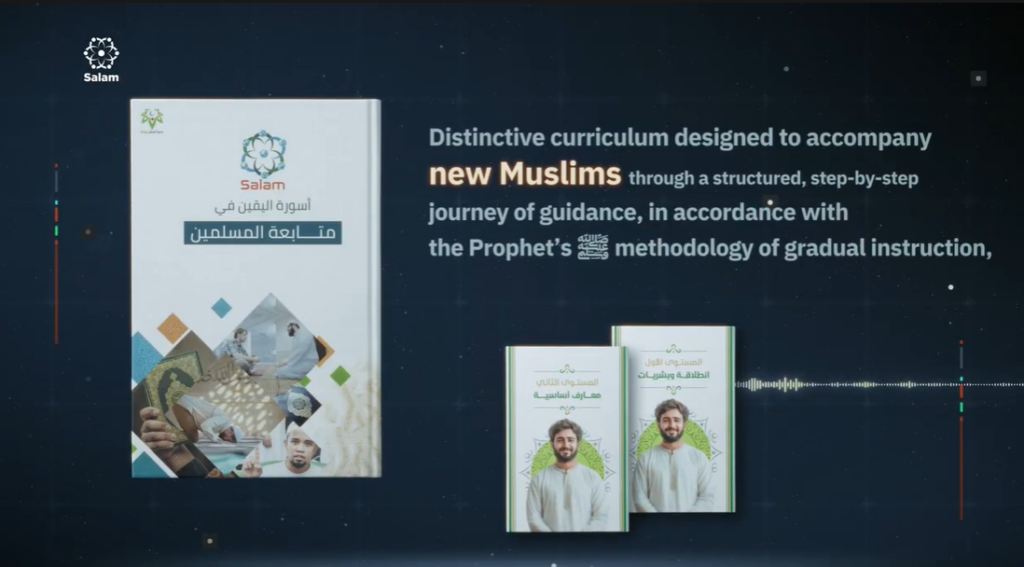
Join Asawirat Al-Yaqeen (Bracelets of Certainty), the Center’s structured post-conversion program for new Muslims, which includes:
- A foundational stage covering the Shahada, prayer, and the basic pillars of faith
- A construction stage covering repentance and the biography of the Prophet Muhammad (PBUH)
- A consolidation stage covering practical life rulings, including family and marriage
- An empowerment stage addressing contemporary questions and theological foundations
There is no pressure attached to any of this. Sincere questions deserve honest answers, at whatever pace a person needs them.
Reach out directly to the Salam Center team to start the Asawirat Al-Yaqeen (Bracelets of Certainty) program for FREE.
Summary
The Quran permits plural marriage up to four wives in Surah An-Nisa 4:3, but only where a man can guarantee real, measurable justice between them. Historical context shows this verse restricted an unlimited pre-Islamic practice rather than introducing something new.
Authentic Hadith and the Prophet Muhammad’s own household demonstrate how demanding that justice truly is, and many classical scholars favored monogamy as the more cautious path. The ruling reflects protection for vulnerable people, not permission for indulgence.
Frequently Asked Questions
Does the Quran require men to have multiple wives?
No. Quran 4:3 permits plural marriage under strict conditions of justice; it never commands it. The default in Islamic marriage remains one wife, and many classical scholars, including Imam al-Shafi’i, considered monogamy the safer and often preferable choice.
How many wives can a Muslim man marry according to the Quran?
A Muslim man may marry a maximum of four wives, as stated explicitly in Quran 4:3. This limit was historically enforced by the Prophet Muhammad (PBUH) himself, including in the well-documented case of Ghaylan ibn Salamah, who was ordered to reduce nine wives to four.
What happens if a husband treats his wives unfairly?
Authentic Hadith describes serious spiritual consequences. The Prophet Muhammad (PBUH) stated that a man who favors one wife unjustly will appear on the Day of Judgment with a side of his body inclined, reflecting the imbalance he created in this life. (Sunan Abi Dawud 2133)
Why did the Quran allow polygamy in the first place?
The Quran’s permission responded to a specific historical injustice: guardians in pre-Islamic Arabia exploiting orphaned girls through unfair marriages. ‘Aisha explained that Quran 4:3 was revealed in connection with orphan girls facing exploitation by their guardians. (Sahih al-Bukhari 5064)
Curious about Islam?
Journey towards clarity and purpose. Our team is here to support you in your search for truth and spiritual guidance.
Embrace the Truth