
Does the Quran Say Muhammad (PBUH) Was the First Muslim?
| Key Takeaways |
| The Quran does not call Prophet Muhammad (PBUH) the first human being ever to submit to Allah. |
| In Quran 6:14 and 6:163, Muhammad (PBUH) is commanded to say he is “the first” of the Muslims among his own people, the Quraysh. |
| Quran 39:12 uses the same wording, instructing the Prophet (PBUH) to declare himself first among his community to embrace full submission to Allah. |
| Earlier prophets, including Ibrahim (Abraham), Musa (Moses), and Adam, are also described in the Quran as Muslims who submitted to Allah. |
| Islam teaches that submission to Allah is the single message carried by every prophet, from Adam to Muhammad (PBUH), not a religion invented in the seventh century. |
The Quran does not present Muhammad (PBUH) as the first human being to submit to Allah — it presents him as the first of his own nation to fully embrace that submission after receiving the final revelation. Three verses use this phrasing: Quran 6:14, Quran 6:163, and Quran 39:12.
In each case, the Prophet (PBUH) is commanded by Allah to say these words to a specific audience — the polytheists of Makkah who worshipped idols alongside, or instead of, Allah. This is not chronological priority over Adam or Ibrahim; it is a declaration of sincerity and precedence within his own community, distinguishing him from those around him who clung to shirk (associating partners with Allah).
1. Prophet Muhammad Is Commanded in the Quran to Declare Himself First to Submit
This verse instructs Prophet Muhammad (PBUH) to publicly reject any protector besides Allah and to announce his own precedence in submission among the disbelievers he was addressing.
قُلْ أَغَيْرَ اللَّهِ أَتَّخِذُ وَلِيًّا فَاطِرِ السَّمَاوَاتِ وَالْأَرْضِ وَهُوَ يُطْعِمُ وَلَا يُطْعَمُ ۗ قُلْ إِنِّي أُمِرْتُ أَنْ أَكُونَ أَوَّلَ مَنْ أَسْلَمَ ۖ وَلَا تَكُونَنَّ مِنَ الْمُشْرِكِينَ
“Say, “Is it other than Allah I should take as a protector, Creator of the heavens and the earth, while it is He who feeds and is not fed?” Say, [O Muhammad], “Indeed, I have been commanded to be the first [among you] who submit [to Allah] and [was commanded], ‘Do not ever be of the polytheists.’ “‘” (Quran 6:14)
2. Prophet Muhammad in the Quran Ties His Entire Life to Allah Alone as the First Muslim
Here the Prophet (PBUH) declares that his prayer, sacrifice, life, and death belong entirely to Allah, with no partner, and affirms his own place as first among the Muslims of his people.
قُلْ إِنَّ صَلَاتِي وَنُسُكِي وَمَحْيَايَ وَمَمَاتِي لِلَّهِ رَبِّ الْعَالَمِينَ لَا شَرِيكَ لَهُ ۖ وَبِذَٰلِكَ أُمِرْتُ وَأَنَا أَوَّلُ الْمُسْلِمِينَ
“Say, “Indeed, my prayer, my rites of sacrifice, my living and my dying are for Allah, Lord of the worlds. (162) No partner has He. And this I have been commanded, and I am the first [among you] of the Muslims.”” (Quran 6:162-163)
Learn More About Islam
Discover the beauty, teachings, and wisdom of Islam in a clear and welcoming way. Start exploring and deepen your understanding today.
Learn More3. The Prophet Is Ordered To Worship Allah With Complete Sincerity As Leader Of The Submitters
This verse pairs sincere worship (ikhlas) with the Prophet’s role as first among those who submit, tying the concept of being “first” directly to sincerity of intention rather than historical sequence.
قُلْ إِنِّي أُمِرْتُ أَنْ أَعْبُدَ اللَّهَ مُخْلِصًا لَهُ الدِّينَ وَأُمِرْتُ لِأَنْ أَكُونَ أَوَّلَ الْمُسْلِمِينَ
“Say, [O Muhammad], ‘Indeed, I have been commanded to worship Allah, [being] sincere to Him in religion. And I have been commanded to be the first [among you] of the Muslims.'” (Quran 39:11-12)
Read Also: What Does the Quran Say About Life?
Earlier Prophets Are Also Called Muslims In The Quran
The Quran identifies submission to Allah — Islam in its linguistic sense — as the religion of every prophet before Muhammad (PBUH), which is why figures like Ibrahim, Musa, and even Adam’s family are described using the same term. Ibrahim (Abraham) is explicitly called neither Jewish nor Christian but a Muslim who submitted to Allah:
مَا كَانَ إِبْرَاهِيمُ يَهُودِيًّا وَلَا نَصْرَانِيًّا وَلَٰكِنْ كَانَ حَنِيفًا مُسْلِمًا وَمَا كَانَ مِنَ الْمُشْرِكِينَ
“Ibrahim was neither Jewish nor Christian, but he was one inclining toward truth, a Muslim [submitting to Allah]. And he was not of those who associated others with Allah.” (Quran 3:67)
Musa (Moses) similarly instructs his people to place their trust in Allah “if you should be Muslims”, using the same root word (aslamtum) that gives Islam its name (Quran 10:84).
This is precisely why classical scholars of tafsir read “first of the Muslims” in 6:14, 6:163, and 39:12 as first among the audience being addressed — the Quraysh and the wider Arab nation receiving the final message — not first in the entire history of mankind.
Read Also: What Does the Quran Say About Love and Relationships?
What Does the Quran Say About Adam and Islam’s Universal Message?
The Quran does not use the phrase “first Muslim” for Adam, though many popular explanations describe him this way because he was the first human being to submit to Allah’s command after his creation.
Allah’s selection of key figures across history
— “Indeed, Allah chose Adam and Noah and the family of Abraham and the family of ‘Imran over the worlds” (Quran 3:33) —
reflects a single lineage of submission running from the first human being to the final Messenger.
This is the framework behind the nine core Islamic principles: Islam is presented not as one option among world religions but as the restored and complete form of the same monotheism Adam, Nuh (Noah), Ibrahim, Musa, and Isa (Jesus) all taught.
Read Also: What Does the Quran Say About Lying?
Learn More About Islam
Discover the beauty, teachings, and wisdom of Islam in a clear and welcoming way. Start exploring and deepen your understanding today.
Learn MoreGet Guidance And Support From Salam Platform
Questions like this one are exactly what the Salam Center team exists to answer — carefully, honestly, and without rushing past the details that matter.
Explore more on the Salam Platform
Read more reflections on the Salam blog
Have a specific question? Reach out directly

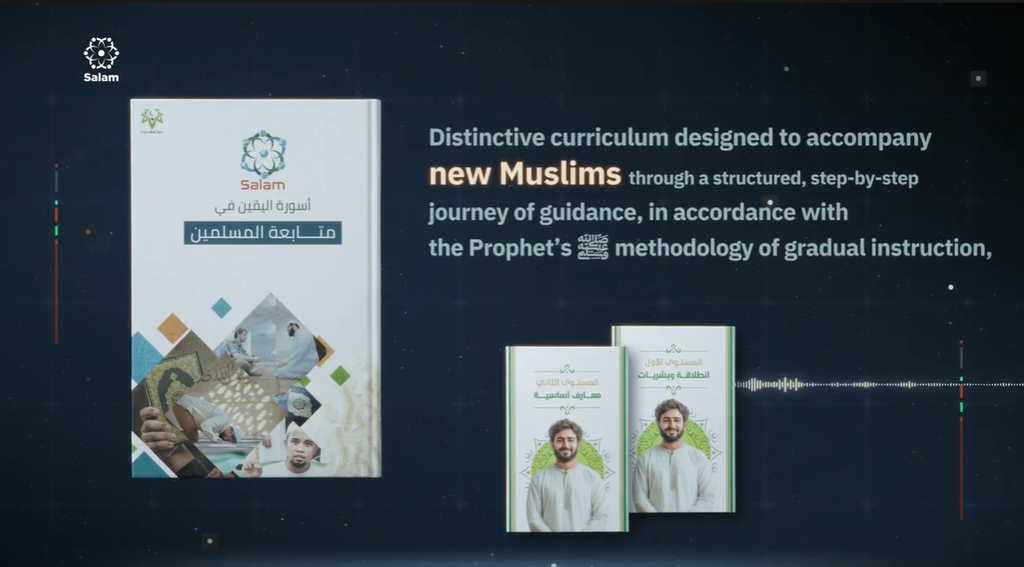
If you’re a new Muslim looking for structured, guided knowledge after Shahada, the Asawirat Al-Yaqeen (Bracelets of Certainty) program offers a four-stage path built for exactly this stage of the journey:
- Stage One lays the foundation — the pillars of Islam, wudu, ghusl, and salah
- Stage Two builds sincerity through repentance and the seerah of the Prophet (PBUH)
- Stage Three consolidates character, etiquette, and everyday Islamic rulings
- Stage Four addresses deeper questions of faith, evidence, and identity as a Muslim
Reach out directly to the Salam Center team to start the Asawirat Al-Yaqeen (Bracelets of Certainty) program for FREE.
Summary
The Quran’s description of Muhammad (PBUH) as “first of the Muslims” refers to his precedence among the Quraysh, not to being history’s earliest believer. Ibrahim, Musa, and Adam all appear in the Quran as earlier examples of submission to Allah.
Reading each verse through its original audience removes any tension between these passages. This continuity across every prophet reflects Islam’s core claim: one message, renewed and completed, not reinvented, in the final revelation.
Frequently Asked Questions
Does the Quran call Muhammad the first Muslim in history?
No. The Quran instructs Muhammad (PBUH) to say he is “the first” among his own people to submit to Allah (Quran 6:14, 6:163, 39:12), not the first human being in history, since earlier prophets like Ibrahim and Adam are also described as submitting to Allah.
Who does the Quran say was the first person to submit to Allah?
The Quran does not name one single “first Muslim” in absolute terms; Adam is widely understood as the first human to submit to Allah, while Ibrahim (Quran 3:67) is explicitly called a Muslim who inclined toward truth.
Is there a contradiction in the Quran about who was first to become Muslim?
No contradiction exists once each verse is read with its audience in view; every “first” refers to precedence within a specific nation or generation, a standard reading confirmed across classical tafsir including that of Al-Tabari and Ibn Kathir.
What does “Muslim” mean in the Quran regarding earlier prophets?
In the Quran, “Muslim” means one who submits to Allah alone, a description applied to Ibrahim, Musa, and the disciples of Isa, showing that submission to Allah is the shared message of every prophet, not a title invented for Muhammad (PBUH).
Why does the Quran call Muhammad “first” if others submitted before him?
Muhammad (PBUH) is called first specifically among the Quraysh and the Arab nation receiving the Quran’s final revelation, distinguishing him from the idol-worshippers around him rather than ranking him before Adam or Ibrahim chronologically.
Curious about Islam?
Journey towards clarity and purpose. Our team is here to support you in your search for truth and spiritual guidance.
Embrace the Truth