
Does the Quran Say How to Pray?
The Quran commands prayer (salah) explicitly in dozens of verses but does not describe its physical movements step-by-step. The number five daily prayers and their exact method were established through the Sunnah of Prophet Muhammad (PBUH), beginning with the night of Al-Isra wal-Mi’raj.
Quran 11:114 identifies prayer at “the two ends of the day and at the approach of the night,” which classical scholars link to the five daily prayer windows. Quran 4:103 confirms that prayer is “decreed upon the believers a decree of specified times,” establishing fixed timing as a divine command.
Does the Quran Say How to Pray?
The Quran commands prayer with striking frequency, but it does not lay out salah as a numbered instruction manual with postures and word-for-word recitations. The Quran establishes prayer as an absolute obligation, names its spiritual purpose, and gives its general timing — while the precise method of performing it comes from the practice of Prophet Muhammad (PBUH).
This division is not a gap or contradiction. It reflects how Allah structured revelation from the very beginning: the Quran lays the foundation, and the Sunnah builds the house upon it.
Consider the command in Surah Al-Ankabut:
اتْلُ مَا أُوحِيَ إِلَيْكَ مِنَ الْكِتَابِ وَأَقِمِ الصَّلَاةَ ۖ إِنَّ الصَّلَاةَ تَنْهَىٰ عَنِ الْفَحْشَاءِ وَالْمُنكَرِ
“Recite, [O Muhammad], what has been revealed to you of the Book and establish prayer. Indeed, prayer prohibits immorality and wrongdoing.” (Quran 29:45)
The verb used throughout the Quran is aqim — establish — not merely “perform.” This word choice matters. It implies steadiness, correctness, and full presence, not a hurried physical motion.
The Quran is telling believers what prayer accomplishes and why it exists, while leaving the mechanics to be transmitted through the Prophet’s own example — a pattern consistent with how the Quran itself describes its relationship to Prophetic explanation.
Does the Quran Say How Many Times to Pray?
The Quran does not state the number five in a single explicit verse. The five daily prayers are established through the Sunnah — specifically the hadith of Al-Isra wal-Mi’raj — while the Quran provides the structural framework that these five prayers fill. Surah Hud gives one of the clearest structural indicators:
وَأَقِمِ الصَّلَاةَ طَرَفَيِ النَّهَارِ وَزُلَفًا مِّنَ اللَّيْلِ ۚ إِنَّ الْحَسَنَاتِ يُذْهِبْنَ السَّيِّئَاتِ ۚ ذَٰلِكَ ذِكْرَىٰ لِلذَّاكِرِينَ
“And establish prayer at the two ends of the day and at the approach of the night. Indeed, good deeds do away with misdeeds. That is a reminder for those who remember.” (Quran 11:114)
Classical commentators read “the two ends of the day” as referring to Fajr and the late-afternoon or Maghrib period, with “the approach of the night” pointing to Isha. Surah Al-Isra adds another layer:
أَقِمِ الصَّلَاةَ لِدُلُوكِ الشَّمْسِ إِلَىٰ غَسَقِ اللَّيْلِ وَقُرْآنَ الْفَجْرِ ۖ إِنَّ قُرْآنَ الْفَجْرِ كَانَ مَشْهُودًا
“Establish prayer at the decline of the sun [from its meridian] until the darkness of the night and [also] the Qur’an of dawn. Indeed, the recitation of dawn is ever witnessed.” (Quran 17:78)
Together these verses sketch four time windows across the day and night. It is Prophetic practice — not a single Quranic verse — that fixes the total at five and assigns each prayer its name: Fajr, Dhuhr, Asr, Maghrib, and Isha.
The Night Journey and the Command for Five Prayers
The specific number five traces back to one of the most significant nights in Islamic history — Al-Isra wal-Mi’raj, the Night Journey of Prophet Muhammad (PBUH) from Mecca to Jerusalem and then through the heavens. Anas ibn Malik narrated the account in detail:
“Then Allah enjoined fifty prayers on my followers… So I returned to Allah and He said, ‘These are five prayers and they are all (equal to) fifty (in reward) for My Word does not change.'” (Sahih al-Bukhari, Hadith 349)
The narration describes the Prophet ﷺ ascending repeatedly between Allah and Musa (Moses), peace be upon him, who advised him to request a reduction because the burden on the Muslim community would otherwise be too heavy.
Each return brought a reduction of ten, until five remained in practice while carrying the reward of fifty — a mercy woven directly into the obligation itself.
Learn More About Islam
Discover the beauty, teachings, and wisdom of Islam in a clear and welcoming way. Start exploring and deepen your understanding today.
Learn MoreWhat Does the Quran Say About Prayer Times and Structure?
Quran 4:103 makes prayer’s fixed scheduling an explicit theological point, not a cultural custom:
فَإِذَا قَضَيْتُمُ الصَّلَاةَ فَاذْكُرُوا اللَّهَ قِيَامًا وَقُعُودًا وَعَلَىٰ جُنُوبِكُمْ ۚ فَإِذَا اطْمَأْنَنتُمْ فَأَقِيمُوا الصَّلَاةَ ۚ إِنَّ الصَّلَاةَ كَانَتْ عَلَى الْمُؤْمِنِينَ كِتَابًا مَّوْقُوتًا
“And when you have completed the prayer, remember Allah standing, sitting, or [lying] on your sides. But when you become secure, re-establish [regular] prayer. Indeed, prayer has been decreed upon the believers a decree of specified times.” (Quran 4:103)
The phrase kitaban mawqutan — “a decree of specified times” — settles the matter of obligation and scheduling directly from the Quran.
What it does not settle is the internal choreography: how many units (rak’ahs) each prayer contains, the exact wording of recitation within it, or the sequence of standing, bowing, and prostrating.
| Element of Salah | Quranic Basis | Sunnah Basis |
| Obligation to pray | Explicit and repeated (e.g., 2:43, 29:45) | Reaffirmed and demonstrated |
| Fixed prayer times | Explicit (4:103, 11:114, 17:78) | Precise clock times and boundaries |
| Number of daily prayers (five) | Implied through time-window verses | Explicitly fixed at five (Hadith of Al-Isra) |
| Physical movements (standing, bowing, prostration) | Referenced generally (e.g., 22:77) | Detailed, demonstrated by the Prophet ﷺ |
| Number of rak’ahs per prayer | Not specified | Transmitted through continuous practice |
This division between Quran and Sunnah is not an accident of history. It reflects a principle embedded in the Quran itself — that the Prophet’s role includes clarifying revelation for the Ummah, a role tied closely to the broader faith in Islam that Muslims hold regarding both sources of guidance.
How Did the Sunnah Complete the Method of Salah?
The Prophet Muhammad (PBUH) did not simply describe prayer in words — he demonstrated it repeatedly before his companions and instructed them directly to replicate what they observed. Malik ibn al-Huwayrith reported the command plainly:
“Pray as you have seen me praying.” (Sahih al-Bukhari, Hadith 631)
This single directive became the operating principle for every detail of salah that the Quran leaves unspecified: the raising of the hands at the opening takbeer, the recitation of Surah Al-Fatiha in every rak’ah, the posture of ruku’ (bowing) and sujood (prostration), and the closing tasleem.
Generations of companions transmitted these details with the same rigor applied to preserving the Quran itself, producing a chain of practice that remains unbroken today.
Step 1: Understanding the Declaration of Faith Before Prayer
Salah presupposes the Shahada — the testimony that there is no deity but Allah and that Muhammad is His Messenger. Without this foundational conviction, prayer has no theological ground to stand on, since salah is an act of submission to the very nature of God that the Shahada affirms.
Read Also: What Does the Quran Say About Killing in Self-Defense?
Step 2: Purification Before Standing in Prayer
Wudu (ablution) or ghusl (ritual purification) precedes valid prayer, a requirement the Quran itself specifies in Surah Al-Ma’idah, and one that underscores how salah engages both body and intention together.
Read Also: What Does the Quran Say About Jihad?
Step 3: The Five Fixed Windows Across the Day
Fajr, Dhuhr, Asr, Maghrib, and Isha each occupy a distinct time window rooted in the solar positions described in Quran 11:114 and 17:78, with the Sunnah providing the exact astronomical boundaries scholars still use to calculate prayer schedules today.
Read Also: How Does the Quran Say Muhammad Died?
Why Does This Quran and Sunnah Partnership Matter?
Understanding that the Quran and Sunnah function together — rather than the Sunnah being a later addition or human invention — matters for anyone examining Islam honestly. The Quran itself instructs believers to obey the Prophet’s example, which means the detailed method of salah carries the same revelatory authority as the command to pray in the first place.
This is not a workaround or a patch on incomplete scripture. It is the structure Allah designed, visible across nearly every area of Islamic practice — from prayer to fasting to the rulings on charity.
Read Also: What Does the Quran Say About Greed?
Learn More About Islam
Discover the beauty, teachings, and wisdom of Islam in a clear and welcoming way. Start exploring and deepen your understanding today.
Learn MoreGet Guidance And Support From Salam Platform
If this question opened the door to more, there is a great deal more waiting.
Explore the Salam Platform for in-depth articles on Islamic belief, worship, and the life of Prophet Muhammad (PBUH).
Browse the Salam blog for continued reading on topics like the nine principles of Islam and the history of the Quran.
Reach out directly — our team is ready to listen, guide, and welcome you.

If you are exploring Islam for yourself, or simply have a question you would like answered honestly and without pressure, the Salam Center team is here for you.
- General questions about Islamic belief and practice
- Guidance on the steps to formally enter Islam
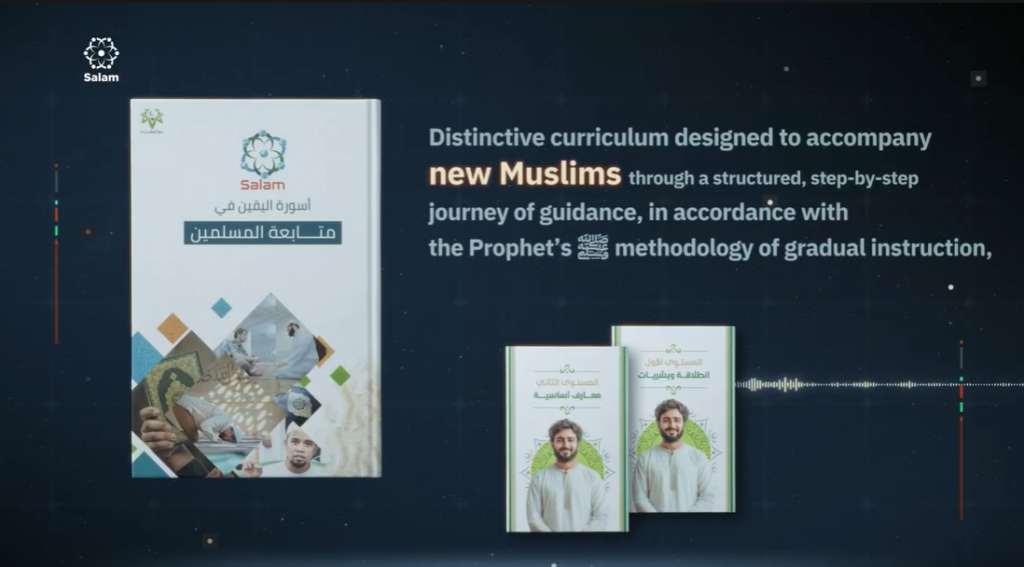
- Joining Asawirat Al-Yaqeen (Bracelets of Certainty), the Center’s structured post-conversion learning path covering the Shahada, purification, prayer, the pillars of faith, and progressively deeper study across four educational stages
- One-on-one conversations for skeptics, seekers, or the simply curious
Reach out directly to the Salam Center team to start the Asawirat Al-Yaqeen (Bracelets of Certainty) program for FREE.
Summary
The Quran commands prayer as an absolute, time-bound obligation and outlines its general daily windows, while the Prophetic Sunnah supplies the exact number of five prayers and their physical method. Together these sources form a single, unbroken system of guidance rather than separate or competing authorities.
Anyone examining Islamic practice benefits from studying both scripture and Sunnah side by side, since the Quran itself instructs believers to follow the Prophet’s demonstrated example. This partnership between text and practice defines not only salah but the broader architecture of Islamic law and worship.
Frequently Asked Questions
Does the Quran name the five daily prayers directly?
No single verse lists Fajr, Dhuhr, Asr, Maghrib, and Isha by name together. The Quran describes prayer windows across the day and night (Quran 11:114, 17:78), and the Sunnah — particularly the Hadith of Al-Isra — fixes the number at five and assigns each prayer its name.
What is the main hadith about how to perform salah?
The Prophet Muhammad’s (PBUH) instruction, “Pray as you have seen me praying,” recorded in Sahih al-Bukhari (Hadith 631), is the foundational text Muslims rely on for the physical method of prayer, including its postures and recitations.
Why doesn’t the Quran describe prayer movements in detail?
The Quran establishes obligation, purpose, and general timing, while leaving demonstrated practice — Prophetic Sunnah — to transmit precise movements, a division the Quran itself supports by commanding obedience to the Prophet’s example.
Curious about Islam?
Journey towards clarity and purpose. Our team is here to support you in your search for truth and spiritual guidance.
Embrace the Truth