The Most Converted Religion in the World
| Key Takeaways |
| Islam is the most converted religion in the world and the fastest-growing major faith, according to the Pew Research Center’s Global Religious Landscape study. |
| The global Muslim population grew by 347 million people between 2010 and 2020 — surpassing the combined growth of all other major religions in the same decade. |
| The primary drivers of conversion to Islam are Tawhid (the pure Oneness of Allah), the intellectual coherence of the Quran, moral clarity, and the transformative structure of Islamic worship. |
| Islam’s conversion pattern is net positive globally — more people enter the faith each year than leave it, a reality confirmed across 117 countries of survey data. |
| By 2050, the global Muslim population is projected to approach 3 billion, making Islam likely the world’s largest religion by the second half of this century. |
Every year, millions of people from every continent, educational background, and cultural tradition take the Shahada — the declaration of faith — and enter the fold of Islam. This is not a trend driven by geography, inheritance, or coercion. It is a phenomenon rooted in sincere seeking, rational conviction, and the soul’s natural pull toward its Creator.
The Pew Research Center, the world’s most cited authority on global religious demographics, released its updated Global Religious Landscape study. Its conclusion was unambiguous: Islam was the world’s fastest-growing religion from 2010 to 2020, outpacing all other faiths combined.
What is The Most Converted Religion in the World?
Islam is the most converted religion in the world. According to The Pew Research Center, from 2010 to 2020 the number of Muslims worldwide increased by 347 million people, reaching 2.0 billion, while Christians grew by 122 million to 2.3 billion — meaning Islam’s growth in raw numbers was nearly three times that of Christianity in the same period. Studies in the 21st century consistently show that in terms of percentage and worldwide spread, Islam is the fastest-growing major religion in the world.
The numbers behind individual conversions are equally striking. It is estimated that around 3 million people convert to Islam every year, with notable increases across Sub-Saharan Africa, Europe, and parts of Asia.
In the United States alone, studies estimate between 20,000 and 30,000 Americans embrace Islam annually. An estimated 25% of American Muslims are converts, with African Americans representing a significant portion of that population.
In the United Kingdom, around 5,000 British people convert to Islam every year, with the majority being women.
Based on survey data collected across 117 countries and territories from 2008 to 2024, approximately 1% of people raised Muslim leave the faith — and this loss is fully offset by a comparable influx of new converts joining Islam.
What is Islam’s Demographic Future?
While the world’s population is projected to grow 32% in the coming decades, the number of Muslims is expected to increase by 70% — from 1.8 billion in 2015 to nearly 3 billion by 2060.
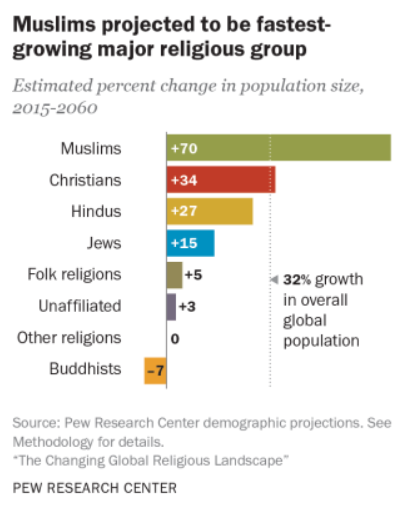
According to Pew Research projections, Islam is poised to become the world’s largest religion by the second half of the 21st century.
As younger Muslim populations come of age and diasporas strengthen their presence in Western societies, Islam’s cultural, spiritual, and demographic influence will continue to expand.
The Pew Research Center, whose Global Religious Futures project draws on more than 2,700 data sources including national censuses and large-scale demographic surveys, is the authoritative source for these projections.
Islam’s growth rate of 1.84% annually makes it the fastest-growing religion globally, with high birth rates cited as the primary driver — though the net positive from conversions adds meaningfully to the total.
These projections are not causes for triumphalism — they are reminders of an obligation. The Ummah’s growth carries with it the responsibility of Islamic guidance grounded in pure monotheism, authentic scholarship, and genuine care for every soul that enters this faith.
What is The Theological Core That Draws Seekers to Islam?
People rarely convert to a religion for sociological reasons alone. At the heart of nearly every conversion story to Islam is an encounter with a single, transformative idea: Tawhid — the absolute, uncompromising Oneness of Allah.
Allah says in the Quran:
قُلْ هُوَ ٱللَّهُ أَحَدٌ ﴿١﴾ ٱللَّهُ ٱلصَّمَدُ ﴿٢﴾ لَمْ يَلِدْ وَلَمْ يُولَدْ ﴿٣﴾ وَلَمْ يَكُن لَّهُۥ كُفُوًا أَحَدُۢ ﴿٤﴾
“Say, “He is Allah, [who is] One, (1) Allah, the Eternal Refuge. (2) He neither begets nor is born, (3) Nor is there to Him any equivalent.” (4)'” (Quran 112:1)
For millions of converts, this verse alone carries the weight of an answer they spent years searching for. There are no intermediaries in Islam, no divided divinity, no theological complexity requiring a specialist to decode. The nature of Allah in Islam is singular, eternal, and wholly accessible to every human soul.
Converts to Islam frequently cite the Quran’s emphasis on intellectual reasoning and critical thinking — not blind acceptance — as a defining feature of the faith.
Once grounded in logic and reason, that faith proves deeply resilient. Academic and scientific professionals, in particular, find in Islam a tradition that does not demand the suspension of reason, but its full exercise.
The Quran Transforms the People Who Honestly Engage With It
Among the most frequently cited reasons for conversion to Islam is direct engagement with the Quran. Some of the most commonly reported reasons for conversion include the eloquence of the Quran’s language, its alignment with scientific evidence, arguments rooted in intellectual reasoning, and the divine wisdom behind its social teachings.
The Quran addresses humanity directly, repeatedly, as thinking beings:
أَفَلَا تَعْقِلُونَ
“Will you not reason?” (Quran 2:44)
This direct appeal to the intellect is not rhetorical. It is the Quran’s method — to invite reflection, not to demand submission without understanding.
Many converts come from academic or scientific backgrounds and find themselves drawn to Islam precisely because of its emphasis on reason, observation, and inquiry, with the Quran repeatedly encouraging readers to reflect on the natural world.
For anyone who wants to understand what the Quran actually is and why Muslims revere it, the Salam Platform’s dedicated resource on what Muslims believe about the Quran offers a grounded, honest introduction.
And for those who want to understand the rational basis for that reverence, why Muslims believe in the Quran lays out the evidential foundations clearly.
The Moral Architecture of Islam is a Way of Life That Fills the Void
Modern life, particularly in the West, has produced extraordinary material wealth alongside an equally extraordinary spiritual emptiness.
Many converts to Islam arrive having already tried the alternatives — secular materialism, therapy culture, liberal pluralism — and found them structurally incapable of answering the deepest questions.
Islam answers those questions completely. It does not offer a Sunday practice or a private spirituality quarantined from daily life. It offers a total framework: how to worship, how to conduct commerce, how to raise children, how to treat neighbors, how to grieve, and how to die. These are the principles of Islam — a comprehensive revelation for a complete human life.
مَنْ عَمِلَ صَالِحًا مِّن ذَكَرٍ أَوْ أُنثَىٰ وَهُوَ مُؤْمِنٌ فَلَنُحْيِيَنَّهُ حَيَاةً طَيِّبَةً
“Whoever does righteousness, whether male or female, while being a believer — We will surely cause him to live a good life.” (Quran 16:97)
The Prophet Muhammad (PBUH) described this moral architecture with equal clarity. In Sahih Muslim, he said: “Part of the excellence of a person’s Islam is that he leaves that which does not concern him.” This principle — purposeful, disciplined living — resonates deeply with those disillusioned by a culture of excess.
People convert to Islam because it fulfills their spiritual needs, answers intellectual questions through clear monotheism, aligns with their moral values around justice and family, and guides practical daily life.
The Prophet Muhammad (PBUH) is a Mercy to the Worlds
The biography of the Prophet Muhammad (PBUH) is inseparable from the story of Islam’s universal reach. He was sent not to one tribe, one nation, or one era — but to all of humanity until the Day of Judgment.
وَمَا أَرْسَلْنَاكَ إِلَّا رَحْمَةً لِّلْعَالَمِينَ
“And We have not sent you, [O Muhammad], except as a mercy to the worlds.” (Quran 21:107)
The Prophet (PBUH) himself described the mechanism by which hearts open to Islam. In Sahih Bukhari, he said:
“Allah said: ‘I am as My servant expects Me to be, and I am with him when he remembers Me.'”
The door to Allah is always open. The seeker who knocks with sincerity finds it answered.
This understanding shapes how God in Islam differs so profoundly from distorted portrayals: Allah is not distant, wrathful, or inaccessible. He is Al-Qarib — The Near. Every convert who found Islam, found it through exactly this proximity.
What to Do When the Truth Becomes Clear to You?
Whether you arrived at this article from genuine curiosity, from a question you’ve carried for years, or from a moment of sincere searching — know that this is not coincidence.
Islam teaches that every human being is born in a state of Fitra — a pure, original nature inclined toward its Creator. The Prophet (PBUH) said in Sahih Bukhari: “Every child is born in a state of Fitra.” The spiritual restlessness so many describe before conversion is simply that Fitra recognizing what it was always made for.
If you feel that pull, the Salam Center is here to walk with you — with no pressure, no agenda, and complete respect for your pace and journey.
Have Questions About Islam?
Our team is ready to answer your questions clearly and respectfully. Ask freely and receive honest guidance.
Ask Us NowExplore More, Learn More, Begin with Salam
The Salam Platform is the content and educational arm of the Salam Center for Da’wah and Dialogue — a non-profit organization whose singular purpose is supporting seekers and new Muslims with honest, grounded, and compassionate knowledge.
On the Salam blog, you’ll find hundreds of articles addressing the questions you actually have — about Allah, the Quran, Islamic practice, misconceptions, and the lived experience of faith.
If you have a specific question, want to learn more about Islam, or are ready to take the next step, reach out directly — our team is ready to listen.
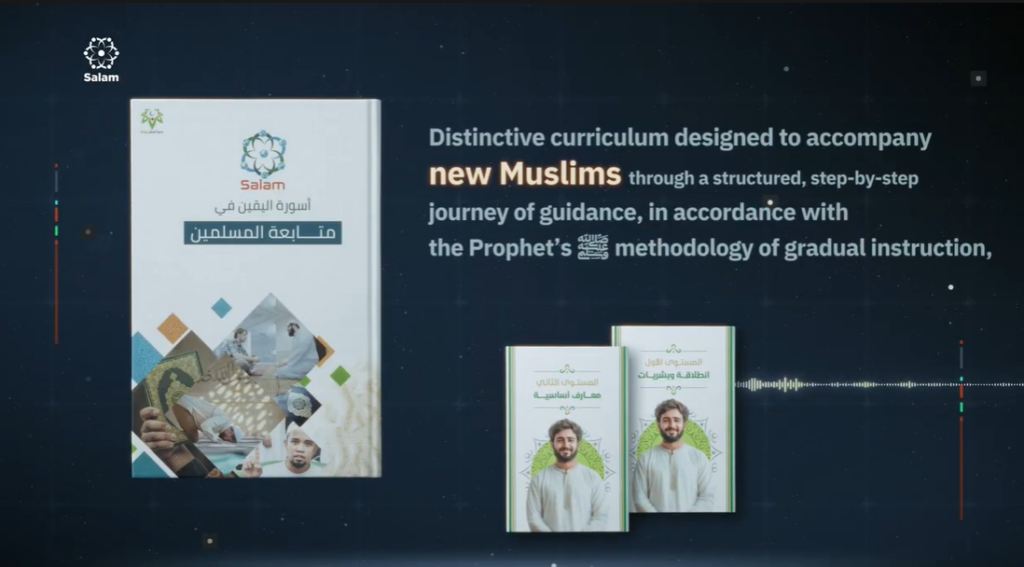
For those who have already entered Islam and want a structured, progressive path forward, the Salam Center offers the Asawirat Al-Yaqeen (Bracelets of Certainty) program — a complete four-stage educational curriculum designed exclusively for new Muslims:
- Stage One — The Foundation: Understanding the Shahada, the pillars of Islam, and the practical essentials of worship — wudu, ghusl, and salah
- Stage Two — The Construction Phase: The six pillars of Iman, zakat, fasting, and the virtues of Hajj
- Stage Three — The Consolidation Phase: Tawbah (sincere repentance), the Seerah of the Prophet (PBUH), and Islamic etiquette
- Stage Four — The Empowerment Phase: Contemporary issues, the characteristics of Ahlus Sunnah, and a life framework built on Surah Al-Asr
The Asawirat Al-Yaqeen (Bracelets of Certainty) curriculum has already guided 114,588 new Muslims across 140 countries — 63.3% completing all four stages, with 41.3% graduating with an excellent grade. This is structured care, not casual content.
Reach out directly to the Salam Center team to start the Asawirat Al-Yaqeen (Bracelets of Certainty) program for FREE.
Conclusion
Islam’s position as the most converted religion in the world rests on both demographic evidence and theological depth. The Pew Research Center’s Global Religious Landscape study confirms a net Muslim population increase of 347 million people from 2010 to 2020, outpacing every other major faith.
Conversion to Islam consistently follows from the same core encounter: Tawhid — the pure Oneness of Allah — offering seekers an intellectually satisfying and spiritually complete alternative to fragmented modern worldviews. The Quran’s rational methodology and the Prophet’s (PBUH) comprehensive moral guidance remain the central attractions across cultures.
The trajectory ahead is clear. With the Muslim population projected to reach nearly 3 billion by 2060, Islam’s universal message continues reaching hearts in every country, language, and tradition — because the Fitra recognizes truth, and truth, by its nature, spreads.
Frequently Asked Questions
Is Islam really the most converted religion in the world?
Yes, Islam is the most converted religion globally, and the data supports this. The Pew Research Center’s report confirms Islam as the world’s fastest-growing major religion from 2010 to 2020, with a global increase of 347 million Muslims in that decade alone.
Estimates place annual conversions to Islam at approximately 3 million worldwide, with 20,000 to 30,000 in the United States annually. While primary growth is demographic, the net conversion balance globally favors Islam — more people enter the faith each year than leave it.
What are the main reasons people convert to Islam?
The most commonly reported reasons for conversion are Tawhid — the pure, undivided Oneness of Allah — the intellectual coherence and linguistic power of the Quran, the clarity of Islamic ethics, and the immediate, unmediated relationship with Allah that Islam establishes.
Many converts also cite the completeness of Islam as a way of life — one that addresses not just ritual worship but commerce, family, justice, and character. Faith in Islam begins with knowledge, not blind submission.
How does one become a Muslim?
Entering Islam requires only the Shahada — the sincere declaration: "Ashhadu an la ilaha illa Allah, wa ashhadu anna Muhammadan rasul Allah" — "I bear witness that there is no deity except Allah, and I bear witness that Muhammad is the Messenger of Allah."
This declaration, made with genuine conviction, marks the entry into Islam. No ceremony, no intermediary, and no complex process is required. The Prophet (PBUH) taught in Sahih Muslim that the Shahada, combined with establishing prayer and giving zakat, constitutes the foundation of the Muslim’s commitment to Allah. Contact the Salam Center team
How does Islam view converts — are they fully equal to born Muslims?
In Islam, all believers stand equal before Allah. The Prophet Muhammad (PBUH) said: "None of you truly believes until he loves for his brother what he loves for himself." This brotherhood encompasses every Muslim without distinction of origin. Converts are not regarded as outsiders or newcomers in perpetuity — they are full members of the Ummah from the moment of their Shahada.
The Quran affirms this directly: "Indeed, the most noble of you in the sight of Allah is the most righteous." (Quran 49:13)
Curious about Islam?
Journey towards clarity and purpose. Our team is here to support you in your search for truth and spiritual guidance.
Embrace the Truth