What Did Muhammad Do Before He Became A Prophet?
| Key Takeaways |
| Prophet Muhammad (PBUH) was born in Mecca around 570 CE and lived a full, active life for 40 years before receiving the first revelation. |
| Prophet Muhammad (PBUH) earned the titles Al-Amin (The Trustworthy) and Al-Sadiq (The Truthful) from his own community — including those who would later oppose him. |
| Prophet Muhammad (PBUH) worked as a merchant and shepherd, traveled trade routes, and built a reputation for absolute honesty that preceded him wherever he went. |
| His first marriage to Khadijah (RA) began as a professional relationship she initiated, drawn by reports of his integrity and character. |
| His pre-prophethood life — marked by spiritual reflection, rejection of idol worship, and moral excellence — was not accidental preparation; it was divine formation. |
Long before the angel Jibreel (Gabriel) appeared in the cave of Hira, long before the words اقْرَأْ — “Recite” — shook a man to his core and changed the world forever, there was a life being quietly and purposefully shaped.
Prophet Muhammad (PBUH) spent four full decades as a man among his people — working, traveling, marrying, grieving, thinking, and earning a reputation that his fiercest enemies could never honestly dispute.
Understanding those 40 years answers something essential: the prophethood did not fall on a random soul. It came to a man whose entire pre-revelation life was, in every meaningful sense, already a preparation.
1. Prophet Muhammad (PBUH) Was an Orphan
Muhammad (PBUH) was born in Mecca in approximately 570 CE, the Year of the Elephant — the year Abraha’s army, which had marched to demolish the Ka’bah, was destroyed by birds carrying stones of baked clay, as recorded in Surah Al-Fil.
His father, Abdullah ibn Abd al-Muttalib, died before he was born. His mother, Aminah, died when he was just six years old.
He was passed first to his grandfather, Abd al-Muttalib — a man of great standing in Mecca — and then, upon his grandfather’s death, to his uncle Abu Talib, who would protect him fiercely for the rest of his life.
These losses were not incidental. Hardship, early and repeated, built in him a tenderness toward the weak and an independence of soul that no comfort could have produced.
The Years with the Banu Sa’d
Arabic custom sent newborns to the desert with wet nurses from Bedouin tribes, where the clean air and pure dialect of the open land were considered the finest early education. Muhammad (PBUH) was nursed by Halimah Al-Sa’diyyah of the Banu Sa’d tribe. The years he spent with her family in the desert instilled in him the eloquence of classical Arabic — a gift that would later make the Quran’s linguistic miracle land with devastating force on native speakers who understood exactly what they were hearing.
Tending Sheep — the Prophet’s First Profession
He worked as a shepherd in his youth, a profession shared by nearly every major prophet before him. He himself confirmed this, as recorded in Sahih Bukhari: “Allah did not send any prophet except that he was a shepherd of sheep.” His companions asked, “Even you?” He replied: “Yes, I used to tend sheep for the people of Mecca for a few qirats.”
The connection matters. Shepherding requires patience, vigilance, selflessness — complete responsibility for those who cannot protect themselves. The prophets were trained in leadership before they were handed people.
2. The Merchant Who Could Not Be Bribed or Lied To
By his teens and early twenties, Muhammad (PBUH) had entered the trade that defined Meccan society. Mecca sat at the intersection of major Arabian trade routes, and commerce was both livelihood and identity for the Quraysh tribe.
He joined trade caravans, traveled to Syria, Yemen, and beyond, and over time built a reputation that was, by any honest account, extraordinary.
His people — the Quraysh — gave him two names that were not titles of politeness but descriptions of documented fact: Al-Amin, the Trustworthy, and Al-Sadiq, the Truthful. These were not honorary labels.
They reflected the lived experience of people who had done business with him, traveled with him, and watched him handle disputes and debts.
The Trade Journey That Changed Prhphet Muhammad’s (PBUH) Life
When he was around 25 years old, a wealthy businesswoman of Mecca named Khadijah bint Khuwaylid (RA) hired him to lead her trade caravan to Syria.
She had heard, through her agent Maysarah, detailed accounts of his character — his honesty in dealing, his unusual fairness, his composed manner even in the pressured world of commerce.
He returned with double the expected profit. Maysarah’s report of the journey was glowing. Khadijah (RA), a widow of standing and means who had turned down proposals from prominent men of Mecca, proposed to Muhammad (PBUH). He accepted. He was 25; she was 40.
Their marriage was one of the most consequential in human history — and it was built, from the first moment, on the recognition of moral character.
Learn More About Islam
Discover the beauty, teachings, and wisdom of Islam in a clear and welcoming way. Start exploring and deepen your understanding today.
Learn More3. Prophet Muhammad (PBUH) Rejected Idolatry Before the Revelation Came
One of the most significant facts about Muhammad’s pre-prophethood years is what he did not do. Mecca was a city of idols — the Ka’bah, originally built by Ibrahim (Abraham) and Ismail (Ishmael) as a house of pure monotheism, had been filled with 360 idols by the time of the Prophet’s birth. Idol worship, tribal sacrifices, and the rituals of polytheism were the social fabric of Meccan life.
Muhammad (PBUH) never participated in idol worship. He never offered sacrifices at the idols’ altars.
He reportedly attended one social event associated with pagan ritual in his youth and felt such aversion that he fell asleep before anything occurred — and he understood this, later, as divine protection.
The rejection of idolatry was already in him, not yet revealed as religion, but present as instinct. This is the framework that Islamic monotheism builds on — the fitrah, the innate human disposition toward the Oneness of Allah, which polytheism works against.
The Withdrawal to the Cave of Hira
As he approached 40, something deepened. He began retreating regularly to a cave on the mountain called Jabal Al-Nur — the Mountain of Light — just outside Mecca. The cave was small, solitary, overlooking the city.
He would spend days there alone, reflecting, contemplating the state of his people and the universe, carrying provisions that Khadijah (RA) would sometimes climb the mountain to replenish.
He was not seeking revelation — he did not know revelation was coming. He was seeking truth through reflection, through tahannuth (spiritual devotion and seclusion), in the tradition of the Hanifs — those Arabs who had preserved, in fragments, the monotheism of Ibrahim (PBUH) and rejected the polytheism that surrounded them.
4. Prophet Muhammad’s (PBUH) Character Before Prophethood
The most remarkable testimony to Muhammad’s (PBUH) pre-prophethood character comes from his enemies. Abu Jahl, Abu Lahab, and other fierce opponents of Islam never accused him of lying before the revelation came.
Their objections to his prophethood were political and social — not a single credible voice from Mecca said: “This man has always been a deceiver.”
In fact, when the Prophet asked them directly, “If I told you an army was approaching from behind this mountain, would you believe me?” — they answered: “Yes, we have never known you to lie.”
This matters for understanding the nature of prophethood. The faith in Islam rests on the recognition that prophets are not chosen arbitrarily — they are known by their fruits long before the first leaf of revelation appears.
Participation in Al-Hilf Al-Fudul
Even in his youth, Muhammad (PBUH) participated in Al-Hilf Al-Fudul — the Pact of the Virtuous — a pre-Islamic alliance among Meccan tribes committed to protecting the weak, ensuring rights for travelers, and opposing injustice.
He later said of it, after Islam, that he would not exchange his participation in that pact for the finest of worldly goods, and that if he were called to such a pact under Islam, he would honor it.
Social justice was not something he discovered through revelation — it was something already burning in him.
Read also: How Did Muhammad Become the Prophet of Islam?
5. The First Revelation to Prophet Muhammad (PBUH)
In the month of Ramadan, in approximately 610 CE, the angel Jibreel came to Muhammad (PBUH) in the cave of Hira. He embraced him — with a force that the Prophet described as overwhelming — and commanded:
اقْرَأْ بِاسْمِ رَبِّكَ الَّذِي خَلَقَ
“Recite in the name of your Lord who created.” (Quran 96:1)
He returned to Khadijah (RA) trembling, wrapped himself in a garment, and told her what had happened. Her response was immediate and certain:
“By Allah, Allah will never disgrace you. You maintain family ties, you bear the burdens of the weak, you earn for the poor, you honor guests, and you help those who face genuine distress.”
She did not say: “Perhaps this is a good sign.” She said: “Allah will never disgrace you” — because she had watched his character for 15 years and knew it was incapable of drawing divine rejection.
This is the nature of Allah’s relationship with humanity — He sends to those whose hearts have already oriented themselves toward truth, even before the formal decree of prophethood arrives.
Read also: Was Muhammad A False Prophet?
Why Were the Pre-Prophethood Years Not Wasted Time?
Western accounts of prophetic biography sometimes treat the pre-prophethood period as biographical background — useful for context, not much more. The Islamic understanding is different, and it is theologically grounded.
The Quran itself addresses this:
وَوَجَدَكَ ضَالًّا فَهَدَىٰ
“And He found you lost and guided [you],” (Quran 93:7)
Scholars of tafsir note that “lost” here does not mean morally lost — it means unaware of the specific knowledge of prophethood and revelation.
His character was already formed. His soul was already oriented. The revelation came not to reform a man but to commission one already prepared.
The five pillars of faith that Islam would eventually articulate — belief in Allah, His angels, His books, His messengers, and the Last Day — found their most natural home in a man who had already spent 40 years living as though accountability to something greater than himself was simply the truth of existence.
Read also: Was Muhammad A Prophet?
The Pre-Prophethood Life of Muhammad (PBUH) and The Pre-Prophethood Lives of Other Prophets
The pre-prophethood life of Muhammad (PBUH) connects him to every prophet before him. Ibrahim (PBUH) refused idolatry before revelation commanded it. Musa (Moses, PBUH) was moved by injustice before the burning bush spoke. Isa (Jesus, PBUH) was known for wisdom and purity before formal prophethood.
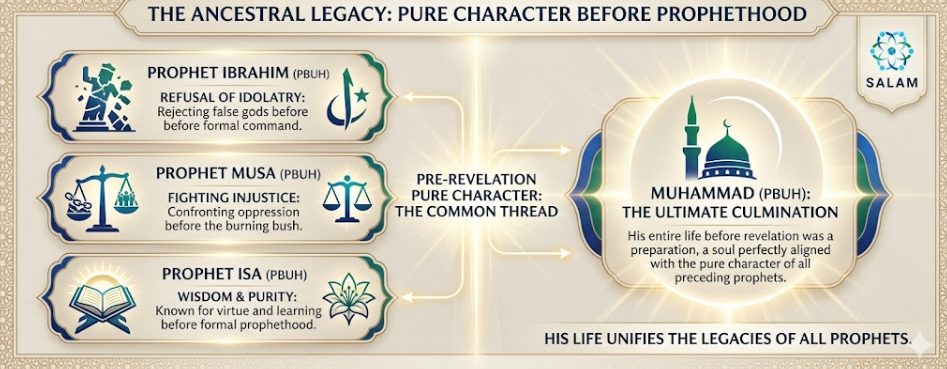
Islamic theology affirms that prophets share core truths — and that all of them carry within their very being the signs of their selection.
Muhammad’s (PBUH) 40 years in Mecca were not a waiting period. They were a formation period — quiet, purposeful, and divinely overseen.
This is why Muslims look at the Seerah (prophetic biography) as evidence, not just history. Every account of his pre-prophethood years is a brick in the evidential case for his truthfulness.
A man who never lied to his enemies is a reliable transmitter of divine speech. A man whose character compelled the trust of those around him — merchants, spouses, tribal leaders — was already carrying something.
He was already, in every way that could be seen, a man fit to receive the words of Allah and bear them to all of humanity — with full reward awaiting those who follow in the afterlife.
Learn More About Islam
Discover the beauty, teachings, and wisdom of Islam in a clear and welcoming way. Start exploring and deepen your understanding today.
Learn MoreRead also: The Prophet Muhammad’s Family Tree From Abraham
Explore More on the Salam Platform
The life of Prophet Muhammad (PBUH) is one thread in a vast and coherent picture. Every question it raises opens into deeper questions about faith, revelation, and the nature of Allah Himself.
If this article moved something in you — curiosity, doubt, or the beginning of something you can’t quite name — you are welcome to keep going.
Browse more articles on the Salam blog covering Islamic beliefs, common misconceptions, and the evidence for Islam explained honestly and without pressure.
The Salam Platform exists for exactly this kind of inquiry. If you have a question not covered here — about entering Islam, about a specific teaching, or simply about where to begin — reach out. Every question is welcome, and every person deserves a genuine answer.

Frequently Asked Questions
Was Muhammad (PBUH) literate before he became a prophet?
Muhammad (PBUH) was unlettered — he could not read or write. The Quran refers to him as Al-Nabi Al-Ummi, the unlettered prophet, in Surah Al-A’raf (7:157). This fact, far from being incidental, is central to the miracle of the Quran itself: a man with no formal education, no access to religious libraries, no literary training, produced a text that the greatest Arab poets and scholars of his time could not match or replicate. The Quran was preserved entirely through oral transmission and divine protection — not through the Prophet’s personal scholarship.
Did Muhammad (PBUH) practice idol worship before Islam?
No. Muhammad (PBUH) never worshipped idols, never offered sacrifices at the altars of Meccan deities, and never participated in pagan rituals — even before any formal revelation prohibited these acts. His companions and even his opponents confirmed this unanimously. He belonged to the tradition of the Hanifs — pre-Islamic monotheists who preserved fragments of the original faith of Ibrahim (PBUH). This disposition toward pure monotheism was part of his character long before the first verse of the Quran arrived.
How did Khadijah (RA) know Muhammad (PBUH) before their marriage?
Khadijah (RA) was a successful merchant who hired Muhammad (PBUH) to lead her trade caravan to Syria when he was approximately 25 years old. Her agent Maysarah traveled with him and returned with detailed accounts of his honesty, composure, and exceptional character. She was so impressed by these reports — and by the doubled profits the journey yielded — that she proposed marriage to him. Their relationship began in commerce and was grounded entirely in the recognition of his moral excellence. The Prophet (PBUH) later said, as recorded in Sahih Muslim, that Khadijah believed him when others disbelieved, supported him when others abandoned him, and helped him with her wealth when others withheld theirs.
Is there a connection between the Prophet’s pre-prophethood life and the principles of Islam he later taught?
The connection is direct and documented. The values Muhammad (PBUH) embodied before revelation — protecting the weak, honoring commitments, rejecting dishonesty, caring for the poor — became the explicit ethical framework of Islam after it. The core principles of Islam as a religion did not arrive as foreign commands imposed on his personality; they arrived as the formal articulation of what he already was. Scholars have long noted this alignment as one of the evidences for the authenticity of his prophethood: the message fit the man with perfect precision.
Did Muhammad (PBUH) know he would become a prophet?
No — there is no Islamic evidence that Muhammad (PBUH) anticipated prophethood before the first revelation. His retreats to the cave of Hira were acts of spiritual seeking, not prophetic expectation. The revelation came upon him suddenly, and his immediate reaction — trembling, seeking comfort from Khadijah (RA), fearing for himself — is the reaction of a man genuinely overwhelmed by something unprecedented. This human authenticity is consistent with every authentic narration of the event. Allah chooses His messengers; they do not appoint themselves. The question of whether Islam’s God is the same as in other faiths is often connected to this — and the answer requires understanding that all prophets ultimately pointed to the same One.
Why does the Prophet’s pre-prophethood character matter for a non-Muslim?
Because it provides historical and evidential grounding for evaluating his claim to prophethood. Muhammad (PBUH) asked people to believe in the Quran as the word of Allah and in himself as the final messenger. That claim must be evaluated against what his life, before and after revelation, actually showed. His pre-prophethood record — unanimously acknowledged honesty, documented social integrity, rejection of corruption and idol worship — removes the most obvious alternative explanations for his prophethood claim. A fraudster builds a pattern of deception; the historical record of Muhammad (PBUH), even according to his opponents, shows the opposite pattern entirely.
Curious about Islam?
Journey towards clarity and purpose. Our team is here to support you in your search for truth and spiritual guidance.
Embrace the Truth