Was Muhammad A Prophet?
| Key Takeaways |
| Muhammad (PBUH) is the final prophet in Islam, sent by Allah to all of humanity — not to one tribe or era. |
| The revelation Prophet Muhammad (PBUH) received began with the angel Jibreel (Gabriel) in the cave of Hira in 610 CE. |
| Prophet Muhammad’s (PBUH) life, character, and the miracle of the Quran itself serve as primary evidences of his prophetic mission. |
| Every major dimension of Islamic belief — prayer, monotheism, law, and ethics — traces directly back to his prophethood. |
Muhammad ibn Abdullah (PBUH) was indeed a prophet — the final messenger sent by Allah to humanity, bearing a message that was neither regional nor temporary. The Quran declares this with unmistakable clarity: خَاتَمَ النَّبِيِّينَ — “the seal of the prophets” (Quran 33:40). That title carries enormous weight. It means the prophetic line that began with Adam and ran through Ibrahim, Musa, and Isa (peace be upon them all) found its completion in him.
For the curious reader encountering this question genuinely — perhaps after a headline, a conversation, or a quiet moment of wondering — the answer deserves more than a simple “yes.”
It deserves the full picture: who he was before the revelation, what happened when it came, what he taught, and why billions across fourteen centuries have found his prophethood not only credible but transformative.
Was Muhammad A Prophet?
Yes, Muhammad ibn Abdullah (PBUH) was indeed a prophet. Muhammad (PBUH) carried the prophethood of all prior messengers to its conclusion, not as a claim of personal greatness but as a divine designation confirmed by the Quran, the inimitable Arabic revelation delivered through an unlettered man over twenty-three years of his life.
The evidence for his prophethood operates on multiple levels simultaneously — the literary miracle of the Quran, the documented coherence of his character under severe persecution, and the immediate recognition by those who already knew what prophetic signs looked like from earlier traditions.
For the sincere inquirer, his prophethood remains among the most substantiated claims in religious history. Engaging seriously with the sources — the Quran and authenticated Sunnah — is the most honest path to a well-founded conclusion.
1. Muhammad (PBUH) Before Revelation Was Known as The Trustworthy
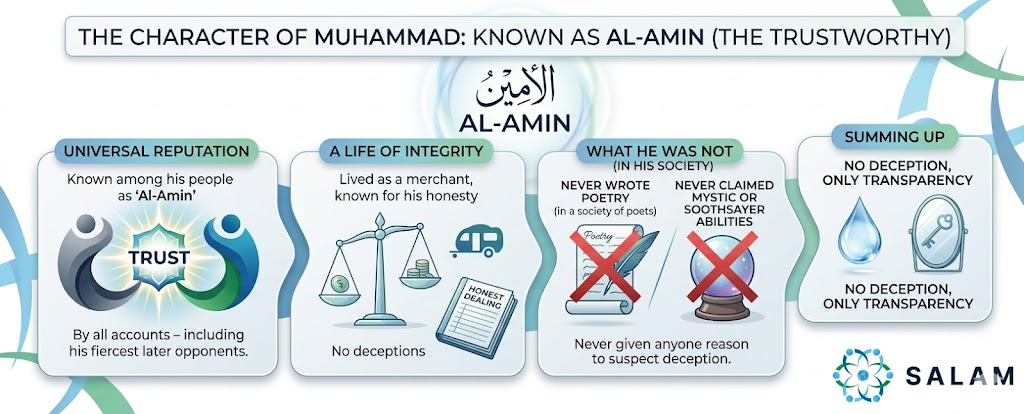
Muhammad (PBUH) was born in Makkah around 570 CE into the Quraysh tribe, a people known for their oral tradition, tribal pride, and the veneration of idols. He lost his father before birth and his mother by the age of six. He was raised by his grandfather, then his uncle Abu Talib. By all accounts — including those of his fiercest later opponents — he was known among his people as Al-Amin: the trustworthy one.
That reputation matters. He never wrote poetry in a society that worshipped poets. He never claimed to be a soothsayer or a mystic.
He lived as a merchant, known for his honesty, who had never given anyone reason to suspect him of deception.
When the revelation finally came to him at the age of forty, his first instinct was not pride — it was terror. He ran home to his wife Khadijah, trembling, and said: “Cover me, cover me.”
This response is not what fabricators do. Fabricators design their persona in advance. What emerged from that cave was a man shaken to his core by something he had never sought.
2. The Moment Muhammad (PBUH) Became a Prophet in Hira
In the year 610 CE, during the month of Ramadan, Muhammad (PBUH) was in seclusion in the cave of Hira on the mountain of Nur, outside Makkah. The angel Jibreel appeared to him and commanded: اقْرَأْ — “Recite!”
Muhammad responded that he could not read. Jibreel embraced him tightly three times, then recited the first verses of what would become the Quran:
اقْرَأْ بِاسْمِ رَبِّكَ الَّذِي خَلَقَ خَلَقَ الْإِنسَانَ مِنْ عَلَقٍ اقْرَأْ وَرَبُّكَ الْأَكْرَمُ
“Recite in the name of your Lord who created – (1) Created man from a clinging substance. (2) Recite, and your Lord is the most Generous – (3)” (Quran 96:1–3)
The Prophet (PBUH) returned home trembling. Khadijah, his wife, wrapped him in a cloak and brought him to her cousin Waraqah ibn Nawfal — an elderly Christian scholar who had studied the ancient scriptures.
When Muhammad (PBUH) described what he had experienced, Waraqah said immediately: “This is the same angel that Allah sent to Moses.”
This moment is preserved in Sahih Bukhari with an unbroken chain of narration. It is among the most reliably documented events in prophetic biography.
“The angel came to him and asked him to read. The Prophet replied, ‘I do not know how to read.’ The Prophet added, ‘The angel caught me forcefully and pressed me so hard that I could not bear it any more. He then released me and again asked me to read and I replied, “I do not know how to read.” Thereupon he caught me again and pressed me a second time till I could not bear it any more. He then released me and again asked me to read, but again I replied, “I do not know how to read.” Thereupon he caught me for the third time and pressed me, and then released me and said, “Read in the name of your Lord, who has created…”‘” (Sahih Bukhari 3)
3. The Quran Stands as the Central Evidence of His Prophethood
When people ask how did Muhammad become a prophet, the fuller question is: what proof accompanied that claim? The answer, for Muslims and for any honest inquirer, begins with the Quran itself.
Muhammad (PBUH) was unlettered — the Quran itself uses this as a sign:
الَّذِينَ يَتَّبِعُونَ الرَّسُولَ النَّبِيَّ الْأُمِّيَّ
“Those who follow the Messenger, the unlettered prophet…” (Quran 7:157)
An unlettered man in seventh-century Arabia produced a text that the greatest masters of Arabic — his contemporaries, his enemies, the poets whose identity was their language — could not replicate. The Quran itself issued this challenge directly:
فَأْتُوا بِسُورَةٍ مِّن مِّثْلِهِ
“Then bring a surah like it.” (Quran 2:23)
No one did. Not then, and not in the fourteen centuries since.
The Quran contains precise knowledge of earlier prophetic traditions, of natural phenomena that were not known to seventh-century scholarship, and of events whose outcomes were predicted before they occurred.
Understanding the nature of the Quran and what it represents is essential to understanding why prophethood is not simply a biographical claim — it is a claim backed by a standing miracle.
Learn More About Islam
Discover the beauty, teachings, and wisdom of Islam in a clear and welcoming way. Start exploring and deepen your understanding today.
Learn More4. Why Is Muhammad a Prophet and Not Simply a Wise Man or Reformer?
This is the question the intellectually serious reader must sit with. Wise men emerge in every era. Reformers challenge corrupt social orders. Philosophers articulate ethical systems. But prophets carry a specific claim: that what they bring does not originate from human reasoning — it comes from Allah.
Muhammad (PBUH) never claimed to speak from his own wisdom. He drew a clear distinction throughout his life between his personal opinions and divine revelation.
When revelation had not yet come on a matter, he said so.
When he was corrected by Allah — and the Quran records moments where he was — those corrections were included in the very scripture he delivered. A man fabricating prophethood would not include his own rebukes in the supposedly divine text.
The Quran makes the source explicit:
وَمَا يَنطِقُ عَنِ الْهَوَىٰ إِنْ هُوَ إِلَّا وَحْيٌ يُوحَىٰ
“Nor does he speak from [his own] inclination. (3) It is not but a revelation revealed, (4)” (Quran 53:3–4)
This is the dividing line between a sage and a prophet. A sage draws on what he knows. A prophet transmits what he is given.
The character of Muhammad’s (PBUH) entire mission — its coherence across twenty-three years, its internal consistency, its preservation — reflects a source beyond human capacity.
Those exploring Islamic beliefs and principles will find that the prophethood of Muhammad (PBUH) is not an isolated claim but the axis around which the entire structure of Islamic faith turns.
Read also: What Did Muhammad Do Before He Became A Prophet?
5. Muhammad’s (PBUH) Character Under Pressure Is an Evidence of His Prophethood
One of the most powerful arguments for the prophethood of Muhammad (PBUH) is the thirteen years of persecution he endured in Makkah before the migration to Madinah. His followers were tortured. He himself was mocked, pelted with filth, besieged, and offered the kingdom of Arabia if he would simply stop. He refused every offer and endured every hardship.
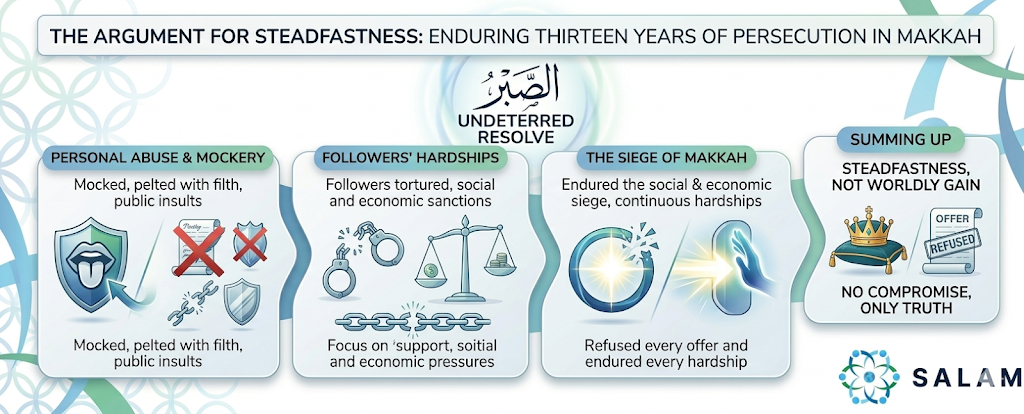
The leaders of Quraysh came to his uncle Abu Talib with a proposition: gold, power, marriage into nobility — everything the world could offer — if Muhammad (PBUH) would abandon his message. His response, recorded across multiple reliable narrations, was:
“O uncle, by Allah, if they placed the sun in my right hand and the moon in my left on condition that I abandon this cause before Allah makes it prevail or I perish therein, I would not abandon it.” (Seerah Ibn Hisham)
This is the response of a man who believes what he is saying. People who fabricate religious claims for power or social gain do not withstand years of brutal persecution when the exit ramp is visible and generously offered.
Read also: How Did Muhammad Become the Prophet of Islam?
6. The Prophethood of Muhammad in the Chain of All Prophets
Muhammad (PBUH) did not arrive as a novelty. He arrived as the completion of a long prophetic tradition. The Quran references dozens of prophets — Ibrahim, Nuh, Yusuf, Dawud, Sulayman, Musa, Isa — and places Muhammad (PBUH) at the end of that chain as the one sent to all peoples, not just one nation.
وَمَا أَرْسَلْنَاكَ إِلَّا رَحْمَةً لِّلْعَالَمِينَ
“And We have not sent you except as a mercy to the worlds.” (Quran 21:107)
This universality distinguishes his mission from earlier ones. Musa (Moses) was sent to the Children of Israel. Isa (Jesus) addressed the same people primarily.
Muhammad (PBUH) was sent to every human being who would ever live after him — which is precisely why his message was preserved with a completeness unlike any that preceded it.
This also explains why Muslims understand faith in Islam to include belief in all the prophets before Muhammad (PBUH) — rejecting none of them — while recognizing that his message supersedes and completes theirs.
Read also: Was Muhammad A Prophet?
7. Pure Monotheism is the Core Message Muhammad (PBUH) Brought
At the center of Muhammad’s (PBUH) prophetic mission was Tawheed: the absolute oneness of Allah. Every prophet before him carried this same message. His brought it to its final, unadulterated form — with no human additions, no gradual corruption, no priesthood standing between the believer and the Creator.
قُلْ هُوَ اللَّهُ أَحَدٌ اللَّهُ الصَّمَدُ لَمْ يَلِدْ وَلَمْ يُولَدْ وَلَمْ يَكُن لَّهُ كُفُوًا أَحَدٌ
“Say, ‘He is Allah, [who is] One, Allah, the Eternal Refuge. He neither begets nor is born, nor is there to Him any equivalent.'” (Quran 112:1–4)
Understanding Islamic monotheism in its depth — what Tawheed actually asserts about the nature of the Divine — is where the prophethood of Muhammad (PBUH) becomes most intellectually compelling.
He did not claim divinity for himself. He consistently directed all worship, all devotion, all ultimate loyalty away from himself and toward Allah alone.
The Quran addresses those who associate partners with Allah — what polytheism means in Islamic thought — precisely because that was the environment Muhammad (PBUH) was sent to transform. Makkah at the time housed 360 idols. He dismantled that system not by force alone, but first and primarily by argument, patience, and proof.
Read also: Was Muhammad A False Prophet?
8. Prophet Muhammad’s (PBUH) Legacy Across Fourteen Centuries Speaks for Itself
The prophethood of Muhammad (PBUH) produced a civilization. Within a century of his death, Islamic scholarship was preserving and advancing mathematics, astronomy, medicine, and philosophy at a time when much of the ancient world’s knowledge was at risk of disappearing.
Within two centuries, an elaborate science of Hadith verification had developed — the most rigorous system of oral tradition authentication in human history — precisely to protect his legacy from distortion.
Today, 1.8 billion people across every continent, culture, and language identify as Muslim. They do not share a race, a language, or a culture. What they share is the testimony that Muhammad (PBUH) was the Messenger of Allah.
Islam’s vision of what awaits in the next life — the accountability, the mercy, the possibility of paradise — all reaches the believer through the prophethood of Muhammad (PBUH). And the Islamic understanding of how other religions relate to this final revelation affirms that the prophetic tradition was always one — culminating in the one who came last.
What Did Other Religions Say About Prophet Muhammad (PBUH) Before His Birth?
One of the remarkable dimensions of Muhammad’s (PBUH) prophethood is that earlier scriptures, according to Islamic scholarship, carried references to his coming. The Quran itself states this:
الَّذِينَ يَتَّبِعُونَ الرَّسُولَ النَّبِيَّ الْأُمِّيَّ الَّذِي يَجِدُونَهُ مَكْتُوبًا عِندَهُمْ فِي التَّوْرَاةِ وَالْإِنجِيلِ
“Those who follow the Messenger, the unlettered prophet, whom they find written in what they have of the Torah and the Gospel…” (Quran 7:157)
Waraqah ibn Nawfal’s immediate recognition — a Christian scholar who had studied the earlier books — was not coincidence. He knew what the signs of prophethood looked like. What came through that cave in Hira matched what the tradition had anticipated.
For readers interested in how Islam understands its relationship to Christianity and Judaism — and the question of whether Muslims and Christians worship the same God — the prophethood of Muhammad (PBUH) is central to that conversation. His mission confirmed the prophets before him while delivering the final, preserved revelation that would not be distorted.
Learn More About Islam
Discover the beauty, teachings, and wisdom of Islam in a clear and welcoming way. Start exploring and deepen your understanding today.
Learn MoreContinue Your Exploration with Salam
If this article opened a door for you, there is much more to walk through.
The Salam blog carries detailed explorations of Islamic beliefs, the life of the Prophet (PBUH), common misconceptions, and the intellectual foundations of the faith — written for curious minds, not prior knowledge.
Browse the Salam Platform for more on the Prophet (PBUH), the Quran, and what Islam actually teaches — across topics from theology to ethics to history.
Have a question this article didn’t answer? Want to know more about the Prophet (PBUH)? Curious about taking the next step?
Reach out directly. Whether you’re seeking guidance on entering Islam, have a specific question about Islamic teachings, or simply want to understand more — the door is open.

Frequently Asked Questions
Was Muhammad a real historical figure?
Yes, Muhammad (PBUH) is one of the most thoroughly documented figures in ancient history. His life is recorded through multiple independent chains of narration in Arabic biographical literature (Seerah), Hadith collections verified by rigorous scholarship, and accounts preserved by his companions (Sahabah) who numbered in the thousands. The early Islamic historical record is, by volume and methodological precision, among the most detailed in all of antiquity. Historians across religious and secular traditions recognize his historicity without serious dispute.
How did Muhammad receive prophethood — what happened when revelation came to him?
The revelation began in 610 CE when the angel Jibreel appeared to Muhammad (PBUH) in the cave of Hira and commanded him to recite. Muhammad (PBUH) was forty years old, in a period of spiritual seclusion he had practiced for years. He returned home shaken and frightened — not triumphant. Revelation then continued over twenty-three years in two modes: Wahy Jali (direct angelic revelation) and Wahy Khafi (direct inspiration to the heart). The process was described by the Prophet (PBUH) himself as sometimes arriving like the ringing of a bell — the most intense form — and other times as a man speaking. (Sahih Bukhari)
Why do Muslims believe Muhammad was the last prophet?
The Quran explicitly designates Muhammad (PBUH) as Khatam an-Nabiyyeen — the seal of the prophets (Quran 33:40). Islamic theology holds that with his prophethood, the divine message reached its final, complete, and perfectly preserved form. There is no further need for prophets because the Quran, as transmitted through him, remains intact and sufficient as a guide for all time. This is not a claim of superiority but of completion — the same way a building is complete when its final stone is placed, not diminished.
Did Muhammad (PBUH) claim to be divine?
Muhammad (PBUH) never claimed divinity and explicitly forbade any such attribution. He said: "Do not over-praise me as the Christians over-praised the son of Mary. I am only a servant of Allah, so say: the servant of Allah and His Messenger." (Sahih Bukhari) His entire mission was built on removing false elevation of human beings to divine status. He directed all worship exclusively toward Allah and consistently described himself as a human being who received revelation — no more, no less. This is one of the clearest distinctions in Islamic theology: the messenger is honored and followed, but Allah alone is worshipped.
Curious about Islam?
Journey towards clarity and purpose. Our team is here to support you in your search for truth and spiritual guidance.
Embrace the Truth