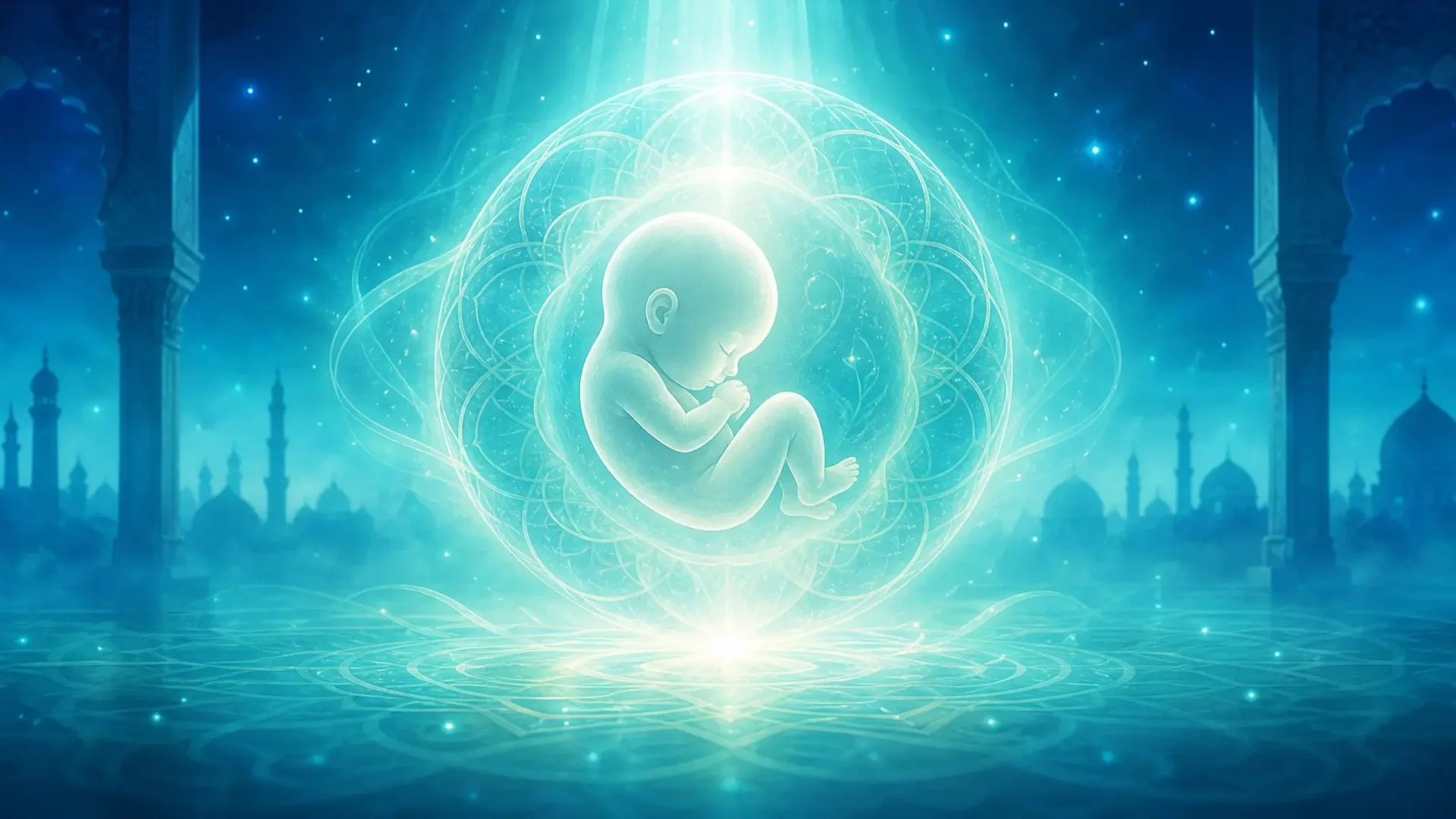
Embryology in the Quran
| Key Takeaways |
| The Quran describes the embryonic stages of human development — nutfa, alaqa, mudgha — with a precision that modern embryology has confirmed centuries later. |
| Allah revealed in Surah Al-Mu’minun a sequential account of fetal development that matches the scientific understanding of fertilization, implantation, and tissue differentiation. |
| The Quranic term “nutfa amshaj” (mixed drop) accurately reflects the genetic mixing of maternal and paternal chromosomes discovered by modern genetics. |
| The phrase “fi dhulumatin thalath” (in three darknesses) corresponds to the three anatomical layers that enclose the developing embryo: the abdominal wall, the uterine wall, and the amniotic sac. |
| The Quran’s account of embryology predates by over a millennium the scientific discoveries. |
| Sex determination occurs at the moment of fertilization through the sperm cell alone — a reality affirmed both by modern genetics and by the Quran in Surah Al-Qiyamah. |
The Quran was revealed to an unlettered Prophet in a 7th-century Arabian desert society that had no microscopes, no biology laboratories, and no knowledge of cellular reproduction.
Yet embedded within its verses is a description of human embryonic development so precise, so sequentially accurate, that it has left contemporary embryologists genuinely astonished.
Embryology in the Quran addresses one of the most compelling arguments for the divine origin of Islam’s scripture. When Allah described the stages of human creation — from the mixed fluid to the clinging clot, from the chewed-looking lump to bones clothed in flesh — He was not borrowing from Greek medicine.
What Are the Stages of Human Creation in the Quran That Mirror Modern Embryological Science?
The clearest and most comprehensive Quranic description of embryonic development appears in Surah Al-Mu’minun. Allah says:
وَلَقَدْ خَلَقْنَا الْإِنْسَانَ مِن سُلَالَةٍ مِّن طِينٍ ثُمَّ جَعَلْنَاهُ نُطْفَةً فِي قَرَارٍ مَّكِينٍ ثُمَّ خَلَقْنَا النُّطْفَةَ عَلَقَةً فَخَلَقْنَا الْعَلَقَةَ مُضْغَةً فَخَلَقْنَا الْمُضْغَةَ عِظَامًا فَكَسَوْنَا الْعِظَامَ لَحْمًا ثُمَّ أَنشَأْنَاهُ خَلْقًا آخَرَ فَتَبَارَكَ اللَّهُ أَحْسَنُ الْخَالِقِينَ
“And certainly did We create man from an extract of clay. (12) Then We placed him as a sperm-drop in a firm lodging. (13) Then We made the sperm-drop into a clinging clot, and We made the clot into a lump [of flesh], and We made [from] the lump, bones, and We covered the bones with flesh; then We developed him into another creation. So blessed is Allah, the best of creators.” (Quran 23:12–14)
This single passage maps onto the verified sequence of embryonic development with extraordinary fidelity:
Stage 1 — Nutfa (the sperm-drop):
The Arabic word nutfa means a small, pure drop. Modern embryology confirms that fertilization results from the union of a single sperm with an ovum — a microscopic event producing the zygote, the entire biological foundation of a new human being.
Stage 2 — Alaqa (the clinging clot):
The fertilized egg implants itself into the uterine wall and clings to it. The Arabic word alaqa carries three simultaneous meanings: something that clings, a leech-like form, and a clot of blood.
All three describe the early embryo accurately — it attaches to the uterine wall, draws nourishment from the maternal blood supply, and resembles a leech in shape when viewed under magnification.
Stage 3 — Mudgha (the chewed lump):
At approximately four weeks, the embryo develops somites — paired block-like structures along its back that create an appearance remarkably similar to the marks left by teeth on a chewed piece of clay.
The word mudgha in Arabic means precisely that: a lump that has been chewed. No anatomical textbook from the 7th century described this appearance; it was only confirmed by modern microscopic imaging.
Stage 4 — Idhaam (bones) clothed in Lahm (flesh):
The Quran specifies that bones form first, followed by the covering of muscle and flesh. Modern embryology confirms this sequence: the cartilaginous skeletal framework develops before the myoblasts (muscle precursor cells) migrate and wrap around it.
Stage 5 — “Another creation”:
This final phrase has been interpreted by scholars as referring to the ensouling of the embryo or the emergence of distinctly human characteristics. This stage marks a qualitative transformation — the emergence of a human being as a complete, independent entity.
The Nutfa Amshaj is the Quran’s Description of Genetic Mixing
Centuries before genetics existed as a field, Allah used a profoundly specific term. In Surah Al-Insan:
إِنَّا خَلَقْنَا الْإِنْسَانَ مِن نُّطْفَةٍ أَمْشَاجٍ نَّبْتَلِيهِ فَجَعَلْنَاهُ سَمِيعًا بَصِيرًا
“Indeed, We created man from a sperm-drop mixture that We may try him; and We made him hearing and seeing.” (Quran 76:2)
The word amshaj is the Arabic plural of mashj — meaning mixed, blended, combined. The zygote is formed from the fusion of 23 chromosomes from the father’s sperm and 23 chromosomes from the mother’s ovum, producing a 46-chromosome cell that inherits traits from both parents across multiple generations.
This genetic blending — a mingling of hereditary information — is precisely what nutfa amshaj describes.
Modern geneticists confirm that no two humans — except identical twins — share the same genetic profile, because each zygote represents a unique recombination of ancestral traits.
The Quran pointed to this reality 14 centuries before Gregor Mendel published his laws of inheritance.
Those seeking to understand why Muslims believe in the Quran often find this scientific convergence among the most compelling evidences.
Learn More About Islam
Discover the beauty, teachings, and wisdom of Islam in a clear and welcoming way. Start exploring and deepen your understanding today.
Learn MoreThe Three Darknesses: A Precise Anatomical Description
Allah says in Surah Az-Zumar:
يَخْلُقُكُمْ فِي بُطُونِ أُمَّهَاتِكُمْ خَلْقًا مِّن بَعْدِ خَلْقٍ فِي ظُلُمَاتٍ ثَلَاثٍ
“He creates you in the wombs of your mothers, creation after creation, within three darknesses.” (Quran 39:6)
Classical commentators debated the meaning of “three darknesses.” Modern embryology provides a precise anatomical answer. The developing embryo is enclosed within:
1. The first darkness is the anterior abdominal wall
The anterior abdominal wall of the mother, which shields the entire uterine cavity from external light and impact.
2. The second darkness is the uterine wall itself
The uterine wall itself, the thick muscular layer (myometrium) within which the placenta embeds and from which the fetus draws its nourishment through the placental blood supply.
3. The third darkness is the amniochorionic membrane
The amniochorionic membrane, comprising the chorion and the inner amnion, which together form the fluid-filled sac surrounding the embryo.
The amniotic fluid within this sac cushions the fetus from mechanical shock and maintains a stable thermal and chemical environment.
These three enclosing layers — the abdominal wall, the uterine wall, and the amniochorionic membrane — correspond with anatomical exactness to the “three darknesses” the Quran described 14 centuries before ultrasound imaging and fetal anatomy were developed as fields.
Sex Determination in the Quran
Another dimension of Quranic embryology that directly anticipates modern genetics is the matter of sex determination. Allah says in Surah Al-Qiyamah:
أَلَمْ يَكُ نُطْفَةً مِّن مَّنِيٍّ يُمْنَى ثُمَّ كَانَ عَلَقَةً فَخَلَقَ فَسَوَّى فَجَعَلَ مِنْهُ الزَّوْجَيْنِ الذَّكَرَ وَالأُنثَى
“Was he not a sperm-drop emitted? Then he was a clinging clot, and [Allah] created [his form] and proportioned [him]. And made of him two mates, the male and the female.” (Quran 75:36–39)
The Quran attributes the creation of both sexes — male and female — to the sperm (mani) emitted by the male, not to the ovum of the female. This is scientifically accurate. The human ovum always carries the X chromosome.
The sperm cell carries either an X chromosome (producing a female child upon fertilization) or a Y chromosome (producing a male child).
The sex of every human being is therefore determined entirely by the father’s sperm — exactly as the Quran implies.
For 14 centuries before chromosomal biology, popular belief blamed mothers for the sex of their children. The Quran assigned this biological reality to the male’s contribution alone.
This connects directly to the broader principles of faith in Islam, which holds that Allah’s knowledge encompasses what no human being could independently discover.
Read Also: Does the Quran Say the Earth Is Flat or Round?
The Origin of the Reproductive Glands in the Quran
One of the most discussed verses in the context of embryology in the Quran is in Surah At-Tariq:
خُلِقَ مِن مَّاءٍ دَافِقٍ يَخْرُجُ مِن بَيْنِ الصُّلْبِ وَالتَّرَائِبِ
“He was created from a fluid, ejected — emerging from between the backbone and the ribs.” (Quran 86:6–7)
This verse describes the origin of the reproductive fluid as emerging from “between the backbone and the ribs” (as-sulb wal-tara’ib). Embryology provides the explanation.
The gonads — both testes and ovaries — develop embryologically at the level of the tenth thoracic vertebra, adjacent to the kidneys, positioned anatomically between the backbone and the lower ribs.
Although they migrate downward during fetal development (the testes descending into the scrotum in the seventh month), their blood supply and nerve innervation remain rooted at this original embryological position.
The testicular artery, which supplies the testes throughout adult life, branches directly from the abdominal aorta at the level of the kidneys — precisely in the region between the spine and the ribcage.
The verse describes not where the fluid exits the body, but where the reproductive apparatus originates — a distinction embryology has validated.
Read Also: Contradictions in the Quran Explained
What Is the Quran Saying About the Nature of Allah Through Embryology?
The embryological verses in the Quran serve a purpose beyond scientific description. They are signs — ayat — meant to direct the intellect toward recognition of the Creator. Allah says in Surah Al-Hajj:
يَا أَيُّهَا النَّاسُ إِن كُنتُمْ فِي رَيْبٍ مِّنَ الْبَعْثِ فَإِنَّا خَلَقْنَاكُم مِّن تُرَابٍ ثُمَّ مِن نُّطْفَةٍ ثُمَّ مِنْ عَلَقَةٍ ثُمَّ مِن مُّضْغَةٍ مُّخَلَّقَةٍ وَغَيْرِ مُخَلَّقَةٍ لِّنُبَيِّنَ لَكُمْ
“O people, if you should be in doubt about the Resurrection, then [consider that] indeed, We created you from dust, then from a sperm-drop, then from a clinging clot, then from a lump of flesh, formed and unformed — that We may show you.” (Quran 22:5)
The phrase “formed and unformed” (mukhallaqah wa ghayr mukhallaqah) describes what modern medicine calls miscarriage or incomplete fetal development — an embryo that does not complete its formation.
The Quran acknowledged this reality of incomplete development as part of Allah’s wisdom, long before obstetrics defined miscarriage as a clinical entity.
Understanding what Muslims believe about the Quran requires recognizing that for Muslims, these passages are not coincidences of language. They are evidence of a book whose Author knows what no human author in the 7th century could have known.
Read Also: The Quran and Modern Science
Learn More About Islam
Discover the beauty, teachings, and wisdom of Islam in a clear and welcoming way. Start exploring and deepen your understanding today.
Learn MoreLearn More Authentic Knowledge About Islam & Quran with Salam
If these signs have stirred something within you — a question, a curiosity, or perhaps a recognition — you are not alone. Thousands have walked this path before you, and the Salam Center exists to walk it with you.
Explore more on the Salam Platform — articles, answers, and resources designed for seekers and new Muslims alike.
Read more deeply on the Salam Blog — covering Islamic beliefs, science and faith, the Quran, and the Prophet’s life.
Reach out directly — whether you have a question, want to declare your Shahada, or simply want to talk: Contact the Salam Center.
Reach out directly — our team is ready to listen, guide, and welcome you.

If you are a new Muslim seeking structured, compassionate guidance, consider joining Asawirat Al-Yaqeen (Bracelets of Certainty) — the Salam Center’s four-stage curriculum for post-conversion growth:
- Stage One: The essentials of faith, prayer, purification, and the pillars of Islam
- Stage Two: Zakat, fasting, the biography of the Prophet, and sincere repentance
- Stage Three: Heart-centered spirituality, etiquette, and practical life rulings
- Stage Four: Contemporary issues, theological evidence, and the characteristics of Ahlus Sunnah
Over 114,000 new Muslims across 140 countries have graduated from this program. The door is open for you.
Reach out directly to the Salam Center team to start the Asawirat Al-Yaqeen (Bracelets of Certainty) program for FREE.
Summary
The Quran describes human embryonic development in Surah Al-Mu’minun through six sequential stages — from fertilization to the clothing of bones with flesh — matching the verified sequence of modern embryology. Terms like alaqa and mudgha carry meanings confirmed by microscopic imaging of early embryos, and the phrase “three darknesses” corresponds precisely to the three anatomical layers surrounding the developing fetus.
Sex determination, genetic mixing, and the embryological origin of the gonads are addressed in the Quran with an accuracy that no human author in the 7th century possessed. These verses stand as enduring signs pointing toward the one who holds all knowledge — Allah, the Creator of life itself.
Frequently Asked Questions
What does the Quran say about embryology?
The Quran describes human embryonic development across six sequential stages: dust (origin), the sperm-drop (nutfa), the clinging clot (alaqa), the chewed-looking lump (mudgha), bones (idhaam), and flesh covering the bones (lahm). This sequence, detailed in Surah Al-Mu’minun (23:12–14), matches the confirmed progression of embryonic development in modern medicine.
What does “nutfa amshaj” mean in the Quran?
“Nutfa amshaj” means a mixed or blended sperm-drop, as stated in Surah Al-Insan (76:2). The term amshaj refers to the mixing of genetic material from both parents — a description that anticipates the chromosomal fusion of sperm and ovum confirmed by modern genetics, in which 23 chromosomes from each parent merge to form the zygote.
What are the three darknesses mentioned in the Quran?
The Quran states in Surah Az-Zumar (39:6) that Allah creates the human being “within three darknesses,” which correspond anatomically to the anterior abdominal wall, the uterine wall, and the amniochorionic membrane (the combined chorion and amnion). These three layers physically enclose and protect the developing embryo from its earliest stages.
Does the Quran mention sex determination?
Yes. Surah Al-Qiyamah (75:36–39) attributes the creation of both male and female to the sperm (mani) — the male’s contribution. Modern genetics confirms this: the ovum always carries an X chromosome, while the sperm carries either X (female) or Y (male). Sex is determined solely by which sperm fertilizes the egg, not by the mother.
Did Prophet Muhammad learn embryology from Greek sources?
No. Prophet Muhammad (PBUH) was unlettered and had no access to translated Greek medical manuscripts. Furthermore, the Quranic stages differ substantively from Galen’s four-stage model — particularly in specifying that bones form before flesh, which Galen did not describe with this precision and which modern embryology has confirmed as accurate.
Curious about Islam?
Journey towards clarity and purpose. Our team is here to support you in your search for truth and spiritual guidance.
Embrace the Truth