
The Quran and Modern Science
| Key Takeaways |
| The Quran contains verses describing natural phenomena that some scholars and scientists view as consistent with discoveries made centuries after its revelation. |
| Surah Al-Anbiya 21:30 describes the heavens and earth as a single joined mass before separation, a description some compare to the expanding universe model. |
| Surah Al-Mu’minun 23:14 outlines stages of human development in the womb, a passage examined extensively by embryologists such as Keith Moore. |
| Maurice Bucaille, a French physician, wrote The Bible, the Quran and Science after studying the Quran’s references to natural phenomena. |
| Muslims do not view the Quran as a science textbook; rather, its primary purpose is guidance (huda), with scientific harmony seen as one sign among many of its origin. |
Yes, many Muslims point to specific verses in the Quran as containing descriptions that align with findings of modern science — but the Quran itself was never presented as a scientific manual. The Quran is, first and foremost, a book of guidance (huda), revealed to direct human beings toward their Creator and toward a righteous life.
The conversation around the Quran and modern science emerged because certain verses, revealed in seventh-century Arabia, describe processes — the development of a human embryo, the formation of mountains, the origin of the cosmos — using language that some researchers and scholars find strikingly consistent with what laboratories and observatories would only confirm many centuries later.
The Quran Commands Scientific Observation
Long before scientific methodology was formalized in the West, the Quran was already instructing humanity to examine the natural world with their eyes and their intellect. Allah says:
أَفَلَا يَنظُرُونَ إِلَى ٱلْإِبِلِ كَيْفَ خُلِقَتْ ﴿١٧﴾ وَإِلَى ٱلسَّمَآءِ كَيْفَ رُفِعَتْ ﴿١٨﴾ وَإِلَى ٱلْجِبَالِ كَيْفَ نُصِبَتْ ﴿١٩﴾ وَإِلَى ٱلْأَرْضِ كَيْفَ سُطِحَتْ
“Then do they not look at the camels – how they are created? (17) And at the sky – how it is raised? (18) And at the mountains – how they are erected? (19) And at the earth – how it is spread out?” (Quran 88:17–18)
This is a direct divine call to empirical observation. The word “yanzuruna” carries the meaning of purposeful, reflective looking — the exact intellectual disposition that underpins scientific inquiry.
Allah frames the natural world as a field of signs (ayat), each one pointing back to its Creator.
The Quran uses the word “ayat” for both its verses and the phenomena of the created world. This dual usage is deliberate: the Book and the Universe speak the same language, authored by the same source.
Learn More About Islam
Discover the beauty, teachings, and wisdom of Islam in a clear and welcoming way. Start exploring and deepen your understanding today.
Learn MoreThe Quranic Verses Most Often Discussed Alongside Scientific Findings
A handful of passages form the core of this discussion. They span topics from the origin of the universe to the stages of human formation inside the womb, and each has generated extensive commentary from both classical and contemporary scholars.
1. The origin of the universe and the separation of heaven and earth
Surah Al-Anbiya describes the heavens and the earth as having once been a single joined entity that was then separated:
أَوَلَمْ يَرَ الَّذِينَ كَفَرُوا أَنَّ السَّمَاوَاتِ وَالْأَرْضَ كَانَتَا رَتْقًا فَفَتَقْنَاهُمَا
“Have those who disbelieved not considered that the heavens and the earth were a joined entity, and We separated them?” (Quran 21:30)
Some contemporary commentators have noted a parallel between this description and the scientific model of an expanding universe that began from a single, unified state.
Classical exegetes understood the separation primarily as the divine act of causing rain to fall and vegetation to grow, an interpretation supported by the verse’s following phrase about water and living things.
In the modern period, some scholars and scientists have additionally observed a parallel between this description of a unified origin followed by separation and the scientific model of a universe expanding from an initial state.
The Arabic terms involved carry enough linguistic depth to accommodate both readings without contradiction.
2. The stages of human development described in Surah Al-Mu’minun
Perhaps the most extensively studied passage in this entire field is the description of embryonic development found in Surah Al-Mu’minun:
ثُمَّ خَلَقْنَا النُّطْفَةَ عَلَقَةً فَخَلَقْنَا الْعَلَقَةَ مُضْغَةً فَخَلَقْنَا الْمُضْغَةَ عِظَامًا فَكَسَوْنَا الْعِظَامَ لَحْمًا ثُمَّ أَنشَأْنَاهُ خَلْقًا آخَرَ ۚ فَتَبَارَكَ اللَّهُ أَحْسَنُ الْخَالِقِينَ
“Then We made the sperm-drop into a clinging clot, and We made the clot into a lump [of flesh], and We made [from] the lump, bones, and We covered the bones with flesh; then We developed him into another creation. So blessed is Allah, the best of creators.” (Quran 23:14)
This verse describes a sequence: a clinging substance (alaqah), then a chewed-looking lump (mudghah), then the formation of bones, followed by the bones being clothed with muscle tissue.
A response from scholars at Students of Knowledge addressing this verse notes that the Arabic term izam (bones) includes the early developmental stage when bones exist as cartilage, and that modern research, including microscopic examination, has found womb development to occur in a manner consistent with this Quranic description — cartilage forming first in the embryo before transforming into bone, with muscle cells subsequently developing from surrounding tissue and gathering around the bones.
The Quran’s grammatical structure does not require strict sequentiality and can accommodate simultaneous or overlapping processes, which aligns with embryological findings, and the Quran’s language is literary and culturally rich rather than precise scientific terminology, so it should be interpreted within that context.
This passage has drawn the attention of researchers in the field of embryology specifically. Numerous scientists have written about this content of the Quran, including Keith L. Moore, a professor in the Department of Anatomy at the University of Toronto, whose textbook The Developing Human contains extracts addressing these Quranic descriptions of human reproduction and development.
3. Mountains described as pegs — and what geology has found
Surah An-Naba offers a description of mountains using a specific Arabic term:
أَلَمْ نَجْعَلِ الْأَرْضَ مِهَادًا ۞ وَالْجِبَالَ أَوْتَادًا
“Have We not made the earth as a resting place? And the mountains as stakes?” (Quran 78:6–7)
The Arabic word awtad (أَوْتَاد) means stakes or pegs — objects whose most functional portion is embedded beneath the surface. Modern earth sciences have confirmed that mountains have deep roots extending under the surface of the ground, roots that can reach several times the elevation of the mountain above ground, and on this basis the word “peg” is considered a particularly suitable description.
The geological understanding of mountains as stabilizers functioning within plate tectonics has only developed since the late 1960s, with modern plate tectonic theory holding that mountain systems act as stabilizers for the Earth’s crust.
The geological phenomenon involved is known as isostasy. This describes the dynamic by which the thickening of the crust results in mountains rising above ground level, compensated by an increase in the depth of the crust into the lower part of the lithosphere, maintaining equilibrium — so elevation above sea level tends to correlate positively with the thickness of the Earth’s crust.
That the Quran employed the word awtad — specifically a peg, whose defining feature is its subsurface depth — rather than a more general word for “mountain” is what contemporary scholars in this field point to as notable.
4. What the Quran states about the expanding cosmos
In 1929, astronomer Edwin Hubble published observational evidence that the universe is continuously expanding — a discovery that reshaped modern cosmology and later led to the Big Bang model. The Quran had already stated:
وَٱلسَّمَاءَ بَنَيْنَٰهَا بِأَيْدٍ وَإِنَّا لَمُوسِعُونَ
“And the heaven We constructed with strength, and indeed, We are [its] expander.” (Quran 51:47)
The Arabic word “mūsiʿūn” comes from the root “wasaʿa,” meaning to expand or to widen. Classical scholars of tafsir understood this verse to describe the vastness and immensity of the heavens, and modern astrophysics has since provided the precise mechanism: space itself is continuously stretching outward in every direction.
5. The Quran’s description of the deep ocean and internal waves
Modern oceanography has confirmed the existence of internal waves — waves that occur deep beneath the ocean’s surface, between layers of water of different densities.
These waves are invisible from above the water and were not scientifically documented until the 20th century.
The Quran describes this phenomenon with layered precision:
أَوْ كَظُلُمَاتٍ فِي بَحْرٍ لُّجِّيٍّ يَغْشَاهُ مَوْجٌ مِّن فَوْقِهِ مَوْجٌ مِّن فَوْقِهِ سَحَابٌ ظُلُمَاتٌ بَعْضُهَا فَوْقَ بَعْضٍ
“Or [they are] like darknesses within a deep sea which is covered by waves, above which are waves, above which are clouds — darknesses, some of them upon others.” (Quran 24:40)
The phrase “waves above which are waves” describes two distinct wave systems — surface waves and the internal waves below them.
A 7th-century human being could not have independently known about internal ocean waves.
The deep ocean, at the depths described, is completely dark — a fact also confirmed by this verse, since human eyes cannot perceive color below approximately 200 meters
A French Physician’s Study of the Quran’s Scientific References
One figure frequently cited in discussions of the Quran and science is Maurice Bucaille, a French physician who specialized in gastroenterology.
Bucaille was born in 1920 in Pont-l’Évêque, France, and died in 1998. In 1973, he was appointed as the family physician of King Faisal of Saudi Arabia, and his patients also included members of the family of Egyptian President Anwar Sadat.
In 1976, following his study of the mummy of the Egyptian pharaoh Ramesses II, Bucaille published The Bible, the Qur’an and Science.
Bucaille approached the Quran intending to study it critically, and after years of research concluded that its content was consistent with — and in some cases anticipated — modern scientific knowledge. His most influential work, The Bible, The Qur’an and Science, published in 1976, examines the scriptures of Judaism, Christianity, and Islam in the context of modern scientific knowledge.
Read Also: Does the Quran Say the Earth Is Flat or Round?
How Muslim Scholars Understand the Quran’s Relationship With Science?
The Quran’s primary purpose is guidance (huda), not scientific instruction. The I’jaz ‘Ilmi (the scientific dimension of the Quran’s inimitability) is understood as one layer of the Quran’s miraculous nature, alongside its linguistic, legislative, and prophetic dimensions — but not as the dominant lens through which the text is read.
The principle guiding serious scholars in this field is that verified, well-established scientific discoveries may illuminate the meaning of Quranic verses — but speculative scientific theories, or theories still under significant debate, are not used to interpret the Quran, because science is subject to revision while the Quran is not.
A verse’s meaning must first be grounded in authentic Arabic linguistic analysis, classical tafsir, and scholarly consensus. Science can then confirm or harmonize, but never override, that foundation.
Read Also: Embryology in the Quran
Learn More About Islam
Discover the beauty, teachings, and wisdom of Islam in a clear and welcoming way. Start exploring and deepen your understanding today.
Learn MoreRead Also: Contradictions in the Quran Explained
Learn More Authentic Knowledge About Islam & Quran with Salam
This topic sits at the heart of why many seekers and intellectuals are drawn to study Islam more deeply. If questions like these resonate with you, the Salam Platform and the Salam Center exist to walk alongside you.
Browse the Salam blog for in-depth articles on Islamic beliefs, science, history, and the life of the Prophet (PBUH).
Have a specific question about Islam? Reach out directly — the team is here to help.

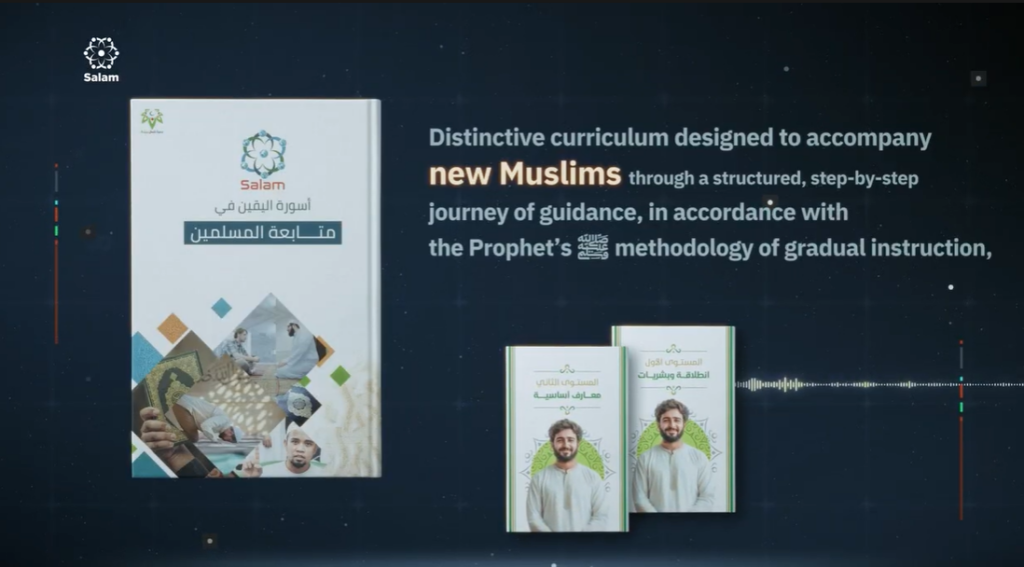
For new Muslims ready for a structured learning journey, the Asawirat Al-Yaqeen (Bracelets of Certainty) program offers a compassionate, step-by-step path toward firm faith:
- Stage One — The Foundation: The meaning of the Shahada, essential acts of worship, and the pillars of Islam and Iman
- Stage Two — The Construction Phase: The biography of Prophet Muhammad (PBUH) and sincere repentance
- Stage Three — The Consolidation Phase: Spiritual character, family rulings, and daily life ethics
- Stage Four — The Empowerment Phase: Contemporary questions, theological evidence, and a life roadmap from Surah Al-Asr
The program has reached over 114,000 new Muslims across 140 countries. If you have recently embraced Islam or are considering it, this is your next step: explore the program here.
Reach out directly to the Salam Center team to start the Asawirat Al-Yaqeen (Bracelets of Certainty) program for FREE.
Summary
The Quran contains verses on embryonic development, cosmic origin, the expanding universe, and the structure of mountains — passages that several scientists and scholars have found strikingly consistent with modern discoveries made centuries later.
The Quran guides; it does not compete with science. Where established science and classical tafsir align, Muslims see an ayah — a sign — of the Quran’s divine origin, inviting reflection on the nature of a book that speaks across every era.
Frequently Asked Questions
Does the Quran claim to be a book of science?
No. The Quran does not present itself as a scientific manual — its own words describe it as a book of guidance (huda) for humanity (Quran 2:2). What Muslim scholars observe is that certain verses, accurately interpreted through classical Arabic linguistics and tafsir, describe natural phenomena in ways consistent with scientific findings made over a thousand years later. This harmony is viewed as a sign (ayah) of the Quran’s divine origin, not its scientific purpose.
What does Quran 23:14 say about human development?
Quran 23:14 describes the human embryo passing through stages: a clinging substance (alaqah), a lump-like form (mudghah), then bones, then the bones clothed with flesh. Embryologist Keith Moore of the University of Toronto examined this verse alongside modern embryological data and found the stages described — including cartilage formation before muscle development — consistent with scientific findings. The passage has been a central focus in academic and Islamic discussions of Quranic scientific accuracy.
What does Quran say about the universe?
Quran 51:47 states: “And the heaven We constructed with strength, and indeed, We are [its] expander” — using the Arabic active participle mūsi’ūn, which indicates an ongoing process of expansion. Classical scholars understood this primarily as a declaration of Allah’s infinite creative power. Contemporary scholars additionally note a parallel with the 20th-century scientific discovery that the universe is continuously expanding — a finding first documented by Edwin Hubble in 1927, approximately 1,300 years after the Quran’s revelation.
Are there Nobel scientists who have expressed belief in a Creator?
Yes — numerous Nobel laureates in physics, chemistry, and medicine have expressed personal belief in a Creator or have described the ordered complexity of the universe as pointing toward an intelligent origin. For a detailed discussion of this, the Salam platform covers scientists who believe in God and Nobel scientists who believe in God in dedicated articles, drawing on verifiable biographical and interview sources.
Curious about Islam?
Journey towards clarity and purpose. Our team is here to support you in your search for truth and spiritual guidance.
Embrace the Truth