
Contradictions in the Quran Explained
| Key Takeaways |
| Every alleged contradiction in the Quran dissolves under careful analysis of Arabic linguistic context and classical Islamic scholarly interpretation. |
| The six-day creation narrative contains no numerical error — the four days mentioned in Surah Fussilat are inclusive of the first two, not additional to them. |
| Differences in descriptions of the same Quranic event often reflect different occasions, different aspects, or different emphases — not inconsistency. |
| Apparent differences in the length of “a day” before Allah reflect distinct categories of time in distinct contexts, all perfectly coherent. |
| The Quran’s consistent internal logic over 23 years of revelation — in a society that desperately sought contradictions — is itself evidence of its divine origin. |
There is a recurring claim, circulated widely online and in certain polemical literature, that the Quran contradicts itself. Those who raise this claim typically cite a handful of verses in isolation, stripped of their Arabic linguistic context, their occasions of revelation, and the interpretive framework that classical Islamic scholarship has always applied to them.
The truth — established by over fourteen centuries of rigorous scholarly tradition — is that not a single genuine logical contradiction exists in the Quran. Every alleged inconsistency either dissolves when the Arabic is properly understood, or when the verse is read in its complete context rather than artificially fragmented.
This article addresses the most cited allegations one by one, the goal is not to be defensive — the Quran needs no defense — but to equip sincere seekers and new Muslims with clear, evidence-based answers.
Are There Real Contradictions in the Quran?
No credible logical contradiction exists in the Quran. Every alleged inconsistency dissolves when examined through classical Arabic grammar, the full context of the verse, and the interpretive methodology of Muslim scholars.
The Quran’s Internal Coherence as Evidence of Its Divine Origin
Every alleged contradiction in the Quran, when examined through the lens of classical Arabic scholarship and the interpretive methodology of Muslim scholars, dissolves into either a linguistic misunderstanding, a contextual misreading, or a confusion between different subjects. This pattern is itself significant.
The Prophet Muhammad (PBUH) received the Quran over 23 years, across varying circumstances — periods of peace and war, in Makkah and Madinah — and the early Arabs who heard it were perhaps the most linguistically acute audience any book has ever faced.
They were hostile, motivated, and masters of Arabic. They found no genuine contradiction. As recorded in the books of Seerah and confirmed in the Quran itself:
أَفَلَا يَتَدَبَّرُونَ الْقُرْآنَ ۚ وَلَوْ كَانَ مِنْ عِندِ غَيْرِ اللَّهِ لَوَجَدُوا فِيهِ اخْتِلَافًا كَثِيرًا
“Then do they not reflect upon the Quran? If it had been from [any] other than Allah, they would have found within it much contradiction.” (Quran 4:82)
This verse does not merely claim absence of contradiction — it issues an open challenge to find it, to any person, across all time.
Fourteen centuries of hostile scrutiny have not produced a genuine logical contradiction. They have produced misreadings, which patient scholarship has answered every time.
For a deeper exploration of the Quran’s preservation and history, see the history of the Quran and what Muslims believe about the Quran.
1. Did Allah Create the Heavens and Earth in Six or Eight Days?
This is the most frequently cited numerical objection. The claim runs: Surah Fussilat (41:9–12) mentions two days for the Earth, four days for its provisions, and two days for the heavens — totalling eight — while other verses state six.
The answer lies in a basic principle of Arabic expression. The four days mentioned in the verse are inclusive, not additional. Allah (SWT) says:
قُلْ أَئِنَّكُمْ لَتَكْفُرُونَ بِالَّذِي خَلَقَ الْأَرْضَ فِي يَوْمَيْنِ… وَجَعَلَ فِيهَا رَوَاسِيَ مِن فَوْقِهَا وَبَارَكَ فِيهَا وَقَدَّرَ فِيهَا أَقْوَاتَهَا فِي أَرْبَعَةِ أَيَّامٍ
“Say, ‘Do you indeed disbelieve in He who created the earth in two days… And He placed on it firmly set mountains over its surface, and He blessed it and determined therein its sustenance in four days.'” (Quran 41:9–10)
The phrase “in four days” refers to the cumulative total of the first two days plus two additional days for provisions and mountains — not four new, independent days.
This is a well-attested Arabic rhetorical pattern, similar to saying:
“I travelled to London in two days, then completed the trip to New York in four days”
— where the four includes the original two.
Adding the two days for the heavens: 4 + 2 = 6 days total — perfectly consistent with the repeated Quranic statement that Allah created the heavens and Earth in six days (see Quran 7:54).
There is no numerical contradiction — only a misreading of Arabic inclusive counting.
2. Is a Day Before Allah Equal to One Thousand or Fifty Thousand Years?
Two verses appear to conflict:
وَإِنَّ يَوْمًا عِندَ رَبِّكَ كَأَلْفِ سَنَةٍ مِّمَّا تَعُدُّونَ
“And indeed, a day with your Lord is like a thousand years of those which you count.” (Quran 22:47)
تَعْرُجُ الْمَلَائِكَةُ وَالرُّوحُ إِلَيْهِ فِي يَوْمٍ كَانَ مِقْدَارُهُ خَمْسِينَ أَلْفَ سَنَةٍ
“The angels and the Spirit will ascend to Him during a day the extent of which is fifty thousand years.” (Quran 70:4)
These two verses are describing two entirely different types of days. The “thousand-year day” in Surah al-Hajj may refer to the days of creation — the cosmic scale at which Allah’s creative acts unfold, with each such day spanning what humans would count as a thousand years.
The “fifty-thousand-year day” in Surah al-Ma’arij refers specifically to the Day of Judgment — a distinct, singular, eschatological event whose enormity for the disbelievers makes it feel incalculably long.
Just as days differ in duration across different planets and contexts even in human scientific understanding, different categories of divine time differ in the Quran’s framework. There is no contradiction — there are simply different categories of days, each precisely identified by its context.
Learn More About Islam
Discover the beauty, teachings, and wisdom of Islam in a clear and welcoming way. Start exploring and deepen your understanding today.
Learn More3. Did Nuh’s (AS) Son Drown While Allah Said His Family Was Saved?
Surah al-Anbiya (21:76) states that Allah saved Nuh and his family. Surah Hud (11:43–46) states that one of his sons drowned. Do these contradict each other? They do not, because the word “family” (ahl) in the Quran is contextually qualified. When Allah commanded Nuh (AS) to board the ark, He explicitly said:
وَأَهْلَكَ إِلَّا مَن سَبَقَ عَلَيْهِ الْقَوْلُ وَمَنْ آمَنَ
“And [take] your family, except those about whom the word has previously come, and whoever has believed.” (Quran 11:40)
The exception was explicit from the outset: those about whom the divine decree of destruction had already been issued were excluded from “family.” When Nuh (AS) interceded for his son after the flood, Allah (SWT) corrected him directly:
يَا نُوحُ إِنَّهُ لَيْسَ مِنْ أَهْلِكَ ۖ إِنَّهُ عَمَلٌ غَيْرُ صَالِحٍ
“O Nuh, indeed he is not of your family; indeed, he is [one whose] work was other than righteous.” (Quran 11:46)
The Quran itself defines “family” in this context as the believing members of his household. The son who drowned was not — by Quranic definition — counted among them. The two passages are in complete harmony.
Classical scholars including Imam Ibn Kathir and Imam al-Qurtubi affirm this unanimously.
4. Did Allah Reveal the Quran Directly, or Through Jibreel (AS)?
The allegation here is that Surah al-Najm (53:6–15) implies direct divine revelation, while Surah al-Nahl (16:102) attributes the revelation to “the Holy Spirit,” and Surah al-Baqarah (2:97) attributes it to Jibreel (AS) specifically. Are these different entities? Is this a contradiction? No. These are three descriptions of the same reality, seen from three angles.
The being described in Surah al-Najm as descending to the Prophet (PBUH) — with six hundred wings, appearing on the upper horizon — is Jibreel (AS) himself, confirmed by the Hadith narrated by Sayyidah Aisha (RA) in both Sahih al-Bukhari and Sahih Muslim.
The Prophet (PBUH) saw Jibreel in his true angelic form twice: once at the beginning of revelation in Makkah, and once during the Night Journey (Isra wal-Mi’raj). This is established fact, not interpretation.
The title “Ruh al-Quds” (Spirit of Holiness / Holy Spirit) in Surah al-Nahl is a divine title given to Jibreel (AS). As Allah (SWT) says:
قُلْ نَزَّلَهُ رُوحُ الْقُدُسِ مِن رَّبِّكَ بِالْحَقِّ
“Say, ‘The Pure Spirit has brought it down from your Lord in truth.'” (Quran 16:102)
He is called “Ruh” (spirit) because he descends with that which revives the dead hearts — the divine revelation. He is “al-Quds” (the holy) because Allah has sanctified and elevated him above all deception or falsehood. And Surah al-Baqarah (2:97) explicitly names him by his personal name:
قُلْ مَن كَانَ عَدُوًّا لِّجِبْرِيلَ فَإِنَّهُ نَزَّلَهُ عَلَىٰ قَلْبِكَ بِإِذْنِ اللَّهِ
“Say, ‘Whoever is an enemy to Jibreel — it is [none but] he who has brought it [the Quran] down upon your heart by permission of Allah.'” (Quran 2:97)
One angel, three descriptions. The Quran’s coherence here is not a flaw — it is a literary and doctrinal strength. For more on this, see what Muslims believe about the Quran.
5. Was Man Created From Clay, Water, or a Sperm-Drop?
The Quran mentions all three: clay (tin), water (ma’), and a sperm-drop (nutfah). This is not contradiction — it is a comprehensive account of human creation across three distinct phases.
Adam (AS) was the first human, created by Allah directly from clay — specifically from dried, sounding clay (salsal) fashioned after passing through stages of wet earth, then fermenting mud, then dried form.
Then Allah breathed into him the divine spirit, and he became a living human being. This is the unique, direct, sovereign creation.
Hawwa (Eve) was created from Adam himself — from one of his ribs, as affirmed in the authenticated Hadith narrated in Sahih al-Bukhari and Sahih Muslim.
Isa (AS) was created in Maryam’s (AS) womb without a father, by divine command. And every other human being since then has been created through the union of male and female gametes — a sperm-drop (nutfah) — as described extensively in Surah al-Insan and Surah al-Mu’minun.
Allah (SWT) says:
إِنَّ مَثَلَ عِيسَىٰ عِندَ اللَّهِ كَمَثَلِ آدَمَ ۖ خَلَقَهُ مِن تُرَابٍ ثُمَّ قَالَ لَهُ كُن فَيَكُونُ
“Indeed, the example of Jesus to Allah is like that of Adam. He created him from dust; then He said to him, ‘Be,’ and he was.” (Quran 3:59)
Each description is accurate for its specific subject. The Quran’s multiple descriptions of human origins demonstrate divine power across different modes of creation — not contradiction.
This diversity is itself a theological statement: Allah creates what He wills, from what He wills, by whatever means He wills, and no single formula of origin constrains Him.
6. How Can Musa (AS) and the Sorcerers Both Claim to Be “the First Believers”?
Surah al-A’raf (7:143) records Musa (AS) saying: “…and I am the first of the believers.” Surah al-Shu’ara (26:51) records the sorcerers of Pharaoh, after their conversion, saying: “…that we may be the first of the believers.” And in Surah al-An’am (6:163), the Prophet Muhammad (PBUH) says: “…and I am the first of the Muslims.”
Were there no believers before each of them? Is the Quran contradicting historical sequence? No — each statement is contextually limited to a specific group, occasion, or domain.
When Musa (AS) said
“I am the first of the believers,”
he had just witnessed the Mount Tur shaking and collapsed in awe. His declaration was specific:
“I am the first to affirm that no one can see You in this worldly life without dying.”
This was a new experiential knowledge, not a claim of being first in absolute faith across all history.
When the sorcerers of Pharaoh declared themselves “the first of the believers,” they meant: “the first of the people of Egypt, from among the Copts, to believe in Musa.” They had just witnessed the miraculous power of Allah’s truth through the staff of Musa (AS).
When the Prophet (PBUH) said “I am the first of the Muslims,” he was speaking in the context of the community of Makkah — meaning the first of his own people to surrender to Allah in this final message.
Classical scholars explain this linguistic principle: the phrase “first of X” in Arabic is always understood as contextually limited — by community, by event, or by the specific knowledge or experience in question — unless the context explicitly makes it universal. There is no contradiction.
7. Does “Swearing By This City” Contradict “I Do Not Swear By This City”?
Surah al-Balad (90:1) opens: لَا أُقْسِمُ بِهَٰذَا الْبَلَدِ which literally means “I do not swear by this city.” Surah al-Tin (95:3) mentions وَهَٰذَا الْبَلَدِ الْأَمِينِ — “and this trustworthy city” — in the context of a divine oath. Does this mean Allah swears by Makkah in one place and declines to swear by it in another? No — because “lā” (لا) in Surah al-Balad is a well-established particle in classical Arabic used for emphasis, not negation.
This usage is called “lā al-za’ida” — the supplementary or rhetorical “lā” — which intensifies the following statement rather than negating it. Grammarians and classical mufassirun are unanimous on this.
The consensus of the Mufassirun is that the verse means:
“I swear by this city.” The “lā” is not negating the oath — it is a rhetorical device familiar to every competent speaker of classical Arabic.
This is not an obscure linguistic argument. The same construction appears in classical Arabic poetry, as in the line:
“The heart almost split open” — where “lā” before “split” intensifies the near-happening, not denies it.
The Quran swears by Makkah in both verses. The only “contradiction” lies in reading classical Arabic with the grammatical assumptions of a different language. No genuine tension exists.
8. Was the Earth Created Before or After the Heavens?
Surah al-Baqarah (2:29) and Surah Fussilat (41:9–12) describe the creation of the Earth before the heavens. Surah al-Nazi’at (79:27–30) mentions the heavens, then says: وَالْأَرْضَ بَعْدَ ذَٰلِكَ دَحَاهَا — “And after that He spread out (dahaha) the earth.” Does “after that” in Surah al-Nazi’at reverse the sequence? No — because daha does not mean “created.” It means “spread out” or “expanded.” This is a crucial distinction in Arabic, and it is the key to the entire alleged contradiction.
The sequence is as follows: Allah created the Earth first in its basic form (two days), then created and arranged the heavens (two days), then spread out and furnished the Earth — extracting water, pasture, fixing mountains, making it habitable — in two further days. This spreading-out (daha) came after the heavens were arranged.
Surah al-Nazi’at is thus speaking about the spreading and preparation of the Earth, which occurred after the completion of the heavens — not about its initial creation. The sequences in all three surahs are consistent when the precise Arabic vocabulary is respected.
9. How Can the Quran Be Preserved While Allah “Erases What He Wills”?
Three sets of verses are cited here:
Surah al-Hijr (15:9):
إِنَّا نَحْنُ نَزَّلْنَا الذِّكْرَ وَإِنَّا لَهُ لَحَافِظُونَ — “Indeed, it is We who sent down the Quran, and indeed, We will be its guardian.” (Quran 15:9)
Surah al-Ra’d (13:39):
يَمْحُو اللَّهُ مَا يَشَاءُ وَيُثْبِتُ — “Allah eliminates what He wills or confirms.” (Quran 13:39)
And related verses on abrogation (naskh) and the replacement of one verse with another (Surah al-Nahl 16:101).
These verses are addressing three completely separate domains and no single one cancels another.
Surah al-Hijr is a divine guarantee: the Quran as a revealed text will be preserved in its integrity until the Day of Judgment. History validates this — the Quran remains letter-perfect across fourteen centuries, across all continents, in a way that no other ancient text has been preserved. This is an observable, historical fact, and it stands as one of the internal evidences for why Muslims believe in the Quran.
Surah al-Ra’d speaks of Allah’s absolute sovereignty over all affairs — over life, death, provision, destiny — that no created being constrains. This has nothing to do with the textual preservation of the Quran. It is a statement about divine omnipotence in the governance of existence.
The abrogation verses in Surah al-Nahl address the divine right to abrogate — to lift or replace — legal rulings across different revelations over time, always with something equal or better. This is a theological principle, not textual tampering.
Three statements, three domains: textual preservation, divine sovereignty, and legislative evolution across revelation. Each operates independently. There is no overlap, and therefore no contradiction.
10. How Can Moses’ Staff Be a “Huge Serpent” and a “Slender Snake” at the Same Time?
Surah al-A’raf (7:107) describes the staff of Musa (AS) turning into thu’ban mubeen — a great, manifest serpent. Surah al-Naml (27:10) and Surah al-Qasas (28:31) describe it moving ka’annaha jan — as though it were a small, swift serpent. Are these contradictory descriptions of the same event? No — they are describing two separate events, and even if they were the same event, the descriptions target different attributes, not incompatible ones.
The initial encounter with the staff, when Allah first revealed the miracle to Musa (AS) at the burning bush before he confronted Pharaoh, is where the “swift, slender movement” is described — Musa (AS) fled in fear at its speed and agility.
The public confrontation before Pharaoh and his court, where the staff devoured the sorcerers’ illusions, is where the “great serpent” description applies — emphasizing its enormous, awe-inspiring size.
Two occasions, two emphases. Even in a single miracle, size and speed are not mutually exclusive attributes. A creature can be large in body and swift in movement simultaneously.
11. Does Prohibiting Wine on Earth Contradict Rivers of Wine in Paradise?
Surah al-Ma’idah (5:90) forbids wine (khamr) in this life. Surah Muhammad (47:15) describes rivers of wine in Paradise that are a delight to those who drink them. The claim: the Quran contradicts itself by forbidding and permitting the same thing.
This is perhaps the easiest of all alleged contradictions to answer, because the Quran explicitly distinguishes between the two contexts.
Wine is forbidden in this world because of its real, tangible harms — it impairs the mind, destroys families, corrupts judgment, and leads to every manner of sin.
This prohibition is a mercy to humanity and is grounded in the Islamic principle of preserving the intellect (hifz al-‘aql), one of the five essential objectives of Islamic law as articulated by Imam al-Ghazali and codified in the tradition of Islamic jurisprudence.
The wine of Paradise is a categorically different substance. It produces no intoxication, no headache, no loss of reason:
لَا فِيهَا غَوْلٌ وَلَا هُمْ عَنْهَا يُنزَفُونَ
“No bad effect is there in it, nor from it will they be intoxicated.” (Quran 37:47)
It shares only the name “wine” — as an analogy to the most pleasurable drink humanity has known — but it shares none of its harmful properties. A prohibition applies to a harmful thing; a promise of Paradise applies to something entirely different in nature.
This is not contradiction — it is the same logic by which a physician might forbid a patient from salty foods in this life while promising them a feast without restrictions in a context of perfect health. Two different things, two different rulings, in two different realms.
12. Does “All Intercession Belongs to Allah” Contradict Verses Affirming Intercession?
Surah al-Zumar (39:44) states: قُل لِّلَّهِ الشَّفَاعَةُ جَمِيعًا — “Say, ‘To Allah belongs [all] intercession entirely.'” (Quran 39:44) Surah Yunus (10:3) says: مَا مِن شَفِيعٍ إِلَّا مِن بَعْدِ إِذْنِهِ — “There is no intercessor except after His permission.” (Quran 10:3) The alleged contradiction: one verse says only Allah intercedes, another says others can intercede. There is no contradiction because the two statements are describing the same reality from two complementary angles.
Surah al-Zumar was revealed in the context of refuting the polytheistic belief that idols and intermediaries possessed independent intercessory power before Allah (SWT). The point is: no created being has any intercession of its own — intercession belongs exclusively to Allah in origin and authority.
Surah Yunus then explains how that authority operates: when Allah wills, He grants certain servants — prophets, martyrs, righteous believers — the permission to intercede for others on the Day of Judgment. This intercession is not independent; it is derivative, conditional, and entirely at Allah’s discretion.
The Prophet Muhammad (PBUH) said, as narrated in Sahih al-Bukhari:
“I will intercede and it will be said: O Muhammad, admit into Paradise those of your Ummah who have no reckoning.”
This Hadith confirms that prophetic intercession is real — but it is exercised only by divine permission. Owned by Allah, permitted to His servants at His will — this is the complete, harmonious picture. There is no contradiction; there are two sides of the same truth.
Read Also: Does the Quran Say the Earth Is Flat or Round?
13. Does Abrogation Mean the Quran Is Unreliable?
Some raise Surah al-Nahl (16:101) — where Allah mentions replacing one verse with another — as evidence that the Quran is internally inconsistent or unreliable. Abrogation (naskh) is not contradiction — it is legislative evolution under a single sovereign authority.
When a physician changes a patient’s prescription as the illness progresses, that is not inconsistency — it is wisdom. Allah (SWT) revealed the Quran over 23 years, progressively addressing the evolving needs of the nascent Muslim community: first establishing creed, then gradually introducing rulings in stages that human nature could absorb.
The abrogation system in the Quran is rigorously documented. Scholars catalogued every instance of abrogation with complete chains of narration. Later rulings in areas like the prohibition of wine, the direction of prayer (qibla), and certain martial regulations refined or replaced earlier rulings — always by Allah’s explicit command, always preserved transparently in the text. The Quran did not hide its abrogated verses — it preserved them as a record of how divine guidance unfolded in real human history.
Contradiction requires two simultaneous, irreconcilable claims. Abrogation is a successive replacement, explicitly acknowledged and documented. These are not the same thing.
Read Also: The Quran and Modern Science
Learn More About Islam
Discover the beauty, teachings, and wisdom of Islam in a clear and welcoming way. Start exploring and deepen your understanding today.
Learn MoreRead Also: Embryology in the Quran
Connect With the Salam Center
If this article has opened questions for you — about the Quran, about Islam, about faith, or about your own search for truth — the Salam Center for Da’wah and Dialogue exists precisely for you.
Explore the Salam Platform for hundreds of articles addressing questions about faith in Islam, the nature of Allah, Islam and other religions, and much more.
Browse the Salam blog for a full library of da’wah and educational content.
Reach out directly for personalized guidance, specific questions, or to begin your journey.

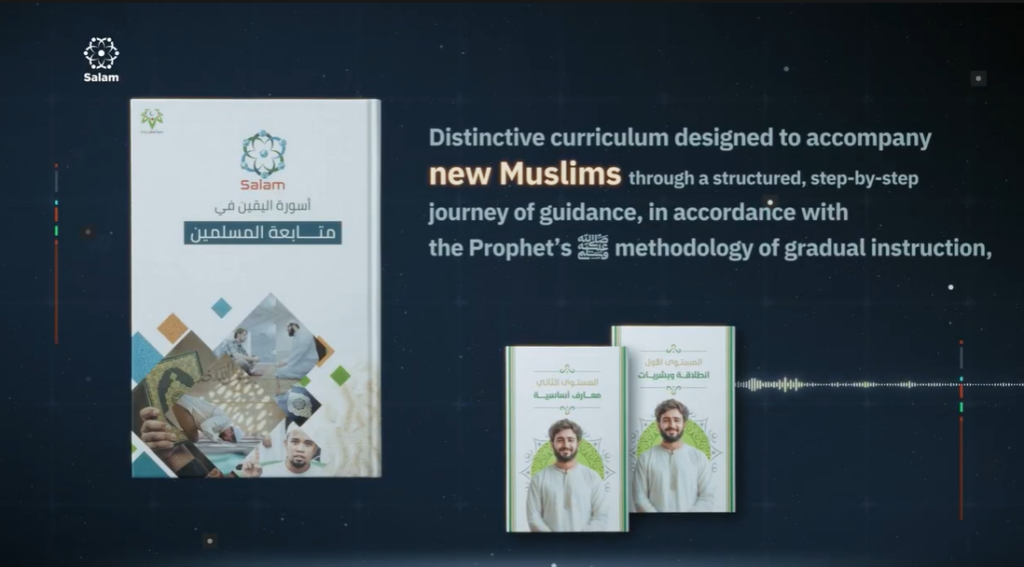
If you have recently taken your Shahada, or are seriously considering Islam, we warmly invite you to join the Asawirat Al-Yaqeen (Bracelets of Certainty) program — the Salam Center‘s structured, four-stage educational curriculum for new Muslims, which has already guided over 114,000 new Muslims across 140 countries. The program covers:
- Stage One: The Foundation — pillars, purification, prayer, and the meaning of the Shahada
- Stage Two: The Construction Phase — pillars of faith, zakat, fasting, and the life of the Prophet (PBUH)
- Stage Three: The Consolidation Phase — ethics, repentance, rulings for daily life
- Stage Four: The Empowerment Phase — contemporary issues, theological evidences, and your roadmap as a Muslim
The Salam Center team is here for every step.
Reach out directly to the Salam Center team to start the Asawirat Al-Yaqeen (Bracelets of Certainty) program for FREE.
Summary
Alleged contradictions in the Quran arise almost exclusively from reading Arabic verses through non-Arabic linguistic assumptions, stripping verses from their context, or conflating separate events and categories. Every specific allegation examined above — from creation timelines to descriptions of divine days to the nature of intercession — resolves completely when classical Arabic grammar and scholarly interpretation are applied.
The Quran’s 23-year revelation before the most linguistically skilled and adversarial audience in history, its preservation in letter-perfect form across fourteen centuries, and its own challenge to humanity to find genuine contradictions within it, remain among the most compelling internal evidences of its divine origin.
Frequently Asked Questions
Does the Quran say the Earth was created before or after the heavens?
The Earth was created first in its basic form, then the heavens were created, then the Earth was spread out and prepared. The word “dahaha” in Surah al-Nazi’at means “spread out” — not “created.” Classical scholars, including Imam Ibn Kathir, confirm this sequence resolves every apparent discrepancy between the relevant verses.
Why does the Quran mention different lengths for “a day” before Allah?
Different verses describe categorically different types of days. The “thousand-year day” refers to the days of creation. The “fifty-thousand-year day” refers specifically to the Day of Judgment. These are distinct Quranic categories — not competing measurements of the same unit of time.
Does abrogation (naskh) in the Quran prove it is unreliable or contradictory?
Abrogation is legislative progression, not contradiction. Allah (SWT) revealed rulings in stages suited to the evolving needs of the early Muslim community. Later rulings replacing earlier ones — always by divine command, always transparently preserved in the text — reflect wisdom and mercy, not inconsistency.
Curious about Islam?
Journey towards clarity and purpose. Our team is here to support you in your search for truth and spiritual guidance.
Embrace the Truth