
Are Adam and Eve in the Quran?
| Key Takeaways |
| Adam and Eve are indeed mentioned in the Quran, where their story is presented as a foundational truth about human origin and the nature of free will. |
| The Quran refers to Adam by name 25 times, establishing him as the first human being and the first prophet sent by Allah. |
| Unlike the Biblical account, Islam does not place the primary blame for the Fall on Eve; both Adam and his wife share equal moral responsibility for their act of disobedience. |
| The Islamic narrative of Adam and Eve concludes with sincere repentance accepted by Allah, making the story ultimately one of mercy and spiritual renewal. |
| The story of Adam in the Quran addresses core theological questions: the purpose of human creation, the reality of the Devil (Iblis), and the meaning of vicegerency on earth. |
Yes — Adam and Eve are in the Quran, and their story is told with remarkable depth across multiple chapters. The Quran presents their account as a living theological lesson about who human beings are, why they were created, and how they relate to Allah.
From Adam’s creation from clay to the couple’s departure from Paradise and their subsequent repentance, every element of the Quranic narrative carries spiritual meaning that scholars of faith in Islam have drawn from for centuries.
What you find in the Quran is a coherent, purposeful telling of humanity’s origin — one that reshapes how a reader understands sin, mercy, and the dignity of the human being.
Are Adam and Eve in the Quran?
Yes, Adam and his wife are mentioned in the Quran explicitly and repeatedly. Adam appears by name twenty-five times across the Quranic text. His wife, referred to as Adam’s zawj (spouse or mate), is described but not named in the Quran itself; the name Hawwa (Eve) comes to us from authenticated narrations of the Prophet Muhammad (PBUH) and the classical exegetical tradition.
The story of Adam and Eve in the Quran unfolds across several surahs (chapters), most prominently Surah Al-Baqarah (Chapter 2), Surah Al-A’raf (Chapter 7), Surah Al-Hijr (Chapter 15), Surah Ta-Ha (Chapter 20), and Surah Sad (Chapter 38). Each telling illuminates a different dimension of the same event.
1. The Creation of Adam and the Divine Command to the Angels
The Quranic account begins before the earth itself. Allah announces to the angels His intention to place a vicegerent (khalifah) on the earth:
وَإِذْ قَالَ رَبُّكَ لِلْمَلَائِكَةِ إِنِّي جَاعِلٌ فِي الْأَرْضِ خَلِيفَةً
“And [mention, O Muhammad], when your Lord said to the angels, ‘Indeed, I will make upon the earth a successive authority.'” (Quran 2:30)
The angels, bewildered, asked whether Allah would place upon the earth one who would cause corruption and shed blood. Allah’s response was sublime in its certainty:
“Indeed, I know that which you do not know.” (Quran 2:30)
Allah then created Adam from clay. Allah fashioned Adam with His own hands and then breathed His spirit into him. When Allah commanded the angels to prostrate before Adam, all of them obeyed. All, except one.
Learn More About Islam
Discover the beauty, teachings, and wisdom of Islam in a clear and welcoming way. Start exploring and deepen your understanding today.
Learn More2. Iblis and the Origin of Arrogance
Iblis — a being from the jinn who had ascended through his worship to the company of the angels — refused. His reasoning was rooted in arrogance: he considered himself superior because he was made from fire while Adam was made from clay.
قَالَ أَنَا خَيْرٌ مِّنْهُ خَلَقْتَنِي مِن نَّارٍ وَخَلَقْتَهُ مِن طِينٍ
“He said, ‘I am better than him. You created me from fire and created him from clay.'” (Quran 38:76)
This moment — the first act of disobedience in creation — established the eternal enmity between Iblis and the children of Adam. Iblis vowed to misguide humanity.
Understanding this context is essential for understanding the Islamic view of the nature of Allah and why human beings were given free will in the first place.
3. Adam and Eve in Paradise and the Forbidden Tree
Allah placed Adam and his wife in Paradise and granted them complete freedom within it — with one exception. They were forbidden from approaching a specific tree:
وَقُلْنَا يَا آدَمُ اسْكُنْ أَنتَ وَزَوْجُكَ الْجَنَّةَ وَكُلَا مِنْهَا رَغَدًا حَيْثُ شِئْتُمَا وَلَا تَقْرَبَا هَٰذِهِ الشَّجَرَةَ فَتَكُونَا مِنَ الظَّالِمِينَ
“And We said, ‘O Adam, dwell, you and your wife, in Paradise and eat therefrom in [ease and] abundance from wherever you will. But do not approach this tree, lest you be among the wrongdoers.'” (Quran 2:35)
Iblis seized his opportunity. He whispered to the couple, swearing falsely by Allah that the tree would grant them eternal life or make them like the angels. They were deceived. Both ate from the tree, and both — equally — bore the consequence.
The Quran is explicit about their joint responsibility:
“And Adam disobeyed his Lord and erred.” (Quran 20:121). This is a critical point.
The Quranic narrative does not single out the woman as the primary cause of the Fall. Both spouses made the choice together, and both were held to account by Allah — a theological position that stands in clear distinction from certain interpretations found in earlier scriptural traditions.
4. The Heart of the Story of Adam and Eve in the Quran is Repentance and Mercy
What elevates the Quranic account beyond a simple cautionary tale is what happens next. Adam and his wife did not despair. They turned back to Allah in sincere repentance:
قَالَا رَبَّنَا ظَلَمْنَا أَنفُسَنَا وَإِن لَّمْ تَغْفِرْ لَنَا وَتَرْحَمْنَا لَنَكُونَنَّ مِنَ الْخَاسِرِينَ
“They said, ‘Our Lord, we have wronged ourselves, and if You do not forgive us and have mercy upon us, we will surely be among the losers.'” (Quran 7:23)
Allah accepted their repentance. The Quran records this in one of the most moving declarations of divine mercy:
فَتَلَقَّىٰ آدَمُ مِن رَّبِّهِ كَلِمَاتٍ فَتَابَ عَلَيْهِ ۚ إِنَّهُ هُوَ التَّوَّابُ الرَّحِيمُ
“Then Adam received from his Lord [some] words, and He accepted his repentance. Indeed, it is He who is the Accepting of repentance, the Merciful.” (Quran 2:37)
Adam’s story is fundamentally a story of divine mercy — that Allah intended, even through this trial, to demonstrate to all of creation the reality of repentance and His infinite capacity to forgive.
5. Adam is the First Prophet in Islam
Islamic theology holds that Adam (peace be upon him) was not merely the first human being — he was the first prophet.
The Islamic scholarly consensus confirms that Adam’s prophethood is established by authentic evidence and is part of the creed of Muslims. Adam received divine guidance and passed it to his children — making his story the opening chapter of a long chain of prophethood that culminated with the Prophet Muhammad (PBUH).
This prophetic dimension is entirely absent in secular or purely anthropological readings of the Adam and Eve story.
Read Also: Is Abraham in the Quran?
6. What the Story of Adam Reveals About Human Nature in Islam
The Quranic account of Adam and Eve answers a question that every thinking person eventually asks: why do human beings struggle, err, and suffer? Islam’s answer is purposeful.
Human beings were not created as fallen creatures permanently stained by original sin — a concept that Islam explicitly rejects.
Every child is born in a state of fitrah (natural purity). The sin of Adam was forgiven. Its consequences — life on earth, toil, and mortality — are not punishments in the sense of eternal condemnation, but rather the conditions of the test that was always intended.
The Islamic view of God in Islam frames Allah as a Lord who knows human weakness and does not abandon His creation to it.
Adam and his wife’s expulsion from Paradise was not exile into meaninglessness; it was the beginning of humanity’s purposeful journey on earth, guided by prophets, culminating in accountability and, for those who believe and repent, a return to a Paradise far greater than the one they left.
Read Also: Is Moses in the Quran?
Learn More About Islam
Discover the beauty, teachings, and wisdom of Islam in a clear and welcoming way. Start exploring and deepen your understanding today.
Learn MoreRead Also: What Does the Quran Teach?
Explore Further Authentic Knowledge About Islam with Salam
If this article opened a door you want to walk through, we welcome you.
Explore more on the Salam Platform — a library of articles, answers, and resources designed for sincere seekers and new Muslims.
Read more on the Salam Blog — where Islamic knowledge is presented clearly, honestly, and with care.
Have a question? Reach out directly — whether you want to understand something about Islam, clarify a misconception, or simply talk to someone knowledgeable and compassionate.

Thinking about embracing Islam? We are here for you — every step of the way.
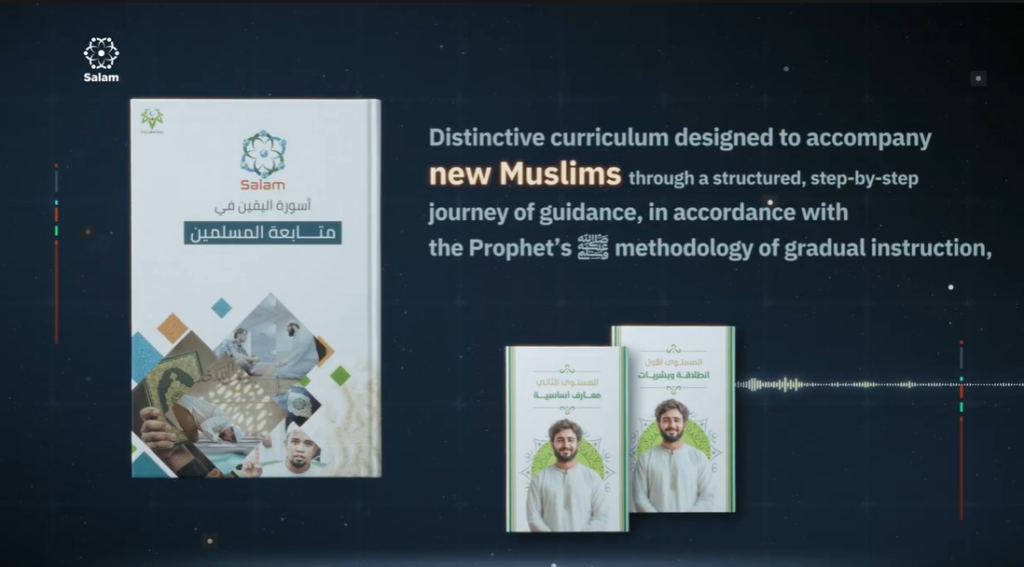
Already a new Muslim? Consider joining the Asawirat Al-Yaqeen (Bracelets of Certainty) program — the Salam Center‘s structured post-conversion curriculum designed to guide you through your new faith with confidence and clarity. The program offers:
- A four-stage educational journey built on the methodology of the Salam Center for Da’wah and Dialogue
- Progressive levels covering creed, worship, biography of the Prophet (PBUH), ethics, and practical life rulings
- A compassionate learning environment that meets you where you are
- Completion already achieved by over 114,000 new Muslims across 140 countries
- Professionally designed lessons built to sustain focus and nurture lasting faith
The Salam Center team is ready to support you. Reach out and begin.
Reach out directly to the Salam Center team to start the Asawirat Al-Yaqeen (Bracelets of Certainty) program for FREE.
Summary
Adam and Eve appear in the Quran across multiple chapters, with Adam named twenty-five times as humanity’s first parent and first prophet. Their story establishes foundational Islamic truths: human beings are dignified creations of Allah, responsible for their choices, and always within reach of divine forgiveness through sincere repentance.
The Quranic account sets Islam apart from other readings of this narrative by placing equal moral responsibility on both spouses, rejecting the doctrine of original sin, and ending with Allah’s complete acceptance of Adam’s repentance — a mercy that extends to every one of his descendants who turns back to their Lord.
Frequently Asked Questions
Is the name Eve (Hawwa) mentioned in the Quran?
The Quran refers to Adam’s wife as his zawj (spouse) without naming her. The name Hawwa (Eve) comes from prophetic narrations and the classical Islamic scholarly tradition. Her unnamed presence in the Quran does not diminish her significance; she is an equal participant in the entire narrative.
Does Islam blame Eve for the Fall the way some traditions do?
Islam does not place primary blame on Eve. The Quran explicitly states that both Adam and his wife were deceived by Iblis and both ate from the forbidden tree. Adam is even mentioned by name when the Quran assigns responsibility: “And Adam disobeyed his Lord and erred” (Quran 20:121), affirming that the account is shared, not gendered.
Did Adam and Eve go to Hell after leaving Paradise?
Adam and Eve were sent to earth — not to Hell — after their disobedience. More significantly, their repentance was accepted by Allah before their departure. The earth was always the intended place of human stewardship. Their time in Paradise was a beginning, not the totality of their purpose, and their story ends with divine forgiveness, not condemnation.
How many times is Adam mentioned in the Quran?
Adam is mentioned by name twenty-five times across the Quranic text, appearing in Surah Al-Baqarah, Surah Al-A’raf, Surah Al-Hijr, Surah Al-Isra, Surah Ta-Ha, Surah Sad, and others. This frequency underscores his centrality to Islamic theology as the first human being and the first prophet.
Curious about Islam?
Journey towards clarity and purpose. Our team is here to support you in your search for truth and spiritual guidance.
Embrace the Truth