Does Islam Think Jesus Is the Messiah? What Muslims Actually Believe
| Key Takeaways |
| Islam affirms that Jesus (peace be upon him) is Al-Masih — the Messiah — a title the Quran uses for him directly and repeatedly. |
| The Islamic understanding of “Messiah” differs from the Christian one: Jesus is honored as a prophet, not as divine or the son of Allah. |
| Muslims believe Jesus was born miraculously of the Virgin Mary, performed real miracles, and was a mighty prophet and messenger of Allah. |
| Islam teaches that Jesus was neither crucified nor killed — Allah raised him to the heavens, and he will return in the final days. |
| Muslims await the second coming of Jesus as a sign of the Last Hour, when he will rule with justice and unite humanity under the truth. |
What makes Islam’s position distinctive is not whether Jesus is the Messiah, but what being the Messiah actually means. The Quran presents Jesus as one of the greatest prophets in human history — born without a father, given the Gospel, granted miraculous powers by Allah’s permission — and yet fully and completely human. A servant of Allah, not a partner in His divinity.
Does Islam Think Jesus Is the Messiah?
Yes, Islam affirms that Jesus (peace be upon him) is the Messiah. The Quran names Jesus Al-Masih in multiple verses across different chapters, and this title is accepted by Muslims as part of the revealed truth about him. In Surah Al-Imran, Allah says:
إِذْ قَالَتِ الْمَلَائِكَةُ يَا مَرْيَمُ إِنَّ اللَّهَ يُبَشِّرُكِ بِكَلِمَةٍ مِّنْهُ اسْمُهُ الْمَسِيحُ عِيسَى ابْنُ مَرْيَمَ
“[And mention] when the angels said, ‘O Mary, indeed Allah gives you good tidings of a word from Him, whose name will be the Messiah, Jesus, the son of Mary.'” (Quran 3:45)
The angels themselves announced his name as Al-Masih before he was even born. This is divine testimony, recorded in revelation, preserved across fourteen centuries.
For Muslims, the question was never whether Jesus is the Messiah — it was always: Messiah in what sense, and for what purpose?
Islam’s answer is clear: Jesus is the Messiah who was sent to the Children of Israel, who called them to the worship of Allah alone, who was raised to the heavens without being killed, and who will return at the end of time to complete his mission in justice and truth.
Read also: How Did Muslims View the People of the Book?
What Do Muslims Believe Will Happen When Jesus Returns?
Muslims await two: the Mahdi — a righteous leader from the household of the Prophet (PBUH) who will fill the earth with justice — and Jesus the Messiah (peace be upon him), who will descend from the heavens to complete his mission.
The Prophet (PBUH) described the relationship between them in a narration recorded in Sahih Muslim (225):
“How will you do when the son of Mary descends and your imam is one of your number?” Jabir reported God’s messenger as saying, “A section of my people will not cease to fight for the truth and prevail till the day of resurrection.” He said that Jesus, son of Mary would then descend and their commander would invite him to come and lead them in prayer, but he would say, “No, you have some put over others as an honour from God to this people.”
Muslims believe Jesus will descend near the white minaret east of Damascus before the Day of Judgment, as described in Sahih Muslim (2937).
Jesus the Messiah will kill the Dajjal — the false messiah — at the gate of Ludd.
Jesus the Messiah will rule with justice, affirm Islam, break the cross as a symbol of corrupted doctrine, and lead a period of righteousness on earth.
His return is one of the major signs of the Last Hour and is affirmed through mass-transmitted narrations from the Prophet Muhammad (PBUH).
The scholar Ibn Kathir, in Al-Bidayah wa’l-Nihayah, dedicates extensive chapters to the narrations surrounding Jesus’s second coming.
Prophet Muhammad (PBUH) described this return in detail:
“”By Him in Whose Hands my soul is, surely (Jesus,) the son of Mary will soon descend amongst you and will judge mankind justly (as a Just Ruler); he will break the Cross and kill the pigs and there will be no Jizya (i.e. taxation taken from non Muslims). Money will be in abundance so that nobody will accept it, and a single prostration to Allah (in prayer) will be better than the whole world and whatever is in it.” Abu Huraira added “If you wish, you can recite (this verse of the Holy Book): — ‘And there is none Of the people of the Scriptures (Jews and Christians) But must believe in him (i.e Jesus as an Apostle of Allah and a human being) Before his death. And on the Day of Judgment He will be a witness Against them.” (4.159)” (Sahih al-Bukhari, Hadith 3448)
The Role of Jesus The Messiah in Islamic Doctrine is Different From Other Doctrines
Ibn al-Qayyim — the 14th-century Islamic scholar and student of Ibn Taymiyyah, whose work Ighathat al-Lahfan remains a landmark in Islamic intellectual tradition — observed that three communities await a figure at the end of time, but they are not waiting for the same one.
Christians await the return of Jesus — but the Jesus of the New Testament, crucified and resurrected, understood as divine.
Jews await their Messiah — whom Islamic texts identify as the Dajjal, the false messiah, the great deceiver that Jesus will slay when he returns.
The distinction is stark. Muslims await the true Messiah — the one who was never killed, never crucified, and who will return to establish justice.
This is why the question “do Muslims believe Jesus is the Messiah” carries such weight: the answer unlocks an entire theological worldview built on the coherence of prophethood, the unity of divine guidance, and the certainty of the Last Day.
Have Questions About Islam?
Our team is ready to answer your questions clearly and respectfully. Ask freely and receive honest guidance.
Ask Us NowWhat Are The Core Islamic Beliefs About Prophet Jesus the Messiah?
Islam affirms Jesus (Al-Masih) as the Messiah and a prophet, not divine. He was miraculously born and performed miracles by Allah’s permission. He was not crucified, but raised alive by Allah. Muslims await his return as a just ruler before the Last Hour.
1. Jesus Was Born of a Virgin Through a Direct Miracle of Allah
The virgin birth of Jesus is affirmed in the Quran with vivid, direct language. Mary — honored in Islam as one of the greatest women ever to live — conceived Jesus without a father, by the command of Allah alone. There was no intermediary, no biological cause — only the divine word “Be.”
قَالَتْ رَبِّ أَنَّىٰ يَكُونُ لِي وَلَدٌ وَلَمْ يَمْسَسْنِي بَشَرٌ ۖ قَالَ كَذَٰلِكِ اللَّهُ يَخْلُقُ مَا يَشَاءُ
“She said, ‘My Lord, how will I have a child when no man has touched me?’ [The angel] said, ‘Such is Allah; He creates what He wills.'” (Quran 3:47)
This miracle does not make Jesus divine — in Islam, the miracle of his birth is a sign of Allah’s absolute power over creation.
The same Allah who created Adam without a father or a mother created Jesus without a father. Both are signs, and both men remain human servants of their Creator.
2. Jesus Is the Word of Allah and a Spirit from Him
The Quran describes Jesus with two remarkable titles: Kalimatullah (a Word from Allah) and Ruhun minhu (a Spirit from Him). These are among the most misunderstood verses in Islamic-Christian dialogue — and they are worth understanding precisely.
إِنَّمَا الْمَسِيحُ عِيسَى ابْنُ مَرْيَمَ رَسُولُ اللَّهِ وَكَلِمَتُهُ أَلْقَاهَا إِلَىٰ مَرْيَمَ وَرُوحٌ مِّنْهُ
“The Messiah, Jesus, the son of Mary, was but a messenger of Allah and His word which He directed to Mary and a soul [created at a command] from Him.” (Quran 4:171)
Islamic scholars explain that “a Word from Allah” refers to the divine command Kun (Be) through which Jesus was created — he came into existence by Allah’s word, not through ordinary human conception.
“A Spirit from Him” denotes that the soul breathed into Jesus came from the source of all souls — Allah — just as every human soul does, though Jesus’s creation was uniquely miraculous.
Neither phrase implies divinity; both affirm the extraordinary nature of his creation within the framework of pure monotheism.
3. Jesus Performed Real Miracles by the Permission of Allah
The Quran records the miracles of Jesus in detail, and Muslims believe in every one of them. He spoke from the cradle as a newborn infant. He formed the shape of a bird from clay and breathed life into it. He healed the blind and the leper. He raised the dead. He knew what people had eaten and what they stored in their homes.
وَأُبْرِئُ الْأَكْمَهَ وَالْأَبْرَصَ وَأُحْيِي الْمَوْتَىٰ بِإِذْنِ اللَّهِ
“And I cure the blind and the leper, and I give life to the dead — by the permission of Allah.” (Quran 3:49)
That phrase — bi-idhni Allah (by the permission of Allah) — appears repeatedly alongside every miracle attributed to Jesus in the Quran. His miracles were real, extraordinary, and divinely granted.
They were signs pointing to Allah, not evidence of Jesus’s own independent divine power.
Every prophet performed miracles befitting his time; the miracles of Jesus were among the most extraordinary of all.
4. Jesus Brought the Gospel and Called to the Worship of Allah Alone
Allah revealed the Injeel (the Gospel) to Jesus as a guide and a light for the Children of Israel. His mission was to confirm what came before him in the Torah, to clarify what had been distorted, and to call his people back to the pure worship of the One Allah. This is the essential message every prophet was sent with — and Jesus was no exception.
وَلَمَّا جَاءَ عِيسَىٰ بِالْبَيِّنَاتِ قَالَ قَدْ جِئْتُكُم بِالْحِكْمَةِ
“And when Jesus brought clear proofs, he said, ‘I have come to you with wisdom.'” (Quran 43:63)
The Quran also records that Jesus foretold the coming of a messenger after him — the Prophet Muhammad (PBUH) — by name, describing him as Ahmad, the one who would confirm and complete the message of all the prophets before him.
This connection between the prophets is one of the core principles of Islam — that all messengers came with one essential message: La ilaha illa Allah — there is no god but Allah.
5. Jesus Was Neither Killed Nor Crucified — Allah Raised Him Alive
This is one of the most significant points of difference between the Islamic and Christian understandings of Jesus — and the Quran addresses it directly and decisively. The crucifixion did not happen as the majority of Christians believe. Allah saved his prophet and messenger from the plot of his enemies.
وَمَا قَتَلُوهُ وَمَا صَلَبُوهُ وَلَٰكِن شُبِّهَ لَهُمْ
“And they did not kill him, nor did they crucify him; but [another] was made to resemble him to them.” (Quran 4:157)
بَل رَّفَعَهُ اللَّهُ إِلَيْهِ
“Rather, Allah raised him to Himself.” (Quran 4:158)
Allah raised Jesus — body and soul — to the heavens, where he remains alive today. He was not killed, he did not die on a cross, and there was no resurrection from death — because there was no death to be resurrected from.
His being raised alive is itself a divine honor: a sign of Allah’s protection over His messengers and His absolute sovereignty over all things.
6. Jesus the Messiah Will Return at the End of Time
The return of Jesus before the Last Hour is one of the major signs of the Day of Judgment in Islamic theology. This is affirmed in the Quran and in mutawatir (mass-transmitted) Hadiths — narrated through so many chains of transmission that their authenticity is beyond reasonable doubt.
The Prophet Muhammad (PBUH) said:
“By the One in Whose Hand my soul is, the Son of Mary will soon descend among you as a just ruler. He will break the cross, kill the pig, abolish the jizyah, and wealth will be so abundant that no one will accept it.” (Sahih al-Bukhari 2222, Sahih Muslim 155)
When Jesus returns, he will descend near the white minaret east of Damascus. He will affirm the message of Islam, rule with justice, and unite believers.
He will also confront and defeat the Dajjal — the false messiah, the great deceiver — killing him at the gate of Ludd.
The scholars of Islam, including Ibn Kathir in his monumental work Al-Bidayah wa’l-Nihayah, detail the events of Jesus’s return extensively, drawing on the chains of authenticated narrations.
Read also: Islam’s Views on Christianity and Christians
7. Jesus Is Honored in Islam — But Worshipping Him Is Forbidden
Honoring Jesus as a prophet, a messenger, and the Messiah is an obligation for every Muslim. Worshipping him, or directing any act of worship toward him, is an act that violates the very foundation of what Jesus himself preached.
The Quran records that on the Day of Judgment, Jesus will distance himself from those who took him as a god:
مَا قُلْتُ لَهُمْ إِلَّا مَا أَمَرْتَنِي بِهِ أَنِ اعْبُدُوا اللَّهَ رَبِّي وَرَبَّكُمْ
“I said not to them except what You commanded me — to worship Allah, my Lord and your Lord.” (Quran 5:117)
This is the Islamic understanding of how Allah views other religions and their relationship to revealed truth — with respect for the prophets they follow, and clarity about the distortions that entered those traditions over time.
Exalting Jesus to divinity is, from the Islamic perspective, the very error he would reject. True love for Jesus means following what he actually taught.
Read also: Do Muslims Believe Jesus Was a Prophet?
What the Quran Says About the Nature of Allah and Jesus
A full understanding of Islam’s view of Jesus requires understanding how Islam views the nature of Allah. In Islam, Allah is absolutely and uniquely One — Ahad — without partners, without equals, without offspring, and without any resemblance to His creation.
قُلْ هُوَ اللَّهُ أَحَدٌ اللَّهُ الصَّمَدُ لَمْ يَلِدْ وَلَمْ يُولَدْ وَلَمْ يَكُن لَّهُ كُفُوًا أَحَدٌ
“Say, ‘He is Allah, [who is] One, Allah, the Eternal Refuge. He neither begets nor is born, nor is there to Him any equivalent.'” (Quran 112:1–4)
The Quran addresses the Trinity directly — not as an abstraction, but as a specific theological claim to be corrected:
لَّقَدْ كَفَرَ الَّذِينَ قَالُوا إِنَّ اللَّهَ ثَالِثُ ثَلَاثَةٍ
“They have certainly disbelieved who say, ‘Allah is the third of three.'” (Quran 5:73)
This is not a rejection of Jesus — it is a defense of him. The Jesus of the Quran never claimed divinity, never asked to be worshipped, and never described himself as the son of God in an ontological sense.
إِنْ هُوَ إِلَّا عَبْدٌ أَنْعَمْنَا عَلَيْهِ وَجَعَلْنَاهُ مَثَلًا لِّبَنِي إِسْرَائِيلَ
“He was not but a servant upon whom We bestowed favor, and We made him an example for the Children of Israel.” (Quran 43:59)
Allah compares the creation of Jesus directly to the creation of Adam:
إِنَّ مَثَلَ عِيسَىٰ عِندَ اللَّهِ كَمَثَلِ آدَمَ ۖ خَلَقَهُ مِن تُرَابٍ ثُمَّ قَالَ لَهُ كُن فَيَكُونُ
“Indeed, the example of Jesus to Allah is like that of Adam. He created him from dust; then He said to him, ‘Be,’ and he was.” (Quran 3:59)
The doctrine of the Trinity, in the Islamic reading, is a post-prophetic development — something added to the religion of Jesus, not something Jesus himself taught. Islam, in this sense, presents itself as the restoration of the original message that Jesus carried.
You can explore this further through what Muslims believe about the Quran and why Muslims believe it to be revealed truth.
Have Questions About Islam?
Our team is ready to answer your questions clearly and respectfully. Ask freely and receive honest guidance.
Ask Us NowSeeking Truth? The Salam Platform Is Here for You
If this article has opened questions for you — about Islam, about Jesus, about the nature of faith itself — you are in exactly the right place.
The Salam Center exists to walk with seekers and new Muslims on this journey, with honesty, warmth, and evidence-grounded guidance.
Explore more on the Salam Platform — a growing library of articles addressing the most sincere questions about Islamic belief, history, and practice.
Read further on the Salam blog — where scholarship meets real human questions.
Reach out directly — whether you want to ask a question, learn more about Islam, or take the Shahada, our team is here to support you with zero pressure and complete respect.

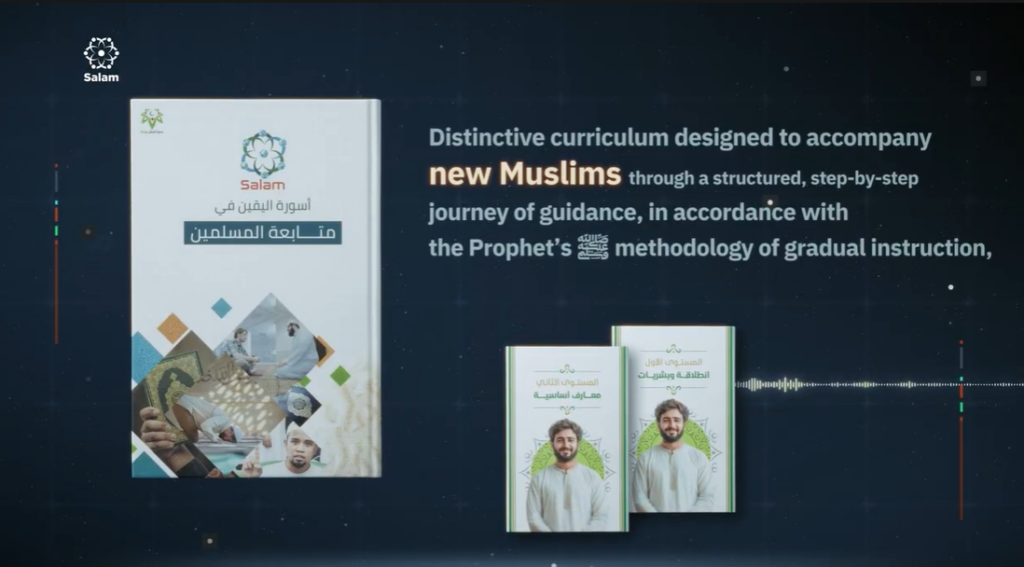
For new Muslims ready to build their knowledge on solid ground, the Salam Center offers the Asawirat Al-Yaqeen (Bracelets of Certainty) program — a structured, four-stage curriculum designed specifically for the post-conversion journey:
- Stage One — The Foundation: The pillars of Islam, the meaning of the Shahada, prayer, purification, and the fundamentals of faith
- Stage Two — The Construction Phase: The six pillars of Iman, fasting, zakat, and the biography of the Prophet (PBUH)
- Stage Three — The Consolidation Phase: Repentance, ethics, moral character, and practical life rulings
- Stage Four — The Empowerment Phase: Contemporary questions, Islamic theology, and a life roadmap rooted in Surah Al-Asr
The program has guided 114,588 new Muslims across 140 countries — with over 63% completing all four stages and 41% graduating with an excellent grade. Every lesson is designed with compassion, clarity, and the understanding that every new Muslim deserves to be met exactly where they are.
Reach out directly to the Salam Center team to start the Asawirat Al-Yaqeen (Bracelets of Certainty) program for FREE.
Conclusion
Islam’s affirmation of Jesus as Al-Masih — the Messiah — is explicit, Quranically established, and central to Islamic belief. Muslims honor Jesus as a prophet, messenger, and one of the greatest human beings ever to walk the earth.
The Islamic understanding of the Messiah is grounded in pure monotheism: Jesus performed real miracles, received divine revelation, and called humanity to worship Allah alone. His extraordinary birth and elevated status are signs of Allah’s power, not evidence of divine nature.
Muslims await Jesus’s return as one of the major signs of the Last Hour — when he will descend with justice, defeat the Dajjal, and fulfill his mission. Faith in his return is part of the comprehensive Islamic belief in the unseen, the prophets, and the certainty of what is yet to come.
Frequently Asked Questions
Do Muslims believe Jesus is the Messiah?
Yes — Muslims believe Jesus (peace be upon him) is Al-Masih, the Messiah, as explicitly named in the Quran multiple times. The Quran states in Surah Al-Imran that the angels announced to Mary that her son would be named Al-Masih Isa ibn Maryam — the Messiah, Jesus, son of Mary. (Quran 3:45)
What differs between Islam and Christianity is the meaning and implications of the title. In Islam, being the Messiah means being an anointed prophet and messenger of Allah — chosen, honored, and given a unique mission — without any connotation of divinity, divine sonship, or atoning sacrifice.
Do Muslims believe Jesus was crucified?
Muslims do not believe Jesus was crucified or killed. The Quran states directly that he was neither killed nor crucified, and that Allah raised him alive to the heavens. (Quran 4:157–158) This is among the clearest statements in the Quran on any historical event — there is no ambiguity in the Arabic text and no scholarly disagreement within Islamic tradition on this point.
The Islamic position is that another person was made to resemble Jesus to those who sought to kill him, and the execution they carried out was not upon him. Allah protected His prophet and raised him in a manner befitting His honor and sovereignty.
Why don’t Muslims worship Jesus if they believe he is the Messiah?
Because Jesus himself — as recorded in the Quran — never asked to be worshipped and explicitly directed all worship to Allah alone. On the Day of Judgment, the Quran records that Jesus will say: "I said not to them except what You commanded me — to worship Allah, my Lord and your Lord." (Quran 5:117)
Worshipping Jesus would, in Islamic understanding, be a violation of the very message Jesus brought. True reverence for Jesus means following what he actually taught — the worship of the One Allah, without partners or intermediaries. This is the foundation of faith in Islam and the message every prophet, from Abraham to Moses to Jesus to Muhammad (PBUH), was sent to deliver.
How does Islam view Jesus compared to the Prophet Muhammad?
Both are honored messengers of Allah, and both are among the five greatest prophets — known in Islamic theology as Ulul Azm (Those of Firm Resolve): Noah, Abraham, Moses, Jesus, and Muhammad, peace be upon them all. Muhammad (PBUH) is the Seal of the Prophets — the final messenger — and his prophethood is universal, addressed to all of humanity until the Last Day.
Jesus’s mission was directed specifically to the Children of Israel, while Muhammad’s was for all mankind. The Quran records that Jesus himself foretold the coming of Muhammad (PBUH) by the name Ahmad. (Quran 61:6) The two prophets are not rivals — they are links in one continuous, divinely guided chain of prophethood, each confirming and honoring the other.
Is the Islamic view of Jesus considered a form of polytheism?
Absolutely not. Islam’s affirmation of Jesus as the Messiah, a spirit created by Allah, and a returning figure at the end of time does not compromise monotheism in any way. All of these attributes describe a created human being endowed with honor by his Creator — they do not elevate Jesus to divinity or make him a partner of Allah.
Islam is built on the absolute rejection of polytheism in every form. Honoring a prophet is an act of obedience to Allah; worshipping a prophet is the precise distortion that Islamic theology was sent to correct. The line between honoring and worshipping is clear, firm, and non-negotiable in Islamic belief.
Curious about Islam?
Journey towards clarity and purpose. Our team is here to support you in your search for truth and spiritual guidance.
Embrace the Truth