Do Muslims Believe Jesus Was a Prophet?
| Key Takeaways |
| Muslims believe Jesus (peace be upon him) was a mighty prophet and messenger of Allah — one of the greatest in human history. |
| Islam affirms the virgin birth of Jesus, his miracles, and his role as a caller to pure monotheism. |
| Muslims reject the crucifixion of Jesus; the Quran states clearly that he was raised alive to Allah. |
| Jesus foretold the coming of Prophet Muhammad (PBUH) by name, according to the Quran. |
| Jesus will return at the end of times, governing by the law of Prophet Muhammad (PBUH), before dying a natural human death. |
Yes — Muslims believe in Jesus deeply, profoundly, and as a matter of faith. A Muslim’s faith is incomplete without it. The Islamic understanding of Jesus (peace be upon him), however, differs sharply from the Christian creed: he is a prophet of Allah, not the son of Allah. He performed miracles by Allah’s permission, not by his own divine nature. He called humanity to worship Allah alone, and he never claimed otherwise.
This is the Islamic position — not a diplomatic compromise, not a theological footnote, but a central pillar of Muslim belief, rooted in the Quran and the authenticated Sunnah of Prophet Muhammad (PBUH).
Do Muslims Believe Jesus Was a Prophet?
Yes, Muslims believe unequivocally that Jesus — known in Arabic as Isa ibn Maryam (Jesus, son of Mary) — was a prophet and messenger of Allah. The Quran affirms this in explicit, unambiguous terms. Allah says:
إِنَّمَا الْمَسِيحُ عِيسَى ابْنُ مَرْيَمَ رَسُولُ اللَّهِ وَكَلِمَتُهُ أَلْقَاهَا إِلَى مَرْيَمَ وَرُوحٌ مِّنْهُ
“The Messiah, Jesus, the son of Mary, was but a messenger of Allah and His word which He directed to Mary and a soul [created at a command] from Him.” (Quran 4:171)
Prophet Muhammad (PBUH) reinforced this with his own words:
“Whoever testifies that there is no god but Allah alone, with no partner, and that Muhammad is His slave and Messenger, and that Jesus is the slave of Allah and His Messenger, and His word which He bestowed upon Mary, and a spirit from Him, and that Paradise is true and Hell is true — Allah will admit him into Paradise.” (Sahih Bukhari, Hadith 3435)
The phrase “slave of Allah” in this hadith carries precise theological weight. It closes the door on exaggeration — on deifying Jesus.
The phrase “His messenger” simultaneously closes the door on belittlement — on dismissing him. Islam holds Jesus in the highest honor that a human being can carry: the honor of prophethood.
This belief is not peripheral to Islam. Rejecting the prophethood of Jesus places a person outside the fold of Islam entirely. Jesus is mentioned by name 25 times in the Quran — more than the Quran mentions Prophet Muhammad (PBUH) by name.
Jesus’ mother, Mary (Maryam), has an entire chapter of the Quran named after her. That is the measure of reverence Islam carries for this noble prophet.
Have Questions About Islam?
Our team is ready to answer your questions clearly and respectfully. Ask freely and receive honest guidance.
Ask Us NowRead also: Does Islam Think Jesus Is the Messiah? What Muslims Actually Believe
What Are the Core Islamic Beliefs About Jesus as a Prophet?
Jesus (peace be upon him) is revered in Islam as a prophet of Allah rather than His son. His miracles were performed solely through Allah’s authorization, not via any personal divinity. Throughout his mission, he called people to the exclusive worship of Allah and never made claims to the contrary.
1. Jesus Was a Servant of Allah and His Messenger, Sent with a Divine Word
The foundational Islamic belief about Jesus is captured in a single Quranic description: he is “the Messenger of Allah, and His word which He directed to Mary, and a soul from Him.” (Quran 4:171)
Each phrase carries meaning. “Messenger of Allah” establishes his prophethood.
“His word” refers to the divine command “Be” (Kun) — by which Allah created Jesus without a father. Jesus was created by that word; he is not himself the eternal Word.
“A soul from Him” means a soul whose origin is Allah’s creation — an honorific attribution, like “the she-camel of Allah” or “the House of Allah.” These are expressions of honor and divine origin, not expressions of divine essence.
The Quran addresses this directly in how Islam views the nature of God: when something is attributed to Allah using the word “from,” it either refers to something He owns and created — as with Jesus — or to an attribute of His own being.
Jesus belongs to the first category. He is a noble creation, honored by attribution, not a fragment of the divine.
2. Jesus Was Born of a Virgin, Without a Father, by the Direct Command of Allah
The virgin birth of Jesus is affirmed in the Quran with full clarity and celebrated as one of Allah’s most extraordinary signs. Mary (Maryam) conceived Jesus without a husband, without any human intervention — by Allah’s direct command alone.
Allah draws the parallel Himself:
إِنَّ مَثَلَ عِيسَىٰ عِندَ اللَّهِ كَمَثَلِ آدَمَ خَلَقَهُ مِن تُرَابٍ ثُمَّ قَالَ لَهُ كُن فَيَكُونُ
“Indeed, the example of Jesus to Allah is like that of Adam. He created him from dust; then He said to him, ‘Be,’ and he was.” (Quran 3:59)
The logic is airtight. Adam was created without a father or a mother. If Adam’s extraordinary origin does not make him divine, then Jesus’s birth without a father carries no different implication.
The miraculous nature of a creation does not elevate it to divinity — it elevates it as a sign of the Creator’s unlimited power.
This is consistent with the core faith in Islam: Allah creates as He wills, by His word alone, and His creation — however miraculous — remains creation. The Creator and the created can never share the same nature.
Read also: How Did Muslims View the People of the Book?
3. Jesus Was Among the Five Greatest Messengers in Human History
Islam places Jesus among Ulul Azm — the five Messengers of firm resolve, the most distinguished prophets ever sent to humanity. Allah says:
وَإِذْ أَخَذْنَا مِنَ النَّبِيِّينَ مِيثَاقَهُمْ وَمِنكَ وَمِن نُّوحٍ وَإِبْرَاهِيمَ وَمُوسَىٰ وَعِيسَى ابْنِ مَرْيَمَ
“And [mention] when We took from the prophets their covenant and from you, and from Noah and Abraham and Moses and Jesus, the son of Mary.” (Quran 33:7)
These five — Noah, Abraham, Moses, Jesus, and Muhammad (peace be upon them all) — form the summit of prophethood. They carried the heaviest missions, endured the most severe trials, and delivered the most transformative messages in human history.
Jesus stands among them by divine appointment, not by human elevation. This is the rank Islam assigns him — and it is among the highest ranks a human being can occupy.
4. Jesus Possessed No Attribute of Divinity
One of the clearest Quranic statements about Jesus addresses the confusion directly:
إِنْ هُوَ إِلَّا عَبْدٌ أَنْعَمْنَا عَلَيْهِ وَجَعَلْنَاهُ مَثَلًا لِّبَنِي إِسْرَائِيلَ
“He was not but a servant upon whom We bestowed favor, and We made him an example for the Children of Israel.” (Quran 43:59)
The word “servant” (abd) in Arabic is not a diminishment — it is a precise theological boundary. It means a created being, fully dependent on his Creator, possessing nothing of lordship, divinity, or self-sufficiency.
Jesus ate, slept, prayed, and relied on Allah for every moment of his existence. These are the conditions of human life, and they are incompatible with the attributes of Allah.
Monotheism in Islam is absolute and indivisible. Allah has no partners, no children, no equals, and no rivals. As the Quran states in one of its most decisive verses:
مَا كَانَ لِلَّهِ أَن يَتَّخِذَ مِن وَلَدٍ ۖ سُبْحَٰنَهُۥٓ ۚ إِذَا قَضَىٰٓ أَمْرًا فَإِنَّمَا يَقُولُ لَهُۥ كُن فَيَكُونُ
“It is not befitting for Allah to take a son; exalted is He! When He decrees an affair, He only says to it, ‘Be,’ and it is.” (Quran 19:35).
The elevation of any created being — however miraculous — to divine status is the one category of error the Quran confronts with the greatest urgency.
Read also: Islam’s Views on Christianity and Christians
5. Allah Granted Jesus Extraordinary Miracles as Evidence of His Prophethood
The miracles of Jesus are affirmed in the Quran — not to suggest divinity, but to confirm prophethood. Every prophet was given signs suited to his time and people. The miracles of Jesus were among the most astonishing ever granted to any messenger.
He spoke as an infant in the cradle, declaring his own prophethood before he could walk. He healed the blind and the leper. He raised the dead. He fashioned a bird from clay and breathed life into it — all by the explicit permission of Allah, as the Quran repeats consistently: “by the permission of Allah.”
وَأُبْرِئُ الْأَكْمَهَ وَالْأَبْرَصَ وَأُحْيِي الْمَوْتَىٰ بِإِذْنِ اللَّهِ
“And I cure the blind and the leper, and I give life to the dead — by the permission of Allah.” (Quran 3:49)
That repeated phrase is the theological key. Miracles are not proof of divinity — they are proof of divine authorization. A prophet performs miracles because Allah empowers him to do so.
The power belongs to Allah; the prophet is its vessel and its witness. This is precisely how Islam principles frame the relationship between Allah and His messengers: absolute in their submission, extraordinary in their gifts, and unambiguous in their humanity.
6. Prophet Jesus Called His People to Worship Allah Alone
The mission of Jesus was identical in its core to the mission of every prophet before and after him: the call to Tawhid — the pure, undiluted monotheism that forms the bedrock of Islam. He never invited his followers to worship himself. The Quran records his words:
إِنَّ اللَّهَ رَبِّي وَرَبُّكُمْ فَاعْبُدُوهُ هَٰذَا صِرَاطٌ مُّسْتَقِيمٌ
“Indeed, Allah is my Lord and your Lord, so worship Him. That is the straight path.” (Quran 3:51)
The grammar is deliberate and significant. Jesus says “my Lord and your Lord” — placing himself in the same position of worship and dependence as those he addressed.
He does not say “I am your Lord” or “worship me.” He points, as all prophets point, toward the One who stands above all creation.
This call to worship Allah alone, without partners or intermediaries, is the constant heartbeat of every prophetic mission — from Adam to Muhammad (PBUH). For a deeper exploration of this theme, the article on God in Islam traces how the Quran presents the nature of Allah across all prophetic traditions.
7. Prophet Jesus Foretold the Coming of Prophet Muhammad by Name
One of the most remarkable — and most overlooked — aspects of the Islamic account of Jesus is his explicit prophecy of the Prophet who would come after him. The Quran records Jesus addressing the Children of Israel:
وَمُبَشِّرًا بِرَسُولٍ يَأْتِي مِن بَعْدِي اسْمُهُ أَحْمَدُ
“And [I am] a bringer of good tidings of a messenger to come after me, whose name is Ahmad.” (Quran 61:6)
Ahmad is another name of Prophet Muhammad (PBUH), sharing the same Arabic root, meaning “the most praised.” This prophecy — preserved in the Quran — establishes an unbroken chain of prophetic continuity. Jesus did not come to conclude the prophetic mission. He came, among other purposes, to prepare the way for the final messenger.
This continuity reflects the Islamic understanding of prophethood as a single, coherent divine project across history. The prophets did not contradict each other — they built upon each other. Jesus confirmed Moses; Muhammad (PBUH) confirmed both. As the Quran explains in its account of how Islam views other religions, Islam sees itself as the completion of the same Abrahamic monotheism that Jesus and Moses and Abraham all carried.
8. No Prophet Was Sent Between Jesus and Muhammad
The Quran’s phrasing in Jesus’s prophecy — “a messenger to come after me” — implies direct succession: no prophet stands between Jesus and Muhammad (PBUH) in the chain of divine messengers.
Scholars of Islam, including Ibn Kathir in his landmark Tafsir al-Quran al-Azim, note that this establishes the temporal proximity of the two missions in prophetic terms.
This detail matters because it frames the role of Muhammad (PBUH) as the direct inheritor of the mission Jesus carried — not a departure from it.
The message that Jesus preached in Palestine, Prophet Muhammad (PBUH) delivered to the whole of humanity. The monotheism Jesus proclaimed in the tongue of Aramaic, Muhammad (PBUH) established as a complete, preserved, and universal way of life.
What Muslims believe about the Quran — as the final, uncorrupted word of Allah — is inseparable from this understanding of prophetic continuity.
9. Prophet Jesus Was Neither Crucified Nor Killed
This is the point where Islamic belief diverges most sharply from mainstream Christianity, and the Quran addresses it with striking directness. Allah says:
وَقَوْلِهِمْ إِنَّا قَتَلْنَا الْمَسِيحَ عِيسَى ابْنَ مَرْيَمَ رَسُولَ اللَّهِ وَمَا قَتَلُوهُ وَمَا صَلَبُوهُ وَلَٰكِن شُبِّهَ لَهُمْ… بَل رَّفَعَهُ اللَّهُ إِلَيْهِ
“And [for] their saying, ‘Indeed, we have killed the Messiah, Jesus, the son of Mary, the messenger of Allah.’ And they did not kill him, nor did they crucify him; but [another] was made to resemble him to them… Rather, Allah raised him to Himself.” (Quran 4:157–158)
The crucifixion, in Islamic belief, did not happen to Jesus. What appeared to those present was a resemblance — another person was crucified, while Jesus was raised alive, body and soul, to Allah. Allah also says: “O Jesus, indeed I will take you and raise you to Myself.” (Quran 3:55)
This is not a minor theological footnote. It strikes at the entire edifice of atonement theology. Islam categorically rejects the notion that Allah required a sacrificial death to forgive humanity’s sins. Why Muslims believe in the Quran — as divine revelation protected from corruption — includes precisely this kind of correction of doctrines that crept into earlier scriptures over centuries.
10. Prophet Jesus Will Return at the End of Times and Will Die a Natural Human Death
The story of Jesus in Islamic belief has not ended. He is alive — raised to Allah — and he will return to earth before the Day of Judgment. This return is among the major signs of the Last Hour confirmed by multiple authenticated hadiths.
Prophet Muhammad (PBUH) described the descent of Jesus in detail: he will land in Damascus, rule by the law of Islam, break the cross as a symbol of false theology, and confront the false messiah (Al-Masih al-Dajjal).
After fulfilling his mission, he will live on earth, marry, have children, and eventually die a natural death — to be buried in the earth as every son of Adam is buried, and to be raised on the Day of Judgment as every human being is raised.
Allah says:
“From the earth We created you, and into it We will return you, and from it We will extract you another time.” (Quran 20:55)
This final chapter of Jesus’s story seals the Islamic portrait of him: a human prophet, raised by Allah’s grace, returning by Allah’s will, dying as humans die, and resurrected as humans are resurrected. Every stage of his existence confirms his humanity — and every stage reflects the power and mercy of the Allah who honored him.
Have Questions About Islam?
Our team is ready to answer your questions clearly and respectfully. Ask freely and receive honest guidance.
Ask Us NowKnow More Authentic Knowledge About Jesus with Salam
If this article opened a question you have been carrying — about Jesus, about Islam, about faith itself — you are exactly where you are meant to be.
The Salam Center exists for people at every stage of that journey. Whether you are exploring Islam for the first time or you have already taken your Shahada and want to build your knowledge on firm ground, there is a place for you here.
Browse the Salam Platform for articles on core Islamic beliefs, prophetic history, and answers to sincere questions about the faith.
Read more on the Salam blog for fresh perspectives on Islam written for seekers and new Muslims.
If you have a question, want to learn more, or are considering taking the next step toward Islam — reach out directly. Someone from the Salam Center team will respond with care and without judgment.

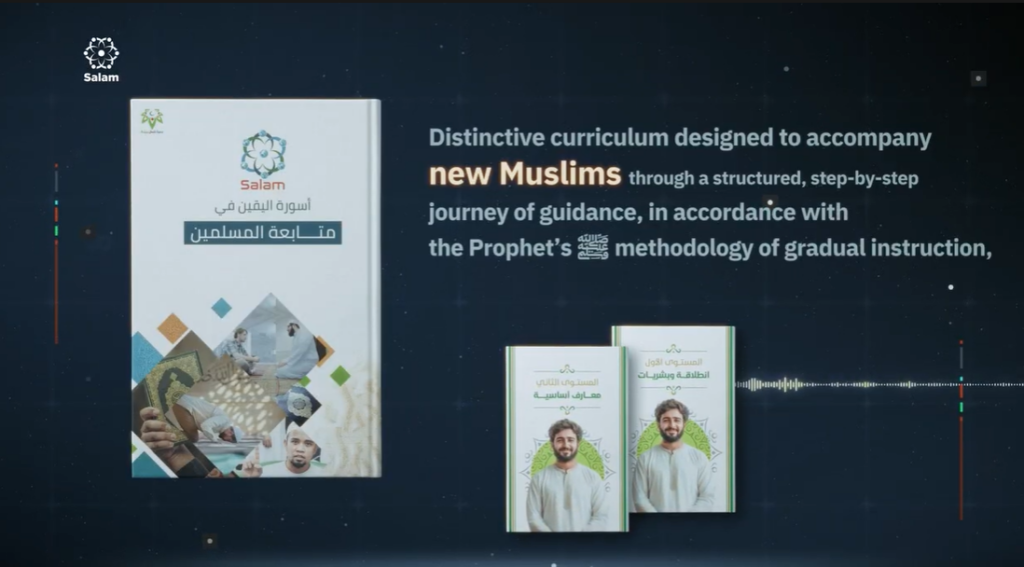
Joining the Asawirat Al-Yaqeen (Bracelets of Certainty) Program for FREE
For those who have already embraced Islam, the Asawirat Al-Yaqeen (Bracelets of Certainty) program was designed for you — a structured, four-stage curriculum that takes you from the basics of worship to a confident, grounded Islamic identity. Here is what it offers:
- A progressive journey through four stages and seven levels — from foundational worship to contemporary Islamic questions
- Content rooted in the Quran, authenticated Sunnah, and the creed of Ahlus Sunnah wal Jama’ah
- Therapeutic language that builds both knowledge and peace of heart
- Interactive assessments and professional formatting designed for genuine learning
- A global community — already walked by over 114,000 new Muslims in 140 countries
Reach out directly to the Salam Center team to start the Asawirat Al-Yaqeen (Bracelets of Certainty) program for FREE.
Conclusion
Muslims hold that Jesus (peace be upon him) was a genuine prophet and messenger of Allah, born of a virgin, performing miracles by divine permission, and calling humanity exclusively to the worship of Allah alone — with no claim of divinity and no aspiration to it.
Islamic belief preserves a Jesus the Quran describes as honored, extraordinary, and entirely human: neither crucified nor killed, but raised alive to Allah, destined to return at the end of times and to die a natural death like every son of Adam before the final resurrection.
The Islamic understanding of Jesus resolves centuries of theological confusion by returning to the prophetic baseline: one God, one message, and a chain of messengers — of whom Jesus and Muhammad (peace be upon them both) stand among the greatest ever sent.
Frequently Asked Questions
Do Muslims consider Jesus a prophet or a god?
Muslims believe Jesus (peace be upon him) was a prophet and messenger of Allah — among the most honored ever sent. Islam categorically rejects the idea that he was divine.
The Quran states plainly: "He was not but a servant upon whom We bestowed favor." (Quran 43:59). Divinity in Islam belongs to Allah alone, without partners or equals, as affirmed in the foundational principle of monotheism.
Do Muslims believe in the virgin birth of Jesus?
Yes. The virgin birth of Jesus is a confirmed article of Islamic faith. Mary (Maryam) conceived Jesus without a husband, by Allah’s direct command. The Quran devotes an entire chapter to her story (Surah Maryam, Chapter 19) and compares the creation of Jesus to the creation of Adam — both formed without the conventional requirements, both signs of Allah’s limitless power. A miraculous origin, in Islamic theology, signals divine power — not divine nature.
Why do Muslims reject the crucifixion of Jesus?
The Quran states explicitly that Jesus was neither killed nor crucified — that what appeared to witnesses was a resemblance, while Allah raised Jesus alive to Himself. (Quran 4:157–158). This is not a disputed or marginal position in Islam; it is settled Quranic doctrine.
Islam also rejects the theological premise behind the crucifixion: the idea that Allah required a sacrificial death to forgive human sin contradicts the Islamic understanding of Allah’s absolute power to forgive without conditions or intermediaries.
Did Jesus predict the coming of Prophet Muhammad in Islam?
Yes. The Quran records Jesus foretelling the arrival of a messenger after him, identified by the name Ahmad — a name of Prophet Muhammad (PBUH). (Quran 61:6). This prophecy frames the two prophets as part of a single, unbroken divine mission: Jesus prepared the way; Muhammad (PBUH) delivered the final message to all of humanity. Islamic scholars have connected this Quranic account to references in earlier scriptures that describe a coming prophet with similar attributes.
Will Jesus return according to Islamic belief?
Yes. The return of Jesus (peace be upon him) before the Day of Judgment is among the established signs of the Last Hour in Islam, affirmed by multiple authenticated hadiths in Sahih Bukhari and Sahih Muslim.
He will descend, govern by the law of Prophet Muhammad (PBUH), confront the false messiah, and live out the remainder of his human life on earth before dying naturally — and being resurrected on the Day of Judgment alongside all of humanity.
How does the Islamic view of Jesus differ from the Christian view?
The central difference is theological: Christians — in their mainstream tradition — hold that Jesus is the Son of God and the second person of the Trinity. Muslims affirm that Allah has no son, no partner, and no equal.
Jesus in Islam is fully honored as a great prophet; in most Christian traditions, he is worshipped as divine. Both traditions affirm the virgin birth and the miracles of Jesus — but interpret their meaning differently. Islam sees them as signs of prophetic authorization; Christianity sees them as evidence of divine incarnation. For a broader look at how Islam views other religions on these shared figures, the Salam Platform offers a dedicated exploration.
Curious about Islam?
Journey towards clarity and purpose. Our team is here to support you in your search for truth and spiritual guidance.
Embrace the Truth