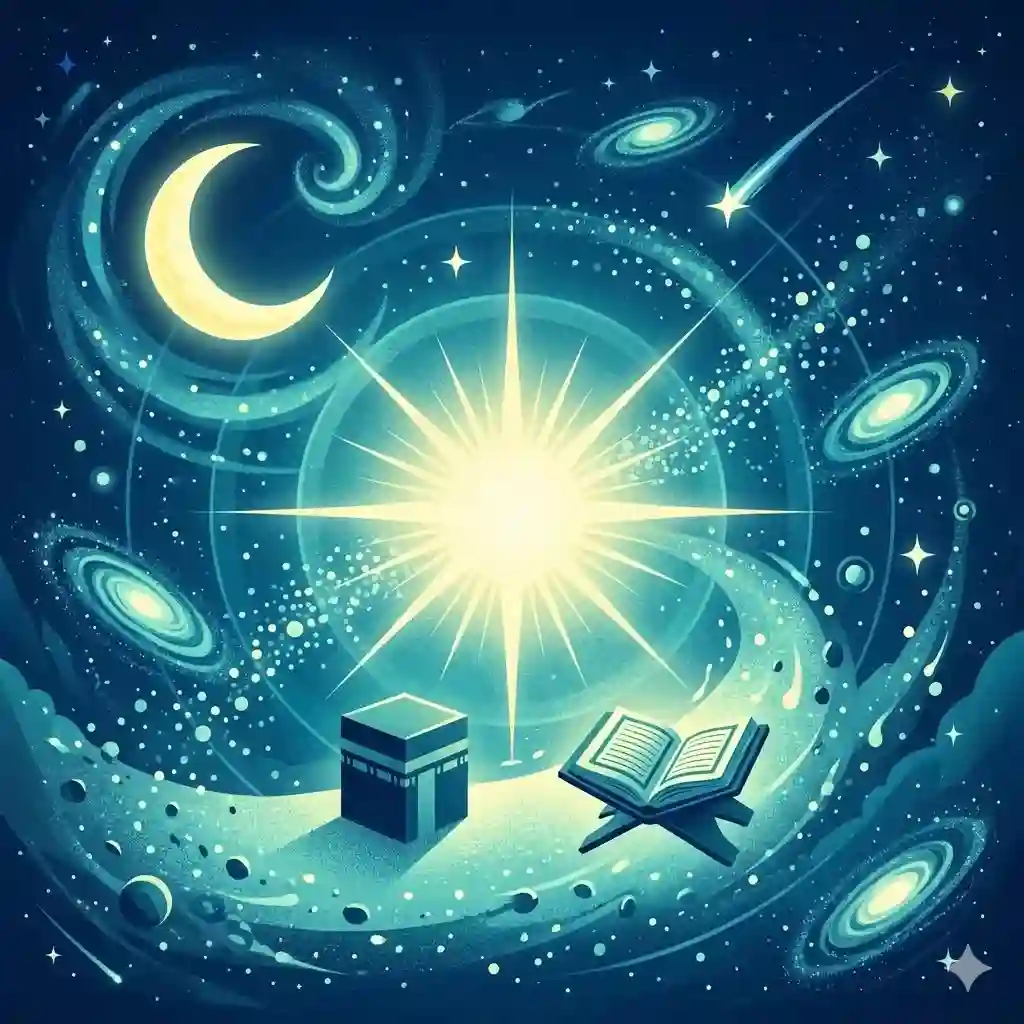
Do Muslims Believe in the Big Bang?
| Key Takeaways |
| Muslims are not required to believe in the Big Bang Theory — belief is obligated only by what Allah revealed in the Quran and authentic Sunnah. |
| The Quran describes the heavens and earth as once being a joined mass that Allah separated, a description some scholars see as consistent with modern cosmological findings. |
| Accepting the Big Bang as a scientific model is permissible in Islam, provided Allah is acknowledged as the Creator who initiated all existence. |
| The most important cosmological question in Islam is not how the universe began, but who began it — and the answer is Allah alone. |
| Scientific theories about the origin of the universe are working models subject to revision; the Quran is a fixed, divine revelation from the Creator of that universe. |
Muslims can engage with the Big Bang Theory without any contradiction with their faith — as long as the framework is understood correctly. The universe did not create itself. Whatever mechanism brought it into being points, by logical necessity, to a Creator who exists outside of it. That Creator, in Islamic belief, is Allah.
The question “do Muslims believe in the Big Bang?” assumes a tension that does not actually exist, once the relationship between science and divine revelation is understood from an Islamic perspective.
Science describes the observable mechanics of creation. The Quran tells us who created it, why, and what that means for human beings. These are answers to different questions, and Islam holds both with clarity.
What the Quran does not do is require Muslims to accept any specific scientific theory as religious truth. A Muslim’s faith is anchored in what Allah revealed — and the Quran’s account of creation is its own, preceding modern cosmology by fourteen centuries.
What Does the Quran Say About the Origin of the Universe?
The most directly relevant verse in this discussion appears in Surah Al-Anbiya:
أَوَلَمْ يَرَ ٱلَّذِينَ كَفَرُوٓا۟ أَنَّ ٱلسَّمَـٰوَٰتِ وَٱلْأَرْضَ كَانَتَا رَتْقًا فَفَتَقْنَـٰهُمَا ۖ وَجَعَلْنَا مِنَ ٱلْمَآءِ كُلَّ شَىْءٍ حَىٍّ ۖ أَفَلَا يُؤْمِنُونَ
“Have those who disbelieved not considered that the heavens and the earth were a joined entity, and We separated them and made from water every living thing? Then will they not believe?” (Quran 21:30)
The Arabic word ratq means a sealed, joined, or fused mass. Fatq means the act of splitting or separating it. The Quran states that Allah performed this separation — that what was once a unified whole was divided and expanded into the cosmos we inhabit.
Many contemporary scholars have noted that this Quranic description carries observable parallels to what the Big Bang model proposes: an initial singularity, followed by a rapid expansion.
The Quran made this claim centuries before Edwin Hubble’s observations of an expanding universe in the 1920s confirmed that the cosmos is not static.
This parallel is acknowledged as striking — but it requires careful handling. Scholars are unanimous that the Quran is not a science textbook, and its verses must not be forced into alignment with any scientific framework simply because doing so feels intellectually satisfying in a given era.
What is The Islamic Position on the Big Bang Theory?
The Big Bang is a scientific model. And Islam’s relationship with Big Bang theory is governed by a clear principle: scientific models occupy a fundamentally different category than divine revelation.
Faith in Islam is built on certainty in what Allah has revealed and what the Prophet Muhammad (PBUH) conveyed. Scientific models, however well-supported, are always provisional — they represent humanity’s best current explanation of observable phenomena, open to revision as new data emerges.
A Muslim who accepts the Big Bang as a working scientific description of cosmic origins is not making a statement of religious belief. They are engaging with a field of human inquiry.
The International Islamic Fiqh Academy, affiliated with the Organisation of Islamic Cooperation, has consistently affirmed that Muslims engaging with modern sciences do so within the framework of tawhid — the absolute oneness of Allah. Any scientific engagement that preserves this framework is acceptable. Any interpretation that removes Allah from the equation is what Muslims reject.
The Question Big Bang Theory Cannot Answer
The Big Bang model describes what happened after the singularity — the expansion, the formation of matter, the emergence of galaxies and stars. What it cannot answer, and has never claimed to answer, is why the singularity existed in the first place, or what caused it to begin.
This is the question that has occupied philosophers and theologians across every civilization. The Muslim answer is rooted in a concept that even pre-Islamic Greek philosophy grasped: any chain of causation must end at an uncaused First Cause.
Aristotle called it the Unmoved Mover. Islam identifies it explicitly and completely — Allah, who has no beginning, no end, no comparable, and no partner.
Understanding how Islam views the nature of Allah makes this clear: He is Al-Awwal (the First) and Al-Akhir (the Last). He preceded the singularity. He is what the Big Bang model, by its own admission, cannot account for.
This is not a gap that science is on the verge of filling. It is a structural boundary of the scientific method itself — which studies the universe from inside it, using instruments made of it. Allah exists outside the universe He created.
Learn More About Islam
Discover the beauty, teachings, and wisdom of Islam in a clear and welcoming way. Start exploring and deepen your understanding today.
Learn MoreWhy Does Islam Not Require Belief in the Big Bang?
The Quran tells Muslims that no human being was present for the creation of the heavens and the earth:
مَّآ أَشْهَدتُّهُمْ خَلْقَ ٱلسَّمَـٰوَٰتِ وَٱلْأَرْضِ وَلَا خَلْقَ أَنفُسِهِمْ
“I did not make them witness to the creation of the heavens and the earth or to the creation of themselves.” (Quran 18:51)
This verse alone establishes a foundational epistemic humility about cosmological origins. Human beings, however sophisticated their instruments, were not present.
They are reconstructing a past they did not observe, from data that requires interpretation. Every cosmological theory — the Big Bang included — carries within it a degree of inference and assumption.
What Muslims believe about the Quran is categorically different: it is direct speech from Allah, preserved without alteration, carrying certainty that no scientific model can match. The Big Bang may be updated, superseded, or refined by future observations. The Quran does not change.
This is why Islamic scholars throughout history have maintained that the governing reference for a Muslim is always revelation, and science is evaluated against that reference — not the reverse. Sheikh Ali Gomaa, former Grand Mufti of Egypt, has articulated this clearly: science describes mechanism; religion describes meaning, origin, and purpose. Both operate in distinct domains, and confusion arises only when one tries to do the other’s work.
Read also: Belief in Holy Books in Islam
Can a Muslim Accept the Big Bang Theory?
Yes, a Muslim can accept the Big Bang as a plausible scientific account of cosmic origins with complete and unwavering belief in Allah as Creator. Many Muslim physicists, astronomers, and cosmologists work within mainstream cosmology daily, and their iman — faith — is uncompromised.
The condition is straightforward: the model is held as a scientific hypothesis, not a metaphysical certainty. And it is never used to argue that the universe is self-originating or that a Creator is unnecessary.
Monotheism in Islam — tawhid — is the non-negotiable foundation of Islamic belief. Allah has no partners, no rivals, and no equals. Any interpretation of the Big Bang that positions “random quantum fluctuation” or “natural law” as the actual originating cause, rather than a description of the mechanism Allah chose to employ, is where a Muslim parts ways — firmly and without apology.
The Islamic principles that govern how Muslims engage with the world make this hierarchy clear: everything is understood through the lens of tawhid, and what Muslims believe about Allah is the lens through which all knowledge — scientific or otherwise — is read.
Read also: Belief In The Day Of Judgement In Islam
Islam’s “Big Questions” Were Already Answered
Western philosophy has recently developed the language of “ultimate questions” — where did we come from? What is happening now? Where are we going? These have been framed as the frontier of philosophical inquiry, the hardest problems humanity faces.
Islam answered them fourteen centuries ago.
Where did we come from?
Allah created the heavens, the earth, and humanity. He created Adam (peace be upon him) directly, as the Quran details in Surah Al-Baqarah — not as an afterthought, but as the purpose of creation.
What is happening now?
Humans are fulfilling their covenant with Allah, carrying the amanah — the trust — of moral responsibility. The Prophet Muhammad (PBUH) summarized the present obligation: obey Allah and follow the Messenger.
Where are we going?
To the Day of Judgment, where every soul will stand before its Creator and receive full account of its choices.
Science, for all its genuine achievements, operates within the “what” and “how.” Islam provides the “who,” the “why,” and the “what comes after.” These are not competing answers to the same question. They are answers to entirely different questions — and Islam’s answers are complete.
Islam does not treat other frameworks with hostility simply because they operate differently. Scientific inquiry is encouraged in Islam — the Quran commands reflection on the creation repeatedly. But the Quran also makes clear where the limits of purely human investigation lie.
Learn More About Islam
Discover the beauty, teachings, and wisdom of Islam in a clear and welcoming way. Start exploring and deepen your understanding today.
Learn MoreRead also: Do Muslims Believe in Christmas?
Explore Further With Salam
If this topic opened further questions for you — about faith in Islam, who Allah is, or why Muslims believe the Quran is divine — the Salam blog is built for exactly these conversations.
Every article is written with care, grounded in authentic sources, and designed for honest seekers who want real answers without spin.
If you have a specific question not covered here — whether about entering Islam, a misconception you have encountered, or simply something you are curious about — the Salam Platform team is available to speak with you directly.
You are welcome here, wherever you are in your journey.

Frequently Asked Questions
Does the Quran support or contradict the Big Bang Theory?
The Quran does not confirm or deny the Big Bang Theory as a scientific model — it was revealed to guide humanity, not to serve as a cosmological textbook. The verse in Surah Al-Anbiya (21:30) describes the heavens and earth as once being a single joined mass that Allah separated, which some scholars see as consistent with the Big Bang’s premise of expansion from a singularity. But Muslims are not required to read modern science into Quranic verses, and doing so carelessly risks distorting both the science and the revelation.
Can a Muslim believe in the Big Bang and still be a good Muslim?
Yes, completely. Accepting the Big Bang as a working scientific model carries no religious consequence in Islam, as long as the Muslim affirms that Allah is the sole Creator who initiated and governs all existence. Holding a scientific theory tentatively — as provisional human knowledge — is entirely different from treating it as religious truth. Dar al-Ifta al-Misriyyah has confirmed that engaging with mainstream scientific cosmology does not conflict with Islamic belief when the framework of tawhid is maintained.
Does the Big Bang prove that the universe created itself without Allah?
The Big Bang Theory makes no claim about the ultimate origin of the singularity itself — science has no tools to investigate what preceded the initial state or what caused it to exist. The theory describes what happened after a beginning; it cannot explain the beginning itself. Islamic theology has always identified Allah as the uncaused First Cause who exists prior to and independent of the created universe — a position that the Big Bang’s structural silence on ultimate origins actually leaves entirely open.
What does Islam say about the origin of the universe?
Islam teaches that Allah created the heavens and earth in six days, as stated repeatedly in the Quran. إِنَّ رَبَّكُمُ ٱللَّهُ ٱلَّذِى خَلَقَ ٱلسَّمَـٰوَٰتِ وَٱلْأَرْضَ فِى سِتَّةِ أَيَّامٍ — "Indeed, your Lord is Allah, who created the heavens and earth in six days" (Quran 7:54). The Quran is not a cosmological manual providing physical timelines; it communicates the essential theological truth that creation is an act of divine will and power, not chance or necessity.
Do Muslims reject science because of their faith?
Muslims engaging with Islam’s core principles understand that the Quran actively commands observation of the natural world. The problem Muslims identify is not science itself, but scientism — the claim that science is the only valid path to truth and that it can, in principle, replace religious knowledge entirely. Muslims hold that Allah is the source of all truth, and scientific discovery is one means by which humanity glimpses the order He built into creation. The two are not in conflict. They serve different purposes and address different dimensions of reality.
Is the Big Bang Theory accepted by Islamic scholars?
There is no single unified scholarly ruling on the Big Bang Theory as a whole, because scholarly bodies assess it from the perspective of theological compatibility rather than scientific validity. The consensus position — reflected in rulings from bodies like Dar al-Ifta al-Misriyyah and the International Islamic Fiqh Academy — is that treating it as a scientific hypothesis is permissible, rejecting any interpretation that negates Allah’s role as Creator is obligatory, and elevating it to religious certainty is unwarranted and unnecessary.
Curious about Islam?
Journey towards clarity and purpose. Our team is here to support you in your search for truth and spiritual guidance.
Embrace the Truth