
Belief In The Day Of Judgement In Islam
| Key Takeaways |
| Belief in the Day of Judgement (Yawm al-Qiyamah) is one of the six pillars of Islamic faith — rejecting it invalidates a Muslim’s belief entirely. |
| On that Day, every soul will be resurrected and held individually accountable before Allah for every deed, word, and intention from their earthly life. |
| The Quran dedicates more verses to the Day of Judgement than almost any other subject, making it a theological cornerstone of the entire religion. |
| Islam describes a detailed sequence of events on that Day — from the blowing of the Trumpet to the weighing of deeds on the Mizan — all grounded in authentic scripture. |
| The belief serves a profound moral function: it anchors human accountability in absolute divine justice, ensuring that no oppressor escapes and no righteous deed goes unrewarded. |
The Day of Judgement stands at the very heart of Islamic theology. Muslims believe with certainty that this world will end, that every soul will be resurrected, and that each person — without exception — will stand before Allah to answer for the life they lived.
The Arabic name is Yawm al-Qiyamah, the Day of Rising, and it appears in the Quran with a frequency and urgency that signals just how central it is to the entire Islamic worldview.
For many Western audiences encountering Islam seriously for the first time, this belief can seem either remote or purely metaphorical.
In Islam, it is neither. It is a concrete, inevitable reality — as certain as the existence of Allah Himself.
The Prophet Muhammad (PBUH) described its signs, its sequence, and its outcomes in precise detail, and the Quran addresses it across dozens of surahs (chapters), returning to it again and again because it is the ultimate destination of all human life.
Belief in the Day of Judgement Is One of the Six Pillars of Islamic Faith
Belief in the Day of Judgement is not optional within Islam — it is a pillar. The Prophet Muhammad (PBUH) was asked about the nature of faith, and his answer has been transmitted in one of the most authenticated narrations in all of Islamic scholarship:
“أَنْ تُؤْمِنَ بِاللَّهِ وَمَلاَئِكَتِهِ وَكُتُبِهِ وَرُسُلِهِ وَالْيَوْمِ الآخِرِ وَتُؤْمِنَ بِالْقَدَرِ خَيْرِهِ وَشَرِّهِ”
“…that you believe in Allah, His angels, His books, His messengers, the Last Day, and that you believe in divine decree — both its good and its bad.” (Sahih Muslim 8a)
The Last Day — al-Yawm al-Ākhir — is listed here alongside belief in Allah Himself. A person who rejects it while affirming the rest cannot be said to hold complete Islamic faith. This is not a peripheral doctrine; it is definitional.
The six pillars of Islamic belief form a unified architecture of conviction, and the five pillars of faith are inseparable from this creedal foundation.
Remove belief in the Day of Judgement, and the entire moral logic of Islam collapses — because the justice that this world routinely fails to deliver must be delivered somewhere, by someone with perfect knowledge and perfect power.
The Quran Speaks About the Day of Judgement with Unmistakable Urgency
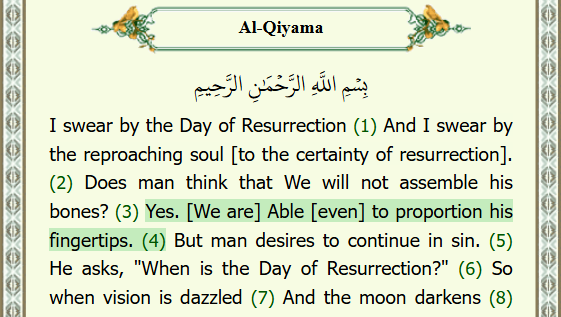
Open almost any surah of the Quran and the Day of Judgement is either explicitly named or implicitly present. Entire chapters — like Surah al-Qiyamah (Chapter 75), Surah al-Infitar (Chapter 82), and Surah al-Ghashiyah (Chapter 88) — are devoted entirely to its description. Allah addresses the skeptic directly:
“أَيَحْسَبُ الْإِنسَانُ أَلَّن نَّجْمَعَ عِظَامَهُ”
“Does man think that We will not assemble his bones?” (Quran 75:3)
The Quran is speaking to a recurring human tendency — the temptation to dismiss accountability as a fantasy.
Allah’s answer is unambiguous: not only will the bones be reassembled, but “Yes. [We are] Able [even] to proportion his fingertips” (75:4). The precision of that image — the unique fingerprint as proof of Allah’s capacity to reconstruct the individual — has struck readers across centuries as both scientifically resonant and spiritually confronting.
The Quran is remarkable in how it addresses this topic: sometimes with cosmic grandeur, sometimes with intimate, personal directness. The Day is simultaneously the end of the universe and the most personal moment a soul will ever experience.
The Names Allah Uses for That Day Reveal Its Dimensions
The Quran uses over a dozen distinct names for the Day of Judgement, and each one illuminates a different facet of what it will be. This is worth pausing on — because the names are not interchangeable synonyms. They are theological statements.
- Yawm al-Qiyamah — the Day of Rising, when all the dead are resurrected
- Yawm al-Dīn — the Day of Recompense, when every account is settled
- Yawm al-Hisāb — the Day of Reckoning, when deeds are counted
- al-Sā’ah — the Hour, emphasizing its sudden arrival
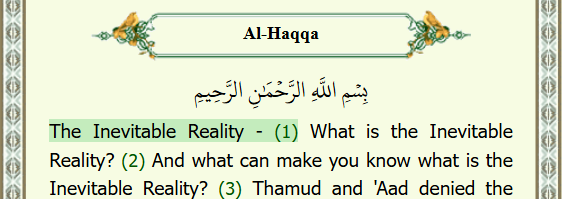
- al-Hāqqah — the Inevitable Reality
- al-Qāri’ah — the Striking Calamity
“الْحَاقَّةُ مَا الْحَاقَّةُ وَمَا أَدْرَاكَ مَا الْحَاقَّةُ”
“The Inevitable Reality — what is the Inevitable Reality? And what can make you know what the Inevitable Reality is?” (Quran 69:1–3)
That rhetorical repetition — what is it? what can make you know what it is? — is a literary and spiritual device of staggering power. Allah is signaling that this reality surpasses ordinary human comprehension. And yet, out of mercy, He describes it in terms the human mind can engage with.
Read also: Belief in Holy Books in Islam
What Will Actually Happen on the Day of Judgement?
Islamic scholarship, drawing on the Quran and authenticated ahadith, describes a detailed sequence of events. They are events that will literally occur.
1. The Blowing of the Trumpet by the Angel Israfil
The Hour begins with a sound. The angel Israfil — entrusted with the cosmic Trumpet, al-Sur — will blow it twice. The first blast ends all life. The second restores it.
“وَنُفِخَ فِي الصُّورِ فَصَعِقَ مَن فِي السَّمَاوَاتِ وَمَن فِي الْأَرْضِ إِلَّا مَن شَاءَ اللَّهُ ۖ ثُمَّ نُفِخَ فِيهِ أُخْرَىٰ فَإِذَا هُمْ قِيَامٌ يَنظُرُونَ”
“And the Trumpet will be blown, and whoever is in the heavens and whoever is on the earth will fall dead except whom Allah wills. Then it will be blown again, and at once they will be standing, looking on.” (Quran 39:68)
2. The Gathering — Al-Hashr
Every human being who ever lived will be gathered on a transformed earth. The Prophet (PBUH) described it:
“يُحْشَرُ النَّاسُ يَوْمَ الْقِيَامَةِ عَلَى أَرْضٍ بَيْضَاءَ عَفْرَاءَ كَقُرْصَةِ النَّقِيِّ لَيْسَ فِيهَا عَلَمٌ لِأَحَدٍ”
“People will be gathered on the Day of Resurrection on white, reddish ground like a flat loaf of bread, with no landmark for anyone.” (Sahih Muslim 2790)
The previous world — its geography, its nations, its borders — will be irrelevant. Every soul stands equally exposed.
3. The Weighing of Deeds — Al-Mizan
A scale, al-Mizan, will be erected. Deeds — not merely their counts but their moral weight — will be measured with absolute precision.
“وَنَضَعُ الْمَوَازِينَ الْقِسْطَ لِيَوْمِ الْقِيَامَةِ فَلَا تُظْلَمُ نَفْسٌ شَيْئًا”
“We will place the scales of justice for the Day of Resurrection, so no soul will be treated unjustly at all.” (Quran 21:47)
The Prophet (PBUH) taught that even seemingly small deeds carry immense weight. Two words light on the tongue but heavy on the scale:
“كَلِمَتَانِ خَفِيفَتَانِ عَلَى اللِّسَانِ، ثَقِيلَتَانِ فِي الْمِيزَانِ، حَبِيبَتَانِ إِلَى الرَّحْمَنِ: سُبْحَانَ اللهِ وَبِحَمْدِهِ، سُبْحَانَ اللهِ الْعَظِيمِ”
“Two words are light on the tongue but heavy on the scale, and beloved to the Most Merciful: ‘Glory be to Allah and His praise; glory be to Allah the Magnificent.'” (Sahih Bukhari 6406)
Learn More About Islam
Discover the beauty, teachings, and wisdom of Islam in a clear and welcoming way. Start exploring and deepen your understanding today.
Learn More4. The Book of Deeds — Al-Kitab
Each person will receive a record of their entire life — every deed, word, and intention, preserved with faultless accuracy. The Quran describes the reaction of those receiving it:
“وَكُلَّ إِنسَانٍ أَلْزَمْنَاهُ طَائِرَهُ فِي عُنُقِهِ ۖ وَنُخْرِجُ لَهُ يَوْمَ الْقِيَامَةِ كِتَابًا يَلْقَاهُ مَنشُورًا اقْرَأْ كِتَابَكَ كَفَىٰ بِنَفْسِكَ الْيَوْمَ عَلَيْكَ حَسِيبًا”
“And [for] every person We have imposed his fate upon his neck, and We will produce for him on the Day of Resurrection a record which he will encounter spread open. (13) [It will be said], “Read your record. Sufficient is yourself against you this Day as accountant.'” (Quran 17:13–14)
The individual’s own soul becomes its own witness. There will be no possibility of denial.
5. The Bridge — Al-Sirat
After the reckoning, every soul must cross al-Sirat, a bridge stretched over Hell. The Prophet (PBUH) described it as finer than a hair and sharper than a sword. The speed of each soul’s crossing reflects the quality of their deeds and light of their faith.
Believers cross; others fall. This is not cruelty — it is the inevitable logic of a life lived at a distance from the One who created it.
Read also: Do Muslims Believe in the Big Bang?
The Divine Justice in the Day of Judgement in Islam
One of the most morally compelling dimensions of belief in the Day of Judgement is what it says about justice. Human courts are imperfect. Oppressors die in comfort. The innocent suffer without earthly remedy. The Quran does not ignore this reality — it speaks directly to it.
“إِنَّ اللَّهَ لَا يَظْلِمُ مِثْقَالَ ذَرَّةٍ”
“Indeed, Allah does not do injustice, even as much as an atom’s weight.” (Quran 4:40)
The Day of Judgement is where this divine promise finds its ultimate expression. Understanding the nature of Allah — His perfect knowledge, His absolute justice, His infinite capacity to account for every act — is inseparable from understanding why this Day is both feared and hoped for simultaneously.
Every dictator who escaped trial, every child who was wronged and never saw justice, every quiet act of goodness performed in private with no witness — all of it is recorded, all of it will be addressed. This is not theological comfort in a soft sense. It is a structural feature of reality, as Islam understands it.
The belief also shapes how Muslims relate to monotheism: Allah alone holds final sovereignty over human fate. No king, no institution, no force can usurp that role. Accountability runs directly between the individual soul and its Creator.
How Does The Belief in the Day of Judgement in Islam Shape Muslim Life and Conduct?
The Day of Judgement is not merely a future event. It is a present reality in the Muslim conscience — shaping daily decisions, governing ethical choices, and grounding moral seriousness in a way that secular frameworks struggle to replicate.
The Prophet (PBUH) made this explicit when he defined a spiritually intelligent person:
“الْكَيِّسُ مَنْ دَانَ نَفْسَهُ وَعَمِلَ لِمَا بَعْدَ الْمَوْتِ”
“The intelligent person is one who subdues his soul and works for what comes after death.” (Sunan Ibn Majah 4260)
This is why Islamic ethics are not primarily rule-based in a legalistic sense — they are accountability-based. A Muslim who prays, fasts, gives in charity, treats people with justice, and guards their tongue is not performing rituals in isolation.
They are building a record. They know, with theological certainty, that every moment of their existence is being weighed.
That consciousness — lived over a lifetime — is what the Quran calls taqwa, and it is the ultimate fruit of genuine belief in the Day of Judgement.
The core principles of Islam all converge on this point: worship is meaningful precisely because it is not performed in a vacuum, but before a Witness who sees everything and will one day account for it all.
Read also: Do Muslims Believe in Christmas?
Where Do Souls Go After the Reckoning?
After the scales are set and the books are read and the bridge is crossed, souls proceed to one of two ultimate destinations.
Jannah — Paradise — is described in the Quran with a richness that defies reduction to simple imagery. It is a state and a place of profound, unending closeness to Allah, where every dimension of human longing finds its perfect fulfilment.
The Quran describes rivers of water, milk, honey, and wine (unlike the intoxicating wine of this world), and gardens of surpassing beauty — but the greatest blessing is stated clearly:
“وُجُوهٌ يَوْمَئِذٍ نَّاضِرَةٌ إِلَىٰ رَبِّهَا نَاظِرَةٌ”
“[Some] faces, that Day, will be radiant, looking at their Lord.” (Quran 75:22–23)
Seeing Allah — ru’yat Allah — is the pinnacle of Jannah, above all its other blessings. For an extended understanding of what Paradise entails, the Islamic concept of heaven deserves its own dedicated exploration.
Jahannam — Hellfire — is the destination of those whose rejection of truth and accumulation of injustice outweighs any mercy extended to them.
The Quran describes it in stark terms, without softening, because the stakes of this life are genuinely that serious. Allah’s justice demands that wrong have consequence, just as it demands that righteousness be rewarded.
Between these two destinations lies al-A’raf — a station mentioned in Surah al-A’raf for those whose deeds are in balance — and the question of Allah’s mercy for those who never received the message is addressed in Islamic scholarship with nuance and care.
Why Is Disbelief in the Day of Judgement Theologically Incoherent?
The Quran repeatedly engages those who deny resurrection with rational argument, not just assertion. One of the clearest:
“أَوَلَيْسَ الَّذِي خَلَقَ السَّمَاوَاتِ وَالْأَرْضَ بِقَادِرٍ عَلَىٰ أَن يَخْلُقَ مِثْلَهُم ۚ بَلَىٰ وَهُوَ الْخَلَّاقُ الْعَلِيمُ”
“Is not He who created the heavens and the earth Able to create the likes of them? Yes, [it is so]; and He is the Knowing Creator.” (Quran 36:81)
The argument is elegant in its simplicity. The power required to create the universe from nothing exceeds — by infinite magnitude — the power required to recreate a human being. If the first act is accepted, denying the second is philosophically inconsistent.
Islam positions the denial of resurrection as a failure of rational coherence, not merely a spiritual failing.
A universe in which consciousness, moral agency, and the capacity for love and cruelty all dissolve into nothing at death — with no accounting, no justice, no completion — is a universe where morality itself is an illusion.
Islam refuses that conclusion.
The architecture of creation points toward its Author, and the Author has spoken clearly about what comes after. This connects directly to the Islamic understanding of why the question of polytheism matters: fragmented divine authority cannot deliver perfect justice, and perfect justice is exactly what the Day of Judgement demands.
When Will the Day of Judgement Occur?
The exact timing of al-Sa’ah (the Hour) is known only to Allah. The Quran states this explicitly:
“يَسْأَلُونَكَ عَنِ السَّاعَةِ أَيَّانَ مُرْسَاهَا ۖ قُلْ إِنَّمَا عِلْمُهَا عِندَ رَبِّي”
“They ask you about the Hour: when will its arrival be? Say, ‘Its knowledge is only with my Lord.'” (Quran 7:187)
No human being, including the Prophet Muhammad (PBUH), was given knowledge of its precise timing.
What Islam does provide is a detailed description of the signs that precede it — both minor signs, many of which scholars have identified in history and the present era, and major signs that signal its imminent arrival.
The uncertainty of its timing is itself part of its moral function: it demands readiness at every moment.
Learn More About Islam
Discover the beauty, teachings, and wisdom of Islam in a clear and welcoming way. Start exploring and deepen your understanding today.
Learn MoreContinue Your Journey Knowledge with the Salam Platform
If this article has opened questions rather than closed them — that is a good sign.
The Day of Judgement is one thread in a vast, coherent tapestry of Islamic belief. Pull it, and you find it connected to everything: the nature of Allah, the purpose of creation, the meaning of prophethood, the wisdom of revealed law.
Explore more on the Salam blog — articles written for the curious, the skeptical, and the sincere seeker, covering Islamic beliefs from the ground up with clarity and depth.
Have a question this article did not answer — about entering Islam, about a specific belief, or about anything at all? Reach out to us at Salam Platform. We welcome every question, without judgment and without pressure.

Frequently Asked Questions
Is belief in the Day of Judgement obligatory for a Muslim?
Yes, belief in Yawm al-Qiyamah is one of the six pillars of Islamic faith, and rejecting it renders a person’s faith incomplete. The Prophet (PBUH) enumerated it explicitly in the famous Hadith of Jibreel, recorded in Sahih Muslim 8a, placing it alongside belief in Allah, the angels, the revealed books, the messengers, and divine decree. A person who accepts the other pillars but denies the Day of Judgement cannot be considered a believing Muslim in the full theological sense.
Will non-Muslims be judged on the Day of Judgement?
Every human soul — Muslim, non-Muslim, and those who never received the message — will stand before Allah on the Day of Judgement. Islamic theology is precise on this: those who received the message of Islam clearly and rejected it are in a different category from those who never had access to it. Allah’s justice accounts for the circumstances of every soul. No one will be held accountable for knowledge they never received. The Quran states plainly that Allah does not burden a soul beyond what it can bear (2:286), and scholars are unanimous that divine justice precedes divine punishment.
What is the Islamic understanding of Heaven and Hell?
Jannah (Paradise) is the eternal reward for those whose faith and deeds — through Allah’s mercy — merit it. It is described in the Quran as a state of profound closeness to Allah, surpassing physical pleasures, culminating in the believer actually seeing their Lord. Jahannam (Hellfire) is the consequence for persistent rejection of truth and accumulation of injustice. Islamic scholars distinguish between Muslims who sin but maintain faith — who may enter Hellfire temporarily before eventually receiving Allah’s mercy — and those whose fundamental rejection of truth is permanent. The Quran makes clear that the greatest loss on that Day is not physical suffering but separation from Allah’s mercy.
Does Islam teach that people will be judged for their intentions, not just their actions?
Yes, intention — niyyah — holds decisive weight in Islamic accountability. The Prophet (PBUH) said: "إِنَّمَا الأَعْمَالُ بِالنِّيَّاتِ" — "Actions are by intentions" (Sahih Bukhari 1). A deed performed for show carries far less weight than the same deed performed sincerely for Allah. Conversely, a good intention that could not be acted upon is itself recorded as a good deed. This creates a system of accountability that accounts for the full interior life of a person — not just their external behavior — which is precisely what a system of perfect divine justice requires.
Curious about Islam?
Journey towards clarity and purpose. Our team is here to support you in your search for truth and spiritual guidance.
Embrace the Truth