The Night Journey of Prophet Muhammad (Al-Isra’ and Al-Mi’raj) – Explained
| Key Takeaways |
| The Night Journey (Al-Isra’ wal-Mi’raj) was a miraculous physical and spiritual journey granted to Prophet Muhammad (PBUH) by Allah, affirmed in the Quran and authentic Sunnah. |
| Al-Isra’ refers to the nocturnal journey from Masjid al-Haram in Makkah to Masjid al-Aqsa in Jerusalem; Al-Mi’raj refers to the ascension through the heavens. |
| The Prophet (PBUH) was carried on a heavenly creature called Al-Buraq — described in authentic hadith as a white beast, larger than a donkey and smaller than a mule. |
| During the ascension, the five daily prayers were made obligatory upon the Muslim Ummah — the single greatest gift returned from that journey. |
| The Night Journey was a divine consolation following the Year of Grief, affirming the Prophet’s rank and the certainty of Allah’s support for His final messenger. |
The story of Prophet Muhammad’s Night Journey — Al-Isra’ wal-Mi’raj — stands as one of the most profound miraculous events in Islamic history, authenticated by both Quranic revelation and a wealth of authentic narrations.
The Night Journey was a journey no human before or after has made in the same form: from the Sacred Mosque in Makkah to Jerusalem in a single night, and then upward through the seven heavens to a station described in the Quran as two bow-lengths or nearer to Allah.
1. The Year of Grief Set the Stage for a Divine Gift
To understand the Night Journey, you must stand in the Prophet’s world the year it occurred. Scholars of the Seerah, including Ibn Kathir in his Al-Bidayah wal-Nihayah, place Al-Isra’ wal-Mi’raj approximately in the tenth year of prophethood — the same year the Prophet (PBUH) lost his beloved wife Khadijah (may Allah be pleased with her) and his protective uncle Abu Talib.
Persecution from Quraysh had intensified. His journey to Ta’if had ended with rejection and humiliation.
Then, in the depths of that grief, Allah called His Prophet upward.
The timing carries its own message. Divine gifts often arrive at the moment of greatest trial. The Night Journey was consolation, elevation, and confirmation — all at once.
2. Al-Isra’ is the Nocturnal Journey from Makkah to Jerusalem
Allah announced Al-Isra’ event directly in the Quran:
سُبْحَانَ الَّذِي أَسْرَىٰ بِعَبْدِهِ لَيْلًا مِّنَ الْمَسْجِدِ الْحَرَامِ إِلَى الْمَسْجِدِ الْأَقْصَى الَّذِي بَارَكْنَا حَوْلَهُ
“Exalted is He who took His Servant by night from al-Masjid al-Haram to al-Masjid al-Aqsa, whose surroundings We have blessed.” (Quran 17:1)
The opening word — Subhan — is a glorification, an expression of Allah’s absolute transcendence. The journey itself is framed as an act of divine power beyond ordinary natural law.
The Prophet (PBUH) is called ‘abd — servant — at this supreme moment, highlighting that servitude to Allah is the highest station a human being can reach.
The journey began at Masjid al-Haram. The Prophet (PBUH) was taken to Masjid al-Aqsa in Jerusalem — the first qiblah of the Muslims, and the gathering place of all prophets.
There, The Prophet (PBUH) led the prophets in prayer, a moment of profound symbolic weight: the seal of prophecy, leading those who preceded him, in the city that connects all divine messages.
3. Al-Buraq is the Name and Description of the Prophet Muhammad’s Mount in The Night Journey
The Prophet (PBUH) did not travel on any earthly mount. He was brought Al-Buraq — and the authentic narrations describe this creature with precision.
Sahih Muslim records the Prophet (PBUH) saying:
“I was brought Al-Buraq, which is an animal white in color, larger than a donkey but smaller than a mule. It places its hoof at the farthest point its gaze reaches.”
Al-Buraq was not a horse in the ordinary sense — and the hadith does not call it a horse. In Arabic, the name derives from barq (lightning), reflecting its extraordinary speed.
The creature’s stride covered the distance to the horizon in a single step. This is the authenticated description of Al-Buraq, the mount of Prophet Muhammad (PBUH) on the night of Al-Isra’.
Some popular narrations that describe Al-Buraq with wings or a human face circulate widely, but scholars of hadith have noted that such specific descriptions lack firm authentication in the canonical collections.
Learn More About Islam
Discover the beauty, teachings, and wisdom of Islam in a clear and welcoming way. Start exploring and deepen your understanding today.
Learn More4. The Prophet Arrives in Jerusalem and Leads the Prophets in Prayer
Upon arriving at Masjid al-Aqsa, the Prophet (PBUH) tethered Al-Buraq at the ring used by the prophets before him. He then entered and performed two rak’ahs of prayer.
Then, according to the narrations in Sahih Muslim, the call to prayer was given — and the assembly of all the prophets gathered behind Muhammad (PBUH) as their imam.
This moment carries extraordinary doctrinal weight for those exploring faith in Islam. Every prophet from Adam to Isa (Jesus), peace be upon them all, stood in that prayer behind the seal of prophecy.
Islam’s relationship with all prior prophets and divine messages is not coincidental — it is the culmination of a single unbroken chain.
5. Al-Mi’raj is the Ascension Through the Seven Heavens
From Jerusalem, Jibril (Gabriel, peace be upon him) ascended with the Prophet (PBUH) through the heavens. The detailed account is recorded across multiple authentic narrations, with the most comprehensive found in Sahih Muslim.
At each level of the heavens, the Prophet (PBUH) met a prophet:
- First Heaven: Adam (peace be upon him), the father of humanity
- Second Heaven: Yahya (John) and Isa (Jesus), peace be upon them
- Third Heaven: Yusuf (Joseph), peace be upon him
- Fourth Heaven: Idris (Enoch), peace be upon him
- Fifth Heaven: Harun (Aaron), peace be upon him
- Sixth Heaven: Musa (Moses), peace be upon him
- Seventh Heaven: Ibrahim (Abraham), peace be upon him, leaning against Al-Bayt al-Ma’mur — the heavenly house directly above the Ka’bah, visited by 70,000 angels each day who never return to it again
Each prophet greeted the Prophet Muhammad (PBUH) with welcome and testified to his prophethood. The entire sequence speaks to the continuity of divine guidance and the central rank of the final messenger within it.
For those exploring how Islam’s principles anchor all of existence in the recognition of Allah’s sovereignty, this ascension is its living proof.
6. Sidrat al-Muntaha is the Lote Tree at the Boundary of Creation
The ascension reached a station beyond which Jibril himself could not proceed. This is Sidrat al-Muntaha — the Lote Tree of the Utmost Boundary — described in Surah An-Najm:
وَلَقَدْ رَآهُ نَزْلَةً أُخْرَىٰ عِندَ سِدْرَةِ الْمُنتَهَىٰ عِندَهَا جَنَّةُ الْمَأْوَىٰ
“And he certainly saw him in another descent, at the Lote Tree of the Utmost Boundary — near it is the Garden of Refuge.” (Quran 53:13–15)
Jibril halted. The Prophet (PBUH) continued alone — to a station of nearness to Allah that remains beyond full human description. What was revealed to him there was revelation itself, intimate and direct.
The understanding of Allah’s nature in Islam rests on firm theological foundations that can be explored further through how Islam views the nature of Allah.
7. The Fifty Prayers Become Five
Among the greatest events of the Mi’raj was the prescription of the daily prayers. Allah initially prescribed fifty prayers upon the Ummah.
As the Prophet (PBUH) descended, Musa (peace be upon him) — knowing from his own experience the difficulty his people faced — urged the Prophet (PBUH) to return and ask for a reduction.
The Prophet (PBUH) returned multiple times, each time Allah reduced the number, until it reached five daily prayers. Then came the divine declaration:
“They are five but they are fifty. My word does not change.”
Five in number, fifty in reward. This is how Allah’s mercy works — the obligation is lightened, the recompense is not.
The five daily prayers are the single greatest practical legacy of Al-Mi’raj, structuring the Muslim’s day around the remembrance of Allah five times from dawn to night.
8. The Quran Confirms the Night Journey and Its Challenges to the Quraysh
Surah Al-Isra’ opens with the announcement of the nocturnal journey, and Surah An-Najm describes the ascension. The Quran is consistent, detailed, and unambiguous.
When the Prophet (PBUH) described his journey to the Quraysh the morning after, their reaction was immediate mockery — because they knew Jerusalem, and some had traveled there. They expected the claim to collapse under scrutiny.
Instead, the Prophet (PBUH) described Masjid al-Aqsa in detail he had no prior means of knowing from personal experience.
Some who had been to Jerusalem confirmed the accuracy of his description. Believers accepted it as a sign; those whose hearts were sealed used it as a pretext for rejection.
وَمَا جَعَلْنَا الرُّؤْيَا الَّتِي أَرَيْنَاكَ إِلَّا فِتْنَةً لِّلنَّاسِ
“And We did not make the sight which We showed you except as a trial for the people.” (Quran 17:60)
The journey was always meant to be both a gift and a sifting. Faith accepts what reason alone cannot manufacture. That is its nature.
The Night Journey and the Centrality of Al-Aqsa in Islamic Belief
Masjid al-Aqsa — the Farthest Mosque — occupies a unique position in Islamic theology. It is one of only three mosques toward which a Muslim may undertake a journey for the sake of worship, as the Prophet (PBUH) stated in Sahih Bukhari:
“Do not set out on a journey except for three mosques: this mosque of mine (in Madinah), al-Masjid al-Haram (in Makkah), and al-Masjid al-Aqsa (in Jerusalem).”
Its centrality to the Night Journey is inseparable from its theological status. It was the gathering point of all prophecy before the ascension began — the bridge between earthly revelation and the heavens.
For anyone exploring how Islam views other religions and divine messages, the Prophet’s prayer leading all prior prophets in Jerusalem is one of Islam’s most vivid expressions of its relationship with the Abrahamic tradition.
Lessons and Spiritual Gifts from Al-Isra’ wal-Mi’raj
The Night Journey is not a historical curiosity. It carries living lessons:
1. Allah honors His servants at their lowest
The Prophet (PBUH) was grieving, persecuted, and rejected when this journey was given to him. Divine support arrives precisely when human support fails.
2. The five prayers are the Mi’raj of the believer
This is not poetic metaphor — it is a principle affirmed by scholars across generations. Each prayer is an ascent to Allah’s presence, a renewal of the covenant of servitude. The Muslim who prays stands in a line that traces back to that night.
3. Jerusalem holds a unique rank in Islamic theology
The Night Journey anchors Masjid al-Aqsa permanently within the Islamic narrative — the first qiblah, the station of all prophets, the beginning of the ascension.
4. The Quran’s internal consistency is itself a sign.
Surah Al-Isra’ and Surah An-Najm address the same event from complementary angles. The Quran‘s structure and miraculous coherence across its many chapters is part of its evidence.
Learn More About Islam
Discover the beauty, teachings, and wisdom of Islam in a clear and welcoming way. Start exploring and deepen your understanding today.
Learn MoreLearn More Authentic Knowledge About Islam with Salam
The story of the Night Journey opens into a vast horizon of Islamic knowledge — the nature of Allah, the rank of the prophets, the meaning of prayer, and the certainty of divine support for those who hold firm to the truth.
If this account has stirred questions in you, or drawn your heart closer, the Salam Center welcomes you — wherever you are in your journey.
Explore more on the Salam Platform — articles, guides, and in-depth resources written for the sincere seeker.
Browse the Salam blog for a wider collection of topics across Islamic belief, practice, and the new Muslim experience.
Reach out directly if you have specific questions, wish to learn more about entering Islam, or want personal guidance from our team.

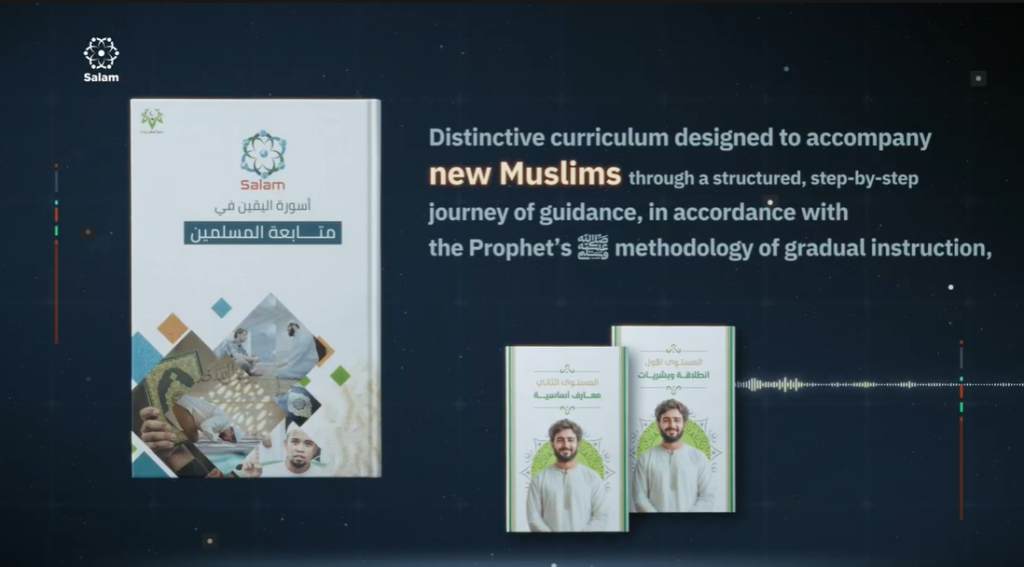
For new Muslims ready for a structured path, the Salam Center offers Asawirat Al-Yaqeen (Bracelets of Certainty) — a four-stage curriculum designed specifically for your post-conversion journey:
- Stage One: The foundational pillars — Shahada, prayer, purification, and the meaning of faith
- Stage Two: The pillars of Iman, fasting, zakat, and Hajj essentials
- Stage Three: Repentance, the biography of the Prophet (PBUH), and character development
- Stage Four: Contemporary issues, theological foundations, and your life roadmap from Surah Al-Asr
The Asawirat Al-Yaqeen (Bracelets of Certainty) program has guided 114,588 new Muslims across 140 countries. The door is open. The path is clear.
Reach out directly to the Salam Center team to start the Asawirat Al-Yaqeen (Bracelets of Certainty) program for FREE.
Summary
Al-Isra’ wal-Mi’raj — the Night Journey and Ascension of Prophet Muhammad (PBUH) — stands as a Quranically affirmed miracle, preserved in the most authenticated hadith collections, establishing Islam’s connection to Jerusalem and all prior prophets. The five daily prayers, obligated on that night, remain its most enduring gift to the Ummah.
Every Muslim who prays inherits something from that night above the heavens. The journey that began in grief and ended at the threshold of divine nearness carries a permanent message: Allah’s support for those who serve Him arrives in ways that surpass all human calculation.
Frequently Asked Questions
What is the story of Prophet Muhammad’s Night Journey in brief?
The Night Journey (Al-Isra’ wal-Mi’raj) was a miraculous two-part journey: first from Masjid al-Haram in Makkah to Masjid al-Aqsa in Jerusalem (Al-Isra’), then an ascension through the seven heavens to Sidrat al-Muntaha (Al-Mi’raj). It is affirmed in Quran 17:1 and authenticated hadith collections including Sahih Bukhari and Sahih Muslim.
What is the name of the Prophet Muhammad’s horse — or creature — in the Night Journey?
The creature is called Al-Buraq. According to Sahih Muslim, it was a white beast, larger than a donkey but smaller than a mule, whose stride covered the farthest point visible in a single step. Al-Buraq is not classified as a horse in the hadith; the name derives from the Arabic word for lightning.
Was the Night Journey physical or only spiritual?
The consensus of Ahlus Sunnah wal Jama’ah scholars is that the journey was physical, undertaken by the Prophet’s body and soul while he was awake. The Quran uses the word ’abd (servant), referring to the whole person, and the Quraysh’s shocked reaction confirms they understood it as a bodily claim.
What was the greatest gift the Prophet (PBUH) brought back from the Night Journey?
The five daily prayers were made obligatory during the Mi’raj. Allah initially prescribed fifty prayers; through the intercession of Prophet Musa (peace be upon him) urging the Prophet (PBUH) to seek reductions, the number was lowered to five — while carrying the reward of fifty.
Why did the Night Journey begin from Masjid al-Aqsa and not ascend directly from Makkah?
Masjid al-Aqsa is the station where all prophets gathered in history and in that night — the Prophet (PBUH) led them all in prayer there before the ascension began. Jerusalem represents the convergence of all divine messages. The ascension departing from there affirms Islam’s position as the culmination and seal of prophethood, and Al-Aqsa’s permanent theological significance in Islamic belief.
Curious about Islam?
Journey towards clarity and purpose. Our team is here to support you in your search for truth and spiritual guidance.
Embrace the Truth