Archaeological Evidence of Prophet Muhammad
| Key Takeaways |
| Physical inscriptions dating to the Prophet’s own lifetime (as early as 625 CE / 4 AH) have been discovered in the Arabian Peninsula, bearing his name and the names of his Companions. |
| The Prophet’s diplomatic letters to the Byzantine emperor Heraclius, the Persian king Khosrow II, and the Egyptian ruler Muqawqis survive as authenticated historical artifacts. |
| The renowned historian Edward Gibbon documented Muhammad’s prophetic mission and his correspondence with world leaders in his landmark work on the Roman Empire. |
| Early Arabic Hijazi script inscriptions from Sal’ Mountain in Medina confirm the presence of named Companions — Abu Bakr, Umar, Ali ibn Abi Talib — in the first years after the Hijra. |
| A funerary inscription dated 55 AH discovered in Halhul, Palestine, is among the oldest Islamic inscriptions found in the Levant, bearing the Shahada in early Kufic script. |
Physical proof of Prophet Muhammad’s existence does not require faith to appreciate — it requires honest inquiry. Secular historians, archaeologists, and museum curators across the world have catalogued artifacts, inscriptions, and letters that place Muhammad ibn Abdullah (PBUH) and his closest Companions squarely within recorded history. These are dated objects, carved stones, and preserved parchments.
For anyone asking whether Muhammad (PBUH) was a real historical figure, the answer archaeology provides is unambiguous: yes — and the evidence begins during his own lifetime.
1. The Earliest Known Arabic Inscription Bearing the Prophet’s Name — Sal’ Mountain, Medina (c. 625 CE / 4 AH)
One of the most remarkable discoveries in early Islamic archaeology comes from the rocky slopes of Jabal Sal’ (Mount Sal’) in Medina, Saudi Arabia.
A stone inscription dated to approximately 4 AH / 625 CE — within the Prophet’s own lifetime — was found carved in early Hijazi script, the precursor to what later became Kufic calligraphy.
The inscription reads, in part:
“… Muhammad ibn Abdullah… Ali ibn Abi Talib… Abu Bakr… Yaj’al Allahu Umar min Ahl al-Jannah…”
Translated: “Muhammad ibn Abdullah… IAli ibn Abi Talib… Abu Bakr… May Allah make Umar among the people of Paradise…”
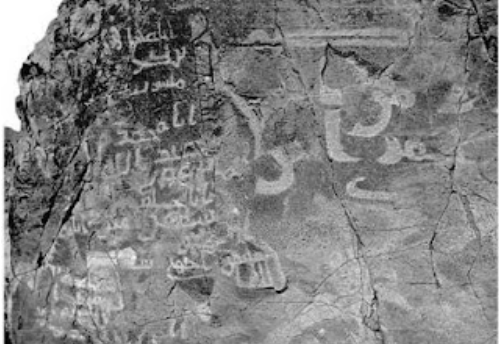
This inscription names the Prophet himself alongside three of the four rightly-guided Caliphs: Abu Bakr, Umar, and Ali ibn Abi Talib. Additional Companions mentioned include Ammar ibn Hazm, Maymun, and Sa’d ibn Mu’adh — all individuals attested in Islamic historical sources.
The inscription also contains explicit affirmations of Islamic creed:
This artifact predates the Umayyad period entirely — the era that Western Orientalists frequently cite as the origin of Islamic historical fabrication — by more than half a century.
Sources:
- M. Hamidullah, “Some Arabic Inscriptions Of Medinah Of The Early Years Of Hijrah”, Islamic Culture, 1939, Volume XIII, p. 438
- G. C. Miles, “Early Islamic Inscriptions Near Ta’if In The Hijaz”, Journal of Near Eastern Studies, 1948, Volume VII, p. 240
- Y. H. Safadi, Islamic Calligraphy, 1979, Shambhala Publications, p. 15
2. A Second Sal’ Inscription Naming Abu Bakr and Umar Together (Early Hijri Period)
A second inscription recovered from the same site at Jabal Sal’ carries a supplication that joins the names of the Prophet’s two most senior Companions in a single devotional statement:
“Amsa wa asbaha Umar wa Abu Bakr yatawadda’an ila Allah”
Translated: “Umar and Abu Bakr spend their evenings and mornings turning to Allah in repentance and supplication.”
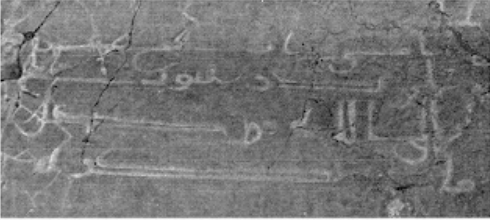
The intimacy and theological precision of this statement — two named individuals, both historically documented figures, engaged in an act of worship directed toward Allah — reflects authentic Islamic devotional expression from the very first generation of Muslims.
Source:
- M. Hamidullah, “Some Arabic Inscriptions Of Medinah Of The Early Years Of Hijrah”, Islamic Culture, 1939, Volume XIII, pp. 427–439
3. A Third Sal’ Inscription Containing the Shahada — The Islamic Declaration of Faith
A third inscription from Jabal Sal’, partially damaged, carries what is recognizable as an early form of the Shahada — Islam’s foundational declaration of faith:
“Ashhadu an la… ilaha [illa A]llah wa ashhadu anna Muhammad ‘abduhu [wa Rasulu]h…”
Translated: “I bear witness that there is no god [but A]llah, and I bear witness that Muhammad is His servant [and Messen]ger…”
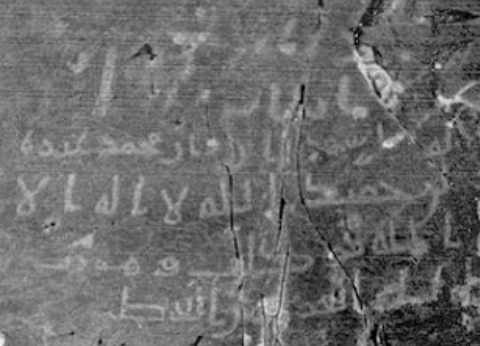
The inscription continues with the Quranic supplication: “wa huwa Rabb al-‘Arsh al-Azim” — “and He is the Lord of the Magnificent Throne” — a phrase drawn directly from Surah Al-Tawbah (9:129).
That the core theological formula of Islam appears in stone during the Prophet’s own era confirms that the Shahada was not a later doctrinal construction but a living declaration from the community’s earliest days.
This connects directly to the foundational discussion of faith in Islam as a structured, evidenced creed.
Source:
- M. Hamidullah, “Some Arabic Inscriptions Of Medinah Of The Early Years Of Hijrah”, Islamic Culture, 1939, Volume XIII, pp. 427–439
Learn More About Islam
Discover the beauty, teachings, and wisdom of Islam in a clear and welcoming way. Start exploring and deepen your understanding today.
Learn More4. The Prophet’s Letter to Muqawqis, Ruler of Byzantine Egypt — Preserved in the Topkapi Museum, Istanbul
In the period following the Treaty of Hudaybiyyah (6 AH / 628 CE), Prophet Muhammad (PBUH) dispatched diplomatic envoys to the rulers of the known world, inviting them to Islam. His letter to al-Muqawqis — the Byzantine-appointed governor of Egypt — was carried by the Companion Hatib ibn Abi Balta’ah.
The letter reads:
“Bismillah al-Rahman al-Rahim. From Muhammad ibn Abdullah to al-Muqawqis, the great one of the Copts. Peace be upon whoever follows guidance. I invite you with the invitation of Islam — submit and you will be safe, and Allah will give you your reward twice over. If you turn away, upon you falls the sin of the Copts. O People of the Scripture, come to a word that is equitable between us and you — that we worship none but Allah, and associate nothing with Him, and that none of us takes others as lords besides Allah. But if they turn away, then say: ‘Bear witness that we are Muslims.'”
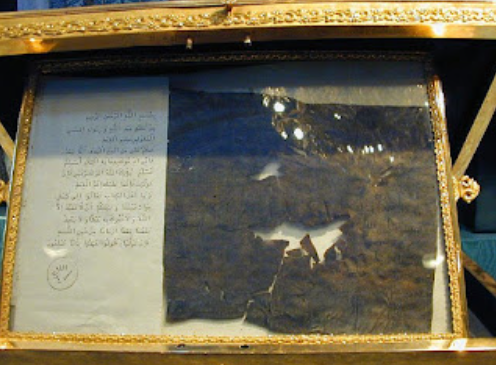
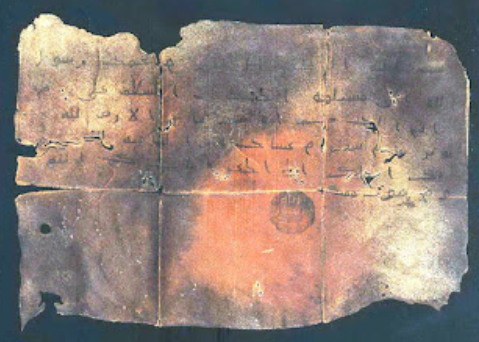
This letter is currently preserved in the Topkapi Museum (Topkapı Sarayı Müzesi) in Istanbul, Turkey — one of the world’s most important repositories of Ottoman and Islamic heritage objects.
Its preservation in a state institution whose holdings are subject to scholarly scrutiny removes any ambiguity about its authenticity as a historical artifact.
The Quranic verse embedded at the letter’s conclusion is Surah Al-Imran (3:64):
قُلْ يَا أَهْلَ الْكِتَابِ تَعَالَوْا إِلَى كَلِمَةٍ سَوَاءٍ بَيْنَنَا وَبَيْنَكُمْ
“Say, ‘O People of the Scripture, come to a word that is equitable between us and you…'” (Quran 3:64)
Read also: Prophet Muhammad’s Family Tree and Lineage
5. The Prophet’s Letter to Heraclius, Emperor of Byzantium — Documented in Multiple Historical Sources
The letter sent to Heraclius (Hiraql), Emperor of the Byzantine Roman Empire, was carried by the Companion Dihyah al-Kalbi. Its text has been preserved in the hadith literature of Sahih Bukhari — the most rigorously authenticated hadith collection in Islamic scholarship — and corroborated by Byzantine historical accounts.
The letter reads:
“Bismillah al-Rahman al-Rahim. From Muhammad, the servant of Allah and His Messenger, to Heraclius, the great one of the Romans. Peace be upon whoever follows guidance. I invite you with the invitation of Islam — submit and you will be safe, and Allah will give you your reward twice over. If you turn away, upon you falls the sin of the Arisiyyin. O People of the Scripture, come to a word equitable between us and you…”
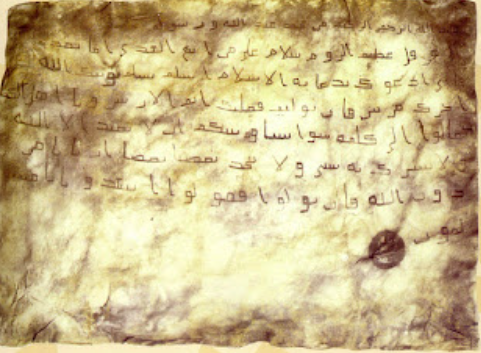
Heraclius’s own response to the letter is documented in Sahih Bukhari. He convened a gathering and reportedly acknowledged — in private — that the description of the expected prophet matched what he knew.
The Byzantine emperor’s engagement with this letter is itself an independent historical corroboration of the Prophet’s outreach to world powers.
Read also: The Splitting of the Moon by Prophet Muhammad
6. The Prophet’s Letter to Khosrow II, King of Persia — Cited by Edward Gibbon
The letter dispatched to Khosrow II (Kisra) of the Sassanid Persian Empire was carried by the Companion Abdullah ibn Hudhafa al-Sahmi. It reads:
“Bismillah al-Rahman al-Rahim. From Muhammad, the Messenger of Allah, to Khosrow, the great one of Persia. Peace be upon whoever follows guidance and believes in Allah and His Messenger, and bears witness that there is no god but Allah alone with no partner, and that Muhammad is His servant and Messenger. I invite you with the call of Allah Almighty, for I am the Messenger of Allah to all mankind, to warn the living and that the word may be fulfilled against the disbelievers. Submit and you will be safe. If you refuse, upon you falls the sin of the Magi.”
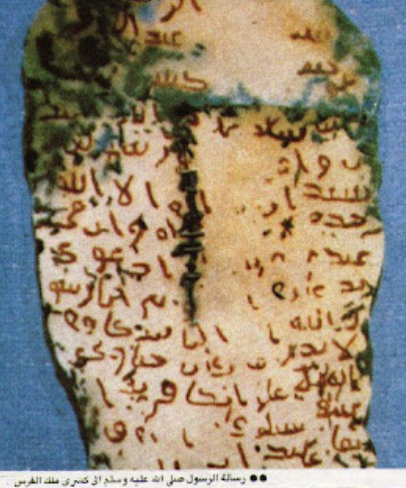
Khosrow II tore the letter in contempt. When news of this reached the Prophet (PBUH), he supplicated that Allah would tear Khosrow’s kingdom apart. The historical record confirms that within a short period, the Sassanid Empire collapsed in internal revolt — Khosrow was killed by his own son — and Persia never recovered its former dominion.
This sequence of events was documented by the British historian Edward Gibbon in his monumental work The History of the Decline and Fall of the Roman Empire (Volume 5, pp. 73–77). Gibbon — writing from a secular, Western scholarly perspective — recorded:
“When the Persian emperor had completed his triumph over the Romans, a letter reached him from an obscure citizen of ‘Mecca,’ inviting him to believe in Muhammad as the Messenger of Allah. He rejected the invitation and tore the letter. When this news reached the Arab Messenger, he said: ‘Allah will tear his kingdom apart and destroy his power.'”
Gibbon’s account is independent corroboration from a non-Muslim historian of international standing — confirming both the Prophet’s existence and his diplomatic correspondence with the world’s superpower of the era.
Read also: Scientific Proof of Prophet Muhammad
7. The Prophet’s Letter to al-Mundhir ibn Sawa, Governor of Bahrain
The letter delivered to al-Mundhir ibn Sawa, the Sassanid-appointed governor of Bahrain, was carried by al-Ala’ ibn al-Hadrami. It reads in part:
“Bismillah al-Rahman al-Rahim. From Muhammad, the Messenger of Allah, to al-Mundhir ibn Sawa. Peace be upon you. I praise Allah before you — there is no god but He. I bear witness that there is no god but Allah and that Muhammad is His servant and Messenger. I remind you of Allah Almighty… Whoever follows my messengers and acts upon their command has obeyed me. Whoever sincerely advises them has sincerely advised me. My messengers have praised you highly. I have interceded for your people. Leave for the Muslims what they have embraced Islam upon… Whoever remains upon Magianism owes the jizya.”
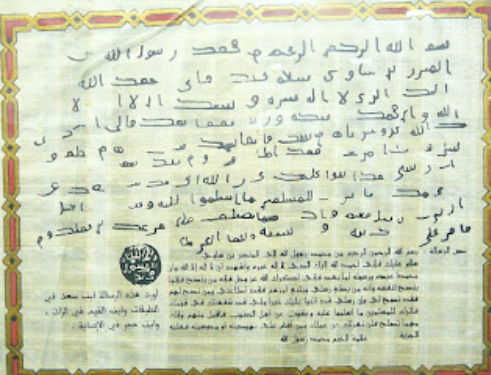
Al-Mundhir ibn Sawa accepted Islam. A significant portion of Bahrain’s population followed. Gibbon himself references this letter in the pages immediately preceding his account of the letter to Khosrow — establishing that the Prophet’s outreach to the Gulf region was documented in Western historiography independently of Islamic sources.
8. The Prophet’s Letter to al-Harith ibn Abi Shamir al-Ghassani, King of al-Hira
The letter carried by the Companion Shuja’ ibn Wahb al-Asadi to al-Harith ibn Abi Shamir, the Ghassanid client-king of al-Hira, reads:
“From Muhammad, the Messenger of Allah, to al-Harith ibn Shamir. Peace be upon whoever follows guidance and believes in Allah and affirms the truth. I invite you to believe in Allah alone with no partner. Your kingdom will be preserved for you.”
The Ghassanid kingdom was a Christian Arab state that served as a Roman buffer against Arabia. That the Prophet (PBUH) addressed its king directly — and that this correspondence entered historical records on both the Islamic and Byzantine sides — further anchors Muhammad’s political existence in the documented landscape of seventh-century geopolitics.
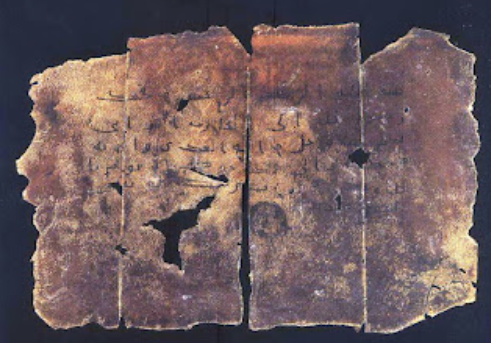
9. The Prophet’s Response to Musaylimah al-Kadhdhab — Evidence of Early Islamic Political Reality
The Prophet’s written reply to Musaylimah ibn Habib — the false prophet of the Banu Hanifa tribe, whom history records as al-Kadhdhab (the Liar) — is itself an archaeological and historical document of significance:
“From Muhammad, the Messenger of Allah, to Musaylimah the Liar. Peace be upon whoever follows guidance. As for what follows: the earth belongs to Allah; He bequeaths it to whomever He wills among His servants. The final outcome belongs to the righteous.”
The existence of this correspondence proves that the Prophet’s prophetic authority was real enough to provoke a rival claimant — and that the early Muslim community maintained documented written communication even in internal theological disputes. This fits squarely within the broader pattern of Islam’s principles as a complete system addressing both spiritual and political realities.
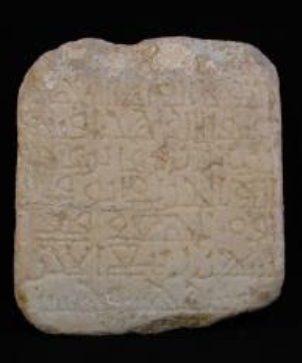
10. The Halhul Funerary Inscription, Palestine — Dated 55 AH / 675 CE
Discovered at the shrine traditionally attributed to the Companion Abdullah ibn Mas’ud in the town of Halhul, north of Hebron in Palestine, this gravestone inscription is among the oldest Islamic epigraphs found in the Levant.
The inscription commemorates al-Malik ibn al-Rumi al-Jarmi and reads:
“[Bismillah al-Rahman al-Rahim] — Allah, there is no god but Allah, Muhammad is the Messenger of Allah. This is the grave of al-Malik ibn al-Rumi ibn Abdullah al-Jarmi. He died on a Friday in the month of Rabi’ al-Akhir in the year fifty-five.”
The stone is carved in early Kufic script with clear diacritical marks. It consists of eight lines; the first line (likely containing the Basmala) has been lost. Paleographic analysis confirms that the script style is consistent with authenticated inscriptions from the same century.
Critically, this inscription:
- Bears the complete Shahada — confirming monotheistic Islamic creed as practiced in the generation immediately following the Prophet
- Uses a precise Islamic calendar date (55 AH), cross-referenceable with 675 CE
- Was carved in early Kufic, the direct descendant of the Hijazi script used in the Prophet’s own era
- Was discovered in Palestine — demonstrating that Islamic faith, grounded in the oneness of Allah, had spread across the region within decades of the Prophet’s death
The artifact is catalogued and accessible through the Museum With No Frontiers — Discover Islamic Art database.
What Do This Archaeological Evidence of Prophet Muhammad Mean Together?
Each item in this list represents a different category of evidence: diplomatic correspondence, devotional rock inscriptions, funerary monuments, and external historical documentation. Together, they form a convergent body of proof.
The Prophet’s letters survive in museum custody and in the hadith literature of Sahih Bukhari — authenticated through chains of transmission that academic hadith scholars like Dr. Jonathan Brown of Georgetown University have analyzed as among the most rigorous oral and written verification systems in pre-modern history. The rock inscriptions from Jabal Sal’ predate the Umayyad period. The Halhul stone was carved less than half a century after the Prophet’s death.
Those who approach Islamic history with genuine intellectual curiosity — rather than predetermined conclusions — find not a mythology constructed in the dark, but a faith whose founding figure left material traces in stone, parchment, and the diplomatic archives of the greatest empires of his age.
Understanding who Allah is in Islam and why Muslims believe in the Quran becomes far more grounded once the historical reality of the Prophet’s mission is appreciated not through blind acceptance but through verified evidence.
Learn More About Islam
Discover the beauty, teachings, and wisdom of Islam in a clear and welcoming way. Start exploring and deepen your understanding today.
Learn MoreYour Path to Deeper Knowledge Starts Here with Salam
If these artifacts have sparked a sincere question — or deepened a conviction already forming — the Salam Center exists to accompany you further.
Explore more on the Salam Platform and read deeply researched articles on the Salam blog.
If you have a specific question about Islam, want to understand what it means to enter this faith, or simply need someone to speak with honestly and without pressure — reach out directly.
Read Also: The Night Journey of Prophet Muhammad (Al-Isra’ and Al-Mi’raj)

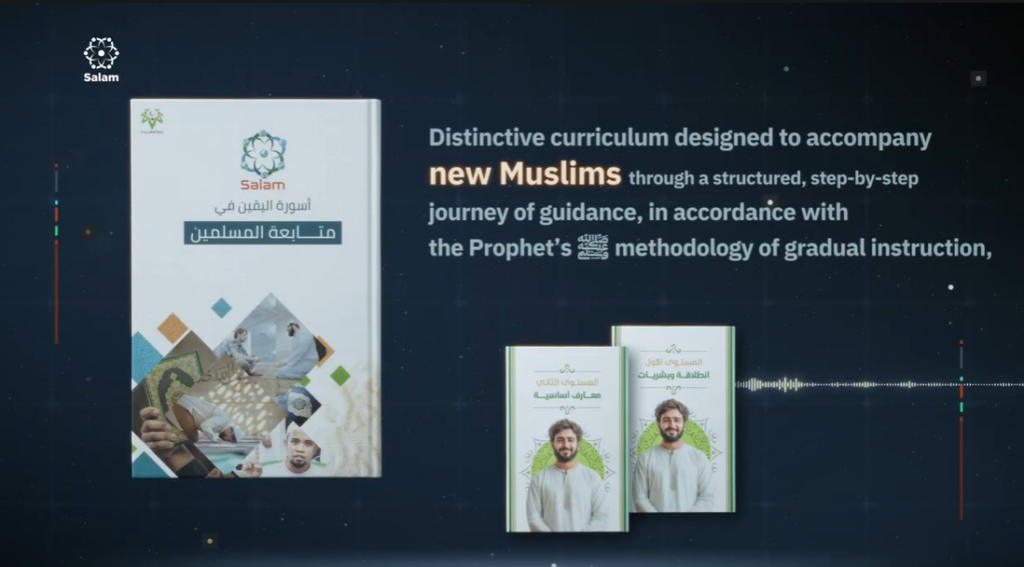
For those who have already taken their Shahada, the Salam Center offers the Asawirat Al-Yaqeen (Bracelets of Certainty) program — a structured four-stage curriculum designed specifically for new Muslims:
- Stage One: The foundational pillars — Shahada, prayer, purification, the meaning of Iman
- Stage Two: Zakat, fasting, Hajj, and the six pillars of faith in complete detail
- Stage Three: Sincere repentance, major sins to avoid, and the life of the Prophet (PBUH)
- Stage Four: Contemporary issues, Quranic evidence, characteristics of Ahlus Sunnah, and a life roadmap based on Surah Al-Asr
The program has guided 114,588 new Muslims across 140 countries, with over 63% completing all four stages. It is available in multiple languages and being developed into a smart interactive application.
Reach out directly to the Salam Center team to start the Asawirat Al-Yaqeen (Bracelets of Certainty) program for FREE.
Conclusion
Archaeological inscriptions from Jabal Sal’ in Medina, dated to approximately 625 CE, carry the Prophet’s name alongside named Companions in early Hijazi script — predating any Umayyad-era sources by decades. These physical artifacts ground Muhammad’s existence in verifiable material history.
Diplomatic letters addressed to Heraclius, Khosrow II, and al-Muqawqis were delivered during the Prophet’s lifetime and corroborated by both Islamic hadith collections and Western historians like Edward Gibbon, whose secular account confirms the Prophet’s outreach to world leaders.
The Halhul funerary inscription, dated 55 AH and preserved in Palestine, shows Islam’s complete Shahada carved in early Kufic script within one generation of the Prophet’s death — evidence that his community, his creed, and his name endured in stone across the known world.
Frequently Asked Questions
Is there any non-Muslim historical source that confirms Prophet Muhammad existed?
Edward Gibbon — the foremost British historian of the Roman Empire — documented Prophet Muhammad’s correspondence with Heraclius and Khosrow II in The History of the Decline and Fall of the Roman Empire (Volume 5, pp. 73–77). Gibbon’s secular account confirms that a figure from Mecca dispatched diplomatic letters to world powers and accurately predicted the eventual Roman victory over Persia — a prediction the historian himself described as extraordinary given the military circumstances of the time. Byzantine sources also record Heraclius’s direct engagement with the Prophet’s letter.
Where are the Prophet’s letters to world leaders preserved today?
The Prophet’s letter to al-Muqawqis, the Byzantine governor of Egypt, is preserved in the Topkapi Museum in Istanbul, Turkey — a state institution whose holdings are subject to ongoing scholarly study. The letters to Heraclius and Khosrow II are documented in Sahih Bukhari and corroborated in external historical sources. The letter texts are internally consistent across multiple chains of transmission, which Islamic hadith methodology — one of the most rigorous historical verification systems of the pre-modern world — considers a marker of authenticity.
Do these inscriptions predate the Umayyad period?
Yes. The Jabal Sal’ inscriptions date to the Prophet’s own lifetime (c. 625 CE), more than thirty years before the Umayyad Caliphate began in 661 CE. This directly refutes the claim — common among Orientalist scholars — that Islamic historical sources were fabricated or systematically shaped during the Umayyad era. Stone inscriptions cannot be retroactively altered.
What does the Halhul inscription prove archaeologically?
The Halhul funerary inscription, dated 55 AH / 675 CE and discovered in Palestine, proves three things: that the full Islamic Shahada was in active use within one generation of the Prophet’s death; that early Kufic script — evolved from the Hijazi script of the Prophet’s era — was already being used for formal religious inscriptions across the Levant; and that Islamic identity, grounded in monotheism and the prophethood of Muhammad, had become a defining framework for Muslim communities from Arabia to Palestine within decades of the Prophet’s passing.
Curious about Islam?
Journey towards clarity and purpose. Our team is here to support you in your search for truth and spiritual guidance.
Embrace the Truth