Scientific Proof of Prophet Muhammad
| Key Takeaways |
| Non-Muslim historians writing within decades of the Prophet’s death documented his existence, teachings, and the rapid rise of Islam with striking accuracy. |
| The Armenian chronicler Sebeos, writing around 661 CE, named Prophet Muhammad (PBUH), described him as a merchant and monotheist preacher, and detailed his specific religious laws. |
| Early Syriac Christian sources from 637–650 CE independently confirm the Arab conquests, the centrality of Muhammadan leadership, and the absence of religious persecution under the early caliphs. |
| Over 40 Quranic manuscripts from the first Islamic century show 100% textual consistency with the Quran in circulation today — a phenomenon unmatched in the history of ancient texts. |
| Rock inscriptions dated to the first Islamic century, including the Zuhayr inscription of 24 AH, preserve the names of companions and caliphs in material form, demolishing the myth of fabricated Islamic history. |
| Modern scholarship, including the revisionist work of Patricia Crone, ultimately confirmed that Muhammad (PBUH) is among the best-attested figures in all of ancient history. |
The historical existence of Prophet Muhammad (PBUH) is not a matter of religious faith alone — it is one of the most thoroughly documented facts in the ancient world. When researchers apply the standard tools of historical criticism to early Islam, they encounter something remarkable: a convergence of evidence from hostile, neutral, and external sources that independently confirm the Islamic narrative with extraordinary precision.
This article presents the scientific and historical proof of Prophet Muhammad (PBUH) in a structured format, drawing on non-Islamic manuscripts, dated rock inscriptions, paleographic analysis, and the testimony of contemporary chroniclers who had every reason to distort the record — yet did not.
Is There Scientific or Historical Proof That Prophet Muhammad Actually Existed?
Yes. The historical evidence for Prophet Muhammad (PBUH) includes non-Muslim written sources from within decades of his death, dated Arabic inscriptions from the first Islamic century, and Quranic manuscripts verified by radiocarbon dating.
The Armenian chronicler Sebeos, writing around 661 CE, named him, described his background as a merchant, and detailed his religious laws.
Syriac Christian sources from 637 and 640 CE refer explicitly to “the Arabs of Muhammad.” This level of external documentation exceeds what exists for many figures of the ancient world whose historicity is never questioned.
1. The Sebeos Chronicle Confirms Prophet Muhammad’s Name, Identity, and Laws
The Armenian bishop and historian Sebeos wrote his chronicle around 661 CE — approximately 29 years after the Prophet’s death. Writing in a Christian context with no reason to affirm Islamic claims, he named “Mahmet” (Muhammad), identified him as a merchant from among the Ishmaelites, described his preaching of strict monotheism, and listed his specific religious prohibitions: the consumption of dead animals, alcohol, lying, and fornication.
This level of detail is extraordinary. These exact prohibitions correspond directly to Quranic legislation and Prophetic practice.
Sebeos was not a Muslim, had no access to Islamic theological sources, and was writing in Armenia.
The fact that his account aligns so precisely with the Islamic record constitutes what historians call external corroboration — independent confirmation from a source with no motive to support the Islamic narrative.
The Sebeos chronicle is held at the Matenadaran Institute of Ancient Manuscripts in Yerevan, Armenia, and has been translated and analyzed by the historian Robert Thomson in The Armenian History Attributed to Sebeos (Liverpool University Press, 1999).
2. Syriac Christian Sources from 637–640 CE Document “The Arabs of Muhammad”
Two Syriac Christian sources, written within a decade of the Prophet’s death, explicitly mention Muhammad’s followers by name.
The Syriac Chronicle of 637 CE refers directly to “the Arabs of Muhammad” in the context of the conquest of Syria and Homs.
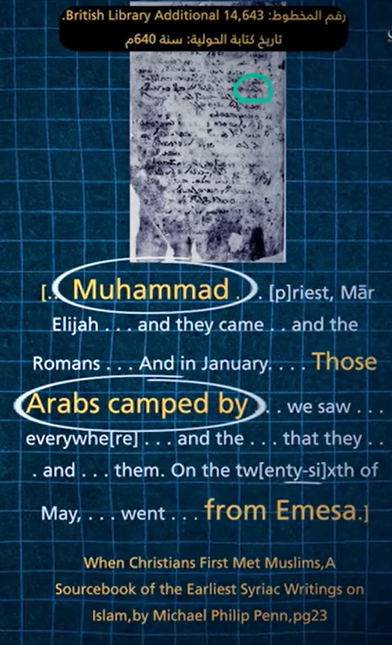
The writings attributed to Thomas the Presbyter, dated to approximately 640 CE, record the Arab victory in the Battle of Dathin and affirm the central authority of Muhammadan leadership over these forces.
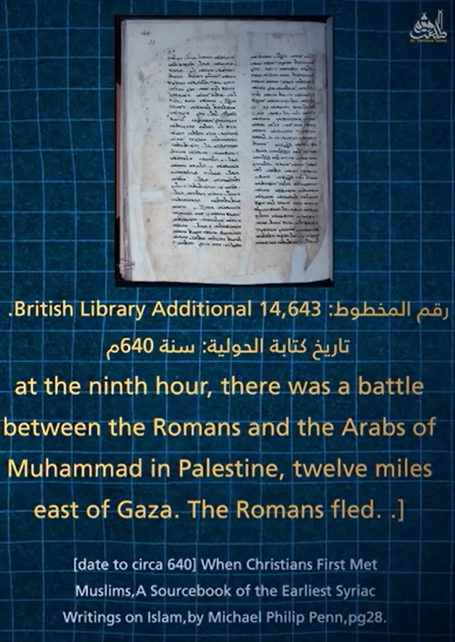
These documents were written in communities living under — or directly adjacent to — the early Islamic expansion. They are not theological documents; they are administrative and ecclesiastical records. Their authors had no incentive to invent a prophet for a rival religion.
The fact that they record these events contemporaneously, using the Prophet’s name as an identifier for an entire movement, confirms that “Muhammad” was an immediately recognizable historical figure in the consciousness of neighboring peoples at that precise moment in history.
Robert Hoyland, Professor of Late Antique and Early Islamic Middle Eastern History at New York University, catalogued over 100 such external documents in his landmark study Seeing Islam as Others Saw It (Darwin Press, 1997), which remains the definitive academic reference for non-Islamic sources on early Islam.
Learn More About Islam
Discover the beauty, teachings, and wisdom of Islam in a clear and welcoming way. Start exploring and deepen your understanding today.
Learn More3. A Syriac Patriarch’s Letter from 650 CE Confirms Religious Tolerance Under the Early Caliphs
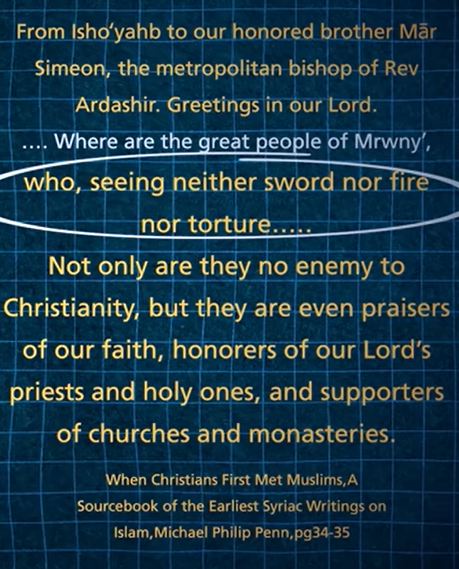
In 650 CE — corresponding to 29 AH, during the caliphate of Uthman ibn Affan — the Patriarch of the Syriac Church wrote a letter to his bishops that has survived as a historical document. In it, he acknowledged that the Arab rulers had not persecuted Christians, had not forced conversions, and had maintained conditions under which Christian communities continued to worship freely.
This document carries significant evidential weight for two reasons.
First, it is dated with precision to the era of the Rightly Guided Caliphs (Khulafa’ ar-Rashidun), not to a later period when the historical record might have been shaped by Muslim scribes.
Second, it comes from a church leader whose natural institutional interest would have been to document any persecution — and he found none to report.
This corroborates the Islamic historical narrative of religious freedom during the early caliphate, a claim that sceptics have questioned.
When a Christian patriarch confirms it in a letter to other Christians, the argument for fabrication collapses entirely.
4. The Zuhayr Rock Inscription of 24 AH Is a Dated Legal Document Naming Umar ibn al-Khattab
Carved into stone in the Arabian Peninsula and dated to 24 AH — the very year of Umar ibn al-Khattab’s assassination — the Zuhayr inscription is among the most important material artifacts of early Islamic history. It records the death of Umar by name and provides a precise hijri date.
This inscription dismantles several revisionist arguments simultaneously. It proves that the name “Umar ibn al-Khattab” was inscribed in durable material form within the lifetime of people who knew him personally. It establishes that the Islamic calendar was in active use from the very first decades. It shows that early Muslims were literate record-keepers, not an oral culture with no contemporaneous documentation.
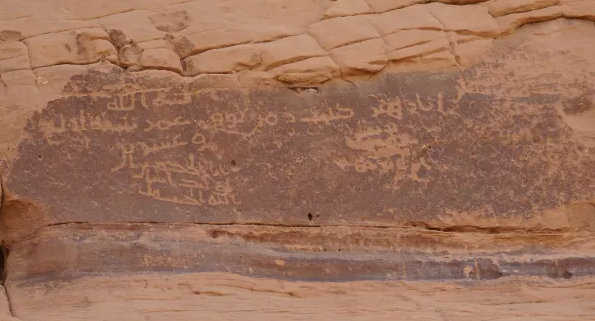
Critically, the inscription also displays early Arabic diacritical marks (tashkeel), refuting the claim that dotting and vowelization were innovations of later centuries.
This aligns with the report attributed to Ibn Abbas that Amir ibn Jadrah used diacritical marks early on, and that the Uthmanic manuscripts were deliberately left without them to accommodate variant recitations — not from ignorance of the system, but by scholarly design.
The inscription is documented in the academic corpus of Arabian epigraphy and discussed in detail by Frédéric Imbert, a specialist in early Arabic inscriptions at Aix-Marseille University, in his peer-reviewed work on Arabian rock graffiti.
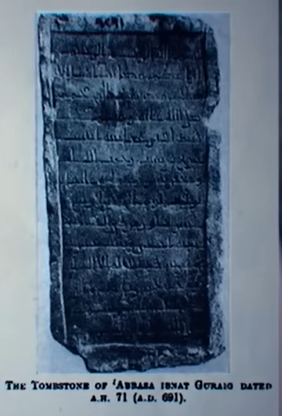
5. The Gravestone of Abbasa bint Jurays, Dated 71 AH, Records Popular Grief Over the Prophet’s Death
Among the earliest Islamic funerary inscriptions is the gravestone of Abbasa bint Jurays, dated to 71 AH. It carries an expression of grief over “the great calamity of the Muslims” — the death of the Prophet Muhammad (PBUH).
This inscription is remarkable not only as a historical artifact but as a window into early Muslim emotional and religious life.
A gravestone erected 71 years after the Prophet’s death still invokes his passing as the defining sorrow of the community.
This is not the behavior of a community that invented a prophet retrospectively. It is the behavior of a community living with the living memory of a real man whose loss had shaped their entire world.
Gravestones, by their nature, cannot be retroactively edited. They are fixed in stone, in time, in a specific location. This one confirms that the grief, the identity, and the communal consciousness of early Muslims were oriented around a real historical figure from the very first generations.
6. Quranic Manuscripts from the First Century AH Show 100% Textual Consistency
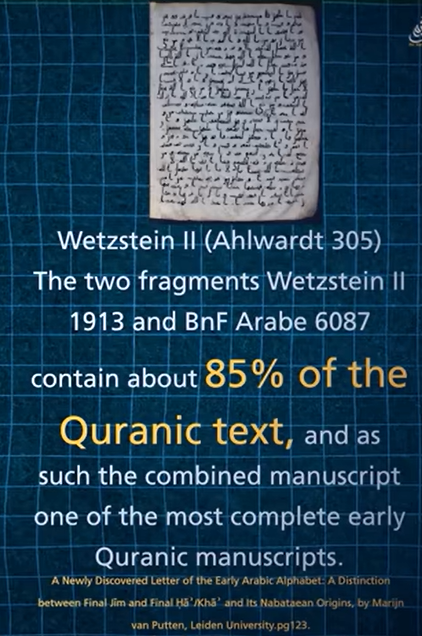
More than 40 Quranic manuscripts dating to the first Islamic century have been subjected to rigorous paleographic and radiocarbon analysis. The results are scientifically staggering: every one of these manuscripts shows a text that is 100% consistent with the Quran in circulation today.
Among the most significant are the Wetzstein manuscript, which covers approximately 85% of the Quranic text; the London manuscript, covering over 60%; and a Paris manuscript that specialists have dated to approximately 30 AH — placing it squarely within the era of the Rightly Guided Caliphs.
To understand why this matters scientifically, consider that the New Testament’s earliest complete manuscripts date to over 300 years after Jesus. The Iliad’s earliest manuscripts are separated from their composition by centuries.
No ancient text in human history can demonstrate what the Quran demonstrates: manuscript coverage of the majority of a text’s content, with zero substantive variation, within decades of its first compilation.
To understand the Islamic position on the Quran’s preservation and its significance for faith in Islam, the textual evidence and the theological tradition are now in full alignment.
7. The Spanish Chronicle of 754 CE Independently Records the Reigns of Abu Bakr and Umar
The anonymous Chronicle of 754 CE, written in Visigothic Spain — geographically and culturally as far from Arabia as the medieval world permitted — independently records the succession of Abu Bakr and Umar, the conquest of Alexandria, and the assassination of Umar ibn al-Khattab during prayer.
The author was a Christian cleric in a Latin-writing tradition. He was recording events that impacted his own civilization’s periphery.
He had no access to Islamic scholarly sources, no familiarity with hadith transmission, and no reason to preserve an accurate account of early Islamic governance other than the fact that it was historically true and consequential enough to document.
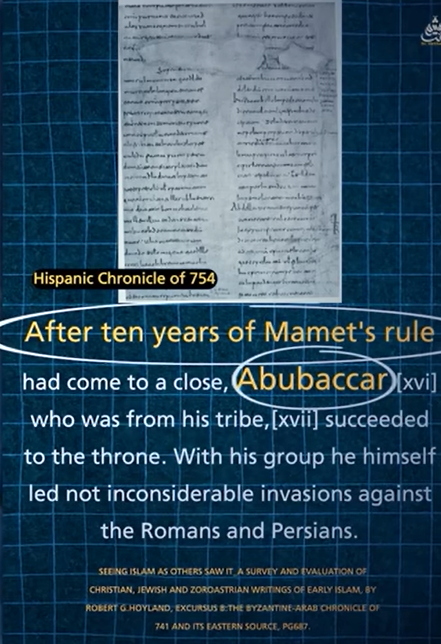
The convergence of this source with the Islamic record on specific details — including the manner of Umar’s death — is the kind of cross-cultural corroboration that historians regard as the gold standard of verification.
When a Spanish Christian chronicler and an Islamic oral tradition, operating in completely separate information environments, agree on the same specific facts, the probability of independent fabrication becomes statistically negligible.
8. Patricia Crone’s Academic Reversal Validates the Historical Method of Islamic Scholarship
Patricia Crone was among the most prominent Western sceptics of early Islamic history. Her 1977 work Hagarism, co-authored with Michael Cook, represented the peak of what historians call the “revisionist” or “sceptical” school — which questioned whether the Islamic narrative of early history could be trusted at all.
By the final decades of her career, Crone had substantially revised her position. In later writings, she acknowledged the historical reality of Prophet Muhammad (PBUH) and stated explicitly that we know more about Muhammad than we know about Jesus — with the ability to know considerably more. This is not a minor concession from a minor scholar.
Crone held the Harold Cherniss Chair in the History of Ideas at the Institute for Advanced Study in Princeton. Her reversal was intellectually honest and academically documented.
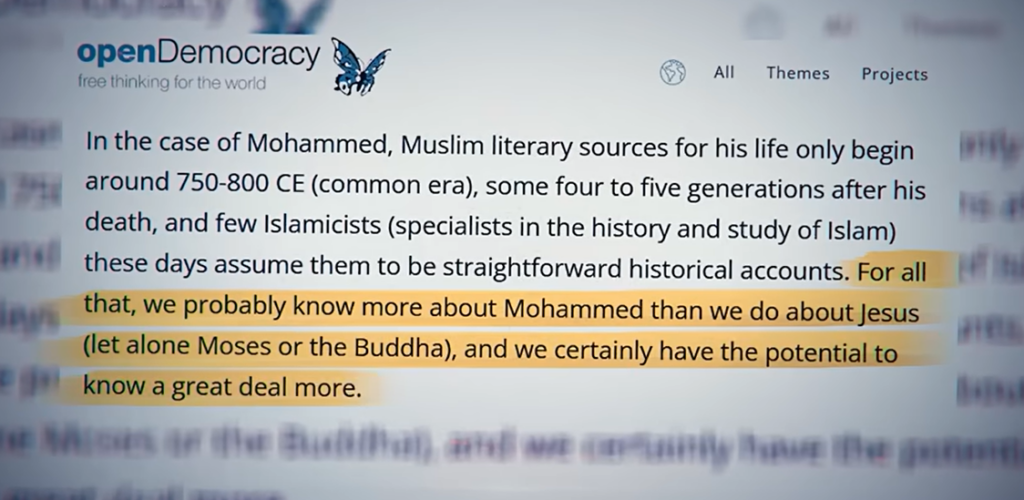
Her trajectory illustrates the larger arc of the field: the more rigorously external evidence is examined, the more consistently it confirms the Islamic historical tradition.
The methodology of isnad — the chain of transmission that Muslim scholars developed to authenticate reports — is now recognized by specialists as a sophisticated epistemological system that anticipates and often surpasses modern source-critical standards.
This understanding deepens any serious engagement with Islamic beliefs as a coherent and historically grounded system of thought.
9. The Convergence of External Sources Confirms What Islamic Scholarship Preserved All Along
The cumulative weight of the evidence reviewed above leads to a conclusion that the historical method demands: the biography of Prophet Muhammad (PBUH) and the early history of the Islamic community are among the most externally corroborated narratives in the ancient world.
Armenian, Syriac, Latin, and Greek sources — written by Christians, pagans, and political administrators across three continents — independently confirm the key contours of the Islamic historical record.
Rock inscriptions across Arabia fix the names and dates of foundational figures in durable material form. Quranic manuscripts demonstrate textual preservation with a consistency unmatched by any comparable ancient document.
The Islamic science of tawatur — mass transmission through multiple independent chains — was not merely a theological mechanism for preserving religious knowledge. It was, as the external evidence now confirms, a historically effective methodology for transmitting accurate information.
What Muslim scholars preserved through isnad and tawatur, external archaeology and manuscript science have now independently verified.
For those exploring what Muslims believe about the Quran or why Muslims believe in the Quran, this convergence of internal and external evidence provides a foundation that is simultaneously scholarly and spiritually profound.
Learn More About Islam
Discover the beauty, teachings, and wisdom of Islam in a clear and welcoming way. Start exploring and deepen your understanding today.
Learn MoreYour Path to Deeper Knowledge Starts Here with Salam
If this article opened a door for you, the Salam Center exists to walk through it with you.
Whether you’re a seeker exploring Islam for the first time, someone correcting what you’ve heard in the media, or a new Muslim looking to build a firm and nourished faith — you are welcome here.
Explore more on the Salam Platform and read through the Salam blog for articles covering Islamic beliefs, history, and practice with the same depth and honesty you found here.
Have a specific question? Want to learn more about entering Islam? Reach out directly — our team is here for you.

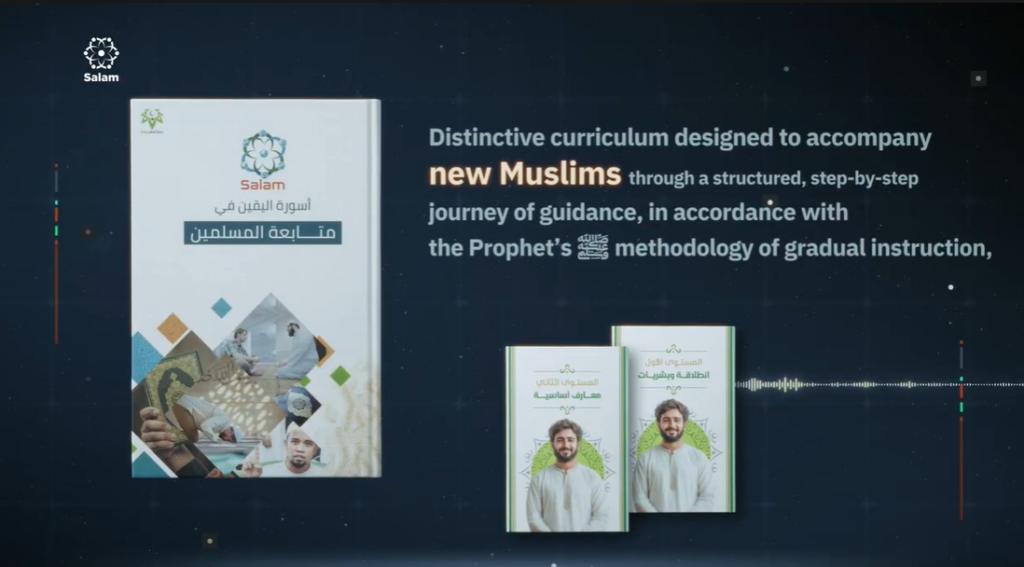
For new Muslims especially, the Salam Center offers the Asawirat Al-Yaqeen (Bracelets of Certainty) program — a structured, four-stage curriculum that has guided over 114,500 new Muslims across 140 countries. It is designed to take you from your first days of faith to a place of deep knowledge, practice, and spiritual confidence. The program includes:
- Stage One: The foundations of faith, the meaning of the Shahada, prayer, and purification
- Stage Two: The six pillars of Iman, fasting, zakat, and Hajj
- Stage Three: Repentance, major sins to avoid, and the biography of the Prophet (PBUH)
- Stage Four: Ethics, family rulings, contemporary issues, and the creed of Ahlus Sunnah wal Jama’ah
63.3% of students complete all four stages, and 41.3% graduate with an excellent grade. The curriculum is available in multiple languages and is being developed into a smart interactive application.
Reach out directly to the Salam Center team to start the Asawirat Al-Yaqeen (Bracelets of Certainty) program for FREE.
Conclusion
Non-Muslim historians writing in Armenia, Syria, and Spain within decades of the Prophet’s death independently documented Muhammad (PBUH) by name, described his monotheistic mission, and recorded the early caliphate’s governance — all consistent with the Islamic historical tradition.
Material evidence from the Arabian Peninsula — dated rock inscriptions, early Quranic manuscripts with radiocarbon-verified ages, and funerary stones from the first Islamic century — provides physical corroboration that no revisionist fabrication theory can account for.
The external record and the Islamic scholarly tradition converge on the same conclusion: Prophet Muhammad (PBUH) is among the most historically attested individuals of the ancient world, and the civilization he founded left an immediate, verifiable, and indelible mark on the written and material record of his time.
Frequently Asked Questions
What do non-Muslim historians say about Prophet Muhammad?
Non-Muslim historians from the seventh century CE confirm the central facts of the Islamic narrative. Sebeos documents Muhammad’s preaching, his legal reforms, and the rapid Arab expansion. Thomas the Presbyter records Arab military victories attributed to Muhammadan leadership.
A Syriac patriarch’s letter from 650 CE confirms religious tolerance under the early caliphs. Robert Hoyland of New York University catalogued over 100 such external documents in his study Seeing Islam as Others Saw It, demonstrating that the external historical record consistently supports rather than contradicts the Islamic tradition.
How do Quranic manuscripts prove the historical reliability of early Islamic history?
Over 40 Quranic manuscripts from the first Islamic century have been scientifically analyzed and show 100% textual consistency with the Quran used today. One Paris manuscript dates to approximately 30 AH — within the era of the Rightly Guided Caliphs. Professor François Déroche of the Collège de France, a leading authority on Islamic manuscript studies, has documented this evidence paleographically.
No other ancient text in human history demonstrates this level of early manuscript coverage with zero substantive variation. This makes the Quran both a scripture and a uniquely verifiable historical artifact, as explored in depth on Salam’s page on what Muslims believe about the Quran.
Did Western scholars who doubted early Islamic history eventually change their position?
The most significant case is Patricia Crone, who co-authored the sceptical work Hagarism in 1977 and later held the Harold Cherniss Chair at the Institute for Advanced Study in Princeton.
By the end of her career, she had reversed her earlier doubts and explicitly acknowledged the historical reality of Prophet Muhammad (PBUH), stating that we know more about him than we know about Jesus. Her intellectual reversal followed the accumulation of external evidence — inscriptions, manuscripts, and non-Islamic sources — that made the sceptical position untenable by rigorous academic standards.
What are the earliest non-Islamic sources that mention Prophet Muhammad by name?
The Sebeos Chronicle (c. 661 CE) is among the earliest, naming "Mahmet" and describing his identity and teachings in detail. The Syriac Chronicle of 637 CE refers to "the Arabs of Muhammad" in the context of the Syrian conquests.
The writings of Thomas the Presbyter (c. 640 CE) reference Arab forces under Muhammadan authority. All three sources predate any suggestion of coordinated Islamic historiographical influence, making them independently reliable witnesses to the Prophet’s historical reality. These sources are analyzed by Robert Hoyland in Seeing Islam as Others Saw It and form part of the broader evidence base discussed at the faith in Islam resource on Salam.
How does Islamic scholarship’s method of transmission compare to modern historical standards?
The Islamic science of isnad — the documented chain of narrators for every hadith — and the principle of tawatur — mass transmission through multiple independent chains — constitute a formal epistemological system for verifying historical reports. Modern historians who have studied this methodology, including Hoyland and the late Crone, have recognized it as sophisticated and rigorous.
The external material evidence now confirms what this system preserved: the Islamic historical tradition transmitted accurate information with a reliability that modern source criticism continues to verify rather than undermine. This intellectual tradition is inseparable from the principles of Islam as a complete and coherent way of life.
Curious about Islam?
Journey towards clarity and purpose. Our team is here to support you in your search for truth and spiritual guidance.
Embrace the Truth