
When Was the Bible Written Compared to the Quran? – Full Guide
| Key Takeaways |
| The Quran was revealed to Prophet Muhammad (PBUH) between 610 CE and 632 CE and was fully compiled into a single written volume shortly after his death, under the Caliph Abu Bakr (RA). |
| The Bible was not written at a single point in time — its books were composed across roughly 1,500 years, from approximately 1400 BCE to 100 CE, by many different authors. |
| The Torah (the first five books of the Old Testament) predates the Quran by over a millennium, while the New Testament was written roughly six centuries before the Quran’s revelation. |
| Islam affirms that the original revelations given to Moses (PBUH) and Jesus (PBUH) were from Allah — but those scriptures were altered over time, which is why Allah sent a final, preserved revelation. |
| Unlike the Bible, the Quran has remained textually unchanged. |
The Quran was compiled into a single authoritative text approximately 2 years after the death of Prophet Muhammad (PBUH), around 650 CE — yet its revelation had begun in 610 CE.
The Bible, by contrast, was not written in any single century. Its Old Testament contains texts stretching back to around 1400 BCE or earlier, and its New Testament was completed somewhere between 50 CE and 100 CE.
When Was the Bible Written Compared to the Quran?
In raw historical terms, the Bible is far older than the Quran. But the Bible is not a single book with a single author or a single date of composition; it is a collection — what Christians call the Old Testament and the New Testament — gathered over an extraordinarily long span of time.
1. The Old Testament is Composed Over More Than a Millennium
Most historians and biblical scholars date the earliest texts of the Hebrew Bible to somewhere between the 10th and 8th centuries BCE, though many Jewish and Christian traditions hold that the Torah (the first five books) was authored by Moses (PBUH) in the 15th or 13th century BCE.
The remaining books — the Psalms, Proverbs, the writings of the Prophets — were added over subsequent centuries, with the Hebrew canon largely settling by around 400 BCE.
The Dead Sea Scrolls, discovered in 1947 near Qumran and extensively studied by scholars at the Israel Antiquities Authority, confirmed that the Hebrew texts of the Old Testament had already been circulating in largely recognizable form by at least the 2nd century BCE.
This demonstrates that the Old Testament, in textual terms, precedes the Quran by anywhere from 600 to more than 2,000 years, depending on which book is being measured.
2. The New Testament is Written Between 50 CE and 100 CE
The New Testament tells a different story. Jesus (PBUH) — whose prophethood Islam affirms — did not write a scripture himself. The Gospels attributed to Matthew, Mark, Luke, and John were written between approximately 65 CE and 100 CE, meaning 35 to 70 years after his time.
Paul’s letters, which constitute a significant portion of the New Testament, were composed in the 50s CE — roughly 20 years after Jesus (PBUH).
The New Testament canon as Christians recognize it today was not formally settled until the late 4th century CE, particularly following the Council of Hippo in 393 CE and the Council of Carthage in 397 CE.
This means the New Testament predates the Quran by approximately 500 to 600 years.
3. The Quran is Revealed Over 23 Years, Compiled in One Generation
The Quran was revealed to Prophet Muhammad (PBUH) in stages over 23 years — beginning in 610 CE with the first verses of Surah Al-‘Alaq, and concluding with the completion of the revelation shortly before his death in 632 CE. Throughout this period, the verses were memorized by thousands of Companions and written on whatever materials were available — palm leaves, bones, parchment.
After the Prophet’s (PBUH) death, Caliph Abu Bakr As-Siddiq (RA) commissioned the formal written compilation within 1 or 2 years from the Prophet’s (PBUH) death, largely through the effort of Zayd ibn Thabit (RA), a principal scribe of the revelation.
The definitive standardized manuscript — the Mushaf — was produced during the caliphate of Uthman ibn Affan (RA), around 650 CE, and copies were sent to the major Muslim cities. This is the same text Muslims read today, letter for letter.
إِنَّا نَحْنُ نَزَّلْنَا الذِّكْرَ وَإِنَّا لَهُ لَحَافِظُونَ
“Indeed, it is We who sent down the Quran, and indeed, We will be its guardian.” (Quran 15:9)
This verse is not a poetic sentiment — it is a theological declaration that Allah has taken upon Himself the protection of this final scripture from corruption. No equivalent guarantee exists for any previous revelation.
Learn More About Islam
Discover the beauty, teachings, and wisdom of Islam in a clear and welcoming way. Start exploring and deepen your understanding today.
Learn MoreWas the Quran Written Before the Bible?
No, the Quran was not written before the Bible. The Bible, in its various components, predates the Quran. But chronological seniority and divine preservation are two separate matters entirely.
Islam does not deny the earlier revelations — it honors them. The faith in Islam requires a Muslim to believe in all previous books and prophets sent by Allah. As affirmed in the Quran:
آمَنَ الرَّسُولُ بِمَا أُنزِلَ إِلَيْهِ مِن رَّبِّهِ وَالْمُؤْمِنُونَ ۚ كُلٌّ آمَنَ بِاللَّهِ وَمَلَائِكَتِهِ وَكُتُبِهِ وَرُسُلِهِ
“The Messenger has believed in what was revealed to him from his Lord, and [so have] the believers. All of them have believed in Allah and His angels and His books and His messengers…” (Quran 2:285)
What Islam asserts with equal clarity is that those earlier scriptures — the Tawrah (Torah) and the Injeel (Gospel in its original form) — were not protected from human alteration the way the Quran has been. You can explore how Islam approaches earlier scriptures in depth through this overview of what Muslims believe about the Bible.
Imam Ibn Kathir (may Allah have mercy on him), in his monumental exegesis Tafsir al-Quran al-Azim, explained that the People of the Book altered their scriptures through additions, deletions, and misinterpretations after the prophets who received them had passed. This scholarly tradition traces back to the earliest generations of Islamic scholarship and reflects a reasoned conclusion — not a polemic.
What is Older, the Bible or the Quran?
The Bible is older. The oldest parts of the Old Testament predate the Quran’s revelation by over 2,000 years. But the Islamic framework asks a more consequential question: which of these scriptures has remained in its original revealed form?
The academic study of textual transmission — what scholars call “textual criticism” — has documented tens of thousands of variant readings across different New Testament manuscripts.
The Quran presents a different picture. From the standardized Uthmanic manuscripts of 650 CE to the copies made today, the text is uniform across the Muslim world in all its essential content.
The Islamic position is clear: age does not equal authenticity. The Quran may be the youngest of the three Abrahamic scriptures by centuries. It is also, by the evidence available and by Allah’s own pledge, the most textually preserved.
What Came First, The Bible or the Quran?
In Islam, revelation itself did not begin with the Bible or the Quran. It began with Adam (PBUH) and continued through a long chain of prophets and books. The Quran explicitly mentions several revealed scriptures:
- The Suhuf (Scrolls) of Ibrahim (Abraham, PBUH)
- The Tawrah revealed to Musa (Moses, PBUH)
- The Zabur (Psalms) revealed to Dawud (David, PBUH)
- The Injeel (Gospel) revealed to Isa (Jesus, PBUH)
- The Quran revealed to Muhammad (PBUH)
Each came in response to the needs of its time and community. Each confirmed the message of the one before it. And each — except the Quran — was entrusted to human communities without a divine guarantee of textual protection.
وَأَنزَلْنَا إِلَيْكَ الْكِتَابَ بِالْحَقِّ مُصَدِّقًا لِّمَا بَيْنَ يَدَيْهِ مِنَ الْكِتَابِ وَمُهَيْمِنًا عَلَيْهِ
“And We have revealed to you the Book in truth, confirming that which preceded it of the Scripture and as a guardian over it.” (Quran 5:48)
The word used here — muhayminan (مُهَيْمِنًا) — means guardian, overseer, or criterion. The Quran does not replace previous revelations out of arrogance. It confirms what was true in them and serves as the final, protected criterion by which truth can be measured.
This is the essence of what Muslims believe about the Quran — a belief rooted not in chronological pride but in a coherent theology of revelation.
How the Quran Regards the Original Injeel Given to Jesus (PBUH)?
Muslims believe fully in the prophethood of Jesus (PBUH) and affirm that he received a true revelation from Allah called the Injeel. The Quran speaks of him with reverence:
وَقَفَّيْنَا عَلَىٰ آثَارِهِم بِعِيسَى ابْنِ مَرْيَمَ مُصَدِّقًا لِّمَا بَيْنَ يَدَيْهِ مِنَ التَّوْرَاةِ ۖ وَآتَيْنَاهُ الْإِنجِيلَ فِيهِ هُدًى وَنُورٌ
“And We sent, following in their footsteps, Jesus, the son of Mary, confirming that which came before him in the Torah; and We gave him the Gospel, in which was guidance and light.” (Quran 5:46)
The original Injeel was guidance and light. The Islam principles page at the Salam Center explores how this affirmation of earlier prophets fits within the broader framework of Islamic belief.
What Muslim scholars have maintained is that the Gospel currently in circulation as the New Testament is a human-authored account of Jesus (PBUH), composed by followers after his time, rather than the direct revelation that descended to him.
This distinction is not a point of hostility toward Christians; it is an honest theological observation. The how Islam views other religions article on the Salam platform offers a fuller treatment of this relationship.
Read Also: The Quran vs. The Torah
Learn More About Islam
Discover the beauty, teachings, and wisdom of Islam in a clear and welcoming way. Start exploring and deepen your understanding today.
Learn MoreRead Also: Does the Quran Have the Old Testament?
Explore Further Authentic Knowledge About Islam with Salam
If this article has opened questions you’d like to continue exploring, the Salam Center is here to accompany you on that journey — without pressure, without judgment, and with the full depth of authentic Islamic knowledge.
Visit the Salam Platform to access a growing library of articles on Islamic belief, history, and practice.
Read more on the Salam blog — covering everything from the basics of faith to the most searched questions about Islam.
Have a specific question? Reach out directly — our team is ready to respond thoughtfully and personally.
Read Also: The Difference Between the Quran and the Bible

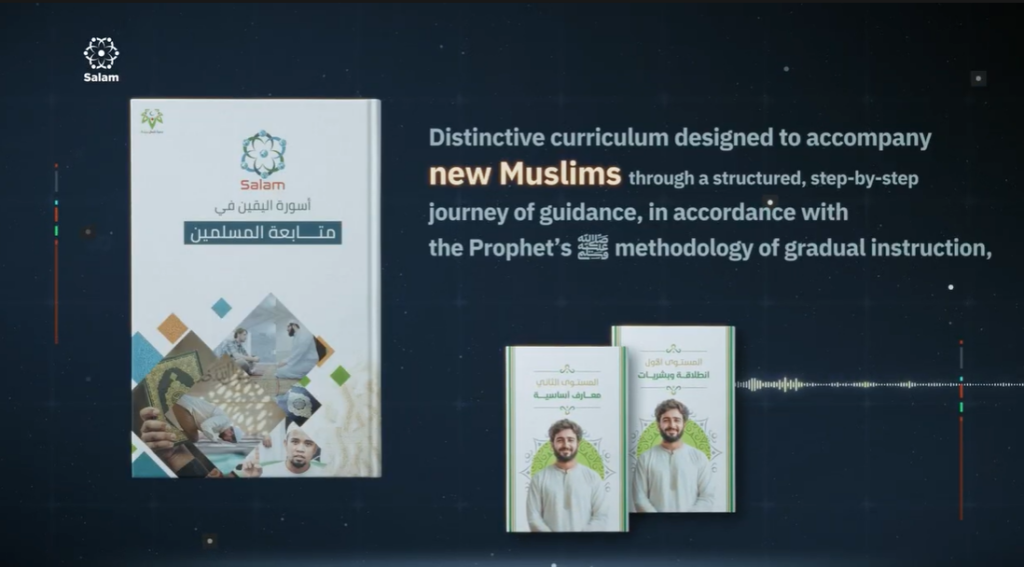
If you have taken your Shahada or are seriously considering Islam, we warmly invite you to join the Asawirat Al-Yaqeen (Bracelets of Certainty) program — the Salam Center‘s structured, four-stage curriculum for new Muslims, built on the methodology of gradual, compassionate learning:
- Stage One — The Foundation: Understand the Shahada, learn the pillars of Islam, and establish your prayer and purification practice
- Stage Two — The Construction Phase: Study the pillars of Iman, Zakat, fasting, and the life of the Prophet (PBUH)
- Stage Three — The Consolidation Phase: Deepen your character through spiritual refinement, ethics, and practical life rulings
- Stage Four — The Empowerment Phase: Engage contemporary issues, understand Islamic theology with confidence, and build your life roadmap from Surah Al-Asr
The program has already guided 114,588 new Muslims across 140 countries — and it is waiting for you.
Reach out directly to the Salam Center team to start the Asawirat Al-Yaqeen (Bracelets of Certainty) program for FREE.
Summary
The Bible was composed across roughly 1,500 years — its Old Testament dating as far back as the 15th century BCE and its New Testament completed by around 100 CE — while the Quran was revealed between 610 CE and 632 CE and formally compiled within two years of the Prophet’s death. Islam affirms all previous divine revelations as genuine but holds that only the Quran carries Allah’s direct guarantee of preservation against textual corruption.
Muslims do not deny the earlier scriptures — they honor the prophets who received them and accept the original revelations as truth from Allah. What Islamic scholarship consistently maintains is that centuries of human transmission altered the texts of the Bible, while the Quran has remained textually uniform from its earliest manuscripts to every copy circulating today, a reality supported by both Islamic theology and modern manuscript scholarship.
Frequently Asked Questions
Was the Quran written before the Bible?
No — the Bible predates the Quran by centuries. The Old Testament was composed between approximately 1400 BCE and 400 BCE, and the New Testament between 50 CE and 100 CE. The Quran was revealed between 610 CE and 632 CE and compiled into a single written volume by around 650 CE, making it the most recent of the three Abrahamic scriptures.
What is older — the Bible or the Quran?
The Bible is significantly older. The oldest books of the Old Testament predate the Quran by over 2,000 years. However, Islam distinguishes between the age of a scripture and its preservation — affirming that the Quran, though youngest in chronological terms, is the only divinely preserved scripture, as stated directly in Quran 15:9.
Do Muslims believe in the Bible?
Muslims affirm that the original Tawrah revealed to Moses (PBUH) and the original Injeel revealed to Jesus (PBUH) were true divine revelations. Islam does not accept the Bible in its current form as a fully intact preserved scripture, because Islamic theology — supported by evidence of textual variation across manuscripts — holds that earlier scriptures were not protected from human alteration. Full details are covered in the Salam article on whether Muslims believe in the Bible.
What came first — the Bible or the Quran — and what does that mean for Islam?
The Bible came first historically. In the Islamic worldview, this reflects the unbroken chain of prophets and revelations Allah sent before the final message to Muhammad (PBUH). Earlier revelations preceded the Quran because they were sent to earlier communities. The Quran came as a guardian and criterion over all that preceded it — confirming what was true and preserving a final, uncorrupted message for all of humanity until the Day of Judgment.
Why do Muslims say the Quran is preserved when the Bible is older?
Age and preservation are separate questions. The Quran’s preservation rests on two foundations: first, the continuous memorization of millions of Muslims (Huffaz) from the time of the Prophet (PBUH) to today; and second, the textual uniformity of Quranic manuscripts across all centuries and regions. Scholars at institutions such as the Corpus Coranicum project have confirmed this stability. Biblical textual criticism, by contrast, has documented hundreds of thousands of manuscript variants across New Testament copies alone.
Curious about Islam?
Journey towards clarity and purpose. Our team is here to support you in your search for truth and spiritual guidance.
Embrace the Truth