
The Prophet Muhammad’s Honesty Story
| Key Takeaways |
| Prophet Muhammad (PBUH) was known as Al-Amin (the Trustworthy) and As-Sadiq (the Truthful) by the people of Makkah long before he received any revelation. |
| His enemies, even while plotting against him, still entrusted their valuables to him. |
| When Prophet Muhammad (PBUH) fled to Madinah, he refused to leave until every trust held for others was returned, sending ‘Ali ibn Abi Talib (RA) to fulfill this obligation. |
| The Roman Emperor Heraclius, upon questioning Abu Sufyan, concluded from the Prophet’s unblemished record of honesty that his prophethood must be genuine. |
Was Prophet Muhammad (PBUH) truly as honest as his followers claim? Before a single verse of revelation had descended, before any question of prophethood arose at all, the people of Makkah had already answered that question — and the answer was unanimous.
They called him Al-Amin: the Trustworthy One. They called him As-Sadiq: the Truthful. These were not titles conferred by admirers.
They came from neighbors, rivals, and trading partners who had watched him live among them for four decades without witnessing a single lie.
1. People of Makkah Called Muhammad (PBUH) Al-Amin Long Before Prophethood
Prophet Muhammad (PBUH) proved by his living example that he was the most truthful and honest person of his age. He was a poor orphan who had started trading with his uncle, but in a very short time, owing to his honest and fair dealings with all people, he became well-known and respected.
Every Makkan, rich or poor, knew him as As-Sadiq (the Truthful) and Al-Amin (the Trustworthy).
In a commercial city where reputation was currency, the Quraysh — who were masters of trade — gave these names to a young man without inherited wealth or political power, purely on the basis of what they had witnessed from him directly.
Khadijah (RA) was informed of Muhammad (PBUH) through his truthful words, great honesty, and kind manners. She sent for him, offered him money to travel to Syria for her business, and gave him a higher rate than others.
When he returned to Makkah, Khadijah noticed more profits and blessings in her wealth than she had seen before. Her hireling, Maisarah, also reported Muhammad’s (PBUH) good manners, honesty, deep thought, sincerity, and faith.
This was the trust of a businesswoman who had employed many men before. She chose Muhammad (PBUH) — not because of his experience or connections, but because his character was known to all.
That same honesty eventually led her to propose marriage to him, a decision she never regretted.
2. When a Whole City Chose Muhammad (PBUH) as Their Judge Before Revelation for His Honesty
One of the most powerful prophet muhammad honesty stories from the Seerah is the arbitration of the Black Stone — an event recorded by Ibn Hisham in Al-Seerah Al-Nabawiyyah and referenced by scholars of Islamic history ever since.
When the Quraysh were rebuilding the Ka’bah, a fierce dispute erupted over who would have the honor of placing the Black Stone (Al-Hajar Al-Aswad) in its position.
Every clan chief refused to yield this honor to another. No clan chief wanted to relinquish this great honor, and there were even those who suggested fighting for the right.
Eventually, Abu Umayya ibn Mughira, a leader from among the Quraysh, suggested that all agree to the decision of the first person to enter from the Banu Shayba gate; the Quraysh agreed and awaited that person whose decision would be binding.
When the people around saw that Muhammad (PBUH) entered through that gate, they expressed their pleasure, saying, “There he is, Al-Amin (the Trustworthy), there is Muhammad.”
A city on the edge of bloodshed fell immediately at peace when they saw who had arrived. No announcement was needed. His reputation for honesty was so settled in their minds that a potential tribal war dissolved the moment he walked through the gate.
He told them to place the Black Stone in the middle of a strong cloth. A representative from each tribe should then take hold of the edge of the cloth and raise the stone. Once raised in this way by all the tribes, Muhammad (PBUH) himself fixed the Black Stone in position.
Every tribe participated. No one was dishonored. The solution was ingenious — but it worked precisely because everyone trusted the man who proposed it.
3. Prophet’s Enemies Confirm His Truthfulness in the Event of Mount Safa Testimony
Years after the Kaaba arbitration, when the Prophet (PBUH) began calling his people to Islam, he gathered the Quraysh at Mount Safa and put them a question before announcing his message. He asked them: if he were to tell them that an army was advancing from behind those mountains, would they believe him?
All said in one voice, “Yes, because we have never heard you telling a lie.” All the people of Makkah, without any exception, swore to his truthfulness and honesty, for he had lived an unblemished and extremely pious life among them for forty years.
Yet most of them still refused to accept him as the Messenger of Allah.
The same people who rejected his message — who called him a sorcerer and a poet and a madman — simultaneously confirmed that he had never lied to them. The leadership of Quraysh said after living forty years with him, “We have experienced nothing but honesty from you.”
Their rejection of his message, then, was not because they doubted his integrity. They could not. Their opposition was tribal, social, and economic — never personal.
The man who stood before them on that day was the same man whose honesty they had built their trust in for a lifetime.
Learn More About Islam
Discover the beauty, teachings, and wisdom of Islam in a clear and welcoming way. Start exploring and deepen your understanding today.
Learn More4. Prophet’s Honesty at the Moment of Danger by Returning Deposits to Enemies
When the Quraysh finalized a plan to assassinate the Prophet (PBUH) and he received divine permission to migrate to Madinah, the first thing on his mind was not his own safety. The Prophet (PBUH) instructed Ali (RA) to sleep in his bed and return the trusts people had left with him to their owners.
On the night that men with swords surrounded his house intending to kill him, he was thinking about the deposits — the valuables that Makkans, including his enemies, had entrusted to him for safekeeping.
Even when he migrated to Madinah, he left behind Ali ibn Abi Talib (RA) to return these trusts to their rightful owners. This example shows that honesty is not dependent on whether others are fair or hostile.
He owed these people nothing in terms of any worldly calculation. They wanted him dead. But he owed them their trusts — and that obligation, in his understanding, was sacred. This is honesty at its most absolute: not the honesty of convenience, but the honesty of conviction.
5. The Prophet’s Honesty Reached Even the Throne of Byzantium
The remarkable reach of the Prophet’s honesty reached even the throne of Byzantium. When the Prophet (PBUH) sent a letter to Heraclius (Hiraql), the Roman Emperor, inviting him to Islam, Heraclius summoned Abu Sufyan — then still among the Prophet’s adversaries — for questioning.
Heraclius told his translator to tell Abu Sufyan’s companions that he wanted to put some questions to him regarding the Prophet and that if he told a lie, they should contradict him.
Abu Sufyan added, “By Allah! Had I not been afraid of my companions labeling me a liar, I would not have spoken the truth about the Prophet.”
Heraclius then asked: had they ever accused Muhammad of lying before he made his prophetic claim? Abu Sufyan answered: no. At the end of the story, Heraclius said, “I asked you if you used to accuse him of lying before he started to say what he now says, and you said, ‘No.’ Consequently, I knew that he did not lie to the people, so he would not lie about Allah.”
A Roman Emperor reached the logical conclusion that a man who had never lied to human beings would not fabricate a claim about the Divine.
The testimony is preserved in Sahih Al-Bukhari, Hadith 7 — one of the most famous narrations in Islamic scholarship. This is not a Muslim source glorifying the Prophet. It is his lifelong adversary, forced by the structure of the questioning to confirm what he knew to be true.
Read Also: The Prophet Muhammad’s (PBUH) Story with the Jinn
What Do the Quran and Hadith Teach About Honesty in Islam?
The Prophet (PBUH) did not merely exemplify honesty. He taught it as a theological imperative — a path with a clear destination.
The hadith narrated by Abdullah ibn Mas’ud (RA), recorded in both Sahih Al-Bukhari 6094 and Sahih Muslim 2607, states:
“Adhere to truthfulness, for truthfulness leads to righteousness, and righteousness leads to Paradise. A man will keep telling the truth and striving to tell the truth until he is recorded with Allah as the most truthful. Beware of lying, for lying leads to wickedness and wickedness leads to Hellfire.”
This is one of the most comprehensive ethical teachings in the Islamic tradition. Honesty is presented as a path of cumulative transformation: a person does not simply choose to be honest on one occasion.
They build themselves into a person of truth through consistent choices, until Allah records them among As-Siddiqeen — the deeply truthful ones.
The Quran reinforces this with a direct divine command in Surah At-Tawbah:
يَا أَيُّهَا الَّذِينَ آمَنُوا اتَّقُوا اللَّهَ وَكُونُوا مَعَ الصَّادِقِينَ
“O you who have believed, fear Allah and be with those who are true.” (Quran 9:119)
The command is structural: align yourself with the truthful. Character is built through proximity, through community, through deliberately choosing to surround yourself with those whose honesty you wish to absorb.
The Prophet (PBUH) also connected honesty directly to faith in Islam. A believer’s relationship with Allah is itself an act of truth — worshipping Him sincerely, speaking what one knows, and living without a gap between the internal and external self.
Understanding the nature of God in Islam — His absolute knowledge of every hidden thing — makes honesty not merely an ethical virtue but a spiritual necessity.
Honesty in the Prophet’s Teachings on Commerce
The Prophet’s (PBUH) honesty extended fully into the marketplace. He established a complete ethical framework for trade built on transparency and truth. Sahih Al-Bukhari 2079 records:
“The seller and the buyer have the right to keep or return goods as long as they have not parted; and if they spoke the truth and made clear the defects of the goods, then they would be blessed in their transaction.”
This principle governed commercial life in early Muslim society. A merchant who conceals a defect is, in Islamic law, committing an act of dishonesty — not merely a business error. And from Abu Sa’id (RA), narrated in Sunan At-Tirmidhi:
“The honest and trustworthy merchant will be with the prophets, the truthful, and the martyrs.”
The highest company imaginable, on the Day of Judgment, is reserved for the one who was honest in trade. This teaching reflects how deeply the Prophet (PBUH) understood that honesty is not compartmentalized.
It does not live only in the mosque, only in speech, only in matters of religion. It permeates every transaction, every promise, every word.
Read Also: The Prophet Muhammad Hijrah Story
Learn More About Islam
Discover the beauty, teachings, and wisdom of Islam in a clear and welcoming way. Start exploring and deepen your understanding today.
Learn MoreRead Also: Prophet Muhammad’s Kindness Stories
Continue Your Journey with Salam
If these stories have moved something in your heart, you are not alone. Thousands have walked this same path — asking sincere questions, following the evidence, and finding in Islam not merely a religion but a complete way of truth.
The Salam Center for Da’wah and Dialogue is here to support you at every step:
Explore more on the Salam Platform and browse our growing library of articles on the Salam blog.
If you have a specific question about Islam, want to understand the Prophet’s life further, or are considering taking your Shahada, reach out directly — the Salam Center team is ready to walk with you.

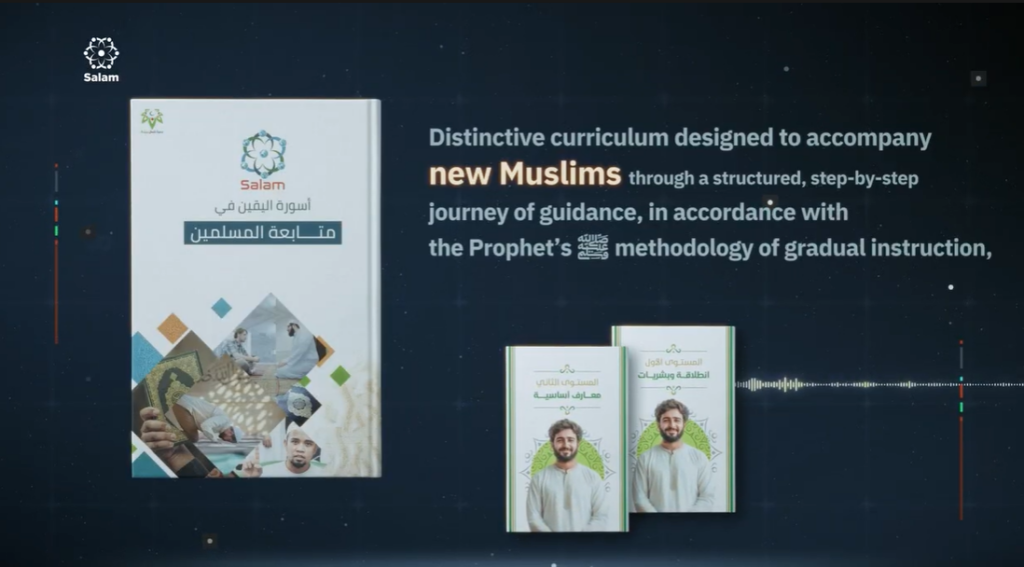
For new Muslims seeking structured guidance, the Asawirat Al-Yaqeen (Bracelets of Certainty) program offers a complete, compassionate pathway to firm faith. The curriculum guides students through:
- Stage One — The Foundation: The pillars of Islam, the meaning of the Shahada, practical worship (wudu, ghusl, and salah), and the six pillars of Iman
- Stage Two — The Construction Phase: Repentance, the biography of the Prophet (PBUH), and lessons drawn from his life
- Stage Three — The Consolidation Phase: Ethics, spiritual disciplines, and practical life rulings for trade, family, and daily conduct
- Stage Four — The Empowerment Phase: Contemporary issues, Islamic evidence regarding other faith traditions, and a life roadmap from Surah Al-Asr
The Asawirat Al-Yaqeen (Bracelets of Certainty) curriculum has reached 114,588 new Muslims across 140 countries. You are welcome to join them.
Reach out directly to the Salam Center team to start the Asawirat Al-Yaqeen (Bracelets of Certainty) program for FREE.
Summary
Prophet Muhammad’s (PBUH) honesty was not a calculated virtue designed to win followers. It was a defining characteristic confirmed by his entire society long before prophethood arrived — recorded in Sahih Al-Bukhari, preserved in classical Seerah, and acknowledged by enemies who never accepted his message.
The path he taught connects directly to the Divine: truthfulness leads to righteousness, and righteousness leads to Paradise. Those who walk that path join the As-Siddiqeen — the truthful ones — whose company Allah has commanded the believers to seek and to keep.
Frequently Asked Questions
Why was Prophet Muhammad (PBUH) called Al-Amin and As-Sadiq?
Prophet Muhammad (PBUH) became known as As-Sadiq (the Truthful) and Al-Amin (the Trustworthy) because of his honest and fair dealings with all people throughout his youth and early adult life in Makkah. These titles were given to him by the Quraysh — including his opponents — long before any prophetic revelation, making them an independent confirmation of his character.
What is the most famous story about Prophet Muhammad’s honesty?
The arbitration of the Black Stone stands as one of the most celebrated prophet muhammad honesty stories in Islamic history. When tribal war threatened Makkah over who would place the Black Stone in the Ka’bah, the Quraysh unanimously chose Muhammad (PBUH) as arbiter the moment he entered, crying “There is Al-Amin!” His wise solution — having all tribes lift the stone together on a cloth — resolved the crisis without bloodshed. This story is recorded in Ibn Hisham’s Al-Seerah Al-Nabawiyyah.
How did even the Roman Emperor Heraclius verify the Prophet’s honesty?
Heraclius questioned Abu Sufyan about whether the Prophet had ever been accused of lying before claiming prophethood. When Abu Sufyan answered no, Heraclius concluded: “I knew that he did not lie to the people, so he would not lie about Allah.” This exchange is preserved in Sahih Al-Bukhari, Hadith 7 — one of the most rigorously authenticated narrations in Islamic scholarship.
What did the Prophet (PBUH) teach about honesty in Islam?
The Prophet (PBUH) taught in a hadith agreed upon by both Al-Bukhari and Muslim: “Adhere to truthfulness, for truthfulness leads to righteousness, and righteousness leads to Paradise. A man keeps telling the truth until he is recorded with Allah as truthful. Beware of lying, for lying leads to wickedness and wickedness leads to Hellfire.” (Sahih Al-Bukhari 6094) Honesty in Islam spans speech, action, business dealings, and sincere worship.
Did Prophet Muhammad (PBUH) maintain his honesty even toward his enemies?
Yes, unequivocally. On the night of his migration to Madinah, the Prophet (PBUH) instructed Ali ibn Abi Talib (RA) to remain behind and return all trusts that people — including enemies — had deposited with him before he departed. This act of honesty took place while men with swords surrounded his home to kill him, and remains one of the most powerful examples of principle-driven integrity in any historical tradition.
Curious about Islam?
Journey towards clarity and purpose. Our team is here to support you in your search for truth and spiritual guidance.
Embrace the Truth