Was Muhammad a Christian Before Islam?
| Key Takeaways |
| Muhammad (PBUH) was never a Christian, Jew, or polytheist before receiving revelation — he followed the Hanif tradition, the monotheistic path of Ibrahim (Abraham). |
| The Quran explicitly states that Ibrahim himself was neither Jewish nor Christian, but a Hanif who submitted to Allah alone (Quran 3:67). |
| Pre-Islamic Mecca contained a small group of Hanifs — monotheists who rejected idol worship without adopting Judaism or Christianity. |
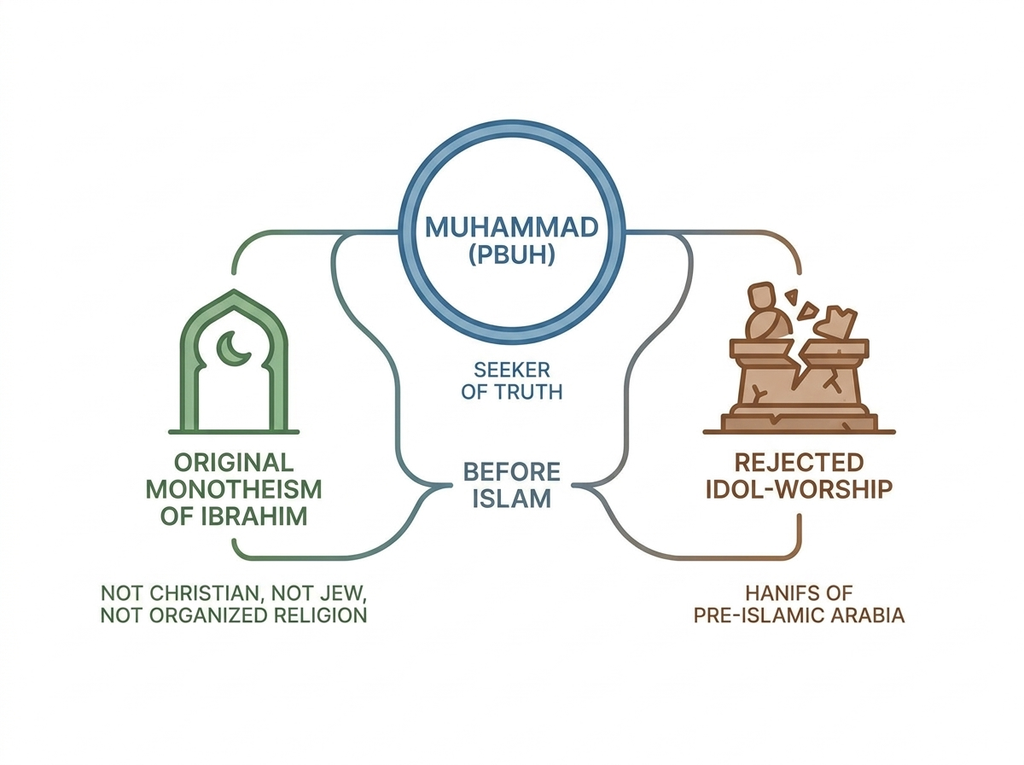
No, Muhammad (PBUH) was not a Christian before Islam. He followed no organized religion in the years before his prophethood at all. What he held instead was something the Quran calls Deen al-Hanif — the pure, unadulterated monotheism traced back to Ibrahim, long before either the Torah or the Gospel existed as scriptures.
Understanding this clarifies a question many sincere seekers ask when they first encounter the story of the Prophet’s life: if he grew up around Christians and Jews in Arabia, why didn’t he simply belong to one of those communities?
The answer reveals something central to how Islam understands its own place in the story of revealed religion.
Was Muhammad a Christian Before Becoming a Muslim?
No — Muhammad (PBUH) was not a Christian, a Jew, or a follower of any organized religion before Islam. He was known among the Hanifs of pre-Islamic Arabia, a small number of Meccans who had already rejected the idol-worship of the Kaaba and sought the original monotheism of Ibrahim without formally joining Judaism or Christianity.
This is confirmed directly in the Quran, which describes Ibrahim’s own religion in nearly identical terms:
مَا كَانَ إِبْرَٰهِيمُ يَهُودِيًّا وَلَا نَصْرَانِيًّا وَلَـٰكِن كَانَ حَنِيفًا مُّسْلِمًا وَمَا كَانَ مِنَ ٱلْمُشْرِكِينَ
“Abraham was neither a Jew nor a Christian; he submitted in all uprightness and was not a polytheist” (Quran 3:67).
Since Muhammad (PBUH) is described in Islamic tradition as walking the same path as Ibrahim before his prophethood, the same description applies to him.
His first substantial contact with Christian scripture came only after the Quran began, when his wife Khadijah took him to her Christian cousin for guidance about what he had experienced.
What Religion Did Pre-Islamic Arabia Practice?
Mecca in the sixth century was overwhelmingly polytheistic. The Kaaba, originally built for the worship of one God, had by that point been filled with idols representing tribal deities. Most of prophet Muhammad’s own tribe, the Quraysh, practiced this idol worship, alongside smaller communities of Jews and Christians scattered across the Arabian Peninsula, particularly in Najran and Yathrib (later Medina).
The Hanifs Were a Minority Seeking the Original Faith
Within this environment, a handful of individuals rejected polytheism outright while also declining to adopt Judaism or Christianity as they existed at the time. These were the Hanifs.
Historical sources name figures such as Waraqah ibn Nawfal, Zayd ibn Amr, and Uthman ibn al-Huwayrith among them — men who sensed that Arabia’s idol worship was false and searched instead for the religion Ibrahim had practiced.
Muhammad (PBUH) held this same conviction of Hanifs from his youth, avoiding the idols and immoral practices of his people even though he had received no revelation yet.
This search connects directly to the broader Islamic understanding of monotheism as the original human condition, corrupted over time by polytheism and human innovation. Muhammad’s private devotion — including his practice of retreating to the Cave of Hira for reflection — reflected this same yearning shared by the Hanifs around him.
What Happened When the First Revelation Came Muhammad (PBUH)?
The moment Muhammad (PBUH) first encountered organized Christianity came only after Islam itself had already begun. When the angel Jibreel appeared to him in the Cave of Hira and he received the first verses of the Quran, he returned home shaken, uncertain what had happened to him.
Khadijah, his wife, brought him to her cousin Waraqah ibn Nawfal — a man who, according to the authentic hadith collection Sahih al-Bukhari, had converted to Christianity during the pre-Islamic period and possessed knowledge of the Gospel in Arabic.
Waraqah listened to the Prophet’s account and recognized the experience immediately: he told him that what had come to him was the same angel who had been sent to Musa (Moses), and he warned him that his own people would eventually drive him out, just as earlier messengers had faced rejection from theirs.
This account is recorded in Sahih al-Bukhari, one of the two most authenticated hadith collections in Sunni Islam.
This single encounter is often the source of confusion about prophet Muhammad’s supposed Christian background — but the timeline makes the matter clear. Waraqah’s role was that of a knowledgeable outsider confirming a prophetic experience, not a teacher shaping a belief system Muhammad (PBUH) already held. By the time this meeting occurred, the Quran had already begun to be revealed.
Why Does Islam Connect Muhammad to Ibrahim Rather Than to Christianity or Judaism?
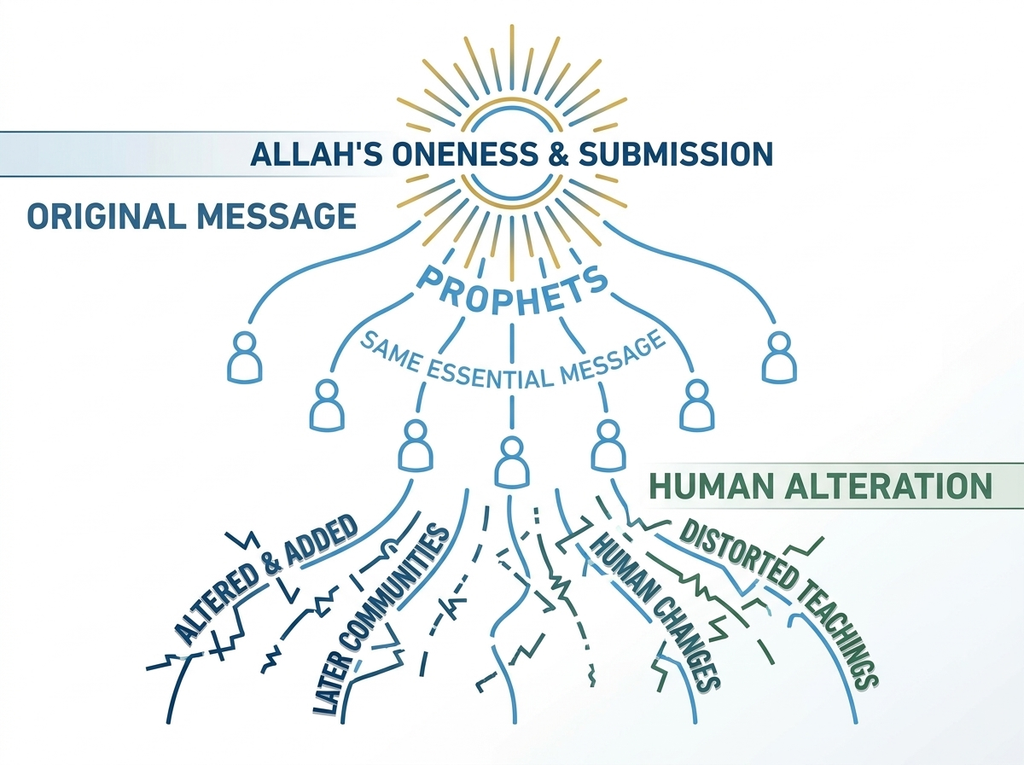
Islamic theology holds that all true prophets, from Adam to Isa (Jesus), delivered the same essential message: the oneness of Allah and submission to Him alone. Over time, later communities altered or added to what those prophets had taught.
The nature of God in Islam is presented as unchanging across this entire chain of prophethood — it is human transmission, not divine intention, that introduced the differences separating one religious community from another.
Ibrahim holds particular significance in this framework because he predates both the Torah and the Gospel.
The Quran makes this chronological point explicit when addressing a dispute between Jewish and Christian representatives who each claimed Ibrahim as one of their own: Allah clarifies that Ibrahim could not have been Jewish or Christian, since both religions’ scriptures came centuries after him. Instead, “he was a Hanif, a Muslim [submitting to Allah], and he was not of the polytheists” (Quran 3:67).
By describing Muhammad’s pre-prophetic life in these same terms, the Islamic tradition positions him as reviving the original faith of Ibrahim rather than founding something unrelated to what came before.
This is why Islam presents itself not as a break from earlier revelation, but as its restoration — a theme explored further in how Islam views other religions.
What Does This Mean for How Islam Views Jesus and Christianity?
Prophet Muhammad’s lack of a Christian background before Islam does not mean the Quran dismisses Jesus. Quite the opposite: Isa (Jesus) is honored throughout the Quran as a prophet, born of a miraculous virgin birth, granted a scripture, and given the ability to perform miracles by Allah’s permission.
What the Quran corrects is not the person of Jesus but claims made about him afterward — particularly divinity — a distinction explored in depth in what the Quran says about Jesus and in the broader comparison of Islam versus Christianity.
This matters for anyone examining Muhammad’s biography, because it shows that Islam’s relationship to Christianity is neither hostile nor derivative. It is corrective, in the same way the Quran describes every prior scripture as needing eventual clarification once human hands had altered it — a topic addressed more fully in why Muslims believe in the Quran.
Read Also: Was Jesus Born of a Virgin in Islam?
Learn More About Islam
Discover the beauty, teachings, and wisdom of Islam in a clear and welcoming way. Start exploring and deepen your understanding today.
Learn MoreReach Out and Continue Learning With Salam
If this question opened up more curiosity than it settled, that’s exactly the point of asking it. The story of Muhammad’s life before revelation is really the story of one honest man searching for truth in a world clouded by idol worship — and that search didn’t end when the revelation began. It’s still open to anyone who wants to walk through it.
- Browse more on the Salam Platform to keep exploring these questions at your own pace
- Read the Salam blog for deeper dives into the Prophet’s life, the Quran, and Islamic belief
- Reach out directly if you have a specific question, want to talk through what’s on your mind, or are considering the next step in your own journey

Summary
Muhammad (PBUH) followed the Hanif tradition before Islam, rejecting Mecca’s idol worship while seeking Ibrahim’s original monotheism. His first real contact with Christian scripture came through Waraqah ibn Nawfal, after revelation had already begun.
The Quran roots this identity in Ibrahim himself, described as neither Jewish nor Christian but wholly submitted to Allah. This framing shows Islam as a restoration of earlier truth, not a departure from it.
Frequently Asked Questions
Did Muhammad practice any religion before Islam?
Muhammad (PBUH) followed no organized religion before Islam, but he is described in Islamic tradition as a Hanif — someone who rejected the idol worship of Mecca and sought the original monotheism of Ibrahim, without belonging to Judaism or Christianity.
Who was Waraqah ibn Nawfal and why is he mentioned in Muhammad’s story?
Waraqah ibn Nawfal was a Christian relative of Khadijah who confirmed, after the first revelation, that Muhammad’s experience matched the calling of earlier prophets. This account appears in Sahih al-Bukhari and occurred after prophethood began, not before.
What does the Quran say about Ibrahim’s religion?
The Quran states that Ibrahim was neither a Jew nor a Christian, but a Hanif who submitted entirely to Allah (Quran 3:67). This verse forms the theological basis for describing Muhammad’s own pre-Islamic faith in the same terms.
Does Islam consider Christianity a false religion?
Islam considers the original teachings of Jesus true revelation, but holds that later additions — particularly claims of Jesus’s divinity — departed from what he actually taught. The Quran affirms Jesus as a prophet while correcting specific theological claims made about him afterward.
Why does Muhammad’s pre-Islamic religion matter to someone exploring Islam today?
It shows that Islam presents itself as a restoration of earlier monotheism, not an unrelated new religion. Recognizing this connects Islamic belief to the broader Abrahamic story that many seekers already find meaningful.
Curious about Islam?
Journey towards clarity and purpose. Our team is here to support you in your search for truth and spiritual guidance.
Embrace the Truth